Attorney-Verified  Hold Harmless Agreement Document for Indiana

Attorney-Verified Hold Harmless Agreement Document for Indiana

The Indiana Hold Harmless Agreement is a legal document designed to protect one party from liability for any injuries or damages that may occur during a specific activity or event. By signing this agreement, individuals or organizations agree to take responsibility for any claims that may arise, thereby shielding the other party from potential legal repercussions. If you need to fill out this form, click the button below.

Article Guide

The Indiana Hold Harmless Agreement form serves as a crucial legal document designed to protect parties from liability in various situations, particularly in contexts such as events, property use, or service agreements. This form outlines the responsibilities of the involved parties, ensuring that one party agrees to indemnify the other against claims, damages, or losses that may arise from specific activities or interactions. By utilizing this agreement, individuals and organizations can clearly define the extent of their liability and establish expectations, thereby fostering a sense of security and understanding. The form typically includes sections that detail the scope of the agreement, the parties involved, and any limitations or exclusions that may apply. Additionally, it often requires signatures from all parties, signifying their consent and acknowledgment of the terms laid out. Understanding the nuances of this agreement is essential for anyone engaging in activities that may carry inherent risks, as it not only clarifies responsibilities but also reinforces the importance of informed consent in legal transactions.

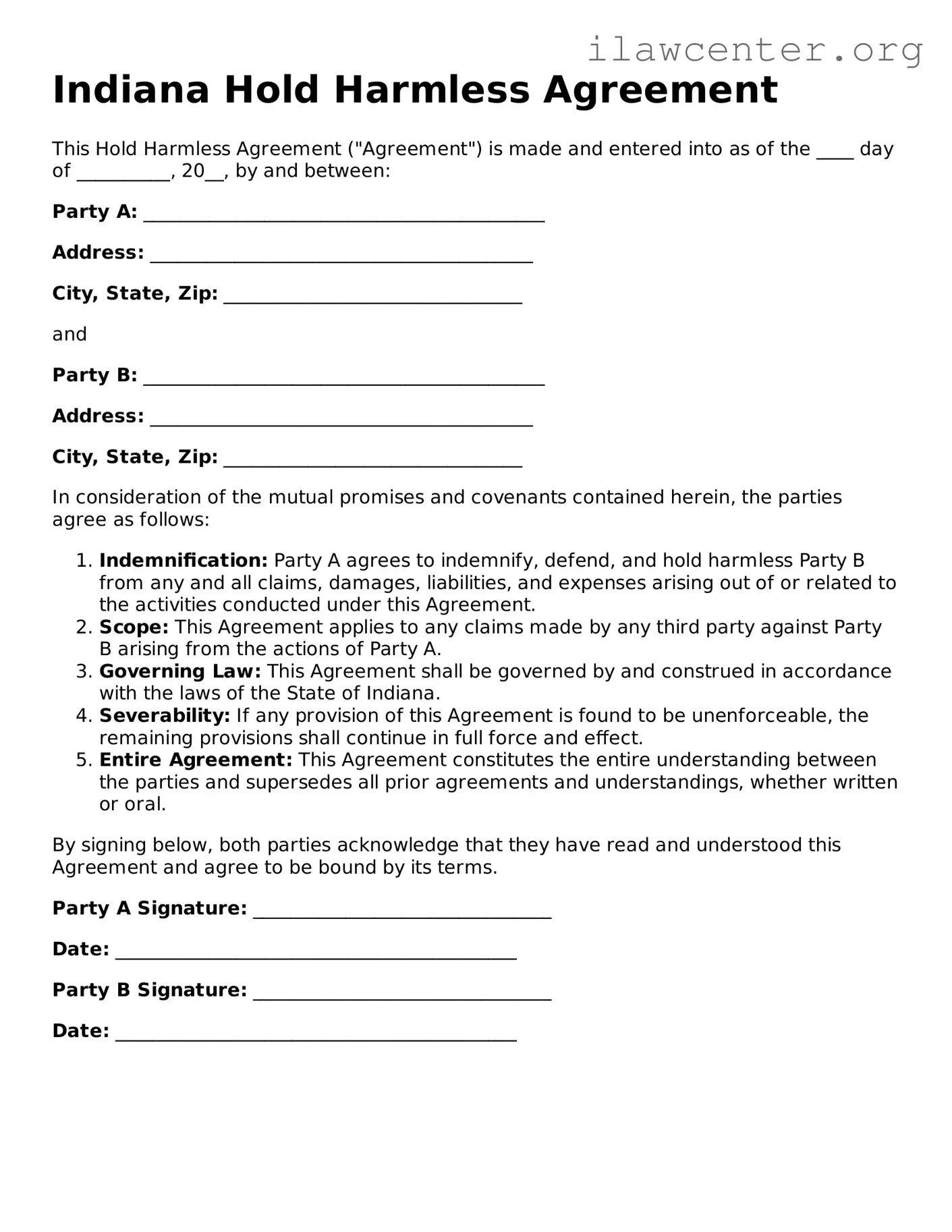
Indiana Hold Harmless Agreement Preview

Indiana Hold Harmless Agreement

This Hold Harmless Agreement ("Agreement") is made and entered into as of the ____ day of __________, 20__, by and between:

Party A: ___________________________________________

Address: _________________________________________

City, State, Zip: ________________________________

and

Party B: ___________________________________________

Address: _________________________________________

City, State, Zip: ________________________________

In consideration of the mutual promises and covenants contained herein, the parties agree as follows:

  1. Indemnification: Party A agrees to indemnify, defend, and hold harmless Party B from any and all claims, damages, liabilities, and expenses arising out of or related to the activities conducted under this Agreement.
  2. Scope: This Agreement applies to any claims made by any third party against Party B arising from the actions of Party A.
  3. Governing Law: This Agreement shall be governed by and construed in accordance with the laws of the State of Indiana.
  4. Severability: If any provision of this Agreement is found to be unenforceable, the remaining provisions shall continue in full force and effect.
  5. Entire Agreement: This Agreement constitutes the entire understanding between the parties and supersedes all prior agreements and understandings, whether written or oral.

By signing below, both parties acknowledge that they have read and understood this Agreement and agree to be bound by its terms.

Party A Signature: ________________________________

Date: ___________________________________________

Party B Signature: ________________________________

Date: ___________________________________________

PDF Form Characteristics

Fact Name Description
Definition The Indiana Hold Harmless Agreement is a legal document that protects one party from liability for damages or injuries incurred by another party.
Purpose This agreement is commonly used in contracts, especially in real estate and service agreements, to mitigate risk.
Governing Law The agreement is governed by the laws of the State of Indiana, specifically under Indiana Code Title 34.
Parties Involved Typically, there are two parties: the indemnitor (who agrees to assume liability) and the indemnitee (who is protected from liability).
Enforceability For the agreement to be enforceable, it must be clear, specific, and mutually agreed upon by both parties.
Limitations The agreement cannot protect a party from liability arising from their own gross negligence or willful misconduct.
Common Uses It is frequently used in construction contracts, event planning, and rental agreements to allocate risk appropriately.

Instructions on Utilizing Indiana Hold Harmless Agreement

Once you have the Indiana Hold Harmless Agreement form in hand, you will need to fill it out carefully to ensure all required information is provided. After completing the form, you will typically need to submit it to the relevant party or organization as specified in your agreement.

  1. Begin by entering the date at the top of the form.
  2. Fill in your full name in the designated section.
  3. Provide your address, including city, state, and zip code.
  4. Identify the party or organization you are entering into the agreement with.
  5. Clearly state the purpose of the agreement in the provided space.
  6. Review the terms and conditions outlined in the form.
  7. Sign and date the form at the bottom, ensuring that your signature is legible.
  8. If required, have a witness sign the form as well.
  9. Make a copy of the completed form for your records before submission.

Important Facts about Indiana Hold Harmless Agreement

What is an Indiana Hold Harmless Agreement?

An Indiana Hold Harmless Agreement is a legal document that protects one party from liability for any injuries or damages that may occur during an activity or event. By signing this agreement, one party agrees not to hold the other party responsible for certain risks involved in that activity.

Who typically uses a Hold Harmless Agreement in Indiana?

This agreement is commonly used by organizations, businesses, or individuals who host events or activities. For example, schools, sports leagues, and community organizations often require participants to sign this agreement before taking part in events.

What are the key components of a Hold Harmless Agreement?

A Hold Harmless Agreement generally includes the names of the parties involved, a description of the activity or event, and specific terms outlining the risks being assumed. It may also state that the participant agrees to indemnify the other party against claims related to injuries or damages.

Is a Hold Harmless Agreement legally binding in Indiana?

Yes, a Hold Harmless Agreement can be legally binding in Indiana, provided it meets certain requirements. The agreement must be clear, voluntary, and not against public policy. Courts will enforce such agreements if they are well-drafted and the parties understand their rights and obligations.

Can a Hold Harmless Agreement protect against all types of liability?

No, a Hold Harmless Agreement cannot protect against all types of liability. It typically cannot shield a party from gross negligence or intentional misconduct. Courts may refuse to enforce an agreement if it attempts to waive liability for these serious actions.

How does one properly execute a Hold Harmless Agreement?

To properly execute a Hold Harmless Agreement, both parties should read the document carefully and ensure they understand its terms. Each party should sign and date the agreement, and it is advisable to keep a copy for personal records. Witnesses or notarization may also be recommended, depending on the situation.

Can a minor sign a Hold Harmless Agreement in Indiana?

Generally, minors cannot legally enter into contracts, including Hold Harmless Agreements. However, a parent or legal guardian can sign on behalf of a minor. This signature acknowledges the risks involved and agrees to hold the other party harmless for any injuries that may occur.

What should I do if I have questions about a Hold Harmless Agreement?

If you have questions about a Hold Harmless Agreement, it is wise to consult with a legal professional. They can provide guidance specific to your situation and help ensure that the agreement is properly drafted and enforceable.
Common mistakes

Completing the Indiana Hold Harmless Agreement form can be a straightforward process, but many individuals make common mistakes that could lead to complications. Understanding these pitfalls is crucial to ensure that the agreement is valid and enforceable.

One frequent error is failing to provide complete and accurate information. When filling out the form, every section must be filled out meticulously. Omissions or inaccuracies can render the agreement ineffective. It is essential to double-check all names, addresses, and dates to avoid any potential disputes later.

Another mistake involves not understanding the terms of the agreement. Many individuals sign without fully grasping what they are agreeing to. This can lead to unintended liabilities or a lack of protection in certain situations. Taking the time to read and comprehend the terms is vital to ensure that the agreement aligns with your intentions.

Additionally, people often overlook the importance of signatures. The agreement must be signed by all relevant parties to be valid. Failing to obtain the necessary signatures can lead to the agreement being challenged. Ensure that everyone involved has signed and that their signatures are dated appropriately.

Moreover, some individuals neglect to consider the need for witnesses or notarization. Depending on the context of the agreement, having a witness or notarizing the document may be required to strengthen its enforceability. This step should not be skipped, as it can provide additional protection in case of future disputes.

Lastly, individuals sometimes rush through the process without seeking legal advice. While it may seem like a simple form, the implications of the agreement can be significant. Consulting with a legal professional can help clarify any uncertainties and ensure that the agreement is tailored to your specific needs.

Documents used along the form

A Hold Harmless Agreement is a crucial document that helps protect one party from legal liability in certain situations. When drafting or using this agreement in Indiana, there are several other forms and documents that are often utilized alongside it. Each of these documents serves a specific purpose and can help clarify responsibilities and expectations between parties.

  • Liability Waiver: This document releases one party from liability for injuries or damages that may occur during an activity. It is commonly used in sports and recreational settings.
  • Indemnity Agreement: Similar to a Hold Harmless Agreement, this document requires one party to compensate the other for certain damages or losses, often related to third-party claims.
  • Release of Liability: This form allows individuals to waive their right to sue for injuries or damages that occur as a result of participating in a specific activity.
  • Insurance Certificate: This document provides proof of insurance coverage, demonstrating that a party has adequate protection against potential claims.
  • Service Agreement: This outlines the terms and conditions under which services will be provided, including any limitations on liability and responsibilities of each party.
  • Contractor Agreement: Often used in construction and service industries, this document details the relationship between a contractor and a client, including liability provisions.
  • Event Permit: Required for hosting public events, this document ensures compliance with local regulations and often includes liability clauses to protect the event organizer.

Understanding these additional documents can enhance the effectiveness of a Hold Harmless Agreement. By using them appropriately, parties can better manage risks and clarify their legal responsibilities, fostering a more secure environment for all involved.

Similar forms

A Hold Harmless Agreement is a legal document designed to protect one party from liability for certain actions or incidents. Several other documents serve similar purposes. Here are eight documents that share characteristics with a Hold Harmless Agreement:

  • Indemnity Agreement: This document obligates one party to compensate another for losses or damages incurred, similar to how a Hold Harmless Agreement protects against liability.
  • Liability Waiver: Often used in recreational activities, this form releases one party from responsibility for injuries or damages, mirroring the protective intent of a Hold Harmless Agreement.
  • Release of Liability: This document allows individuals to waive their right to sue for damages, akin to the protections offered in a Hold Harmless Agreement.
  • Insurance Policy: Certain insurance policies include clauses that protect against liability, functioning similarly to a Hold Harmless Agreement by providing coverage for potential claims.
  • Service Agreement: Many service agreements include indemnification clauses that protect one party from liability, paralleling the intent of a Hold Harmless Agreement.
  • Contractor Agreement: This document often contains provisions that limit liability for contractors, reflecting the same principles found in a Hold Harmless Agreement.
  • Non-Disclosure Agreement (NDA): While primarily focused on confidentiality, NDAs can include clauses that protect against liability for breaches, sharing a common goal with Hold Harmless Agreements.
  • Event Participation Agreement: Participants in events often sign these agreements to acknowledge risks and waive liability, similar to the protections offered by a Hold Harmless Agreement.

Dos and Don'ts

When filling out the Indiana Hold Harmless Agreement form, it's important to approach the process carefully. Here is a list of things to consider doing and avoiding:

  • Do read the entire form thoroughly before filling it out.
  • Do provide accurate information to ensure the agreement is valid.
  • Do sign and date the form in the appropriate sections.
  • Do consult with a legal professional if you have any questions.
  • Do keep a copy of the completed form for your records.
  • Don't leave any required fields blank.
  • Don't rush through the form; take your time to ensure accuracy.
  • Don't use unclear or ambiguous language when providing details.
  • Don't forget to review the terms of the agreement before signing.
  • Don't assume that a verbal agreement is sufficient; written documentation is essential.

Misconceptions

The Indiana Hold Harmless Agreement form can often be misunderstood. Here are four common misconceptions:

  • It completely eliminates liability. Many believe that signing this agreement means they cannot be held responsible for any damages or injuries. In reality, while it does provide some protection, it does not cover gross negligence or intentional misconduct.
  • It is only for businesses. Some think that only companies need this agreement. However, individuals participating in activities like sports or events can also benefit from it, as it protects against claims arising from those activities.
  • It is a one-size-fits-all document. There is a misconception that this form can be used in any situation without modification. Each agreement should be tailored to fit the specific circumstances and needs of the parties involved.
  • It requires legal representation to be valid. While having a lawyer review the agreement is wise, it is not mandatory for the document to be legally binding. As long as both parties understand and agree to the terms, it can still hold up in court.

Understanding these points can help clarify the purpose and limitations of the Indiana Hold Harmless Agreement form. It is essential to approach such agreements with a clear perspective.

Key takeaways

When filling out and using the Indiana Hold Harmless Agreement form, it’s important to understand its purpose and how to complete it correctly. Here are some key takeaways to keep in mind:

  • Purpose: The Hold Harmless Agreement is designed to protect one party from legal liability for any injuries or damages that may occur during a specific activity or event.
  • Parties Involved: Identify the parties involved clearly. This typically includes the party being protected (indemnitee) and the party agreeing to hold them harmless (indemnitor).
  • Clear Language: Use straightforward and clear language when drafting the agreement. Avoid complex legal terms to ensure all parties understand their rights and obligations.
  • Specific Activities: Clearly define the activities or events covered by the agreement. This helps avoid ambiguity and ensures everyone knows what is included.
  • Duration: Specify the duration for which the agreement is valid. This could be for a single event or an ongoing relationship.
  • Signatures Required: Ensure that all parties involved sign the agreement. This is crucial for the document to be legally binding.
  • Witness or Notary: Depending on the situation, consider having the agreement witnessed or notarized to add an extra layer of validity.
  • Review Before Signing: Encourage all parties to review the agreement carefully before signing. This helps prevent misunderstandings later on.
  • Legal Advice: While not always necessary, seeking legal advice can be beneficial, especially for complex situations or high-risk activities.
  • Keep Copies: After the agreement is signed, make sure to keep copies for all parties involved. This ensures that everyone has access to the terms agreed upon.

By following these key takeaways, individuals can effectively utilize the Indiana Hold Harmless Agreement form, ensuring clarity and protection for all parties involved.