Attorney-Verified  Homeschool Letter of Intent Document for Indiana

Attorney-Verified Homeschool Letter of Intent Document for Indiana

The Indiana Homeschool Letter of Intent form is a crucial document that parents must submit to officially notify the state of their decision to homeschool their children. This form serves as a formal declaration of intent and helps ensure compliance with Indiana's educational regulations. If you're ready to take the next step in your homeschooling journey, fill out the form by clicking the button below.

Article Guide

For families considering homeschooling in Indiana, the Homeschool Letter of Intent form serves as a crucial first step in the process. This form is a simple yet essential document that notifies the local school district of a parent or guardian's decision to educate their child at home. By submitting this letter, families affirm their commitment to providing a tailored educational experience outside the traditional classroom setting. The form typically requires basic information, such as the names and ages of the children being homeschooled, as well as the address of the family. While the form is straightforward, it is an important legal requirement that ensures compliance with state regulations. Additionally, understanding the significance of this document can help parents navigate the homeschooling landscape more effectively, enabling them to focus on creating enriching learning environments for their children.

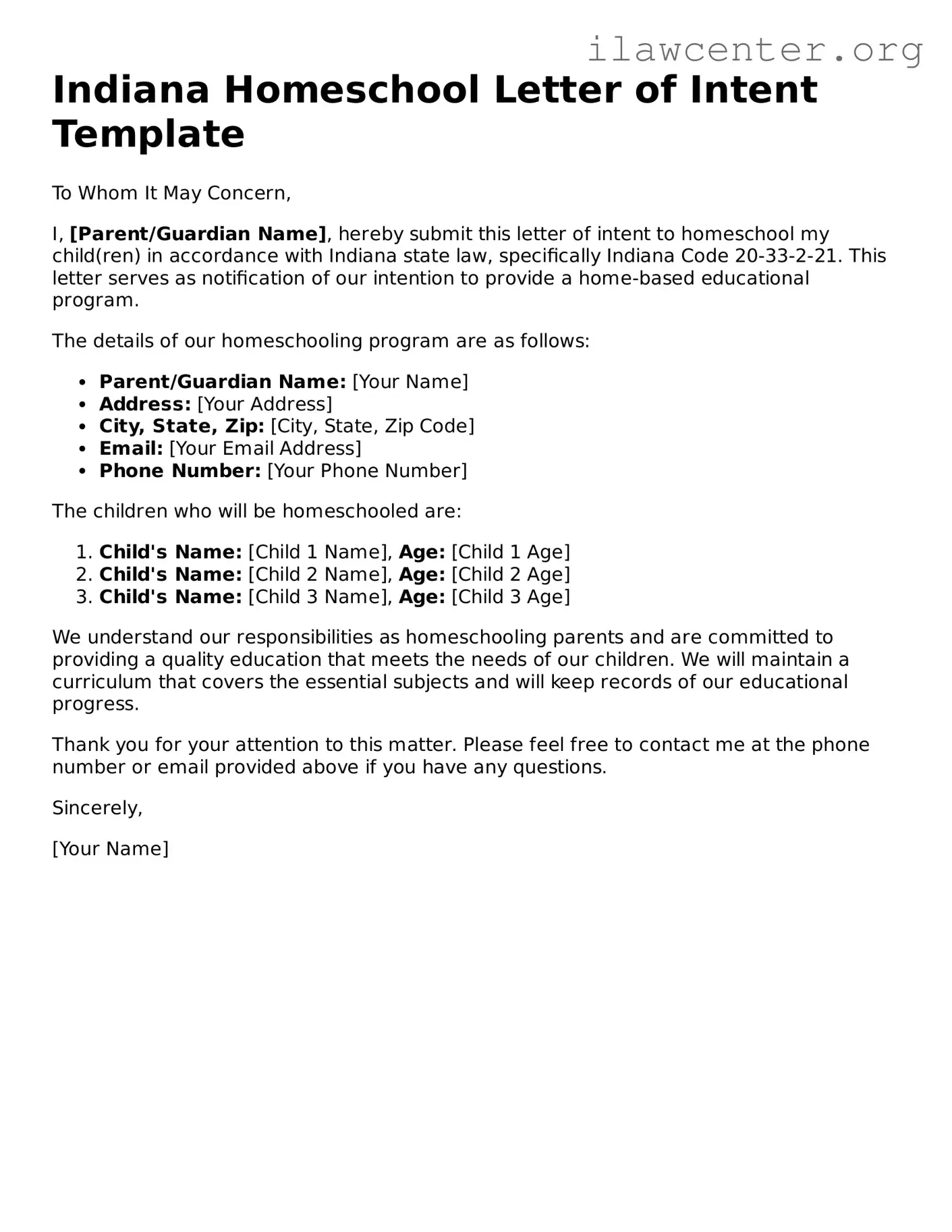
Indiana Homeschool Letter of Intent Preview

Indiana Homeschool Letter of Intent Template

To Whom It May Concern,

I, [Parent/Guardian Name], hereby submit this letter of intent to homeschool my child(ren) in accordance with Indiana state law, specifically Indiana Code 20-33-2-21. This letter serves as notification of our intention to provide a home-based educational program.

The details of our homeschooling program are as follows:

  • Parent/Guardian Name: [Your Name]
  • Address: [Your Address]
  • City, State, Zip: [City, State, Zip Code]
  • Email: [Your Email Address]
  • Phone Number: [Your Phone Number]

The children who will be homeschooled are:

  1. Child's Name: [Child 1 Name], Age: [Child 1 Age]
  2. Child's Name: [Child 2 Name], Age: [Child 2 Age]
  3. Child's Name: [Child 3 Name], Age: [Child 3 Age]

We understand our responsibilities as homeschooling parents and are committed to providing a quality education that meets the needs of our children. We will maintain a curriculum that covers the essential subjects and will keep records of our educational progress.

Thank you for your attention to this matter. Please feel free to contact me at the phone number or email provided above if you have any questions.

Sincerely,

[Your Name]

PDF Form Characteristics

Fact Name Details
Governing Law The Indiana Homeschool Letter of Intent is governed by Indiana Code § 20-33-2-28.
Purpose This form serves to notify the local school corporation of a parent's intent to homeschool their child.
Submission Deadline The Letter of Intent must be submitted within 10 days of the start of the homeschool program.
Required Information Parents must provide the child's name, age, and address on the form.
Annual Requirement The form must be submitted annually for each child being homeschooled.
Notification Method Parents can submit the form via mail or in person to the local school corporation.
Record Keeping Parents are encouraged to keep a copy of the submitted form for their records.
Legal Protections Submitting the Letter of Intent provides legal recognition of the homeschooling arrangement.
Additional Resources Indiana offers various resources and support groups for homeschooling families.

Instructions on Utilizing Indiana Homeschool Letter of Intent

Once you have gathered the necessary information, you can begin filling out the Indiana Homeschool Letter of Intent form. This form is essential for officially notifying the state of your decision to homeschool your child. After completing the form, you will submit it to the appropriate local school authority.

  1. Obtain the Indiana Homeschool Letter of Intent form. You can find it on the Indiana Department of Education's website or through your local school district.
  2. Fill in your name and address at the top of the form. Ensure that your contact information is accurate.
  3. Provide the name of the child or children you plan to homeschool. List each child’s full name and date of birth.
  4. Indicate the school year for which you are submitting the intent. This is typically the current academic year.
  5. Sign and date the form at the bottom. Your signature confirms your intent to homeschool.
  6. Make a copy of the completed form for your records before submitting it.
  7. Submit the form to your local school authority. This can often be done by mail or in person, depending on the district's requirements.

Important Facts about Indiana Homeschool Letter of Intent

What is the Indiana Homeschool Letter of Intent form?

The Indiana Homeschool Letter of Intent form is a document that parents or guardians must submit to notify the local school district of their intention to homeschool their children. This form is a crucial step in the homeschooling process, as it formally establishes the family's choice to provide education at home rather than through a traditional school setting.

Who needs to fill out the Letter of Intent?

Any parent or guardian who wishes to homeschool a child in Indiana must complete the Letter of Intent. This includes families who are starting homeschooling for the first time, as well as those who may be transitioning from a public or private school. It is important to include all children who will be homeschooled in the submission.

When should the Letter of Intent be submitted?

The Letter of Intent should be submitted at the beginning of the school year or when a family decides to start homeschooling. It is best to submit the form as early as possible to ensure compliance with state regulations. If a family starts homeschooling mid-year, they should submit the form promptly to inform the school district of their educational choice.

Is there a specific format for the Letter of Intent?

While there is no official state form for the Letter of Intent, it should include essential information such as the names of the children being homeschooled, their ages, and the address of the family. A simple, clear letter stating the intent to homeschool is sufficient. It’s a good idea to keep a copy for personal records.

What happens after the Letter of Intent is submitted?

Once the Letter of Intent is submitted, the school district will acknowledge receipt. There are no further requirements from the district at this stage. However, families are encouraged to keep records of their homeschooling activities and progress, as they may be required to demonstrate educational progress in the future.

Are there any penalties for not submitting the Letter of Intent?

Failing to submit the Letter of Intent can lead to complications, including potential truancy issues. Indiana law requires that families notify their local school district of their intent to homeschool. To avoid any legal issues, it is important to complete and submit the form in a timely manner.
Common mistakes

When filling out the Indiana Homeschool Letter of Intent form, people often make common mistakes that can lead to delays or complications. One frequent error is providing incomplete information. It's crucial to fill in all required fields, including the names of the students and their birthdates. Omitting any detail can result in the rejection of the form.

Another mistake is failing to sign and date the form. A signature is not just a formality; it signifies that the information provided is accurate and complete. Without a signature, the form is considered invalid, and this can lead to unnecessary back-and-forth communication with the school district.

Some individuals mistakenly assume that the form can be submitted at any time. However, there are specific deadlines for submitting the Letter of Intent. It’s essential to be aware of these timelines to ensure compliance with state regulations.

People also often overlook the importance of keeping a copy of the submitted form. Having a record is vital for future reference. This can be helpful if questions arise or if proof of intent is needed later on.

Another common issue is not updating the form when circumstances change. If a family moves or if there are changes in the student’s educational status, the form should be revised and resubmitted. Failing to do so can lead to confusion with the local education authority.

Some parents mistakenly believe that they can submit the form electronically. Indiana requires that the Letter of Intent be submitted in hard copy. Understanding the submission method is crucial to avoid complications.

Additionally, many people do not double-check their information before submission. Simple typographical errors can cause significant delays. Taking a moment to review the form can save time and hassle later.

Another common oversight is misunderstanding the definition of homeschooling. Some may fill out the form without fully grasping what it means to homeschool in Indiana. It’s important to understand the responsibilities that come with this educational choice.

Lastly, some individuals fail to communicate with their local school district after submitting the form. Keeping an open line of communication can help clarify any questions and ensure a smoother homeschooling experience.

Documents used along the form

The Indiana Homeschool Letter of Intent form is a crucial document for families who wish to homeschool their children. Along with this form, several other documents may be necessary to ensure compliance with state regulations and to facilitate the homeschooling process. Below is a list of commonly used forms and documents that may accompany the Letter of Intent.

  • Educational Plan: This document outlines the curriculum and educational goals for the homeschooling year. It may include subjects to be taught, resources to be used, and methods of assessment.
  • Attendance Record: Keeping a record of daily attendance is important for tracking the child's educational progress. This document helps demonstrate compliance with Indiana's educational requirements.
  • Progress Reports: These reports summarize the child's academic progress throughout the year. They can be useful for both parents and students to reflect on learning achievements and areas needing improvement.
  • Standardized Test Results: Indiana law requires homeschooled students to take standardized tests at certain intervals. Keeping copies of these results can help verify educational progress.
  • Portfolio of Work: This is a collection of the student's work, including assignments, projects, and assessments. It serves as evidence of learning and can be reviewed during evaluations or assessments.

Gathering these documents can help streamline the homeschooling process and ensure that families remain compliant with state regulations. Each document serves a unique purpose and contributes to the overall educational experience for homeschooled children.

Similar forms

  • Notice of Intent to Homeschool: This document serves a similar purpose as the Homeschool Letter of Intent. It formally notifies the local education authority of a parent's decision to homeschool their child, outlining the educational plan.
  • Withdrawal Form from Public School: When a parent decides to homeschool, they often need to submit a withdrawal form to the public school. This document officially removes the child from the school system, similar to how the Letter of Intent initiates homeschooling.
  • Educational Plan: This document details the curriculum and educational approach the parent intends to use. Like the Homeschool Letter of Intent, it provides clarity about the educational direction for the child.
  • Affidavit of Homeschooling: Some states require an affidavit that confirms a parent's commitment to homeschooling. This legal document parallels the Letter of Intent by affirming the parent's educational choice.
  • Curriculum Choice Form: This form outlines the specific curriculum a parent plans to use for homeschooling. It is similar in function, as it communicates the educational strategy to the authorities.
  • Attendance Records: Keeping track of a child's attendance is crucial in homeschooling. These records serve a similar purpose to the Letter of Intent by documenting the child's educational engagement.
  • Assessment Reports: Many states require periodic assessments of homeschooled children. These reports provide evidence of educational progress, akin to the information shared in the Letter of Intent.
  • Homeschooling Portfolio: A portfolio showcases a child's work and progress over time. It complements the Letter of Intent by providing tangible evidence of the homeschooling experience.
  • Notification of Change in Educational Status: If a family changes their homeschooling approach or curriculum, they may need to notify local authorities. This document is similar to the Letter of Intent in that it keeps educational authorities informed.
  • Request for Special Education Services: If a homeschooled child requires special education services, parents may need to submit a request. This document parallels the Letter of Intent by addressing specific educational needs.

Dos and Don'ts

When filling out the Indiana Homeschool Letter of Intent form, it's important to follow certain guidelines to ensure your submission is accurate and complete. Here are nine things to keep in mind:

  • Do provide accurate information about your child, including their full name and date of birth.
  • Do include your address to establish residency in Indiana.
  • Do submit the form by the deadline to avoid any issues with your homeschooling status.
  • Do keep a copy of the completed form for your records.
  • Do check for any required signatures before submitting the form.
  • Don't leave any sections of the form blank; fill in all required fields.
  • Don't use outdated forms; ensure you have the latest version of the Letter of Intent.
  • Don't forget to notify your local school district of your intent to homeschool.
  • Don't include unnecessary personal information that is not required by the form.

Misconceptions

  • Misconception 1: The Letter of Intent is optional.

    In Indiana, submitting a Letter of Intent is not optional. Parents must file this document to officially notify the state of their decision to homeschool their children.

  • Misconception 2: The Letter of Intent requires extensive documentation.

    Contrary to popular belief, the form itself is straightforward and does not demand extensive documentation or detailed educational plans.

  • Misconception 3: The Letter of Intent is only for new homeschoolers.

    This form is required every year, regardless of whether the family is new to homeschooling or has been doing it for years.

  • Misconception 4: Submitting the Letter of Intent guarantees state funding.

    Filing this letter does not entitle families to any state funding or financial assistance for homeschooling.

  • Misconception 5: The form must be submitted at a specific time.

    While there are deadlines for submission, the form can be filed at any time during the school year, as long as it is done before the school year ends.

  • Misconception 6: There is a standard format for the Letter of Intent.

    The state does not enforce a specific format. Parents have the flexibility to create their own version, as long as it includes the necessary information.

  • Misconception 7: The Letter of Intent is the only requirement for homeschooling.

    While the Letter of Intent is crucial, families must also comply with other educational requirements, such as providing instruction and maintaining educational records.

Key takeaways

When filling out and using the Indiana Homeschool Letter of Intent form, there are several important points to consider. These takeaways can help ensure that the process is smooth and compliant with state regulations.

  • Submit the letter on time: The Indiana Homeschool Letter of Intent must be submitted to the local school superintendent at least 10 days before the start of the school year. This ensures that your intent to homeschool is officially recognized.
  • Provide accurate information: It is crucial to fill out the form with correct details, including the names and ages of the children being homeschooled. Inaccurate information can lead to complications or misunderstandings.
  • Keep a copy for your records: After submitting the letter, retain a copy for your personal files. This serves as proof that you have informed the school district of your homeschooling plans.
  • Understand the requirements: Familiarize yourself with Indiana's homeschooling laws. The letter of intent is just one part of the process; ongoing compliance with educational standards is also necessary.
  • Communicate with local authorities: If you have questions or concerns, don't hesitate to reach out to your local school district. They can provide guidance and clarification on the homeschooling process.