Attorney-Verified  Marital Separation Agreement Document for Indiana

Attorney-Verified Marital Separation Agreement Document for Indiana

A Marital Separation Agreement in Indiana is a legal document that outlines the terms of a couple's separation, addressing issues such as property division, child custody, and support obligations. This agreement helps both parties clarify their rights and responsibilities during the separation process. For those considering this step, filling out the form is essential; click the button below to get started.

Article Guide

When couples in Indiana decide to take a step back from their marriage, a Marital Separation Agreement can serve as a vital tool in navigating this transition. This form outlines the terms of the separation, addressing key aspects such as property division, financial responsibilities, and child custody arrangements. By clearly defining each party's rights and obligations, the agreement helps to minimize misunderstandings and conflicts during what can be an emotionally charged time. It typically covers essential topics like spousal support, division of assets and debts, and parenting plans, ensuring that both parties have a mutual understanding of their responsibilities moving forward. While it may seem daunting, creating this agreement can provide a sense of clarity and direction, allowing both individuals to focus on their personal growth and future well-being.

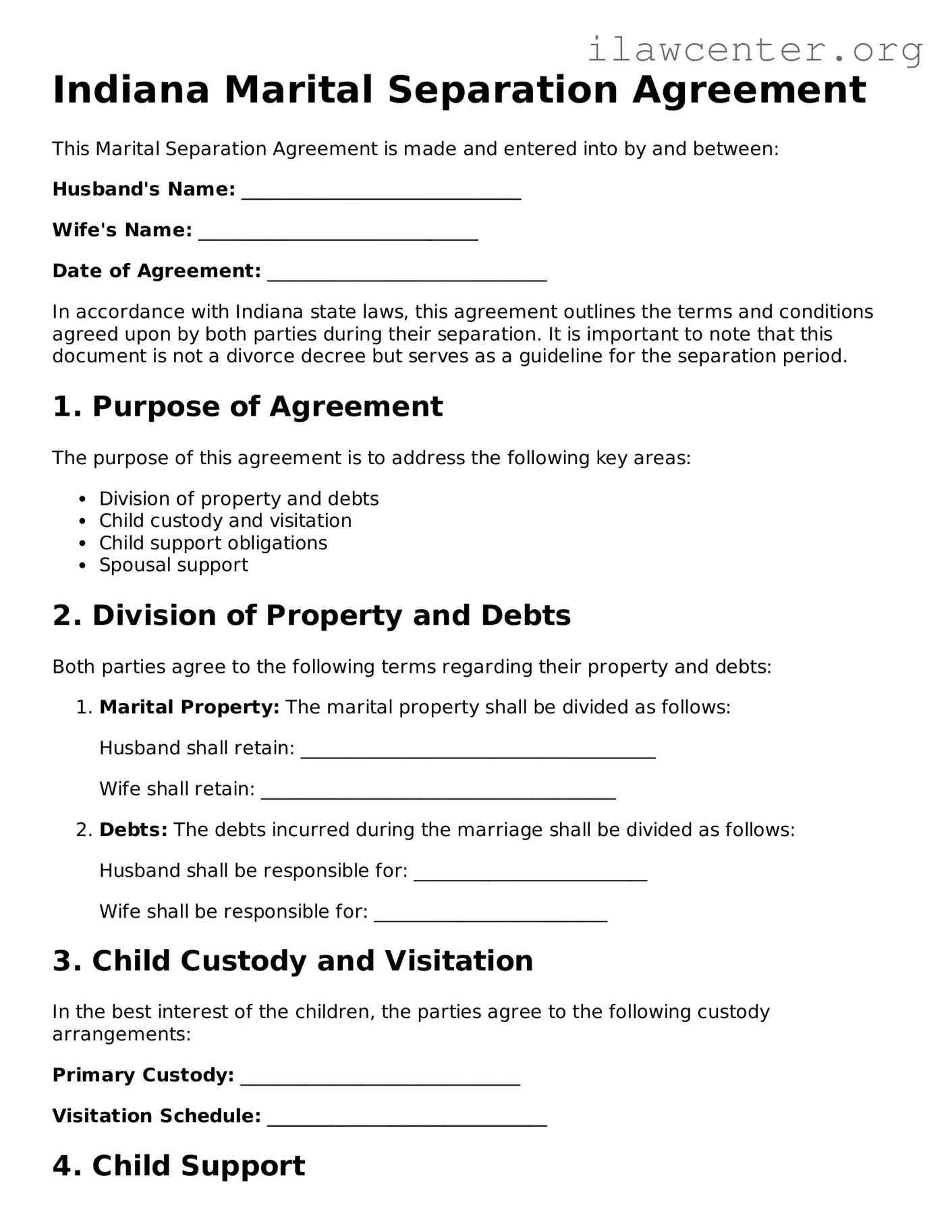
Indiana Marital Separation Agreement Preview

Indiana Marital Separation Agreement

This Marital Separation Agreement is made and entered into by and between:

Husband's Name: ______________________________

Wife's Name: ______________________________

Date of Agreement: ______________________________

In accordance with Indiana state laws, this agreement outlines the terms and conditions agreed upon by both parties during their separation. It is important to note that this document is not a divorce decree but serves as a guideline for the separation period.

1. Purpose of Agreement

The purpose of this agreement is to address the following key areas:

  • Division of property and debts
  • Child custody and visitation
  • Child support obligations
  • Spousal support

2. Division of Property and Debts

Both parties agree to the following terms regarding their property and debts:

  1. Marital Property: The marital property shall be divided as follows:
  2. Husband shall retain: ______________________________________

    Wife shall retain: ______________________________________

  3. Debts: The debts incurred during the marriage shall be divided as follows:
  4. Husband shall be responsible for: _________________________

    Wife shall be responsible for: _________________________

3. Child Custody and Visitation

In the best interest of the children, the parties agree to the following custody arrangements:

Primary Custody: ______________________________

Visitation Schedule: ______________________________

4. Child Support

Child support will be paid by:

Amount: ______________________________

Payment Schedule: ______________________________

5. Spousal Support

Spousal support shall be provided as follows:

Amount: ______________________________

Duration: ______________________________

6. Miscellaneous Provisions

Both parties agree to the following additional terms:

  • Modification of this agreement must be in writing and signed by both parties.
  • Each party acknowledges that they have had the opportunity to seek independent legal advice.
  • This agreement shall be governed by the laws of the State of Indiana.

By signing below, both parties agree to the terms outlined in this Marital Separation Agreement.

Husband's Signature: ______________________________

Date: ______________________________

Wife's Signature: ______________________________

Date: ______________________________

PDF Form Characteristics

Fact Name Description
Purpose The Indiana Marital Separation Agreement is used to outline the terms of a couple's separation, including asset division, child custody, and support arrangements.
Governing Law This agreement is governed by Indiana state law, specifically under the Indiana Code Title 31, Article 15.
Voluntary Agreement Both parties must voluntarily agree to the terms outlined in the agreement for it to be enforceable.
Written Document The agreement must be in writing to be valid and effective in Indiana.
Child Custody Provisions regarding child custody and visitation should be included if children are involved.
Asset Division The agreement should clearly specify how marital assets and debts will be divided between the parties.
Spousal Support It can include terms for spousal support, detailing any financial obligations one spouse may have to the other.
Modification Parties can modify the agreement in the future, but any changes must also be in writing.
Legal Advice While not required, obtaining legal advice before signing the agreement is highly recommended to ensure fairness and legality.
Filing Requirement The agreement does not need to be filed with the court unless it is part of a divorce proceeding.

Instructions on Utilizing Indiana Marital Separation Agreement

Filling out the Indiana Marital Separation Agreement form is an important step in the process of legally separating from your spouse. After completing the form, it will need to be reviewed and signed by both parties, potentially leading to a smoother transition during this challenging time.

  1. Begin by downloading the Indiana Marital Separation Agreement form from a reliable source or the Indiana government website.
  2. Read through the entire form to familiarize yourself with the sections and requirements.
  3. In the first section, enter your full name and the full name of your spouse.
  4. Provide your current addresses, including city, state, and zip code for both parties.
  5. Fill in the date of marriage and the date of separation.
  6. Detail the terms of the separation, including any agreements on property division, child custody, and support payments.
  7. Clearly outline any debts and how they will be handled during the separation.
  8. Include any other relevant agreements that both parties have discussed and agreed upon.
  9. Review the completed form for accuracy and completeness.
  10. Both parties should sign the form in the designated areas, ideally in front of a notary public to ensure validity.

Important Facts about Indiana Marital Separation Agreement

What is a Marital Separation Agreement in Indiana?

A Marital Separation Agreement is a legal document that outlines the terms of a couple's separation. It addresses issues such as property division, child custody, visitation, and support. This agreement is essential for couples who want to live apart but are not ready to divorce.

Who should use a Marital Separation Agreement?

Couples who are considering a separation but wish to clarify their rights and responsibilities may benefit from this agreement. It is particularly useful for those with children or shared assets, as it helps prevent misunderstandings and disputes during the separation period.

Is a Marital Separation Agreement legally binding?

Yes, once both parties sign the Marital Separation Agreement, it becomes legally binding. However, it is advisable for each party to consult with a legal professional to ensure that their rights are protected and that the agreement complies with Indiana law.

Can the terms of the agreement be changed later?

Yes, the terms of a Marital Separation Agreement can be modified if both parties agree to the changes. It is important to document any modifications in writing and have both parties sign the updated agreement to ensure its enforceability.

What happens if one party does not follow the agreement?

If one party fails to adhere to the terms of the Marital Separation Agreement, the other party may seek legal enforcement. This could involve going to court to compel compliance or to seek damages for any losses incurred due to the breach.

Do I need a lawyer to create a Marital Separation Agreement?

While it is not legally required to have a lawyer, it is highly recommended. A lawyer can help ensure that the agreement is fair, comprehensive, and compliant with Indiana law, which can prevent future disputes.

What should be included in a Marital Separation Agreement?

A comprehensive Marital Separation Agreement should include details about property division, child custody arrangements, child support, spousal support, and any other relevant issues. Clear and specific language helps avoid confusion later on.

How do I file the Marital Separation Agreement with the court?

In Indiana, you typically do not need to file a Marital Separation Agreement with the court unless you are using it in conjunction with a divorce proceeding. However, it is wise to keep a copy of the signed agreement in a safe place and consult with a legal professional about any necessary filings.

Common mistakes

Filling out the Indiana Marital Separation Agreement form can be a daunting task. Mistakes can lead to complications down the road. Here are seven common errors people often make when completing this important document.

One frequent mistake is failing to provide complete information. Each section of the form requires specific details about both parties. Omitting even minor information can lead to delays or misunderstandings later. Ensure that all names, addresses, and relevant dates are accurately filled out.

Another common error involves not clearly outlining the terms of separation. This includes agreements on property division, child custody, and support payments. Vague language can create confusion. It is crucial to be as precise as possible to avoid potential disputes.

Some individuals neglect to consider the tax implications of their agreements. For instance, how property division affects taxes can be significant. Consulting with a tax professional can provide clarity and help avoid unexpected financial burdens.

People often forget to sign and date the form. While this may seem trivial, an unsigned document is not legally binding. Both parties must sign and date the agreement for it to be valid. Double-checking this step can save time and frustration.

Additionally, many fail to keep copies of the completed form. After filing, it is important to have a record of the agreement. This can be useful for future reference or if disputes arise. Make sure to store a copy in a safe place.

Another mistake is not understanding the legal consequences of the agreement. It is essential to recognize that this document may affect various aspects of life, including financial obligations and parental rights. Taking the time to fully comprehend the implications is vital.

Finally, some individuals do not seek legal advice before submitting the form. Even if both parties agree on the terms, having a legal professional review the document can help identify potential issues. This step can provide peace of mind and ensure that the agreement is fair and enforceable.

Documents used along the form

When navigating a marital separation in Indiana, several documents may accompany the Indiana Marital Separation Agreement. Each of these forms serves a specific purpose and can help clarify the terms of the separation. Below is a list of commonly used documents that can be beneficial during this process.

  • Petition for Legal Separation: This document initiates the legal process for separation. It outlines the reasons for the separation and requests the court to grant the legal separation.
  • Child Custody Agreement: This agreement details the arrangements for the custody of children involved in the separation, including physical and legal custody and visitation rights.
  • Child Support Worksheet: This form calculates the amount of financial support one parent will provide to the other for the care of their children, based on Indiana's guidelines.
  • Property Settlement Agreement: This document outlines how marital property and debts will be divided between the spouses, helping to prevent disputes in the future.
  • Financial Disclosure Statement: This form requires both parties to disclose their financial information, including income, expenses, assets, and liabilities, ensuring transparency during the separation process.
  • Temporary Orders: These are court orders that provide immediate relief regarding child custody, support, and property issues while the separation is pending.
  • Notice of Intent to Relocate: If one parent plans to move, this document informs the other parent of the intent to relocate, which may affect custody arrangements.
  • Affidavit of Service: This document confirms that one party has properly served the other with the necessary legal documents, ensuring that all parties are aware of the proceedings.
  • Final Decree of Legal Separation: This is the official court order that finalizes the legal separation, outlining the terms agreed upon in the separation agreement.

Understanding these documents can significantly ease the separation process. Each form plays a crucial role in ensuring that all aspects of the separation are addressed fairly and legally. Being well-informed can lead to a smoother transition for everyone involved.

Similar forms

A Marital Separation Agreement is a crucial document for couples who decide to live apart but are not yet ready to divorce. Several other documents serve similar purposes in outlining rights, responsibilities, and arrangements between parties. Here are five documents that share similarities with a Marital Separation Agreement:

  • Divorce Agreement: This document outlines the terms of a divorce, including asset division, child custody, and support obligations. Like a Marital Separation Agreement, it aims to clarify the arrangement between the parties but finalizes the end of the marriage.
  • Child Custody Agreement: This agreement focuses specifically on the arrangements for children, detailing where they will live, visitation schedules, and how decisions will be made. Both documents prioritize the well-being of children and ensure that parental responsibilities are clearly defined.
  • Property Settlement Agreement: This document details how marital property will be divided between spouses. Similar to a Marital Separation Agreement, it helps prevent disputes by clearly outlining each party's rights to assets and debts.
  • Postnuptial Agreement: A Postnuptial Agreement is created after marriage and addresses similar issues as a Marital Separation Agreement, such as asset division and spousal support. It can be particularly useful if circumstances change during the marriage.
  • Separation Agreement: Often used interchangeably with a Marital Separation Agreement, this document outlines the terms under which a couple separates. It includes provisions for support, property division, and child custody, making it a comprehensive plan for living apart.

Understanding these documents can empower individuals to make informed decisions during a challenging time. Each serves to protect rights and clarify expectations, ultimately promoting smoother transitions for everyone involved.

Dos and Don'ts

When filling out the Indiana Marital Separation Agreement form, it’s important to approach the process thoughtfully. Here are four things you should and shouldn't do:

  • Do read the entire form carefully before starting. Understanding what each section requires will save you time and prevent errors.
  • Do be honest and accurate in your disclosures. Providing truthful information helps avoid complications later on.
  • Don't rush through the process. Take your time to ensure that all details are correct and that you fully understand what you are agreeing to.
  • Don't ignore the importance of legal advice. Consulting with a legal professional can help clarify any questions and ensure that your rights are protected.

Misconceptions

Many people have misunderstandings about the Indiana Marital Separation Agreement form. Here are five common misconceptions and the truths behind them.

  1. Misconception 1: A separation agreement is the same as a divorce.

    This is not true. A separation agreement allows couples to live apart while remaining legally married. Divorce, on the other hand, ends the marriage entirely.

  2. Misconception 2: You must go to court to create a separation agreement.

    While some couples may choose to have a court review their agreement, it is not a requirement. Couples can create and sign the agreement privately.

  3. Misconception 3: A separation agreement is not legally binding.

    This is incorrect. Once both parties sign the agreement, it becomes a legally binding contract. It outlines the rights and responsibilities of each spouse during the separation.

  4. Misconception 4: You cannot change a separation agreement once it is signed.

    Actually, couples can modify the agreement if both parties agree to the changes. It is important to document any modifications in writing.

  5. Misconception 5: A separation agreement covers all aspects of divorce.

    This is misleading. While a separation agreement can address many issues like property division and support, it does not finalize a divorce. A separate divorce process is needed for that.

Understanding these misconceptions can help individuals navigate the process more effectively. It’s important to have clear information when making decisions about separation and divorce.

Key takeaways

When filling out and using the Indiana Marital Separation Agreement form, consider the following key takeaways:

  1. The agreement outlines the terms of separation, including property division and support obligations.
  2. Both parties must voluntarily agree to the terms for the agreement to be valid.
  3. It is essential to include a detailed list of all marital assets and debts.
  4. Each party should fully disclose their financial situation to ensure fairness.
  5. Consider including provisions for child custody and visitation if children are involved.
  6. The agreement should be signed in front of a notary public to ensure its legality.
  7. Review the agreement with a legal professional to avoid potential issues later.
  8. Keep copies of the signed agreement for personal records and future reference.
  9. Be aware that the agreement can be modified if both parties consent to the changes.
  10. Filing the agreement with the court may be necessary to enforce its terms.

Understanding these points can help ensure that the Indiana Marital Separation Agreement is completed correctly and serves its intended purpose.