Attorney-Verified  Motor Vehicle Power of Attorney Document for Indiana

Attorney-Verified Motor Vehicle Power of Attorney Document for Indiana

The Indiana Motor Vehicle Power of Attorney form is a legal document that allows an individual to designate another person to act on their behalf in matters related to motor vehicle transactions. This form is particularly useful for managing tasks such as title transfers, registration, and other vehicle-related duties when the owner is unable to be present. To ensure smooth processing of vehicle transactions, consider filling out the form by clicking the button below.

Article Guide

The Indiana Motor Vehicle Power of Attorney form is an important legal document that allows individuals to designate someone else to handle specific vehicle-related transactions on their behalf. This form is particularly useful when the vehicle owner is unable to be present for tasks such as registering a vehicle, transferring ownership, or dealing with the Bureau of Motor Vehicles. By completing this form, the vehicle owner grants authority to the designated agent to act in their stead, ensuring that all necessary actions can be taken without delay. It is essential for the form to be filled out accurately, as it requires details such as the names of both the principal and the agent, the vehicle information, and the scope of authority granted. Additionally, the form must be signed and dated to be valid. Understanding the implications of this document can provide peace of mind, knowing that someone trusted can manage vehicle matters effectively when needed.

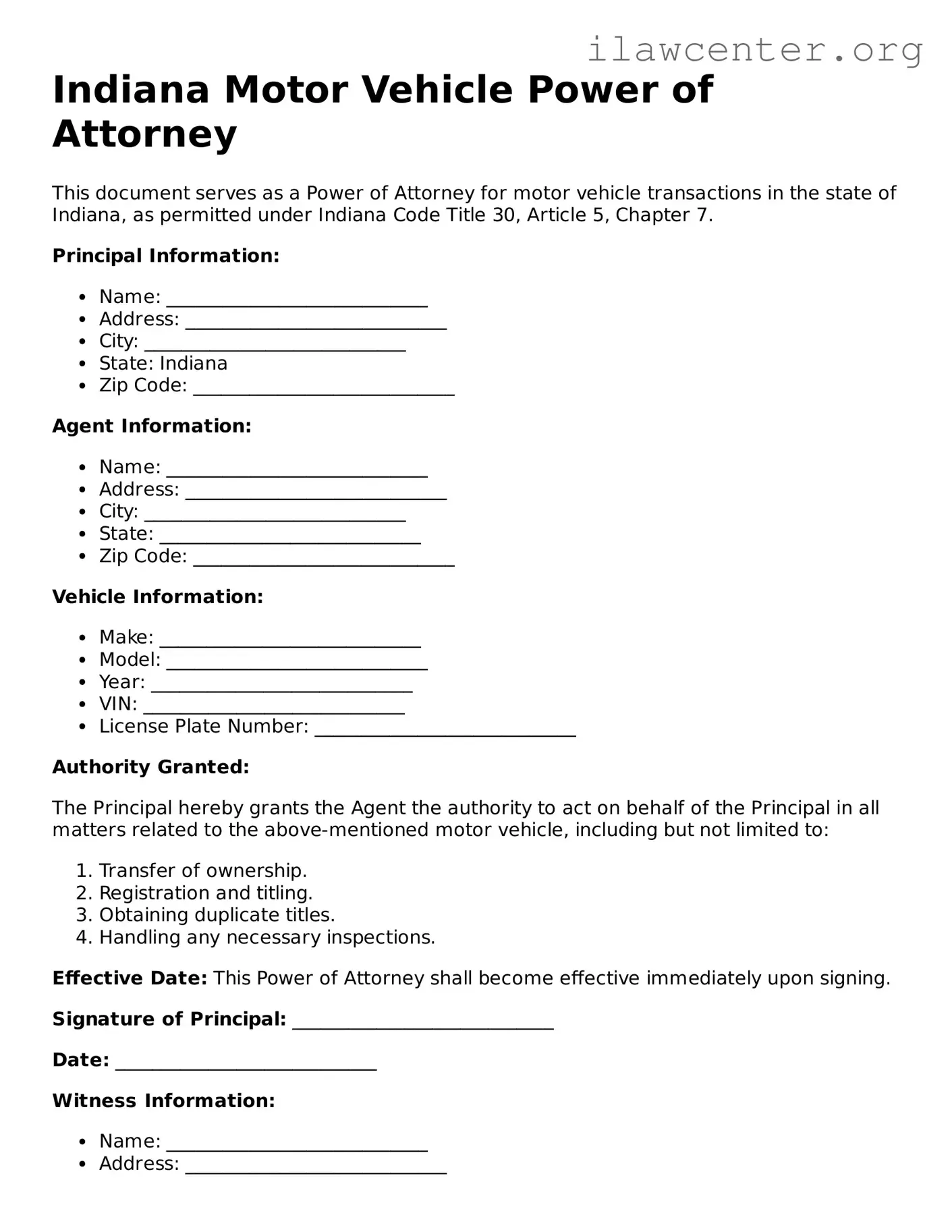
Indiana Motor Vehicle Power of Attorney Preview

Indiana Motor Vehicle Power of Attorney

This document serves as a Power of Attorney for motor vehicle transactions in the state of Indiana, as permitted under Indiana Code Title 30, Article 5, Chapter 7.

Principal Information:

  • Name: ____________________________
  • Address: ____________________________
  • City: ____________________________
  • State: Indiana
  • Zip Code: ____________________________

Agent Information:

  • Name: ____________________________
  • Address: ____________________________
  • City: ____________________________
  • State: ____________________________
  • Zip Code: ____________________________

Vehicle Information:

  • Make: ____________________________
  • Model: ____________________________
  • Year: ____________________________
  • VIN: ____________________________
  • License Plate Number: ____________________________

Authority Granted:

The Principal hereby grants the Agent the authority to act on behalf of the Principal in all matters related to the above-mentioned motor vehicle, including but not limited to:

  1. Transfer of ownership.
  2. Registration and titling.
  3. Obtaining duplicate titles.
  4. Handling any necessary inspections.

Effective Date: This Power of Attorney shall become effective immediately upon signing.

Signature of Principal: ____________________________

Date: ____________________________

Witness Information:

  • Name: ____________________________
  • Address: ____________________________

Signature of Witness: ____________________________

Date: ____________________________

PDF Form Characteristics

Fact Name Description
Purpose The Indiana Motor Vehicle Power of Attorney form allows an individual to authorize someone else to handle motor vehicle transactions on their behalf.
Governing Law This form is governed by Indiana Code § 32-17-1-1 et seq.
Eligibility Any adult resident of Indiana can create this form to designate an agent.
Agent Responsibilities The agent can perform tasks such as signing documents for vehicle registration, title transfers, and other related activities.
Revocation The principal can revoke the power of attorney at any time, as long as they provide written notice to the agent.
Signature Requirement The form must be signed by the principal and may require notarization to be valid.

Instructions on Utilizing Indiana Motor Vehicle Power of Attorney

Filling out the Indiana Motor Vehicle Power of Attorney form is a straightforward process. By completing this form, you will designate someone to act on your behalf regarding motor vehicle matters. Below are the steps to follow to ensure the form is filled out correctly.

  1. Obtain the Indiana Motor Vehicle Power of Attorney form. This can be found online or at your local Bureau of Motor Vehicles (BMV) office.
  2. Read the instructions carefully to understand the requirements for completing the form.
  3. Fill in your full name and address in the designated sections. Ensure that this information is accurate.
  4. Provide the name and address of the person you are appointing as your attorney-in-fact. This individual will have the authority to act on your behalf.
  5. Specify the powers you are granting. This may include the ability to sign documents or make decisions regarding the vehicle.
  6. Indicate the vehicle details, including the make, model, year, and Vehicle Identification Number (VIN), if applicable.
  7. Sign and date the form. Your signature must match the name provided at the beginning of the form.
  8. Have the form notarized. This step is necessary to validate the document.
  9. Make copies of the completed form for your records and for the attorney-in-fact.

Once you have completed these steps, the form is ready for submission to the appropriate authorities or for use as needed. Ensure that the appointed individual understands their responsibilities and the scope of their authority.

Important Facts about Indiana Motor Vehicle Power of Attorney

What is the Indiana Motor Vehicle Power of Attorney form?

The Indiana Motor Vehicle Power of Attorney form allows one person to authorize another to handle specific tasks related to their vehicle. This includes signing documents for vehicle registration, title transfers, and other motor vehicle-related matters.

Who can be a principal in this Power of Attorney?

The principal is the person who grants authority to another. In this case, the principal must be the owner of the vehicle or someone who has legal rights to act on behalf of the vehicle owner.

Who can be an agent?

The agent is the person who receives the authority to act on behalf of the principal. This can be a friend, family member, or any trusted individual. The agent must be at least 18 years old and capable of handling the responsibilities assigned to them.

What tasks can the agent perform?

The agent can perform a variety of tasks, such as signing documents for vehicle registration, transferring the title of the vehicle, and handling any other necessary paperwork related to the vehicle. The specific tasks should be clearly outlined in the form.

How do I fill out the form?

To fill out the form, provide the required information, including the names and addresses of both the principal and the agent. Clearly specify the powers being granted to the agent. Make sure to sign and date the form to make it valid.

Does the Power of Attorney need to be notarized?

Yes, the Indiana Motor Vehicle Power of Attorney form must be notarized to be legally binding. This means a notary public needs to witness the signing of the document and provide their seal on it.

Can I revoke the Power of Attorney once it is created?

Yes, you can revoke the Power of Attorney at any time. To do this, you should create a written revocation document and notify the agent that their authority has been canceled. It is also a good idea to inform any institutions that may have a copy of the original Power of Attorney.

Is there a specific duration for which the Power of Attorney is valid?

The Power of Attorney remains valid until it is revoked by the principal or until the specific tasks outlined in the form are completed. If you want to set a specific duration, you can include that in the document.

What happens if the principal becomes incapacitated?

If the principal becomes incapacitated, the Power of Attorney may still be valid, depending on the type of Power of Attorney created. A durable Power of Attorney remains effective even if the principal is no longer able to make decisions. It is important to specify this when creating the document.

Where can I obtain the Indiana Motor Vehicle Power of Attorney form?

You can obtain the Indiana Motor Vehicle Power of Attorney form from various sources, including the Indiana Bureau of Motor Vehicles (BMV) website, legal document websites, or by consulting with a legal professional. Make sure to use the most current version of the form.

Common mistakes

Filling out the Indiana Motor Vehicle Power of Attorney form can be a straightforward process, yet many individuals encounter common pitfalls that can lead to complications. One frequent mistake is failing to provide accurate information about the vehicle. This includes the vehicle identification number (VIN), make, model, and year. Omitting or incorrectly entering these details can result in delays or even the rejection of the document.

Another common error is neglecting to sign the form. A signature is essential for the document to be valid. In some cases, individuals may forget to sign altogether or may not realize that all required parties need to sign. Without these signatures, the power of attorney may not hold up in legal situations.

Many people also overlook the importance of designating a clear and specific agent. The agent is the person who will act on behalf of the vehicle owner. Failing to clearly identify this individual can create confusion and lead to disputes later on. It’s crucial to ensure that the agent's name is spelled correctly and that their contact information is up-to-date.

In addition, some individuals may not understand the scope of the authority they are granting. The form allows for specific powers to be delegated, such as the ability to sell the vehicle or transfer its title. Not clearly defining these powers can lead to misunderstandings about what the agent is permitted to do.

Another mistake involves not providing a valid date on the form. Without a date, the document may be considered incomplete. It is important to date the form when it is signed to establish a clear timeline of authority.

People often forget to keep a copy of the completed form for their records. This can be problematic if there are questions or disputes later regarding the authority granted. Retaining a copy ensures that both the vehicle owner and the agent have access to the same information.

Additionally, some individuals may not understand the importance of notarization. While notarization is not always required, having the document notarized can add an extra layer of legitimacy and can be beneficial in certain situations. Skipping this step may lead to challenges in the future.

Lastly, individuals sometimes fail to review the form thoroughly before submission. Mistakes in the details can lead to significant issues, so taking the time to double-check all information is essential. A careful review can prevent minor errors from becoming major headaches.

By being aware of these common mistakes, individuals can ensure that their Indiana Motor Vehicle Power of Attorney form is filled out correctly, thereby facilitating a smoother process in managing their vehicle-related matters.

Documents used along the form

When dealing with the Indiana Motor Vehicle Power of Attorney form, several other documents may be necessary to ensure a smooth transaction. Each of these forms serves a specific purpose and can help clarify responsibilities and rights in vehicle-related matters. Understanding these documents is essential for anyone navigating the process.

  • Indiana Vehicle Title Application: This form is used to apply for a new title when purchasing a vehicle or transferring ownership. It provides essential details about the vehicle and the new owner.
  • Bill of Sale: A bill of sale is a legal document that records the transaction between a buyer and seller. It includes information about the vehicle, the sale price, and the parties involved, serving as proof of ownership transfer.
  • Indiana Registration Application: This application is necessary for registering a vehicle with the state. It ensures that the vehicle is legally recognized and can be driven on public roads.
  • Odometer Disclosure Statement: This form is required when selling a vehicle to disclose the mileage on the odometer. It protects both the buyer and seller by preventing fraud regarding the vehicle's condition.
  • Affidavit of Heirship: In cases where a vehicle owner has passed away, this document helps establish the rightful heir to the vehicle. It simplifies the transfer process without going through probate.
  • Power of Attorney for Vehicle Transactions: While similar to the Motor Vehicle Power of Attorney, this document specifically grants authority for vehicle-related transactions, such as signing titles or registration applications.

Having these documents on hand can significantly ease the process of vehicle ownership transfer and management. Each form plays a crucial role in ensuring that all legal requirements are met, providing peace of mind for both buyers and sellers.

Similar forms

The Motor Vehicle Power of Attorney form is a specific legal document that grants someone the authority to act on your behalf regarding vehicle-related matters. Several other documents serve similar purposes, allowing individuals to delegate authority in various contexts. Here are five such documents:

  • General Power of Attorney: This document allows one person to act on behalf of another in a wide range of legal and financial matters. Like the Motor Vehicle Power of Attorney, it grants authority but is not limited to vehicle-related transactions.
  • Healthcare Power of Attorney: This form designates an individual to make medical decisions on your behalf if you become unable to do so. Similar to the Motor Vehicle Power of Attorney, it involves granting authority, but it focuses on healthcare decisions rather than vehicle matters.
  • Durable Power of Attorney: This type of document remains effective even if the principal becomes incapacitated. It is akin to the Motor Vehicle Power of Attorney in that it allows someone to act on your behalf, but it can cover a broader range of responsibilities.
  • Limited Power of Attorney: This document restricts the authority granted to specific tasks or situations. It shares similarities with the Motor Vehicle Power of Attorney by allowing focused authority, often for a defined period or particular actions.
  • Financial Power of Attorney: This form allows someone to manage your financial affairs, including banking and property transactions. Like the Motor Vehicle Power of Attorney, it empowers an agent to act in your best interest, but it encompasses a wider array of financial matters.

Understanding these documents can help you make informed decisions about delegating authority in various aspects of your life. Each serves a unique purpose while sharing the common theme of granting someone else the ability to act on your behalf.

Dos and Don'ts

When filling out the Indiana Motor Vehicle Power of Attorney form, it's essential to be careful and precise. Here are some important dos and don'ts to keep in mind:

  • Do ensure that all information is accurate and up to date.
  • Do sign the form in the presence of a notary public.
  • Do include the full name and address of both the principal and the agent.
  • Do specify the powers you are granting clearly.
  • Do keep a copy of the completed form for your records.
  • Don't leave any fields blank; fill in all required information.
  • Don't use white-out or erase any mistakes; instead, cross out errors and initial them.
  • Don't forget to date the form when you sign it.
  • Don't assume verbal agreements are sufficient; everything must be in writing.
  • Don't overlook the need for a witness if required by your specific situation.

Misconceptions

Understanding the Indiana Motor Vehicle Power of Attorney form is essential for anyone looking to manage vehicle transactions on behalf of another person. However, several misconceptions can lead to confusion. Here are five common misconceptions:

  1. It can only be used for vehicle sales.

    Many believe that this form is exclusively for selling vehicles. In reality, it can also authorize someone to handle various tasks, such as registering a vehicle, obtaining title transfers, or dealing with repairs.

  2. Only a lawyer can create this document.

    While legal assistance can be beneficial, individuals can create a Power of Attorney form without a lawyer. The form must meet specific requirements, but many resources are available to help guide individuals through the process.

  3. It must be notarized to be valid.

    Notarization is not always required for a Power of Attorney in Indiana. However, having it notarized can provide an additional layer of validation and may be necessary for certain transactions.

  4. It is only valid for a limited time.

    Some people think that the Power of Attorney expires after a short period. In fact, it remains valid until the specified tasks are completed or until the principal revokes it, unless a specific expiration date is included in the document.

  5. Anyone can be appointed as an agent.

    While it is true that individuals can choose their agents, there are some restrictions. The person appointed must be at least 18 years old and should be someone the principal trusts to make decisions in their best interest.

By clarifying these misconceptions, individuals can approach the Indiana Motor Vehicle Power of Attorney form with greater confidence and understanding. Ensuring that the correct information is available helps facilitate smoother vehicle transactions and protects the interests of all parties involved.

Key takeaways

When filling out and using the Indiana Motor Vehicle Power of Attorney form, keep these key points in mind:

  1. Understand the purpose: This form allows you to authorize someone to act on your behalf regarding motor vehicle transactions.
  2. Choose your agent wisely: Select a trustworthy individual who will handle your affairs responsibly.
  3. Complete the form accurately: Ensure all required fields are filled out correctly to avoid delays or issues.
  4. Sign in front of a notary: Your signature must be notarized to validate the document legally.
  5. Specify the powers granted: Clearly outline the specific actions your agent can take, such as signing documents or transferring titles.
  6. Limit the duration: If desired, specify a time frame for how long the power of attorney will be effective.
  7. Keep copies: Make sure to retain copies of the completed form for your records and provide one to your agent.
  8. Notify relevant parties: Inform any institutions or agencies that may need to recognize the power of attorney.
  9. Revocation process: Understand how to revoke the power of attorney if you no longer wish for it to be in effect.
  10. Consult a professional: If you have questions or concerns, consider seeking legal advice to ensure your needs are met.

Following these guidelines will help ensure that your Indiana Motor Vehicle Power of Attorney form is filled out correctly and used effectively.