Attorney-Verified  Motorcycle Bill of Sale Document for Indiana

Attorney-Verified Motorcycle Bill of Sale Document for Indiana

The Indiana Motorcycle Bill of Sale is a crucial document that serves as a record of the sale or transfer of ownership of a motorcycle in Indiana. This form not only protects both the buyer and seller but also helps in the registration process with the state. To ensure a smooth transaction, consider filling out the form by clicking the button below.

Article Guide

When buying or selling a motorcycle in Indiana, a Motorcycle Bill of Sale form plays a crucial role in the transaction. This document serves as a legal record of the sale, providing essential details such as the buyer's and seller's names, contact information, and the motorcycle's specific identification number (VIN). It outlines the sale price and any conditions of the sale, ensuring both parties are clear about the terms. Additionally, the form may include information about the motorcycle's make, model, year, and odometer reading at the time of sale. Having a properly completed Bill of Sale not only protects the interests of both the buyer and seller but also simplifies the process of transferring ownership and registering the motorcycle with the state. By using this form, both parties can avoid potential disputes and ensure a smooth transaction, making it an indispensable tool for motorcycle enthusiasts and casual sellers alike.

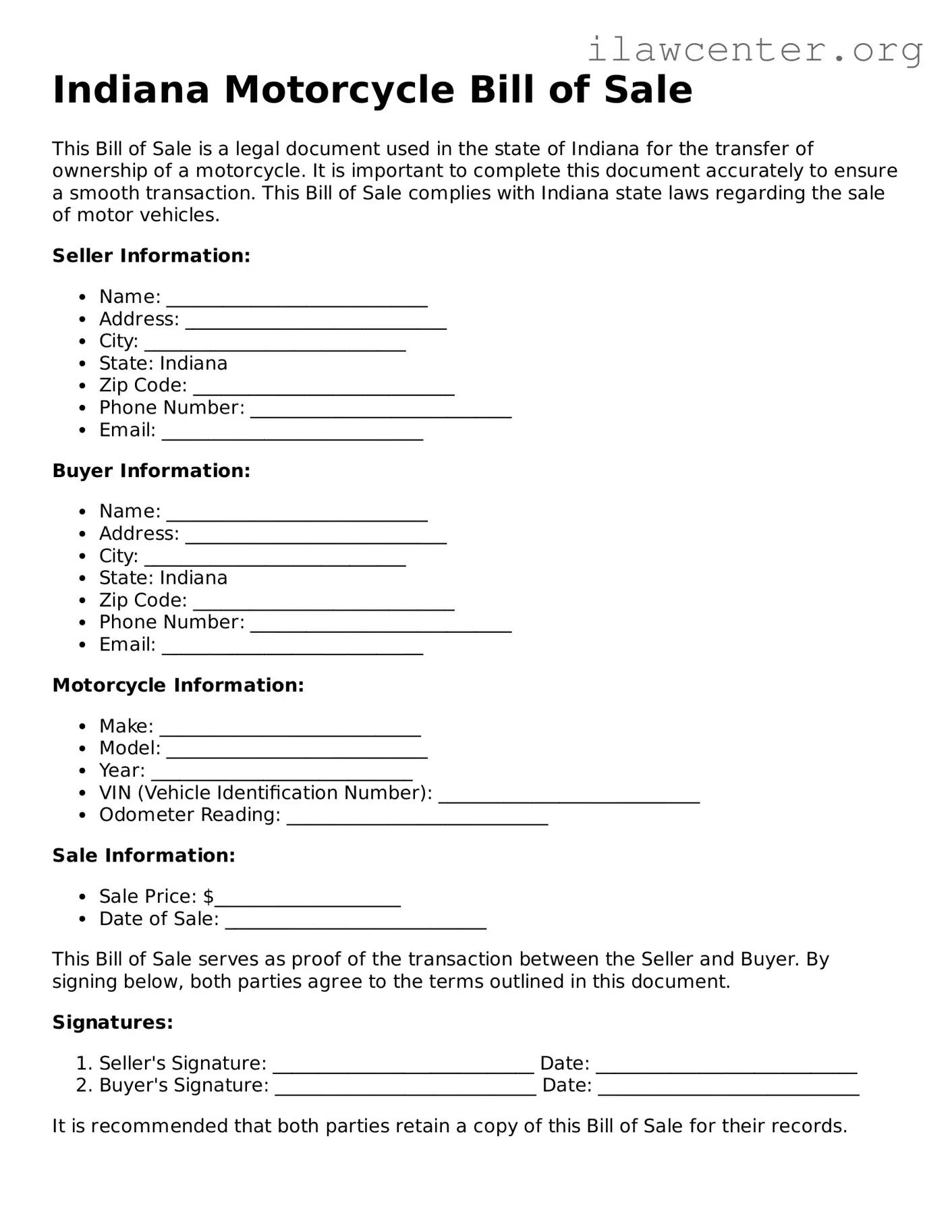
Indiana Motorcycle Bill of Sale Preview

Indiana Motorcycle Bill of Sale

This Bill of Sale is a legal document used in the state of Indiana for the transfer of ownership of a motorcycle. It is important to complete this document accurately to ensure a smooth transaction. This Bill of Sale complies with Indiana state laws regarding the sale of motor vehicles.

Seller Information:

  • Name: ____________________________
  • Address: ____________________________
  • City: ____________________________
  • State: Indiana
  • Zip Code: ____________________________
  • Phone Number: ____________________________
  • Email: ____________________________

Buyer Information:

  • Name: ____________________________
  • Address: ____________________________
  • City: ____________________________
  • State: Indiana
  • Zip Code: ____________________________
  • Phone Number: ____________________________
  • Email: ____________________________

Motorcycle Information:

  • Make: ____________________________
  • Model: ____________________________
  • Year: ____________________________
  • VIN (Vehicle Identification Number): ____________________________
  • Odometer Reading: ____________________________

Sale Information:

  • Sale Price: $____________________
  • Date of Sale: ____________________________

This Bill of Sale serves as proof of the transaction between the Seller and Buyer. By signing below, both parties agree to the terms outlined in this document.

Signatures:

  1. Seller's Signature: ____________________________ Date: ____________________________
  2. Buyer's Signature: ____________________________ Date: ____________________________

It is recommended that both parties retain a copy of this Bill of Sale for their records.

PDF Form Characteristics

Fact Name Description
Purpose The Indiana Motorcycle Bill of Sale form serves as a legal document to transfer ownership of a motorcycle from one party to another.
Governing Law This form is governed by Indiana Code Title 9, Article 17, which outlines vehicle registration and titling laws.
Required Information Essential details include the motorcycle's make, model, year, Vehicle Identification Number (VIN), and the sale price.
Signatures Both the seller and buyer must sign the document to validate the sale and transfer of ownership.
Witness Requirement While not mandatory, having a witness sign the bill of sale can provide additional legal protection.
Record Keeping Both parties should keep a copy of the bill of sale for their records, as it may be needed for future reference.
Notarization Notarization is not required for the Indiana Motorcycle Bill of Sale, but it can enhance the document's credibility.
Sales Tax The buyer is responsible for paying sales tax based on the sale price when registering the motorcycle.
Use for Title Application This bill of sale can be used as proof of purchase when applying for a new title or registration with the Indiana Bureau of Motor Vehicles.

Instructions on Utilizing Indiana Motorcycle Bill of Sale

Once you have obtained the Indiana Motorcycle Bill of Sale form, you will need to fill it out accurately to ensure a smooth transaction. This document serves as a record of the sale and includes important details about the motorcycle and the parties involved.

  1. Begin by entering the date of the sale in the designated field.
  2. Provide the seller's full name and address. Ensure that this information is current and accurate.
  3. Enter the buyer's full name and address in the appropriate section.
  4. Fill in the motorcycle's details, including the make, model, year, color, and Vehicle Identification Number (VIN).
  5. Specify the sale price of the motorcycle clearly.
  6. Both the seller and buyer should sign and date the form to validate the transaction.

After completing the form, keep a copy for your records. The buyer may need to present this document when registering the motorcycle with the Indiana Bureau of Motor Vehicles.

Important Facts about Indiana Motorcycle Bill of Sale

What is a Motorcycle Bill of Sale in Indiana?

A Motorcycle Bill of Sale is a legal document that records the sale and transfer of ownership of a motorcycle. It includes essential details such as the buyer's and seller's names, contact information, motorcycle specifications, and the sale price. This document serves as proof of the transaction and can be useful for registration and title transfer purposes.

Is a Motorcycle Bill of Sale required in Indiana?

While a Motorcycle Bill of Sale is not legally required in Indiana, it is highly recommended. Having this document can protect both the buyer and seller by providing a clear record of the transaction. It can also help in case of disputes or issues regarding ownership in the future.

What information should be included in the Motorcycle Bill of Sale?

The Motorcycle Bill of Sale should include the following information: the names and addresses of both the buyer and seller, the motorcycle's make, model, year, VIN (Vehicle Identification Number), sale price, and the date of the sale. Both parties should sign the document to validate the transaction.

Can I create my own Motorcycle Bill of Sale?

Yes, you can create your own Motorcycle Bill of Sale. It is important to ensure that all necessary information is included and that it is signed by both parties. Various templates are available online, which can help you structure the document correctly.

Do I need to have the Motorcycle Bill of Sale notarized?

Notarization is not required for a Motorcycle Bill of Sale in Indiana. However, having the document notarized can add an extra layer of legitimacy and may be beneficial if any disputes arise later.

How does the Motorcycle Bill of Sale affect the title transfer process?

The Motorcycle Bill of Sale is an important part of the title transfer process. When a motorcycle is sold, the seller must provide the buyer with the signed bill of sale along with the title. The buyer will need both documents to register the motorcycle in their name with the Indiana Bureau of Motor Vehicles (BMV).

What should I do if I lose my Motorcycle Bill of Sale?

If you lose your Motorcycle Bill of Sale, you can create a new one, but it is best to have both parties sign it again. If the original sale was documented with a title transfer, the BMV may have a record of the transaction, which can also help in verifying ownership.

Can I use a Motorcycle Bill of Sale for a trade-in?

Yes, a Motorcycle Bill of Sale can be used for a trade-in. When trading in a motorcycle at a dealership, the dealership may require a bill of sale to verify the transaction and the motorcycle's ownership. This document can help facilitate the trade-in process.

What happens if the motorcycle has a lien on it?

If the motorcycle has a lien, the seller must disclose this information to the buyer. The lien must be satisfied before the sale can be completed. The Motorcycle Bill of Sale should indicate that the lien has been cleared or that arrangements have been made for its payment as part of the sale.

Where can I obtain a Motorcycle Bill of Sale form?

Motorcycle Bill of Sale forms can be found online through various legal websites, or you can create one using a template. Additionally, some local offices or motorcycle dealerships may provide a standard form for this purpose.
Common mistakes

Filling out the Indiana Motorcycle Bill of Sale form can seem straightforward, but many people make common mistakes that can lead to issues later on. One frequent error is not including all necessary information. The form requires specific details about the motorcycle, such as the Vehicle Identification Number (VIN), make, model, and year. Omitting any of this information can cause delays in registration.

Another mistake is failing to provide accurate contact information. Both the buyer and seller must include their names and addresses. If this information is incorrect or incomplete, it can complicate communication and the transfer of ownership.

Many individuals also overlook the importance of signatures. Both parties must sign the bill of sale to validate the transaction. If either signature is missing, the document may not be legally binding, which can create problems down the line.

Some people mistakenly think that a bill of sale is only necessary for high-value transactions. However, even for lower-priced motorcycles, having a bill of sale is crucial for proof of ownership. Without it, the buyer may struggle to register the motorcycle in their name.

Another common issue arises from not dating the document. A date is essential as it marks when the sale occurred. This can be important for legal and registration purposes. Failing to date the bill of sale can lead to confusion about when the transfer of ownership took place.

Additionally, individuals may neglect to include the sale price. This detail is important not only for the buyer and seller but also for tax purposes. Without a clear sale price, the buyer may face challenges when registering the motorcycle.

Some may also misinterpret the form's requirements. For instance, people sometimes believe they can use a generic bill of sale template instead of the specific Indiana form. Using the correct form is essential to ensure compliance with state regulations.

Finally, a lack of copies can lead to problems. Both the buyer and seller should keep a copy of the signed bill of sale for their records. This serves as proof of the transaction and can be useful in case any disputes arise in the future.

Documents used along the form

When purchasing or selling a motorcycle in Indiana, several forms and documents may accompany the Motorcycle Bill of Sale. These documents serve various purposes, from proving ownership to facilitating the registration process. Understanding these documents is crucial for both buyers and sellers to ensure a smooth transaction.

  • Title Transfer Form: This document is essential for transferring ownership of the motorcycle from the seller to the buyer. It must be completed and submitted to the Indiana Bureau of Motor Vehicles (BMV) to officially register the new owner.
  • Vehicle Identification Number (VIN) Verification: This form verifies the motorcycle's VIN, ensuring that it matches the information on the title and preventing potential fraud. It may be required by the BMV during the registration process.
  • Odometer Disclosure Statement: This document is required to disclose the motorcycle's mileage at the time of sale. It helps protect against odometer fraud and is often included in the title transfer process.
  • Sales Tax Form: Buyers may need to complete a sales tax form to report the purchase price of the motorcycle. This form is necessary for calculating any applicable sales tax owed to the state.
  • Proof of Insurance: Before registering the motorcycle, buyers must provide proof of insurance. This document demonstrates that the motorcycle is insured, which is a legal requirement in Indiana.
  • Application for Title: This form is used to apply for a new title after the purchase. It includes information about the buyer, seller, and the motorcycle itself, and must be submitted to the BMV.
  • Affidavit of Ownership: If the seller cannot provide the original title, this affidavit may be used to declare ownership of the motorcycle. It serves as a sworn statement regarding the motorcycle's history.
  • Release of Liability: This document protects the seller from future liabilities related to the motorcycle after the sale. It confirms that the seller is no longer responsible for the vehicle once it is sold.
  • Motorcycle Registration Application: After purchasing a motorcycle, the buyer must complete this application to register the vehicle with the state. Registration is necessary for legal operation on public roads.
  • VIN Inspection Form: In some cases, a VIN inspection may be required to confirm the motorcycle's identity. This form is typically completed by a law enforcement officer or authorized inspector.

Being aware of these documents can greatly simplify the buying and selling process. Ensure that all necessary paperwork is completed accurately and submitted on time to avoid complications. Proper documentation not only protects both parties but also ensures compliance with Indiana's motor vehicle laws.

Similar forms

  • Vehicle Title: The vehicle title serves as the official document that proves ownership of a motorcycle. Like the Motorcycle Bill of Sale, it includes essential details such as the vehicle identification number (VIN), make, model, and year. Both documents are crucial when transferring ownership from one party to another.
  • Purchase Agreement: A purchase agreement outlines the terms of the sale, including the price, payment method, and any conditions. Similar to the Motorcycle Bill of Sale, it formalizes the transaction and protects both the buyer and seller by detailing their responsibilities.
  • Odometer Disclosure Statement: This document records the mileage of the motorcycle at the time of sale. It is often required by law and ensures that the buyer is aware of the motorcycle’s usage history. The Motorcycle Bill of Sale may include an odometer disclosure section to confirm this information as well.
  • Sales Receipt: A sales receipt provides proof of the transaction and typically includes the date of sale, the names of both parties, and the amount paid. Similar to the Motorcycle Bill of Sale, it acts as a record of the exchange and can be used for future reference.
  • Transfer of Ownership Form: This form is often required by state authorities to officially transfer ownership of a vehicle. Like the Motorcycle Bill of Sale, it includes pertinent information about the motorcycle and the parties involved, ensuring that the transfer is documented properly.

Dos and Don'ts

When filling out the Indiana Motorcycle Bill of Sale form, it's important to get it right. Here are some guidelines to help you:

  • Do include the correct date of the sale. This helps establish when the transaction took place.
  • Do provide accurate information about the motorcycle. Include details like the make, model, year, and VIN.
  • Do have both the buyer and seller sign the form. Signatures confirm that both parties agree to the sale.
  • Do keep a copy of the completed form for your records. This can be helpful for future reference.
  • Don't leave any required fields blank. Missing information can lead to issues down the line.
  • Don't use white-out or make alterations. Any changes can raise questions about the validity of the document.

Misconceptions

When it comes to the Indiana Motorcycle Bill of Sale form, several misconceptions often arise. Understanding these can help clarify the process of buying or selling a motorcycle in Indiana.

  • Misconception 1: A Bill of Sale is not necessary for motorcycle transactions.
  • Many people believe that a Bill of Sale is optional. However, it is a crucial document that provides proof of the transaction and can protect both the buyer and seller.

  • Misconception 2: The Bill of Sale must be notarized.
  • Some individuals think that notarization is required for the Bill of Sale to be valid. In Indiana, notarization is not necessary, although it can add an extra layer of security.

  • Misconception 3: Only the seller needs to sign the Bill of Sale.
  • It's a common belief that only the seller's signature is required. In reality, both the buyer and seller should sign the document to ensure mutual agreement on the terms of the sale.

  • Misconception 4: The Bill of Sale serves as the title.
  • Some may think that the Bill of Sale acts as a title. While it provides proof of purchase, it does not replace the motorcycle title, which must also be transferred to the new owner.

  • Misconception 5: The Bill of Sale must include a detailed description of the motorcycle.
  • While it is beneficial to include detailed information, such as the make, model, and VIN, it is not strictly required. A basic description suffices, but more detail can help avoid disputes.

  • Misconception 6: The Bill of Sale can be verbal.
  • Some people believe a verbal agreement is enough. However, having a written Bill of Sale is essential for legal protection and clarity in the transaction.

  • Misconception 7: You can use a generic Bill of Sale for any motorcycle transaction.
  • Using a generic form may not cover specific state requirements. It's best to use the Indiana Motorcycle Bill of Sale form to ensure compliance with local laws.

Key takeaways

When it comes to completing and utilizing the Indiana Motorcycle Bill of Sale form, there are several important points to keep in mind. Here are key takeaways to ensure a smooth process:

  1. Essential Information: Include the seller's and buyer's full names, addresses, and contact information. This establishes clear ownership transfer.
  2. Motorcycle Details: Accurately describe the motorcycle. Include the make, model, year, Vehicle Identification Number (VIN), and mileage. This information is crucial for identification.
  3. Sale Price: Clearly state the sale price of the motorcycle. This amount should reflect the agreed-upon value between the buyer and seller.
  4. Date of Sale: Record the date when the transaction occurs. This helps in tracking ownership and is important for future reference.
  5. Signatures: Both parties must sign the document. This signifies mutual agreement and acceptance of the terms outlined in the bill of sale.
  6. Notarization: While not required, having the bill of sale notarized can add an extra layer of authenticity and can be beneficial for future transactions.
  7. Keep Copies: Each party should retain a copy of the signed bill of sale. This serves as proof of the transaction and can be useful for registration purposes.
  8. Registration and Title Transfer: After the sale, ensure that the buyer registers the motorcycle and transfers the title at the local Bureau of Motor Vehicles (BMV). This step is crucial for legal ownership.

By following these guidelines, both buyers and sellers can navigate the motorcycle sale process in Indiana with confidence and clarity.