Attorney-Verified  Operating Agreement Document for Indiana

Attorney-Verified Operating Agreement Document for Indiana

The Indiana Operating Agreement form is a crucial document that outlines the management structure and operational procedures of a limited liability company (LLC) in Indiana. This agreement serves as a roadmap for members, detailing their rights, responsibilities, and the overall governance of the business. To ensure your LLC operates smoothly, consider filling out the form by clicking the button below.

Article Guide

When establishing a limited liability company (LLC) in Indiana, one of the most essential documents to consider is the Operating Agreement. This form serves as a foundational blueprint for the management and operations of the LLC, detailing the rights and responsibilities of its members. It outlines how decisions will be made, how profits and losses will be distributed, and the procedures for adding or removing members. Additionally, the Operating Agreement addresses the process for resolving disputes among members, ensuring that there is a clear path forward in case of disagreements. By defining these critical aspects, the Operating Agreement not only helps to prevent misunderstandings but also provides legal protection for the members involved. Whether you are starting a new business or managing an existing one, having a well-crafted Operating Agreement is vital for the smooth functioning of your LLC and the safeguarding of your interests.

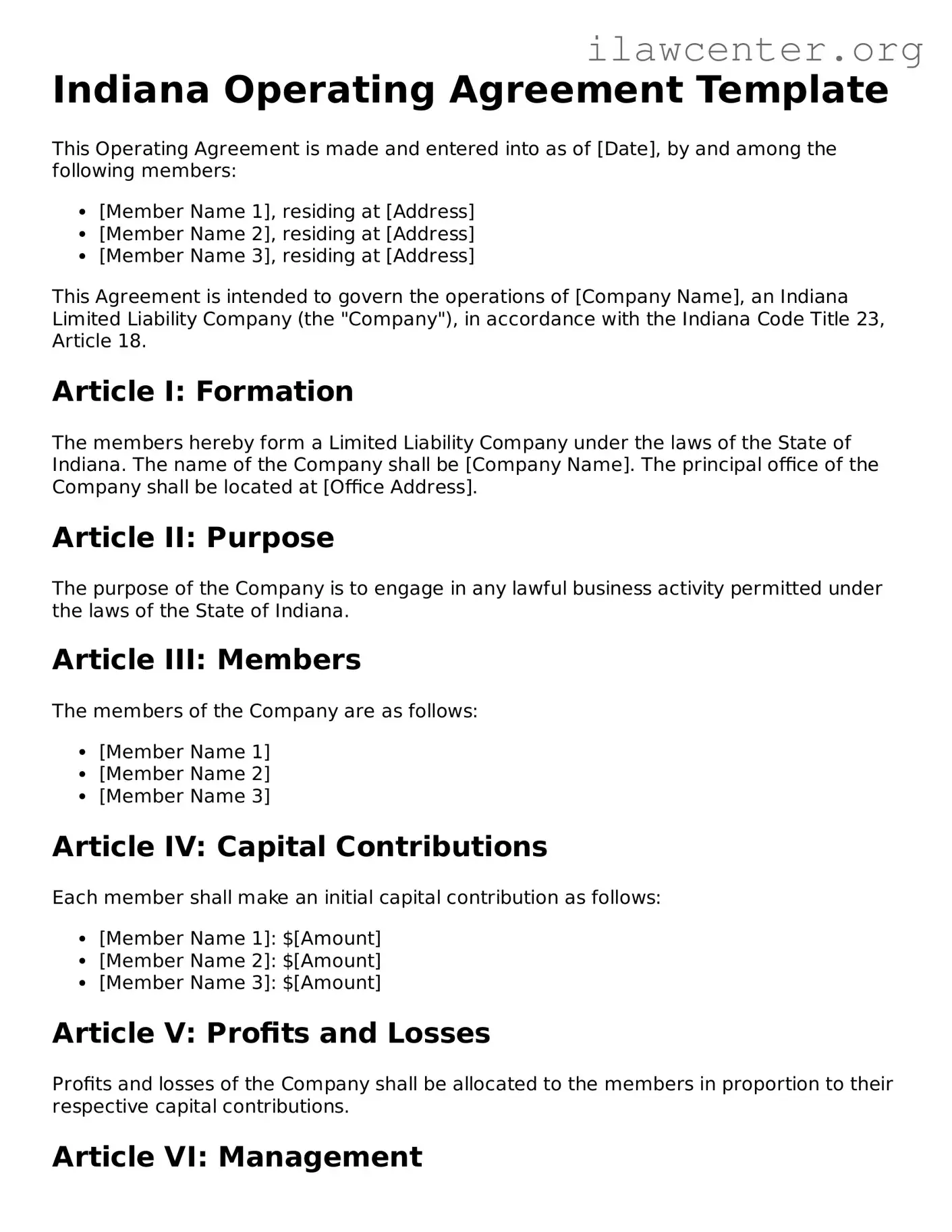
Indiana Operating Agreement Preview

Indiana Operating Agreement Template

This Operating Agreement is made and entered into as of [Date], by and among the following members:

  • [Member Name 1], residing at [Address]
  • [Member Name 2], residing at [Address]
  • [Member Name 3], residing at [Address]

This Agreement is intended to govern the operations of [Company Name], an Indiana Limited Liability Company (the "Company"), in accordance with the Indiana Code Title 23, Article 18.

Article I: Formation

The members hereby form a Limited Liability Company under the laws of the State of Indiana. The name of the Company shall be [Company Name]. The principal office of the Company shall be located at [Office Address].

Article II: Purpose

The purpose of the Company is to engage in any lawful business activity permitted under the laws of the State of Indiana.

Article III: Members

The members of the Company are as follows:

  • [Member Name 1]
  • [Member Name 2]
  • [Member Name 3]

Article IV: Capital Contributions

Each member shall make an initial capital contribution as follows:

  • [Member Name 1]: $[Amount]
  • [Member Name 2]: $[Amount]
  • [Member Name 3]: $[Amount]

Article V: Profits and Losses

Profits and losses of the Company shall be allocated to the members in proportion to their respective capital contributions.

Article VI: Management

The management of the Company shall be vested in the members. Decisions shall be made by a majority vote of the members.

Article VII: Indemnification

The Company shall indemnify its members and managers to the fullest extent permitted by Indiana law.

Article VIII: Amendments

This Operating Agreement may be amended only by a written agreement signed by all members.

Article IX: Governing Law

This Agreement shall be governed by and construed in accordance with the laws of the State of Indiana.

IN WITNESS WHEREOF, the members have executed this Operating Agreement as of the date first above written.

__________________________

[Member Name 1]

__________________________

[Member Name 2]

__________________________

[Member Name 3]

PDF Form Characteristics

Fact Name Details
Purpose The Indiana Operating Agreement outlines the management structure and operational procedures of a limited liability company (LLC).
Governing Law This agreement is governed by the Indiana Code Title 23, Article 18, which pertains to LLCs.
Members All members of the LLC should sign the Operating Agreement to ensure mutual understanding and agreement.
Flexibility The agreement allows for flexibility in management, enabling members to define roles and responsibilities as they see fit.
Amendments Members can amend the Operating Agreement, but it typically requires a majority vote or unanimous consent, depending on the terms set forth in the agreement.
Not Mandatory While an Operating Agreement is not legally required in Indiana, it is highly recommended for clarity and protection of member interests.

Instructions on Utilizing Indiana Operating Agreement

Filling out the Indiana Operating Agreement form is an important step in establishing the structure and rules for your business. Once completed, you can move forward with your business operations, ensuring clarity among members regarding their rights and responsibilities.

  1. Begin by downloading the Indiana Operating Agreement form from a reliable source.
  2. Read through the entire form to familiarize yourself with the required information.
  3. Fill in the name of your business at the top of the form.
  4. Provide the principal office address of the business.
  5. List the names and addresses of all members involved in the business.
  6. Specify the percentage of ownership for each member.
  7. Detail the management structure, indicating whether it will be member-managed or manager-managed.
  8. Outline the voting rights of each member, including how decisions will be made.
  9. Include provisions for the distribution of profits and losses among members.
  10. Address the process for adding new members or removing existing ones.
  11. Sign and date the form at the bottom, ensuring all members do the same.

After completing the form, retain a copy for your records and distribute copies to all members. This document will serve as a foundational agreement as your business begins operations.

Important Facts about Indiana Operating Agreement

What is an Indiana Operating Agreement?

An Indiana Operating Agreement is a legal document that outlines the management structure and operating procedures of a Limited Liability Company (LLC) in Indiana. This agreement serves as a blueprint for how the LLC will be run, detailing the rights and responsibilities of its members and managers.

Is an Operating Agreement required in Indiana?

No, Indiana does not legally require LLCs to have an Operating Agreement. However, having one is highly recommended. It helps clarify the roles of members, reduces the risk of disputes, and can provide protections in legal situations.

What should be included in an Indiana Operating Agreement?

An Operating Agreement should typically include details such as the LLC's name, purpose, and duration. It should outline the management structure, member contributions, profit-sharing arrangements, and procedures for adding or removing members. Additionally, it may cover dispute resolution methods and what happens if a member leaves the LLC.

Can I create my own Operating Agreement?

Yes, you can create your own Operating Agreement. Many templates are available online that can help guide you through the process. However, it is wise to consult with a legal professional to ensure that your agreement meets all necessary requirements and adequately protects your interests.

How does an Operating Agreement affect liability protection?

An Operating Agreement can reinforce the liability protection that an LLC provides. By clearly defining the roles and responsibilities of members, it helps demonstrate that the LLC operates as a separate entity. This separation can be crucial in protecting personal assets from business debts and liabilities.

Can the Operating Agreement be changed after it's created?

Yes, an Operating Agreement can be amended after it has been created. Most agreements include a section outlining the process for making changes, which typically requires a vote or agreement from the members. Keeping the Operating Agreement up-to-date is essential for reflecting any changes in the business structure or membership.

What happens if there is no Operating Agreement?

If an LLC does not have an Operating Agreement, it will be governed by Indiana's default LLC laws. These laws may not align with the members' intentions and could lead to misunderstandings or disputes. Without a clear agreement, resolving conflicts can become more complicated and may require legal intervention.

How do I file my Operating Agreement with the state?

You do not need to file your Operating Agreement with the state of Indiana. It is an internal document meant for the members of the LLC. However, it is advisable to keep it in a safe place and have copies accessible to all members.

Is it necessary to notarize the Operating Agreement?

Notarization is not required for an Operating Agreement in Indiana. However, having the document notarized can add an extra layer of authenticity and may be beneficial if disputes arise in the future.

Where can I find a template for an Indiana Operating Agreement?

Templates for Indiana Operating Agreements can be found online through various legal websites, business formation services, and state resources. While templates can provide a good starting point, it is advisable to customize the agreement to fit your specific needs and consult with a legal professional for guidance.
Common mistakes

Filling out the Indiana Operating Agreement form can be a crucial step for business owners. However, several common mistakes can lead to complications down the line. Understanding these pitfalls can help ensure that the agreement serves its intended purpose effectively.

One frequent mistake is failing to specify the management structure. Many individuals overlook the importance of clearly defining whether the business will be managed by members or designated managers. This oversight can create confusion regarding decision-making authority and responsibilities.

Another common error is inadequately outlining member contributions. It is essential to detail what each member is contributing to the business, whether it be capital, property, or services. Without this clarity, disputes may arise regarding ownership percentages and profit distribution.

Some individuals neglect to include a buy-sell agreement within the Operating Agreement. This clause is vital for outlining the procedures for transferring ownership interests in the event of a member's departure or death. Omitting this can lead to complications and conflicts among remaining members.

Additionally, many people fail to address the dissolution process. It is important to have a clear plan for how the business will be dissolved if necessary. Without this, members may find themselves in a difficult situation when deciding how to wind down operations.

Another mistake involves not updating the agreement as the business evolves. Changes in membership, business structure, or operations should prompt a review and revision of the Operating Agreement. Failing to keep the document current can lead to misunderstandings and legal issues.

Some individuals also make the mistake of overlooking state-specific requirements. Each state has its own regulations regarding Operating Agreements. Ignoring these can result in an agreement that is not compliant with Indiana law, potentially jeopardizing the business's legal standing.

Lastly, many people do not seek legal advice when drafting their Operating Agreement. While templates are available, they may not address the unique needs of every business. Consulting with a legal professional can provide tailored guidance, ensuring that the agreement is comprehensive and enforceable.

Documents used along the form

When forming a limited liability company (LLC) in Indiana, several documents complement the Indiana Operating Agreement. Each of these documents serves a specific purpose in establishing and maintaining your business. Below is a list of commonly used forms and documents.

  • Articles of Organization: This document officially registers your LLC with the state. It includes basic information such as the name of the LLC, its address, and the names of its members.
  • Employer Identification Number (EIN) Application: Obtaining an EIN from the IRS is essential for tax purposes. This number is used to identify your business for federal tax filings.
  • Member Consent Forms: These forms document the approval of decisions made by the members of the LLC. They provide a written record of member agreements and decisions.
  • Bylaws: While not always required, bylaws outline the internal rules and procedures for the LLC. They cover topics such as member meetings and voting rights.
  • Membership Certificates: These certificates serve as proof of ownership in the LLC. They can be issued to members to signify their stake in the business.
  • Meeting Minutes: Documenting the minutes of member meetings is crucial. These records provide a summary of discussions and decisions made during meetings.
  • Operating Procedures: This document details the day-to-day operations of the LLC. It can include policies on finances, member responsibilities, and dispute resolution.
  • Amendment Forms: If any changes need to be made to the Operating Agreement or Articles of Organization, amendment forms are necessary to officially document those changes.
  • Tax Forms: Depending on the structure of your LLC, various tax forms may be required for state and federal filings. These ensure compliance with tax regulations.

Utilizing these documents alongside the Indiana Operating Agreement helps establish a solid foundation for your LLC. Proper documentation not only ensures compliance with state laws but also promotes clear communication among members.

Similar forms

The Operating Agreement is an essential document for LLCs, outlining the management structure and operational procedures. It shares similarities with several other important documents. Here’s a list of those documents and how they relate to the Operating Agreement:

  • Bylaws: Bylaws serve a similar purpose for corporations, detailing how the company will be governed. They outline the roles of officers, meeting procedures, and voting rights, much like an Operating Agreement does for an LLC.
  • Partnership Agreement: This document governs the relationships between partners in a partnership. It specifies each partner's responsibilities, profit-sharing arrangements, and dispute resolution processes, paralleling the structure of an Operating Agreement.
  • Shareholder Agreement: For corporations, a Shareholder Agreement outlines the rights and obligations of shareholders. It covers issues like share transfers and voting, akin to how an Operating Agreement addresses member rights and responsibilities.
  • Joint Venture Agreement: This agreement is used when two or more parties collaborate on a specific project. It details the contributions, responsibilities, and profit-sharing, similar to how an Operating Agreement defines member roles and contributions in an LLC.
  • Franchise Agreement: A Franchise Agreement outlines the relationship between a franchisor and franchisee. It includes operational procedures and obligations, echoing the governance and operational guidelines found in an Operating Agreement.
  • Employment Agreement: This document establishes the terms of employment between an employer and employee. It covers duties, compensation, and termination, paralleling how an Operating Agreement defines the roles and responsibilities of LLC members.
  • Non-Disclosure Agreement (NDA): While primarily focused on confidentiality, an NDA can include operational aspects regarding proprietary information. This can relate to an Operating Agreement’s provisions on protecting company secrets and intellectual property.
  • Asset Purchase Agreement: This document outlines the terms for purchasing assets from a business. It includes details about the assets, liabilities, and obligations, similar to how an Operating Agreement addresses the distribution of assets among members.

Dos and Don'ts

When filling out the Indiana Operating Agreement form, it is essential to approach the task with care and attention to detail. Below is a list of things you should and shouldn't do during this process.

  • Do read the instructions carefully before starting.
  • Do provide accurate and complete information.
  • Do include the names of all members and their respective roles.
  • Do specify the management structure clearly.
  • Don't leave any sections blank unless instructed.
  • Don't use vague language that could lead to misunderstandings.
  • Don't forget to review the document for errors before submission.
  • Don't overlook the importance of signatures from all members.

Misconceptions

When it comes to the Indiana Operating Agreement form, several misconceptions can lead to confusion among business owners and stakeholders. Understanding these myths is crucial for ensuring proper compliance and effective business operations. Below is a list of common misconceptions about the Indiana Operating Agreement form, along with explanations to clarify the facts.

  • 1. An Operating Agreement is not necessary for all LLCs. Many people believe that an Operating Agreement is optional for all Limited Liability Companies (LLCs). However, while Indiana does not require an Operating Agreement by law, having one is highly advisable as it outlines the management structure and operational procedures of the LLC.
  • 2. An Operating Agreement can only be created by lawyers. Some individuals think that only legal professionals can draft an Operating Agreement. In reality, any member of the LLC can create this document. While legal assistance can be beneficial, it is not a strict requirement.
  • 3. The Operating Agreement is a public document. A common belief is that the Operating Agreement must be filed with the state and thus becomes a public record. In Indiana, this is not the case; the Operating Agreement is an internal document that does not need to be submitted to the state.
  • 4. All members must sign the Operating Agreement. Some assume that every member of the LLC must sign the Operating Agreement for it to be valid. While it is a good practice to have all members sign, the agreement can still be enforceable even if not all members have signed it, as long as it is agreed upon by the majority.
  • 5. The Operating Agreement cannot be changed once created. Many believe that once an Operating Agreement is established, it cannot be modified. In fact, members can amend the Operating Agreement as needed, provided they follow the procedures outlined within the document itself.
  • 6. An Operating Agreement only covers financial matters. Some think that the Operating Agreement is solely focused on financial aspects like profit distribution. However, it also addresses management roles, decision-making processes, and member responsibilities, making it a comprehensive governance document.
  • 7. The Operating Agreement is irrelevant if the LLC has only one member. A misconception exists that a single-member LLC does not need an Operating Agreement. However, even for single-member LLCs, having an Operating Agreement can help clarify the owner’s intentions and protect personal assets.
  • 8. Verbal agreements can replace a written Operating Agreement. Some individuals believe that verbal agreements among members can substitute for a written Operating Agreement. This is risky, as verbal agreements can lead to misunderstandings and disputes that are difficult to resolve without a formal document.

By addressing these misconceptions, business owners can better understand the importance of the Indiana Operating Agreement form and ensure that their LLC operates smoothly and in accordance with their goals.

Key takeaways

When filling out and using the Indiana Operating Agreement form, it's essential to keep several key points in mind. This document serves as a foundational element for your business, outlining how it will operate and the roles of its members. Here are some important takeaways:

  • Understand the Purpose: The Operating Agreement is crucial for outlining the management structure and operational procedures of your business.
  • Define Member Roles: Clearly specify the roles and responsibilities of each member to avoid confusion and ensure accountability.
  • Include Profit Distribution: Detail how profits and losses will be shared among members. This clarity helps prevent disputes down the line.
  • Address Decision-Making: Establish how decisions will be made, whether by majority vote or unanimous consent, to streamline operations.
  • Plan for Changes: Include provisions for adding new members or handling the departure of existing ones, ensuring smooth transitions.
  • Compliance with State Laws: Ensure that your Operating Agreement complies with Indiana state laws to maintain its validity and enforceability.
  • Review and Update Regularly: As your business evolves, revisit the Operating Agreement to make necessary adjustments reflecting current operations and member dynamics.

By focusing on these key elements, you can create a comprehensive Operating Agreement that supports the long-term success of your business in Indiana.