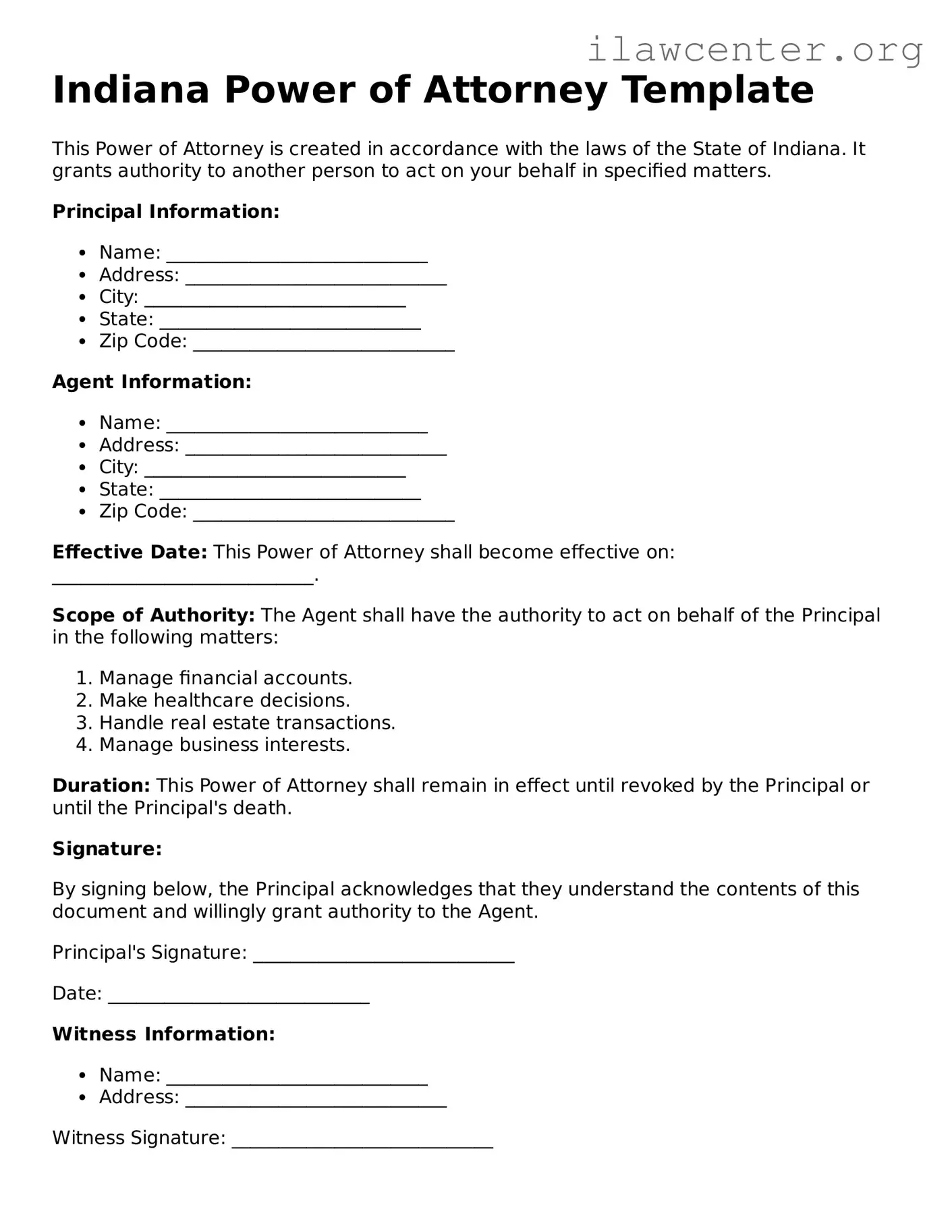
What is a Power of Attorney in Indiana?
A Power of Attorney (POA) in Indiana is a legal document that allows one person, known as the principal, to grant another person, referred to as the agent or attorney-in-fact, the authority to make decisions on their behalf. This authority can be limited to specific tasks or can be broad, covering a wide range of decisions, including financial and medical matters. The POA can be effective immediately or can be set to become effective at a future date or upon the occurrence of a specific event, such as the principal becoming incapacitated.
What types of Power of Attorney are available in Indiana?
Indiana recognizes several types of Power of Attorney forms. The most common are the General Power of Attorney, which grants broad powers to the agent, and the Limited Power of Attorney, which restricts the agent's authority to specific tasks or timeframes. Additionally, there is a Durable Power of Attorney, which remains effective even if the principal becomes incapacitated, and a Healthcare Power of Attorney, which specifically allows the agent to make medical decisions on behalf of the principal if they are unable to do so.
How do I create a Power of Attorney in Indiana?
To create a Power of Attorney in Indiana, the principal must complete a written document that clearly outlines the powers granted to the agent. The document must be signed by the principal in the presence of a notary public. While witnesses are not required, having them can provide additional validation. It is advisable to use a form that complies with Indiana state law to ensure that it is valid and enforceable. Once completed, the principal should provide copies to the agent and any relevant institutions, such as banks or healthcare providers.
Can I revoke a Power of Attorney in Indiana?
Yes, a principal can revoke a Power of Attorney at any time as long as they are competent to do so. The revocation must be in writing and should be signed by the principal. It is important to notify the agent and any institutions that were relying on the original Power of Attorney about the revocation to prevent any unauthorized actions by the agent. If the Power of Attorney was recorded with a county recorder, the revocation should also be recorded to ensure public notice.
What happens if the principal becomes incapacitated?
If the principal becomes incapacitated and has executed a Durable Power of Attorney, the agent can continue to act on behalf of the principal. This is one of the primary benefits of a Durable Power of Attorney, as it allows for seamless decision-making during periods of incapacity. If a non-durable Power of Attorney was executed, it would become void upon the principal’s incapacitation. In such cases, a court may need to appoint a guardian to make decisions for the incapacitated individual.