Attorney-Verified  Prenuptial Agreement Document for Indiana

Attorney-Verified Prenuptial Agreement Document for Indiana

A prenuptial agreement form in Indiana is a legal document that outlines the financial and property rights of each spouse before marriage. This agreement can help clarify expectations and protect assets in the event of a divorce. To get started on your prenuptial agreement, fill out the form by clicking the button below.

Article Guide

Prenuptial agreements, often referred to as prenups, play a crucial role in outlining the financial and personal arrangements between couples before they enter into marriage. In Indiana, the Prenuptial Agreement form serves as a legal document that helps partners define their rights and responsibilities regarding property, debts, and other financial matters. This form allows individuals to specify how assets will be divided in the event of a divorce or separation, thus providing clarity and reducing potential conflicts. Additionally, it may address spousal support and other relevant issues, ensuring that both parties have a mutual understanding of their financial expectations. By establishing these terms in advance, couples can foster open communication and create a solid foundation for their future together. Understanding the key components of the Indiana Prenuptial Agreement form is essential for anyone considering this proactive approach to marital planning.

Indiana Prenuptial Agreement Preview

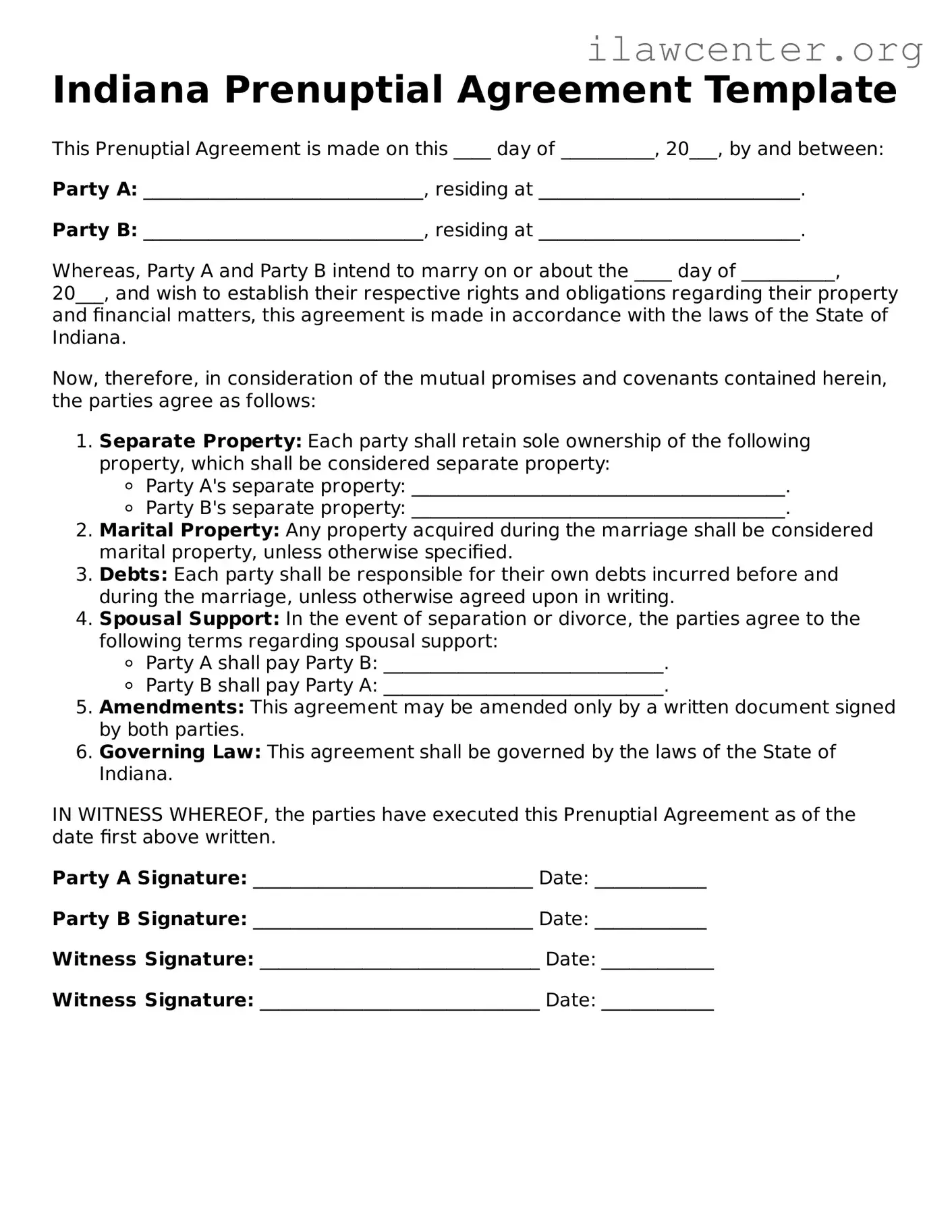
Indiana Prenuptial Agreement Template

This Prenuptial Agreement is made on this ____ day of __________, 20___, by and between:

Party A: ______________________________, residing at ____________________________.

Party B: ______________________________, residing at ____________________________.

Whereas, Party A and Party B intend to marry on or about the ____ day of __________, 20___, and wish to establish their respective rights and obligations regarding their property and financial matters, this agreement is made in accordance with the laws of the State of Indiana.

Now, therefore, in consideration of the mutual promises and covenants contained herein, the parties agree as follows:

  1. Separate Property: Each party shall retain sole ownership of the following property, which shall be considered separate property:
    • Party A's separate property: ________________________________________.
    • Party B's separate property: ________________________________________.
  2. Marital Property: Any property acquired during the marriage shall be considered marital property, unless otherwise specified.
  3. Debts: Each party shall be responsible for their own debts incurred before and during the marriage, unless otherwise agreed upon in writing.
  4. Spousal Support: In the event of separation or divorce, the parties agree to the following terms regarding spousal support:
    • Party A shall pay Party B: ______________________________.
    • Party B shall pay Party A: ______________________________.
  5. Amendments: This agreement may be amended only by a written document signed by both parties.
  6. Governing Law: This agreement shall be governed by the laws of the State of Indiana.

IN WITNESS WHEREOF, the parties have executed this Prenuptial Agreement as of the date first above written.

Party A Signature: ______________________________ Date: ____________

Party B Signature: ______________________________ Date: ____________

Witness Signature: ______________________________ Date: ____________

Witness Signature: ______________________________ Date: ____________

PDF Form Characteristics

Fact Name Description
Definition An Indiana Prenuptial Agreement is a legal document created by two parties before marriage to outline the division of assets and financial responsibilities in case of divorce or separation.
Governing Law Indiana Code Title 31, Article 11 governs prenuptial agreements in Indiana.
Written Requirement The agreement must be in writing to be enforceable in court.
Voluntary Agreement Both parties must enter into the agreement voluntarily, without coercion or undue influence.
Full Disclosure Each party must fully disclose their assets and debts for the agreement to be valid.
Legal Representation While not required, it is advisable for each party to have independent legal counsel to ensure their interests are protected.
Modification The agreement can be modified or revoked at any time by mutual consent, provided it is documented in writing.
Enforceability Courts may not enforce provisions that are deemed unconscionable or unfair at the time of enforcement.
Duration The agreement remains in effect throughout the marriage unless otherwise specified or revoked.

Instructions on Utilizing Indiana Prenuptial Agreement

Filling out the Indiana Prenuptial Agreement form is an important step for couples considering marriage. This process allows you to outline your financial rights and responsibilities before tying the knot. To ensure everything is completed accurately, follow the steps outlined below.

  1. Begin by downloading the Indiana Prenuptial Agreement form from a reliable source.
  2. Read through the entire form carefully to understand each section and what information is required.
  3. In the first section, fill in the full names of both parties involved in the agreement.
  4. Provide the current addresses for both individuals, ensuring accuracy for legal purposes.
  5. Next, indicate the date of the marriage or the anticipated marriage date.
  6. In the financial disclosure section, list all assets and liabilities for both parties. Be thorough to avoid any misunderstandings later.
  7. Include any specific terms or conditions you wish to establish regarding property division, spousal support, or other financial matters.
  8. Once all sections are filled out, review the document for any errors or omissions.
  9. Both parties should sign the form in the presence of a notary public to ensure its validity.
  10. Make copies of the signed agreement for both parties to keep for their records.

After completing the form, it's advisable to discuss the contents with a legal professional to ensure that it meets all necessary requirements and adequately protects both parties' interests.

Important Facts about Indiana Prenuptial Agreement

What is a prenuptial agreement in Indiana?

A prenuptial agreement, often referred to as a "prenup," is a legal document created by two individuals before they marry. In Indiana, this agreement outlines the division of assets and responsibilities in the event of divorce or separation. It can also address issues such as spousal support and the management of debts. This agreement helps both parties understand their rights and obligations, promoting transparency and reducing potential conflicts in the future.

What should be included in an Indiana prenuptial agreement?

In Indiana, a prenuptial agreement can cover various topics, including the distribution of property, management of debts, and spousal support. It's also advisable to include provisions about how to handle any future income or assets acquired during the marriage. Each couple's situation is unique, so tailoring the agreement to fit specific needs and circumstances is essential. Consulting with a legal expert can help ensure all necessary elements are included.

Is a prenuptial agreement enforceable in Indiana?

Yes, a prenuptial agreement is enforceable in Indiana as long as it meets certain legal requirements. The agreement must be in writing, signed by both parties, and executed voluntarily without coercion. Additionally, both parties should fully disclose their financial situations before signing. If these conditions are met, the agreement is likely to be upheld in court.

Can a prenuptial agreement be modified or revoked in Indiana?

Yes, a prenuptial agreement can be modified or revoked in Indiana. Both parties must agree to any changes, and these modifications should be documented in writing and signed by both individuals. It is advisable to follow the same formalities as the original agreement to ensure the changes are legally binding.

Do I need a lawyer to create a prenuptial agreement in Indiana?

While it is not legally required to have a lawyer when creating a prenuptial agreement in Indiana, it is highly recommended. A legal expert can help ensure that the agreement complies with state laws and accurately reflects the intentions of both parties. Having independent legal counsel can also provide additional protection and help prevent disputes in the future.

When should we start discussing a prenuptial agreement?

It is best to start discussing a prenuptial agreement well in advance of the wedding date. Engaging in these conversations early allows both parties to express their thoughts and concerns openly. This proactive approach can help foster a sense of trust and collaboration, making it easier to reach an agreement that satisfies both individuals.

What happens if we don’t have a prenuptial agreement?

If a couple does not have a prenuptial agreement in place, Indiana's default divorce laws will govern the division of assets and debts in the event of separation or divorce. This could lead to outcomes that may not align with either party's preferences. Without a prenup, the court will determine how to divide property and whether spousal support is warranted, which may result in lengthy and costly legal battles.
Common mistakes

Filling out a prenuptial agreement form in Indiana can be a straightforward process, but many people make common mistakes that can lead to complications down the road. One frequent error is failing to provide complete and accurate information about assets and debts. It is crucial to list all properties, bank accounts, and liabilities to ensure transparency between both parties.

Another mistake is not considering future financial changes. Couples often focus solely on their current financial situation, neglecting to discuss how their finances might evolve over time. This oversight can create misunderstandings later, especially if one partner's income increases or if they acquire significant assets after marriage.

Many individuals also overlook the importance of legal counsel. While it might seem cost-effective to fill out the form without assistance, having an attorney review the agreement can help identify potential issues and ensure that both parties' rights are protected. Legal advice can clarify the implications of various terms and conditions included in the agreement.

Additionally, some people forget to discuss the prenuptial agreement with their partner before signing. Open communication is vital to a healthy relationship, and discussing the agreement can help both parties feel more comfortable with its terms. Without this conversation, one partner may feel blindsided or unfairly treated.

Another common error is not signing the document in front of a notary. In Indiana, notarization is essential for the agreement to be legally binding. Failing to have the agreement notarized can lead to disputes about its validity in the future.

People sometimes also forget to include a clause regarding how disputes will be resolved. This can lead to confusion and conflict if disagreements arise later. Establishing a clear process for resolving disputes can save both parties time and stress.

Some couples make the mistake of not updating their prenuptial agreement after significant life changes, such as the birth of a child or a substantial change in income. Regularly reviewing and updating the agreement ensures that it remains relevant and fair for both parties.

Another pitfall is using vague language in the agreement. Clear and specific terms are essential to avoid misunderstandings. Ambiguities can lead to disputes over interpretation, which can be costly and time-consuming to resolve.

Lastly, individuals often underestimate the emotional aspect of signing a prenuptial agreement. It is important to approach the conversation with empathy and understanding. A prenuptial agreement should not feel like a lack of trust but rather a way to protect both parties and their future together.

Documents used along the form

Prenuptial agreements are essential tools for couples planning to marry, especially when it comes to protecting individual assets and clarifying financial responsibilities. Alongside the Indiana Prenuptial Agreement form, several other documents often come into play to ensure a comprehensive understanding of the couple's financial situation and intentions. Here are five important documents that are frequently used in conjunction with a prenuptial agreement:

  • Financial Disclosure Statement: This document outlines each party's assets, liabilities, income, and expenses. Transparency is crucial in prenuptial agreements, and this statement helps ensure that both partners are fully informed about each other's financial standing.
  • Postnuptial Agreement: Similar to a prenuptial agreement, a postnuptial agreement is created after marriage. It can address changes in circumstances or clarify financial matters that may have arisen since the wedding.
  • Separation Agreement: This document is used when a couple decides to separate but not yet divorce. It details the terms of the separation, including asset division, spousal support, and child custody arrangements.
  • Divorce Settlement Agreement: If a marriage ends, this document outlines the terms agreed upon by both parties regarding the division of assets, debts, and any support obligations. It serves to finalize the divorce process.
  • Will: While not directly related to prenuptial agreements, having a will is crucial for any married couple. It specifies how assets should be distributed upon death and can help avoid disputes later on.

Understanding these documents can greatly enhance the clarity and effectiveness of a prenuptial agreement. Couples are encouraged to consult with legal professionals to ensure that their agreements and accompanying documents align with their specific needs and state laws.

Similar forms

A Prenuptial Agreement is a legal document that outlines the terms of a couple's financial arrangements before marriage. Several other documents serve similar purposes, focusing on financial and property matters. Here are ten documents that share similarities with a Prenuptial Agreement:

  • Postnuptial Agreement: This document is created after marriage and addresses similar financial issues as a prenuptial agreement, often reflecting changes in circumstances.
  • Separation Agreement: When couples decide to separate, this agreement outlines the division of assets and responsibilities, similar to a prenuptial agreement.
  • Divorce Settlement Agreement: This document finalizes the terms of a divorce, including asset division and support obligations, much like a prenuptial agreement but after the marriage has ended.
  • Living Together Agreement: For unmarried couples, this document sets out the financial and property arrangements, akin to a prenuptial agreement for those planning to marry.
  • Property Settlement Agreement: Often part of divorce proceedings, this agreement details how property will be divided, similar to the provisions in a prenuptial agreement.
  • Trust Agreement: This document establishes a trust for managing assets, which can be related to the financial planning aspects of a prenuptial agreement.
  • Will: While primarily a document for posthumous asset distribution, a will can include provisions for spousal rights and property, similar to a prenuptial agreement.
  • Power of Attorney: This document allows one person to make financial decisions for another, which can intersect with the financial considerations of a prenuptial agreement.
  • Business Partnership Agreement: For couples in business together, this agreement outlines ownership and profit-sharing, similar to how a prenuptial agreement addresses financial interests.
  • Debt Agreement: This document specifies how debts will be handled, reflecting the financial responsibilities that a prenuptial agreement also addresses.

Dos and Don'ts

When filling out the Indiana Prenuptial Agreement form, it's important to approach the process thoughtfully. Here are some key do's and don'ts to keep in mind:

  • Do be honest about your financial situation. Disclose all assets, debts, and income to ensure transparency.
  • Do consult with a legal professional. Getting advice can help clarify your rights and obligations.
  • Don't rush the process. Take your time to review the agreement carefully and make sure it reflects your intentions.
  • Don't leave out important details. Omitting information can lead to misunderstandings or disputes later on.

Misconceptions

Many people have misunderstandings about prenuptial agreements in Indiana. Here are eight common misconceptions:

  1. Prenuptial agreements are only for the wealthy.

    This is not true. Prenuptial agreements can benefit anyone who wants to protect their assets or clarify financial responsibilities, regardless of their income level.

  2. They are only for divorce situations.

    Prenuptial agreements can also help couples define their financial expectations during marriage, not just in the event of a divorce.

  3. They are difficult to enforce.

    When properly drafted and executed, prenuptial agreements are generally enforceable in Indiana courts.

  4. Only one partner needs a lawyer.

    It is advisable for both partners to seek independent legal advice to ensure that the agreement is fair and fully understood by both parties.

  5. Prenuptial agreements are permanent and cannot be changed.

    Couples can modify or revoke a prenuptial agreement at any time, provided both parties agree to the changes.

  6. They can cover any topic.

    Prenuptial agreements cannot address child custody or child support, as these issues are determined based on the best interests of the child at the time of divorce.

  7. They create distrust between partners.

    On the contrary, discussing a prenuptial agreement can foster open communication about finances and expectations, strengthening the relationship.

  8. Prenuptial agreements are only for heterosexual couples.

    Indiana law recognizes prenuptial agreements for all couples, regardless of sexual orientation.

Key takeaways

When considering a prenuptial agreement in Indiana, it is important to understand several key aspects of the process. Below are five essential takeaways regarding the Indiana Prenuptial Agreement form.

  1. Voluntary Agreement: Both parties must enter into the agreement voluntarily. Coercion or undue pressure can render the agreement invalid.
  2. Full Disclosure: Each party should provide complete financial disclosure. This includes assets, debts, and income to ensure fairness and transparency.
  3. Written Document: The prenuptial agreement must be in writing. Oral agreements are not enforceable in Indiana.
  4. Legal Review: It is advisable for each party to seek independent legal counsel. This helps ensure that both parties understand their rights and the implications of the agreement.
  5. Enforceability: The agreement can be enforced by the courts if it meets legal requirements. Courts will review for fairness and clarity at the time of enforcement.

Understanding these points can help in the successful preparation and execution of a prenuptial agreement in Indiana.