Attorney-Verified  Quitclaim Deed Document for Indiana

Attorney-Verified Quitclaim Deed Document for Indiana

A Quitclaim Deed is a legal document that allows a property owner to transfer their interest in a property to another party without making any guarantees about the title. This form is commonly used in Indiana for various purposes, such as transferring property between family members or clearing up title issues. To ensure a smooth transfer, consider filling out the Indiana Quitclaim Deed form by clicking the button below.

Article Guide

When it comes to transferring property ownership in Indiana, the Quitclaim Deed form stands out as a straightforward and efficient tool. This legal document allows one party, known as the grantor, to convey their interest in a property to another party, called the grantee, without making any promises about the title's validity. This means that the grantor is not guaranteeing that they own the property free and clear of any liens or encumbrances. The simplicity of the Quitclaim Deed makes it particularly useful in various situations, such as transferring property between family members, settling estates, or clearing up title issues. However, while the form is easy to understand, it is crucial for both parties to be aware of their rights and responsibilities. Properly completing and recording the Quitclaim Deed can ensure a smooth transition of ownership and help avoid potential disputes down the line. Understanding the nuances of this form can empower individuals to make informed decisions about their property transactions in Indiana.

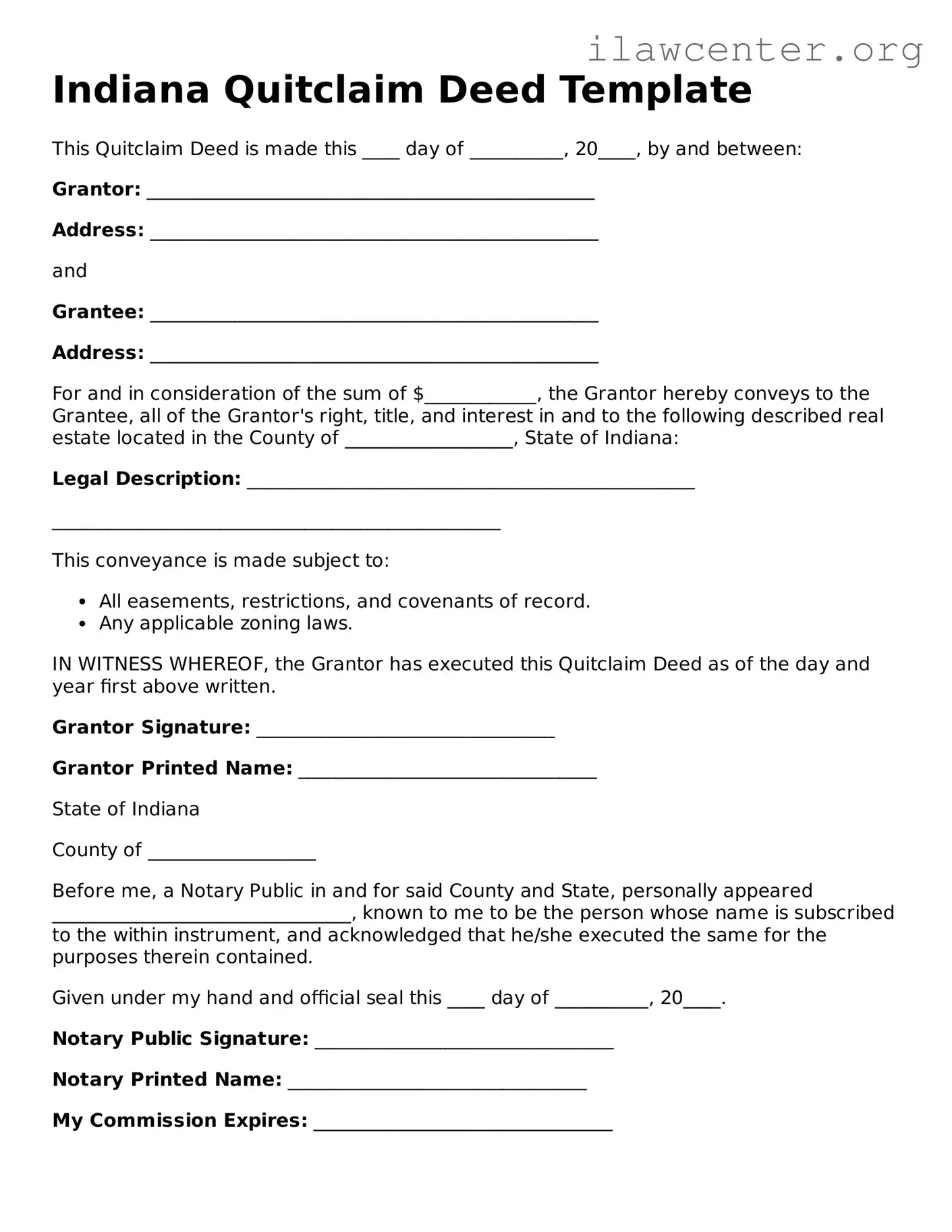
Indiana Quitclaim Deed Preview

Indiana Quitclaim Deed Template

This Quitclaim Deed is made this ____ day of __________, 20____, by and between:

Grantor: ________________________________________________

Address: ________________________________________________

and

Grantee: ________________________________________________

Address: ________________________________________________

For and in consideration of the sum of $____________, the Grantor hereby conveys to the Grantee, all of the Grantor's right, title, and interest in and to the following described real estate located in the County of __________________, State of Indiana:

Legal Description: ________________________________________________

________________________________________________

This conveyance is made subject to:

  • All easements, restrictions, and covenants of record.
  • Any applicable zoning laws.

IN WITNESS WHEREOF, the Grantor has executed this Quitclaim Deed as of the day and year first above written.

Grantor Signature: ________________________________

Grantor Printed Name: ________________________________

State of Indiana

County of __________________

Before me, a Notary Public in and for said County and State, personally appeared ________________________________, known to me to be the person whose name is subscribed to the within instrument, and acknowledged that he/she executed the same for the purposes therein contained.

Given under my hand and official seal this ____ day of __________, 20____.

Notary Public Signature: ________________________________

Notary Printed Name: ________________________________

My Commission Expires: ________________________________

PDF Form Characteristics

Fact Name Description
Definition A Quitclaim Deed is a legal instrument used to transfer interest in real property from one party to another without any warranties.
Governing Law The use of Quitclaim Deeds in Indiana is governed by Indiana Code Title 32, Article 21.
No Warranty Unlike other types of deeds, a Quitclaim Deed does not guarantee that the grantor has valid ownership of the property being transferred.
Common Uses These deeds are often used among family members, in divorce settlements, or to clear up title issues.
Form Requirements In Indiana, a Quitclaim Deed must be in writing, signed by the grantor, and notarized to be valid.
Recording To provide public notice of the transfer, the Quitclaim Deed should be recorded with the county recorder's office where the property is located.

Instructions on Utilizing Indiana Quitclaim Deed

After completing the Indiana Quitclaim Deed form, the next step is to ensure that it is signed and notarized. This will help in the proper recording of the deed with the county recorder's office. Following the completion of the form, you will need to take care of a few additional steps to finalize the process.

  1. Obtain the Indiana Quitclaim Deed form. This can typically be found online or at your local county recorder's office.
  2. Fill in the name of the grantor (the person transferring the property) in the designated space. Ensure the name is accurate and matches the title of the property.
  3. Enter the name of the grantee (the person receiving the property). Double-check the spelling and ensure it is correct.
  4. Provide the legal description of the property. This information can usually be found on the current deed or through your county's property records.
  5. Include the address of the property being transferred, if applicable.
  6. Indicate the date of the transaction. This is the date when the deed is signed.
  7. Have the grantor sign the form in the appropriate section. The signature must be handwritten.
  8. Schedule a meeting with a notary public to have the grantor's signature notarized. The notary will verify the identity of the grantor and witness the signing.
  9. Make copies of the completed and notarized Quitclaim Deed for your records.
  10. Submit the original Quitclaim Deed to the county recorder’s office for recording. Be prepared to pay any applicable recording fees.

Important Facts about Indiana Quitclaim Deed

What is a Quitclaim Deed in Indiana?

A Quitclaim Deed is a legal document used to transfer ownership of real estate in Indiana. It allows the grantor to convey their interest in the property to the grantee without making any guarantees about the title. This type of deed is commonly used among family members or in situations where the property’s title is not in dispute.

How does a Quitclaim Deed differ from a Warranty Deed?

The primary difference between a Quitclaim Deed and a Warranty Deed lies in the level of protection offered to the grantee. A Warranty Deed guarantees that the grantor holds clear title to the property and has the right to sell it. In contrast, a Quitclaim Deed does not provide such assurances, meaning the grantee may assume some risk regarding the property's title.

When should I use a Quitclaim Deed?

Quitclaim Deeds are often used in specific situations, such as transferring property between family members, adding or removing a spouse from the title after marriage or divorce, or transferring property into a trust. They are also used to clear up title issues or when the grantor is unsure of their ownership rights.

What information is required to complete a Quitclaim Deed in Indiana?

To complete a Quitclaim Deed in Indiana, the document must include the names of the grantor and grantee, a legal description of the property, the address of the property, and the date of the transfer. Additionally, the grantor must sign the deed in the presence of a notary public.

Is it necessary to have a lawyer to create a Quitclaim Deed?

While it is not legally required to have a lawyer draft a Quitclaim Deed, it is advisable to seek legal counsel, especially if there are complexities involved in the property transfer. A lawyer can help ensure that the deed is properly executed and that all legal requirements are met.

Do I need to file the Quitclaim Deed with the county?

Yes, in Indiana, a Quitclaim Deed must be filed with the county recorder’s office where the property is located. Filing the deed provides public notice of the transfer and updates the property records. There may be a filing fee associated with this process.

Are there any taxes associated with a Quitclaim Deed?

In Indiana, a Quitclaim Deed may be subject to transfer taxes, although exemptions can apply in certain situations, such as transfers between family members. It is important to check with local authorities to understand any applicable taxes or fees before completing the transfer.

Can a Quitclaim Deed be revoked?

A Quitclaim Deed cannot be revoked once it has been executed and recorded. However, the grantor may choose to create a new deed to transfer the property back or to another party. This process would involve the same steps as the original transfer.

What happens if the property has liens or debts?

When a Quitclaim Deed is executed, it does not remove any existing liens or debts associated with the property. The grantee assumes these obligations unless otherwise specified. It is crucial for the grantee to conduct due diligence to understand any financial encumbrances before accepting the property.
Common mistakes

Filling out the Indiana Quitclaim Deed form can be a straightforward process, but there are common mistakes that individuals often make. One significant error is not providing complete and accurate information about the property. Omitting details like the legal description or the property address can lead to confusion and potential legal issues down the line. It’s essential to double-check that all required fields are filled out correctly.

Another frequent mistake is failing to include the names of all parties involved. Both the grantor (the person transferring the property) and the grantee (the person receiving the property) must be clearly identified. If one party is left out, it could invalidate the deed. Always ensure that the names are spelled correctly and match the official documents.

People often overlook the need for notarization. A Quitclaim Deed in Indiana must be signed in front of a notary public. Without this step, the deed may not be legally recognized. It’s advisable to schedule a meeting with a notary before submitting the form to avoid any last-minute issues.

Additionally, some individuals forget to record the deed with the county recorder’s office. Simply filling out the form and signing it is not enough. Recording the deed is crucial as it provides public notice of the property transfer and protects the rights of the grantee. Failing to do this can lead to disputes over ownership.

Another mistake is not considering potential tax implications. While Quitclaim Deeds are often used to transfer property without money changing hands, they can still have tax consequences. It’s wise to consult with a tax professional to understand any potential liabilities that may arise from the transfer.

Lastly, people sometimes use outdated forms or incorrect versions of the Quitclaim Deed. Indiana may update its forms, and using an old version can lead to complications. Always check for the most current form on the official state website or consult with a legal professional to ensure compliance with current laws.

Documents used along the form

When transferring property ownership in Indiana, a Quitclaim Deed is often accompanied by several other forms and documents to ensure a smooth and legally sound transaction. Each of these documents serves a specific purpose, helping to clarify the details of the transfer and protect the interests of all parties involved.

  • Property Transfer Disclosure Form: This document provides essential information about the property being transferred. It may include details about the condition of the property, any known defects, and other relevant facts that the buyer should be aware of before completing the transaction.
  • Affidavit of Property Value: This affidavit helps to establish the fair market value of the property at the time of transfer. It is often required by local tax authorities to ensure accurate property tax assessments.
  • Title Search Report: A title search report is conducted to verify the ownership history of the property. This document identifies any liens, encumbrances, or other claims against the property that could affect the new owner’s rights.
  • Closing Statement: Also known as a settlement statement, this document outlines all the financial details of the transaction. It includes the purchase price, closing costs, and any adjustments that need to be made at the time of closing.
  • Grantor-Grantee Index: This index is a record of property transfers in the county. It lists the names of the individuals involved in the transaction and helps to maintain a public record of ownership changes.

Understanding these additional forms and documents can greatly enhance the property transfer process. They provide clarity and protect the interests of both the buyer and the seller, ensuring that all legal requirements are met and that the transaction proceeds smoothly.

Similar forms

A Quitclaim Deed is a legal document used to transfer ownership of property. Several other documents serve similar purposes or functions in real estate transactions. Here are six documents that are comparable to a Quitclaim Deed:

  • Warranty Deed: This document guarantees that the seller holds clear title to the property and has the right to sell it. Unlike a Quitclaim Deed, it offers protection against future claims.
  • Grant Deed: Similar to a Warranty Deed, a Grant Deed provides some assurances regarding the title. It confirms that the property has not been sold to anyone else and that there are no undisclosed liens.
  • Deed of Trust: This document is used to secure a loan with real property as collateral. It involves three parties: the borrower, the lender, and a trustee, and it functions differently from a Quitclaim Deed, which simply transfers ownership.
  • Lease Agreement: While not a deed, a Lease Agreement allows a tenant to occupy a property for a specified time. It does not transfer ownership but grants rights to use the property.
  • Affidavit of Heirship: This document is often used when a property owner passes away without a will. It helps establish ownership for heirs and can facilitate the transfer of property, similar to a Quitclaim Deed.
  • Real Estate Purchase Agreement: This contract outlines the terms of a property sale. It differs from a Quitclaim Deed, as it does not transfer ownership until all conditions are met and the deed is executed.

Dos and Don'ts

When filling out the Indiana Quitclaim Deed form, it is essential to approach the task with care. Here are some guidelines to consider:

  • Do ensure that all names are spelled correctly and match the names on the property title.
  • Do include a complete legal description of the property being transferred.
  • Don't leave any sections of the form blank; incomplete forms may be rejected.
  • Don't forget to have the document notarized before submitting it for recording.

Misconceptions

When dealing with property transfers, many individuals encounter the Indiana Quitclaim Deed form. Unfortunately, several misconceptions surround this legal document. Understanding these myths can help individuals make informed decisions regarding property transactions.

  • A Quitclaim Deed Transfers Ownership Completely. While a quitclaim deed does transfer whatever interest the grantor has in the property, it does not guarantee that the grantor has any ownership interest at all. This means that if the grantor does not own the property, the recipient receives nothing.
  • Quitclaim Deeds Are Only for Family Transfers. Although quitclaim deeds are often used among family members, they are not limited to such transactions. They can be utilized in various situations, including sales, divorces, and clearing up title issues.
  • Using a Quitclaim Deed Eliminates All Liabilities. A quitclaim deed does not remove any existing liens or debts associated with the property. If there are outstanding mortgages or tax obligations, the new owner may still be responsible for these liabilities.
  • Quitclaim Deeds Are Irrevocable. While quitclaim deeds are generally final, they can sometimes be challenged in court, especially if fraud or coercion is involved. It is important to ensure that all parties fully understand the implications before signing.
  • All Quitclaim Deeds Must Be Notarized. In Indiana, while it is advisable to have a quitclaim deed notarized for it to be valid, it is not a strict requirement. However, notarization helps to prevent disputes regarding the authenticity of the signatures.
  • Quitclaim Deeds Are the Same as Warranty Deeds. This is a common misunderstanding. A warranty deed provides a guarantee that the grantor holds clear title to the property and has the right to transfer it. In contrast, a quitclaim deed offers no such assurances.
  • Quitclaim Deeds Are Only for Residential Properties. Quitclaim deeds can be used for any type of property, whether residential, commercial, or industrial. They are a versatile tool for transferring property interests in various contexts.

Recognizing these misconceptions can assist individuals in navigating the complexities of property transactions more effectively. It is always wise to seek professional advice when considering the use of a quitclaim deed to ensure that all aspects are understood and appropriately managed.

Key takeaways

Filling out and using the Indiana Quitclaim Deed form can be straightforward if you keep a few key points in mind. Here are some essential takeaways:

  1. Understand the purpose: A Quitclaim Deed transfers ownership of property without guaranteeing that the title is clear. It’s often used between family members or in situations where the buyer trusts the seller.
  2. Gather necessary information: You will need details about the property, including the legal description, the names of the grantor (seller) and grantee (buyer), and their addresses.
  3. Fill out the form accurately: Ensure that all information is correct. Mistakes can lead to complications later on.
  4. Signatures matter: The grantor must sign the deed in front of a notary public. This step is crucial for the deed to be legally binding.
  5. Consider witnesses: While not required, having witnesses can provide additional assurance that the transaction is legitimate.
  6. File with the county: After signing, you must file the Quitclaim Deed with the county recorder's office where the property is located.
  7. Pay the required fee: There may be a small fee for filing the deed, so be prepared to cover that cost.
  8. Keep copies: Always keep a copy of the filed Quitclaim Deed for your records. It serves as proof of the transfer.
  9. Understand tax implications: Transferring property may have tax consequences. Consulting a tax professional is advisable.
  10. Seek legal advice if unsure: If you have questions or concerns about the process, don’t hesitate to reach out to a legal expert for guidance.

By keeping these points in mind, you can navigate the Quitclaim Deed process with confidence.