Attorney-Verified  Trailer Bill of Sale Document for Indiana

Attorney-Verified Trailer Bill of Sale Document for Indiana

The Indiana Trailer Bill of Sale is a legal document used to transfer ownership of a trailer from one party to another. This form outlines essential details, including the buyer and seller's information, trailer specifications, and the sale price. To ensure a smooth transaction, it is important to complete this form accurately; fill it out by clicking the button below.

Article Guide

When it comes to buying or selling a trailer in Indiana, having the right documentation is essential to ensure a smooth transaction. The Indiana Trailer Bill of Sale form serves as a crucial legal document that records the transfer of ownership from the seller to the buyer. This form typically includes important details such as the names and addresses of both parties, a description of the trailer, including its make, model, year, and Vehicle Identification Number (VIN), and the purchase price. Additionally, it may contain information about any liens on the trailer, which is vital for the buyer to know. By properly completing this form, both parties can protect their interests and create a clear record of the sale, which can be invaluable for future reference or in case of disputes. Understanding the nuances of this form not only facilitates a successful transaction but also helps buyers and sellers navigate the often complex world of vehicle ownership transfer in Indiana.

Indiana Trailer Bill of Sale Preview

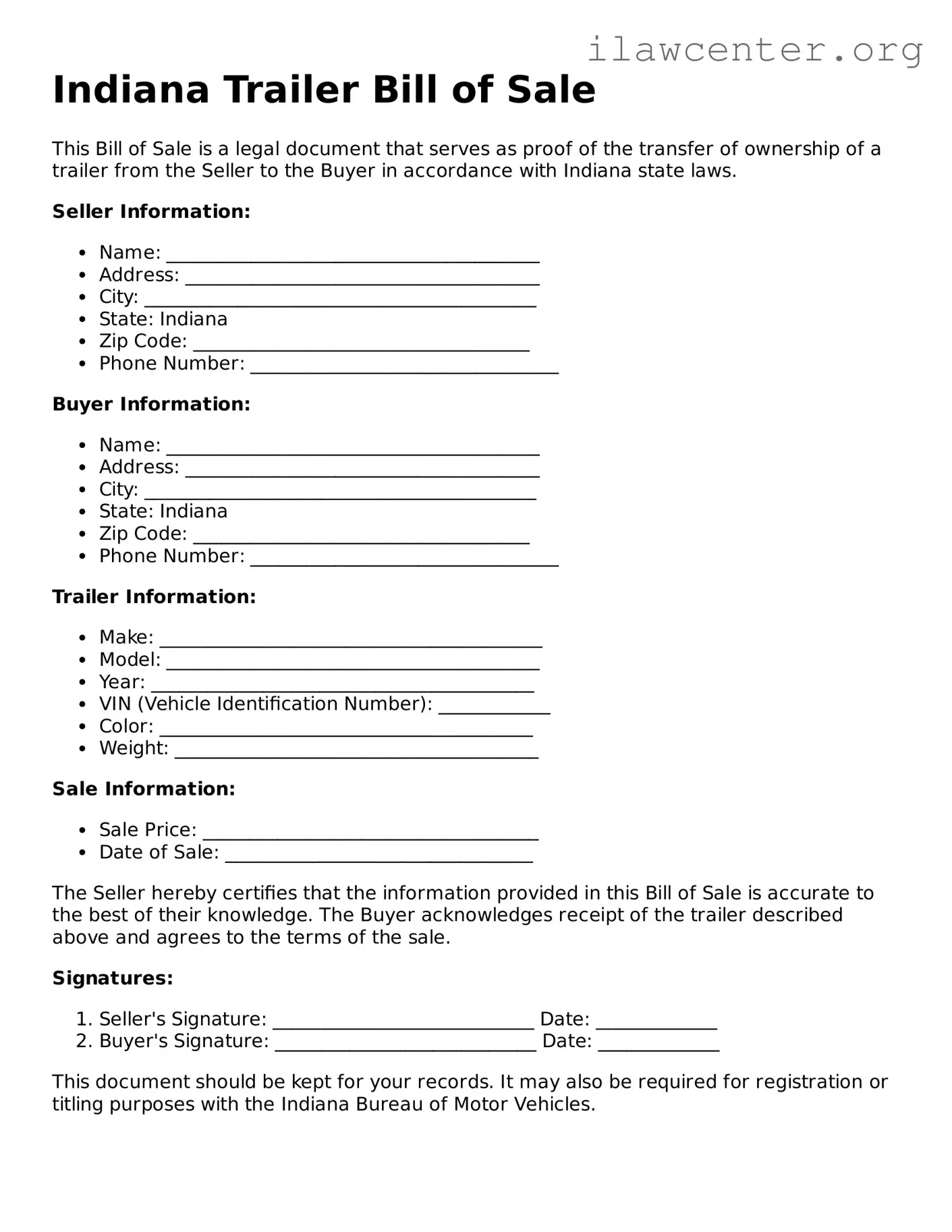
Indiana Trailer Bill of Sale

This Bill of Sale is a legal document that serves as proof of the transfer of ownership of a trailer from the Seller to the Buyer in accordance with Indiana state laws.

Seller Information:

  • Name: ________________________________________
  • Address: ______________________________________
  • City: __________________________________________
  • State: Indiana
  • Zip Code: ____________________________________
  • Phone Number: _________________________________

Buyer Information:

  • Name: ________________________________________
  • Address: ______________________________________
  • City: __________________________________________
  • State: Indiana
  • Zip Code: ____________________________________
  • Phone Number: _________________________________

Trailer Information:

  • Make: _________________________________________
  • Model: ________________________________________
  • Year: _________________________________________
  • VIN (Vehicle Identification Number): ____________
  • Color: ________________________________________
  • Weight: _______________________________________

Sale Information:

  • Sale Price: ____________________________________
  • Date of Sale: _________________________________

The Seller hereby certifies that the information provided in this Bill of Sale is accurate to the best of their knowledge. The Buyer acknowledges receipt of the trailer described above and agrees to the terms of the sale.

Signatures:

  1. Seller's Signature: ____________________________ Date: _____________
  2. Buyer's Signature: ____________________________ Date: _____________

This document should be kept for your records. It may also be required for registration or titling purposes with the Indiana Bureau of Motor Vehicles.

PDF Form Characteristics

Fact Name Details
Purpose The Indiana Trailer Bill of Sale form is used to document the sale of a trailer between a buyer and a seller.
Governing Law This form is governed by Indiana state law, specifically Indiana Code Title 9.
Required Information Buyers and sellers must provide their names, addresses, and signatures on the form.
Trailer Details Details about the trailer, including make, model, year, and Vehicle Identification Number (VIN), must be included.
Date of Sale The date of the transaction must be clearly stated on the form.
Consideration The sale price or consideration for the trailer should be specified.
Notarization While notarization is not required, it is recommended for added legal protection.

Instructions on Utilizing Indiana Trailer Bill of Sale

Once you have the Indiana Trailer Bill of Sale form in hand, you will need to provide specific information to ensure the transaction is properly documented. Carefully follow the steps below to complete the form accurately.

  1. Start by entering the date of the sale at the top of the form.
  2. Fill in the names and addresses of both the seller and the buyer. Make sure to include complete information for both parties.
  3. Provide the trailer's details, including the make, model, year, and Vehicle Identification Number (VIN).
  4. Indicate the sale price of the trailer clearly. This should be the agreed-upon amount between the seller and the buyer.
  5. If applicable, note any additional terms or conditions of the sale in the designated area on the form.
  6. Both the seller and the buyer should sign and date the form at the bottom. This confirms that both parties agree to the terms outlined.

After completing the form, ensure that both parties retain a copy for their records. This document will serve as proof of the transaction and may be required for registration or title transfer purposes.

Important Facts about Indiana Trailer Bill of Sale

What is the Indiana Trailer Bill of Sale form?

The Indiana Trailer Bill of Sale form is a legal document used to record the sale of a trailer in the state of Indiana. This form serves as proof of the transaction between the seller and the buyer. It includes essential details such as the names and addresses of both parties, the trailer's identification number, make, model, year, and the sale price. Properly completing this form can help prevent disputes and ensure that both parties have a clear understanding of the sale terms.

Do I need to have the Trailer Bill of Sale notarized?

No, the Indiana Trailer Bill of Sale does not require notarization to be valid. However, both parties may choose to have the document notarized for added security and to provide an extra layer of authenticity. This step can be beneficial if there are any future disputes regarding the sale or ownership of the trailer.

Is the Trailer Bill of Sale form required for registering my trailer?

Yes, the Trailer Bill of Sale form is typically required when registering a trailer in Indiana. When you go to the Bureau of Motor Vehicles (BMV) to register the trailer, you will need to present the completed bill of sale along with other necessary documents. This form helps establish your ownership and is an essential part of the registration process.

Can I create my own Trailer Bill of Sale form?

While you can create your own Trailer Bill of Sale form, it is advisable to use a standard template that meets Indiana's requirements. A properly structured form ensures that all necessary information is included and reduces the risk of missing critical details. Templates are readily available online and can be easily filled out to suit your specific transaction.

Common mistakes

Filling out the Indiana Trailer Bill of Sale form can seem straightforward, but many people make common mistakes that can lead to complications. One frequent error is not including all necessary details about the trailer. Buyers and sellers should ensure they provide the trailer’s make, model, year, and Vehicle Identification Number (VIN). Missing this information can create confusion and may even affect the registration process.

Another mistake is not having both parties sign the document. Both the buyer and seller must sign the Bill of Sale for it to be valid. If one party neglects to sign, the transaction may not hold up if there are disputes later on. Always double-check that all required signatures are present before finalizing the sale.

Many people overlook the importance of including the sale price. This detail is crucial for both parties. It serves as a record of the transaction and is often needed for tax purposes. Leaving this field blank can lead to misunderstandings or even legal issues down the line.

Some individuals fail to date the Bill of Sale. This date is significant as it marks when the ownership officially changes hands. Without a date, it can be challenging to establish the timeline of the transaction, which may be important for future reference.

Another common mistake is not providing accurate contact information. Both the buyer and seller should include their full names, addresses, and phone numbers. This information is vital if either party needs to reach out after the sale for any reason.

People sometimes forget to check the form for errors before submitting it. Typos or incorrect information can lead to delays in processing or even rejection of the Bill of Sale. Taking a moment to review the form can save time and frustration later.

Lastly, some sellers do not keep a copy of the completed Bill of Sale. This document serves as proof of the transaction and can be crucial if disputes arise. Both parties should retain a copy for their records to ensure they have documentation of the sale.

Documents used along the form

When completing a trailer sale in Indiana, several other forms and documents may be required alongside the Trailer Bill of Sale. These documents help ensure a smooth transaction and provide necessary information for legal ownership transfer. Below is a list of commonly used forms in conjunction with the Indiana Trailer Bill of Sale.

  • Title Transfer Form: This document is essential for transferring ownership of the trailer from the seller to the buyer. It includes information about the trailer, such as its Vehicle Identification Number (VIN), and must be signed by both parties.
  • Indiana Vehicle Registration Application: After purchasing a trailer, the new owner must register it with the state. This application collects information about the trailer and the owner, facilitating the issuance of a registration certificate.
  • Affidavit of Ownership: If the trailer does not have a title or if the title is lost, an affidavit may be required. This document serves as a sworn statement of ownership and may need to be notarized.
  • Bill of Sale for Personal Property: While the Trailer Bill of Sale is specific to trailers, a general bill of sale may also be used. This document provides a record of the transaction and outlines the terms of the sale.
  • Sales Tax Form: Indiana requires sales tax on the purchase of trailers. A sales tax form may need to be completed to report the transaction and ensure compliance with state tax laws.
  • Insurance Verification: Proof of insurance may be necessary before registering the trailer. This document confirms that the buyer has obtained the required insurance coverage for the trailer.
  • VIN Inspection Form: In some cases, a VIN inspection may be required to verify the identity of the trailer. This form provides confirmation that the VIN matches the information on the title and bill of sale.
  • Power of Attorney (if applicable): If the seller cannot be present for the transaction, a power of attorney may be needed. This document allows another person to act on behalf of the seller to complete the sale.

Having these documents ready can streamline the trailer sale process in Indiana. Each form plays a vital role in ensuring compliance with state regulations and protecting the interests of both the buyer and the seller.

Similar forms

The Trailer Bill of Sale form serves a specific purpose in the transfer of ownership for trailers. However, several other documents fulfill similar functions in different contexts. Below is a list of documents that share similarities with the Trailer Bill of Sale form:

  • Vehicle Bill of Sale: This document is used to transfer ownership of motor vehicles, providing details about the buyer, seller, and the vehicle itself.
  • Boat Bill of Sale: Similar to the Trailer Bill of Sale, this form is used for the sale of boats, detailing the transfer of ownership and any relevant specifications.
  • Motorcycle Bill of Sale: This document serves to record the sale of a motorcycle, including information about the buyer, seller, and the motorcycle's identification.
  • ATV Bill of Sale: This form is used for the sale of all-terrain vehicles, capturing essential details about the transaction and the vehicle.
  • Snowmobile Bill of Sale: Used for the transfer of ownership of snowmobiles, this document includes information about the buyer, seller, and snowmobile specifications.
  • Personal Property Bill of Sale: This general form can be used for various types of personal property sales, outlining the terms of the transaction.
  • Real Estate Purchase Agreement: While focused on real property, this document outlines the terms of sale and transfer of ownership, similar to the Trailer Bill of Sale in its purpose.
  • Lease Agreement: Though primarily for rental arrangements, lease agreements can include clauses for eventual purchase, resembling the ownership transfer aspect of a bill of sale.

Dos and Don'ts

When filling out the Indiana Trailer Bill of Sale form, it’s important to follow certain guidelines to ensure the process goes smoothly. Here’s a list of things you should and shouldn’t do:

  • Do provide accurate information about the trailer, including the Vehicle Identification Number (VIN).
  • Do include the names and addresses of both the buyer and the seller.
  • Do specify the sale price clearly to avoid any misunderstandings.
  • Do sign and date the form to validate the transaction.
  • Don’t leave any sections blank; fill out all required fields completely.
  • Don’t use white-out or any correction fluid on the form; it can raise questions about the validity.
  • Don’t forget to keep a copy of the completed bill of sale for your records.

Misconceptions

Misconceptions about the Indiana Trailer Bill of Sale form can lead to confusion and potential issues during the buying or selling process. Here are seven common misconceptions:

  1. It is not necessary for a bill of sale.

    Many people believe that a bill of sale is optional when transferring ownership of a trailer. In reality, having a bill of sale is important for legal proof of the transaction.

  2. All states use the same bill of sale format.

    Some assume that a bill of sale from Indiana will be accepted in other states without modification. Each state has its own requirements, so it’s essential to use the correct form for the state where the transaction occurs.

  3. Only the seller needs to sign the bill of sale.

    Another misconception is that only the seller's signature is required. Both the buyer and seller should sign the bill of sale to ensure that the transaction is valid and acknowledged by both parties.

  4. The bill of sale does not need to be notarized.

    Some people think notarization is unnecessary. While it may not be a requirement in Indiana, having the bill of sale notarized can add an extra layer of security and authenticity to the document.

  5. It is not important to include trailer details.

    Some may overlook the importance of including specific details about the trailer, such as the Vehicle Identification Number (VIN) and make. These details are crucial for identifying the trailer and preventing disputes.

  6. A bill of sale guarantees ownership.

    There is a belief that having a bill of sale automatically grants ownership. While it serves as proof of the transaction, the title must also be transferred to complete the ownership process legally.

  7. Once signed, the bill of sale cannot be changed.

    Some think that after signing, the document is set in stone. However, if both parties agree, they can amend the bill of sale to correct any errors or add additional information.

Key takeaways

When filling out and using the Indiana Trailer Bill of Sale form, it is important to keep several key points in mind. This document serves as a legal record of the sale and transfer of ownership of a trailer. Below are essential takeaways to consider:

  1. Complete Information: Ensure that all sections of the form are filled out completely. This includes the names and addresses of both the seller and buyer.
  2. Trailer Details: Provide accurate details about the trailer, including its make, model, year, Vehicle Identification Number (VIN), and any other identifying features.
  3. Sale Price: Clearly state the sale price of the trailer. This amount should reflect the agreed-upon price between the seller and buyer.
  4. Date of Sale: Include the date when the sale takes place. This is important for record-keeping and legal purposes.
  5. Signatures: Both the seller and buyer must sign the form. Signatures confirm the agreement and transfer of ownership.
  6. Witness or Notary: While not always required, having a witness or notary public sign the document can add an extra layer of validation.
  7. Keep Copies: Both parties should retain a copy of the completed bill of sale for their records. This can be helpful for future reference or disputes.
  8. Check Local Requirements: Verify if there are any additional local requirements or forms needed for the sale of a trailer in your area.
  9. Transfer of Title: Remember that the bill of sale is separate from the title transfer. Ensure that the title is also signed over to the buyer.
  10. Use for Registration: The completed bill of sale may be required for the buyer to register the trailer with the Indiana Bureau of Motor Vehicles (BMV).

By following these key takeaways, individuals can ensure a smoother transaction when buying or selling a trailer in Indiana.