Attorney-Verified  Vehicle Purchase Agreement Document for Indiana

Attorney-Verified Vehicle Purchase Agreement Document for Indiana

The Indiana Vehicle Purchase Agreement form is a legal document that outlines the terms and conditions of a vehicle sale between a buyer and a seller. This agreement ensures that both parties are clear on the details of the transaction, including the purchase price, vehicle description, and any warranties or conditions. To ensure a smooth transaction, it’s important to fill out this form accurately.

Ready to get started? Fill out the form by clicking the button below.

Article Guide

The Indiana Vehicle Purchase Agreement form serves as a crucial document in the process of buying or selling a vehicle within the state. This form outlines the essential details of the transaction, including the buyer's and seller's information, vehicle identification number (VIN), make, model, and year of the vehicle. It also specifies the purchase price and any conditions related to the sale, such as warranties or financing arrangements. Both parties must sign the agreement to confirm their acceptance of the terms. Additionally, the form may include provisions for the transfer of ownership and the responsibilities of each party, ensuring a clear understanding of the transaction. Properly completing this form helps protect the interests of both buyers and sellers, facilitating a smooth exchange and reducing the likelihood of disputes.

Indiana Vehicle Purchase Agreement Preview

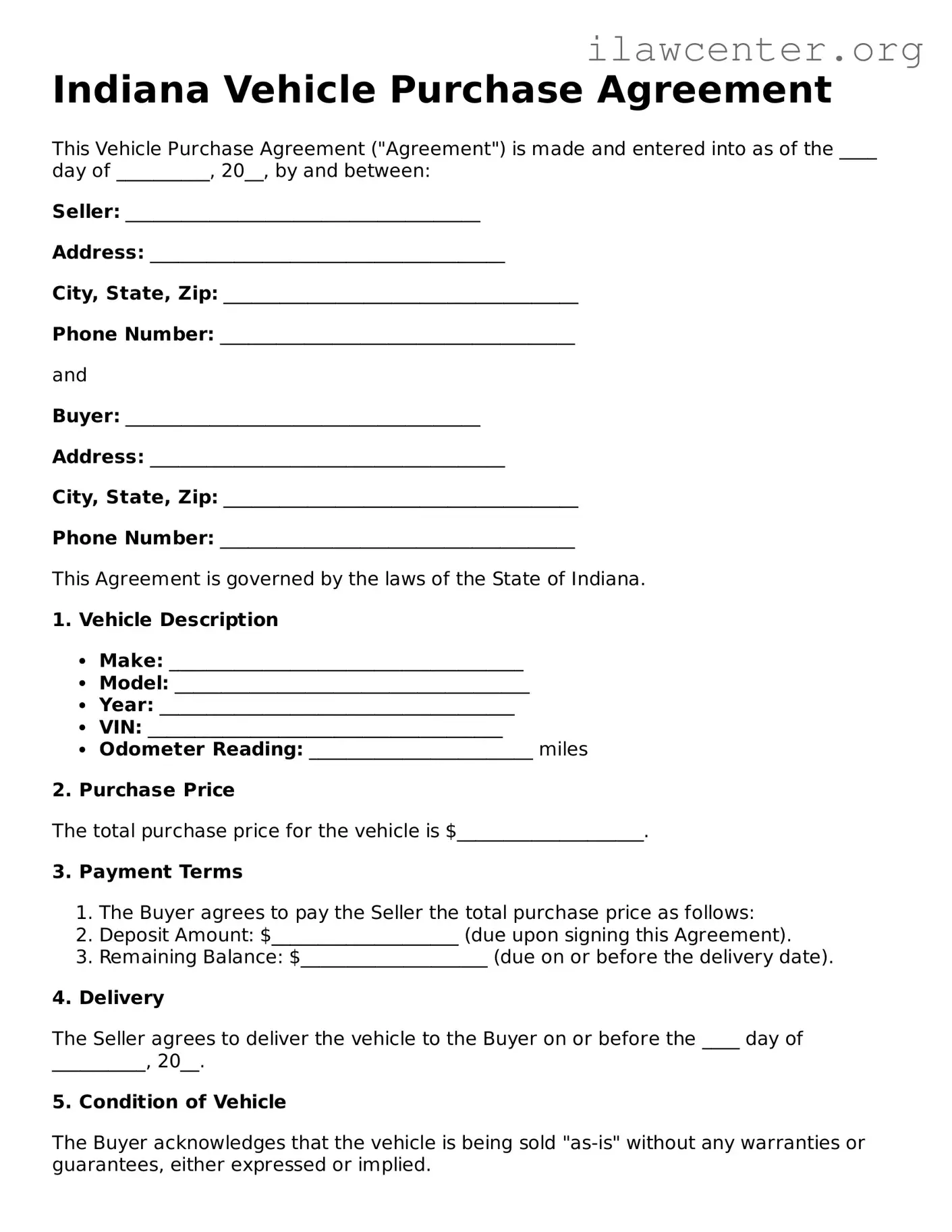
Indiana Vehicle Purchase Agreement

This Vehicle Purchase Agreement ("Agreement") is made and entered into as of the ____ day of __________, 20__, by and between:

Seller: ______________________________________

Address: ______________________________________

City, State, Zip: ______________________________________

Phone Number: ______________________________________

and

Buyer: ______________________________________

Address: ______________________________________

City, State, Zip: ______________________________________

Phone Number: ______________________________________

This Agreement is governed by the laws of the State of Indiana.

1. Vehicle Description

  • Make: ______________________________________
  • Model: ______________________________________
  • Year: ______________________________________
  • VIN: ______________________________________
  • Odometer Reading: ________________________ miles

2. Purchase Price

The total purchase price for the vehicle is $____________________.

3. Payment Terms

  1. The Buyer agrees to pay the Seller the total purchase price as follows:
  2. Deposit Amount: $____________________ (due upon signing this Agreement).
  3. Remaining Balance: $____________________ (due on or before the delivery date).

4. Delivery

The Seller agrees to deliver the vehicle to the Buyer on or before the ____ day of __________, 20__.

5. Condition of Vehicle

The Buyer acknowledges that the vehicle is being sold "as-is" without any warranties or guarantees, either expressed or implied.

6. Signatures

By signing below, both parties agree to the terms outlined in this Vehicle Purchase Agreement.

Seller's Signature: ___________________________ Date: ________________

Buyer's Signature: ___________________________ Date: ________________

PDF Form Characteristics

Fact Name Description
Purpose The Indiana Vehicle Purchase Agreement form is used to document the sale of a vehicle between a buyer and a seller, ensuring both parties understand the terms of the transaction.
Governing Law This form is governed by the Indiana Code Title 9, which outlines the laws related to motor vehicles and sales transactions in the state.
Required Information Essential details such as the vehicle's make, model, year, VIN, purchase price, and the names and addresses of both the buyer and seller must be included.
Signatures Both parties must sign the agreement to validate the transaction. This signature confirms acceptance of the terms outlined in the document.

Instructions on Utilizing Indiana Vehicle Purchase Agreement

Once you have the Indiana Vehicle Purchase Agreement form ready, you will need to fill it out accurately to ensure a smooth transaction. This form captures essential details about the vehicle and the buyer and seller. Follow these steps to complete the form correctly.

  1. Start by entering the date at the top of the form.
  2. Fill in the seller's name and address in the designated sections.
  3. Provide the buyer's name and address next.
  4. Enter the vehicle information, including the make, model, year, and Vehicle Identification Number (VIN).
  5. Indicate the purchase price of the vehicle clearly.
  6. Specify any trade-in details, if applicable, including the trade-in vehicle's information.
  7. Fill in the odometer reading at the time of sale.
  8. Both the buyer and seller should sign and date the form at the bottom.

After completing the form, ensure that both parties keep a copy for their records. This will help in case of any future questions or issues regarding the transaction.

Important Facts about Indiana Vehicle Purchase Agreement

What is the Indiana Vehicle Purchase Agreement form?

The Indiana Vehicle Purchase Agreement form is a legal document used to outline the terms and conditions of a vehicle sale between a buyer and a seller. This agreement typically includes details such as the vehicle's identification number (VIN), purchase price, payment method, and any warranties or conditions related to the sale. It serves to protect both parties by clearly defining their responsibilities and expectations during the transaction.

Is the Indiana Vehicle Purchase Agreement form required by law?

No, the Indiana Vehicle Purchase Agreement form is not legally required for every vehicle sale. However, it is highly recommended to use this form to ensure that both the buyer and seller have a clear understanding of the transaction. Having a written agreement can help prevent disputes and provide documentation in case of any issues that may arise after the sale.

How do I fill out the Indiana Vehicle Purchase Agreement form?

To fill out the Indiana Vehicle Purchase Agreement form, start by entering the names and contact information of both the buyer and seller. Next, include the vehicle's details, such as the make, model, year, and VIN. Specify the purchase price and any payment terms. If applicable, include information about warranties or other conditions. Finally, both parties should sign and date the agreement to make it official.

What should I do after completing the Indiana Vehicle Purchase Agreement form?

After completing the form, both the buyer and seller should retain a copy for their records. It is also advisable to transfer the vehicle title and register the vehicle with the Indiana Bureau of Motor Vehicles (BMV) as soon as possible. This ensures that the vehicle ownership is officially recognized and helps avoid any potential legal issues in the future.

Can I modify the Indiana Vehicle Purchase Agreement form?

What if there is a dispute after the sale?

If a dispute arises after the sale, the Indiana Vehicle Purchase Agreement form can serve as a crucial piece of evidence. Both parties should refer to the agreement to clarify the terms and conditions of the sale. If the dispute cannot be resolved amicably, it may be necessary to seek legal advice or mediation to address the issue in a fair and legal manner.
Common mistakes

Filling out the Indiana Vehicle Purchase Agreement form can seem straightforward, but many people make common mistakes that can lead to complications later. One frequent error is failing to include the correct vehicle identification number (VIN). The VIN is essential for identifying the vehicle and ensuring that the transaction is valid. Omitting or miswriting this number can cause issues with registration and ownership transfer.

Another mistake often made is not providing accurate buyer and seller information. This includes names, addresses, and contact details. If any of this information is incorrect, it can create confusion and may even lead to disputes about ownership. Always double-check that all personal information is accurate and up to date.

People also frequently overlook the importance of detailing the sale price and payment terms. Clearly stating the purchase price helps avoid misunderstandings. Additionally, if there are any financing arrangements or trade-ins, these should be documented in the agreement. Not doing so can lead to complications when the buyer attempts to register the vehicle.

Failing to sign and date the form is another common mistake. Both the buyer and seller must sign the agreement for it to be legally binding. Without signatures, the document may not hold up in a dispute. Ensure that all required parties have signed and that the date of the transaction is included.

Some individuals neglect to review the entire document before submission. Skimming through the form can lead to overlooked errors or missing information. Taking the time to read through the agreement carefully can help catch mistakes before they become problematic.

Finally, not keeping a copy of the completed agreement is a mistake many make. It’s essential to retain a copy for personal records. This can serve as proof of the transaction and provide necessary details for future reference. Always make sure to have a copy for both parties involved.

Documents used along the form

When purchasing a vehicle in Indiana, several forms and documents often accompany the Vehicle Purchase Agreement. These documents help ensure that the transaction is legal and that both parties are protected. Below is a list of commonly used documents that you might encounter during the process.

  • Bill of Sale: This document serves as a receipt for the transaction. It includes details about the vehicle, such as the make, model, and VIN, as well as the purchase price and date of sale.
  • Title Transfer Form: To officially transfer ownership of the vehicle, this form must be completed. It requires information from both the seller and the buyer and is submitted to the Indiana Bureau of Motor Vehicles (BMV).
  • Odometer Disclosure Statement: This form is necessary to verify the vehicle's mileage at the time of sale. It protects both the buyer and seller from any potential fraud regarding the odometer reading.
  • Application for Certificate of Title: After purchasing the vehicle, the new owner must complete this application to obtain a new title in their name. This document is submitted to the BMV along with the required fees.
  • Affidavit of Ownership: If the title is lost or unavailable, this affidavit can help establish ownership. The seller must sign it, confirming that they are the rightful owner of the vehicle.
  • Sales Tax Form: Indiana requires buyers to pay sales tax on vehicle purchases. This form helps calculate the tax owed based on the purchase price.
  • Loan Agreement: If financing the vehicle, a loan agreement will outline the terms of the loan, including interest rates, repayment schedules, and any collateral involved.
  • Insurance Verification: Before registering the vehicle, buyers must provide proof of insurance. This document confirms that the vehicle is insured as required by Indiana law.
  • Power of Attorney: In some cases, the seller may grant a power of attorney to another person to handle the title transfer or other aspects of the sale on their behalf.

Understanding these documents can help streamline the vehicle purchasing process. By being prepared with the necessary paperwork, both buyers and sellers can ensure a smoother transaction and avoid potential issues down the line.

Similar forms

  • Bill of Sale: This document serves as proof of the transaction between the buyer and seller. It outlines the sale price, vehicle details, and the parties involved, much like a Vehicle Purchase Agreement.
  • Lease Agreement: Similar to a Vehicle Purchase Agreement, a lease agreement outlines the terms under which a vehicle can be used. It specifies payments, duration, and responsibilities, ensuring both parties understand their commitments.
  • Title Transfer Document: This document is crucial for transferring ownership of a vehicle. It complements the Vehicle Purchase Agreement by officially documenting the change in ownership.
  • Financing Agreement: If a vehicle is financed, this agreement details the loan terms, interest rates, and payment schedule. It works alongside the Vehicle Purchase Agreement to clarify the financial aspects of the purchase.
  • Odometer Disclosure Statement: This statement confirms the vehicle's mileage at the time of sale. It's often included in a Vehicle Purchase Agreement to protect both parties from potential fraud.
  • Warranty Document: If the vehicle comes with a warranty, this document outlines coverage details. It complements the Vehicle Purchase Agreement by ensuring the buyer knows what is protected after the purchase.
  • Inspection Report: An inspection report provides details about the vehicle's condition prior to sale. This document can be referenced in a Vehicle Purchase Agreement to assure the buyer of the vehicle's status.

Dos and Don'ts

When filling out the Indiana Vehicle Purchase Agreement form, it is essential to approach the task with care. Here are some important things to do and avoid during this process:

  • Do read the entire form carefully before starting to fill it out.
  • Do provide accurate and complete information about the vehicle, including the VIN, make, model, and year.
  • Do ensure that both the buyer and seller sign the agreement to make it valid.
  • Do keep a copy of the signed agreement for your records.
  • Don't leave any sections blank; if a section does not apply, indicate that clearly.
  • Don't rush through the process; take your time to avoid mistakes.
  • Don't forget to check for any additional requirements specific to your county or city.

By following these guidelines, you can help ensure a smooth transaction and avoid potential issues in the future.

Misconceptions

Understanding the Indiana Vehicle Purchase Agreement form is crucial for anyone looking to buy or sell a vehicle in the state. However, several misconceptions can lead to confusion. Here’s a list of common misunderstandings:

  • The form is only necessary for used vehicles. Many believe that the Vehicle Purchase Agreement is only required for used cars. In reality, it is essential for both new and used vehicle transactions in Indiana.
  • It’s just a formality and doesn’t hold legal weight. Some people think the agreement is merely a formality. However, it serves as a legally binding contract that outlines the terms of the sale and protects both the buyer and seller.
  • Verbal agreements are sufficient. Many assume that a verbal agreement is enough to finalize a vehicle sale. This is incorrect. Written agreements are necessary to avoid misunderstandings and provide clear evidence of the transaction.
  • Only the seller needs to sign the form. A common misconception is that only the seller's signature is required. In fact, both the buyer and the seller must sign the Vehicle Purchase Agreement for it to be valid.
  • All terms can be added later. Some believe they can modify the agreement after signing. Once the form is signed, any changes require mutual consent and should be documented to avoid disputes.
  • It’s the same as a bill of sale. Many confuse the Vehicle Purchase Agreement with a bill of sale. While they serve similar purposes, the Vehicle Purchase Agreement includes more detailed terms regarding the sale.

Being aware of these misconceptions can help ensure a smoother vehicle transaction process in Indiana. Always read the agreement carefully and consider seeking legal advice if unsure about any terms.

Key takeaways

When dealing with the Indiana Vehicle Purchase Agreement form, there are several important points to keep in mind. Understanding these key takeaways can help ensure a smooth transaction.

  • Accurate Information: Fill out the form with precise details about the vehicle, including the make, model, year, and VIN. This information is crucial for both parties.
  • Seller and Buyer Details: Clearly list the names and addresses of both the buyer and seller. This helps establish who is involved in the transaction.
  • Payment Terms: Specify the payment method and any conditions regarding the payment. This can prevent misunderstandings later.
  • Disclosure of Vehicle Condition: The seller should disclose any known issues with the vehicle. Transparency builds trust and can protect both parties legally.
  • Signatures Required: Ensure that both parties sign the agreement. This step is essential for the document to be legally binding.

By keeping these takeaways in mind, you can navigate the process of buying or selling a vehicle in Indiana with greater confidence.