Fillable Informed Consent for Research Study Document

Fillable Informed Consent for Research Study Document

The Informed Consent for Research Study form is a document that ensures participants are fully aware of the details and implications of their involvement in a research study. This form outlines the purpose of the study, potential risks, and the rights of the participants. To contribute to the research, please fill out the form by clicking the button below.

Article Guide

When participating in a research study, understanding the Informed Consent for Research Study form is crucial. This document serves as a guide, outlining the purpose of the study, the procedures involved, and any potential risks or benefits associated with participation. It ensures that participants are fully aware of what to expect, including how their data will be used and their rights throughout the process. Additionally, the form provides information on confidentiality measures, compensation for participation, and the ability to withdraw from the study at any time without penalty. By signing this form, participants affirm their voluntary agreement to take part, having been provided with all necessary information to make an informed decision. It is designed to promote transparency and trust between researchers and participants, ensuring ethical standards are upheld in the pursuit of knowledge.

Informed Consent for Research Study

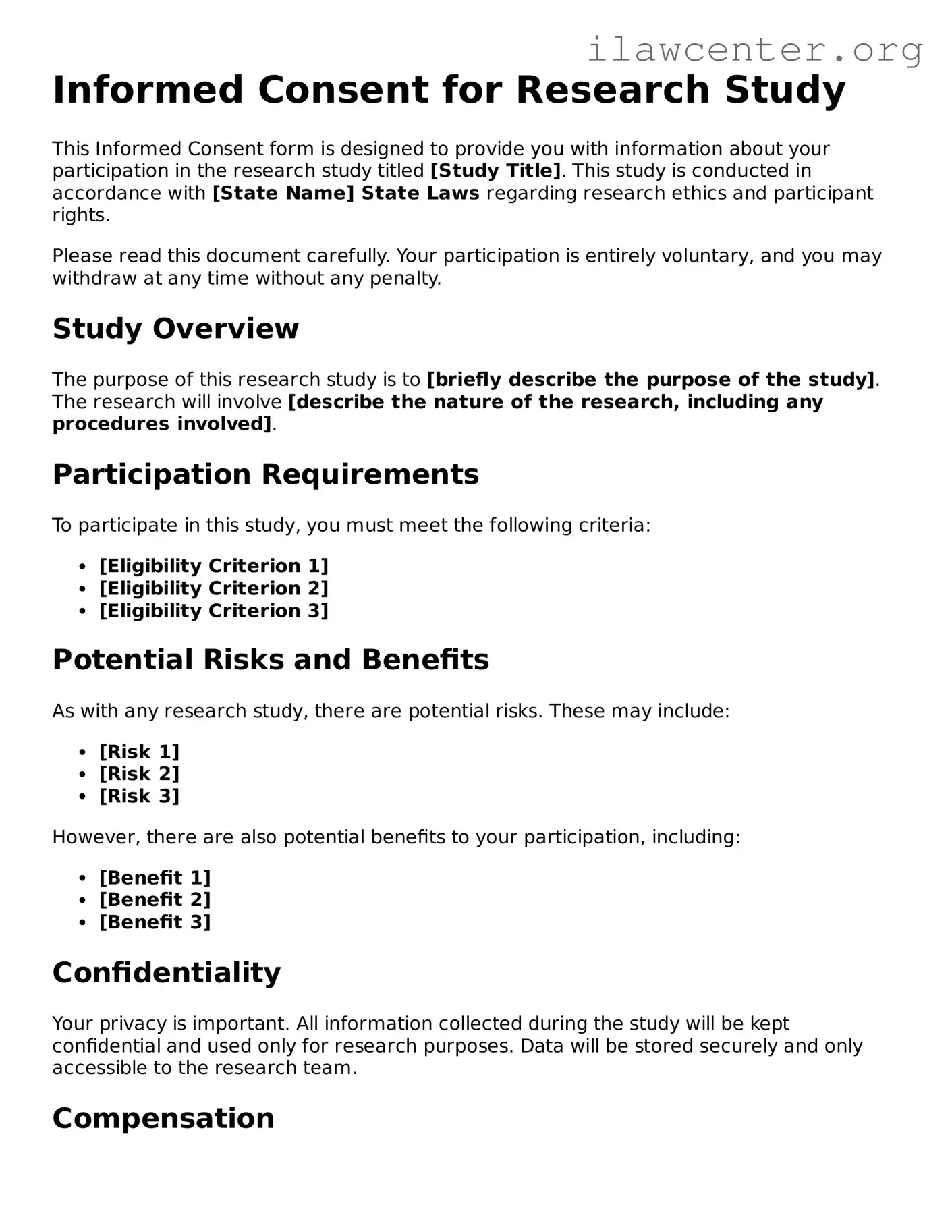
This Informed Consent form is designed to provide you with information about your participation in the research study titled [Study Title]. This study is conducted in accordance with [State Name] State Laws regarding research ethics and participant rights.

Please read this document carefully. Your participation is entirely voluntary, and you may withdraw at any time without any penalty.

Study Overview

The purpose of this research study is to [briefly describe the purpose of the study]. The research will involve [describe the nature of the research, including any procedures involved].

Participation Requirements

To participate in this study, you must meet the following criteria:

  • [Eligibility Criterion 1]
  • [Eligibility Criterion 2]
  • [Eligibility Criterion 3]

Potential Risks and Benefits

As with any research study, there are potential risks. These may include:

  • [Risk 1]
  • [Risk 2]
  • [Risk 3]

However, there are also potential benefits to your participation, including:

  • [Benefit 1]
  • [Benefit 2]
  • [Benefit 3]

Confidentiality

Your privacy is important. All information collected during the study will be kept confidential and used only for research purposes. Data will be stored securely and only accessible to the research team.

Compensation

Participants may receive compensation for their involvement in this study. The details of the compensation are as follows:

[Describe compensation, if applicable]

Contact Information

If you have any questions about this study, please contact:

[Researcher's Name]
[Institution/Organization]
[Phone Number]
[Email Address]

Consent Statement

By signing below, you agree that:

  1. You have read and understood the information provided above.
  2. You have had the opportunity to ask questions and have received satisfactory answers.
  3. You voluntarily agree to participate in this research study.

Participant Name: [Participant's Name]

Participant Signature: [Signature]

Date: [Date]

Researcher Name: [Researcher's Name]

Researcher Signature: [Signature]

Date: [Date]

PDF Form Characteristics

Fact Name Description
Definition of Informed Consent Informed consent is a process that ensures participants understand the nature, risks, and benefits of a research study before agreeing to participate.
Purpose The main purpose of the informed consent form is to protect participants' autonomy and ensure they make well-informed decisions regarding their involvement in research.
Essential Elements The form should include information about the study's purpose, procedures, risks, benefits, and the right to withdraw at any time without penalty.
Governing Laws In the U.S., informed consent is governed by federal regulations, including the Common Rule (45 CFR 46), and may also be subject to state-specific laws.
Language Accessibility The language used in the consent form should be clear and understandable, avoiding complex terminology to ensure all participants can comprehend the information.
Documentation Requirements Researchers must document the informed consent process, often by having participants sign the consent form, which serves as proof of their agreement.
Special Considerations Additional considerations may be necessary for vulnerable populations, such as minors or individuals with cognitive impairments, requiring extra safeguards in the consent process.

Completing the Informed Consent for Research Study form is an important step in participating in a research study. This process ensures that you understand the nature of the study, what is expected of you, and any potential risks involved. After filling out the form, it will be reviewed by the research team, who will address any questions or concerns you may have.

  1. Begin by reading the entire form carefully to understand the study's purpose and procedures.
  2. Fill in your personal information, including your name, contact details, and any identification number required.
  3. Review the section detailing the study's risks and benefits. Make sure you comprehend what is being stated.
  4. Indicate your understanding of the study by checking the appropriate box or signing where indicated.
  5. If applicable, provide information about your medical history or any medications you are currently taking.
  6. Sign and date the form at the designated area to confirm your consent to participate.
  7. Keep a copy of the signed form for your records, as it contains important information regarding your participation.

What is the purpose of the Informed Consent for Research Study form?

The Informed Consent for Research Study form is designed to ensure that participants understand the nature of the study, what is expected of them, and any potential risks or benefits. It provides essential information that helps individuals make an informed decision about whether to participate in the research.

Who needs to sign the Informed Consent form?

Any individual who wishes to participate in the research study must sign the Informed Consent form. This includes adults, and in some cases, minors may need a parent or guardian to provide consent on their behalf.

What information is included in the Informed Consent form?

The form typically includes details about the study's purpose, procedures, duration, potential risks and benefits, confidentiality measures, and the right to withdraw from the study at any time without penalty. It aims to provide a clear understanding of what participation entails.

Can I withdraw my consent after signing the form?

Yes, you can withdraw your consent at any time during the study. Participants have the right to stop participating without any negative consequences. If you decide to withdraw, simply inform the research team, and they will guide you through the process.

What happens if I do not understand something in the Informed Consent form?

If you have any questions or need clarification about any part of the form, it is important to ask the research team before signing. They are there to help ensure that you fully understand the study and what is involved in your participation.

Is my participation in the study confidential?

Yes, confidentiality is a key aspect of research ethics. The Informed Consent form will outline how your personal information will be protected. Researchers are committed to keeping your data private and will use it only for the purposes stated in the study.

What are the potential risks of participating in the study?

Every research study carries some level of risk. The Informed Consent form should clearly describe any potential risks associated with participation. It is crucial to read this section carefully and discuss any concerns with the research team.

What are the benefits of participating in the research study?

Benefits may vary depending on the study. Some participants may gain access to new treatments or interventions, while others may contribute to valuable knowledge that can help improve future healthcare practices. The form should outline these benefits clearly.

Will I receive compensation for my participation?

Some studies offer compensation for participation, while others do not. The Informed Consent form will specify whether you will receive any payment or reimbursement for your time and expenses incurred during the study.

Who can I contact if I have more questions after signing the Informed Consent form?

If you have further questions or concerns after signing the form, you can contact the research team or the institution's ethics board. Their contact information should be provided on the form, ensuring you have access to support throughout your participation.
Common mistakes

Filling out the Informed Consent for Research Study form is a crucial step in participating in any research project. However, individuals often make several common mistakes that can compromise their understanding of the study. One frequent error is failing to read the entire document thoroughly. Participants may skim through the text, missing important details about the study's purpose, procedures, and potential risks. This lack of attention can lead to misunderstandings about what participation entails.

Another mistake involves not asking questions when something is unclear. The consent form is designed to provide essential information, but it can be complex. Participants sometimes hesitate to seek clarification, fearing they may seem uninformed or bothersome. This reluctance can result in participants agreeing to terms they do not fully comprehend, which undermines the very purpose of informed consent.

Additionally, individuals may overlook the section that discusses their right to withdraw from the study at any time. This critical detail is often buried within the text. Participants might mistakenly believe that once they consent, they are obligated to continue, even if they feel uncomfortable later. Recognizing the right to withdraw is vital for ensuring that participation remains voluntary and informed.

Lastly, some participants may neglect to consider the implications of their personal data being used in the research. The consent form typically outlines how data will be collected, stored, and utilized. However, individuals may not fully grasp the potential consequences of sharing their information. This oversight can lead to concerns about privacy and confidentiality that are not adequately addressed prior to participation.

Documents used along the form

When conducting research studies, obtaining informed consent is crucial. However, several other forms and documents often accompany the Informed Consent for Research Study form. These documents help ensure that participants understand their rights, the nature of the study, and any potential risks involved. Below is a list of commonly used forms.

  • Research Protocol: This document outlines the study's objectives, methodology, and procedures. It provides a comprehensive overview of how the research will be conducted.
  • Participant Information Sheet: This sheet offers detailed information about the study, including its purpose, procedures, and potential risks. It is designed to help participants make informed decisions.
  • Data Collection Instruments: These may include surveys, questionnaires, or interview guides that will be used to gather data from participants. They are essential for ensuring consistency in data collection.
  • Confidentiality Agreement: This document assures participants that their personal information will be kept confidential. It outlines how data will be stored and who will have access to it.
  • Debriefing Form: After participation, this form provides participants with additional information about the study's findings and purpose. It helps to clarify any questions they may have.
  • Assent Form (for minors): If the study involves minors, this form is used to obtain their agreement to participate, in addition to parental consent. It ensures that the minor understands the study in an age-appropriate manner.
  • Withdrawal Form: This document allows participants to formally withdraw from the study at any time. It reinforces their right to discontinue participation without penalty.

These documents collectively enhance the ethical conduct of research by ensuring transparency and protecting the rights of participants. Proper documentation fosters trust and encourages participation, ultimately contributing to the integrity of the research process.

Similar forms

  • Patient Consent Form: This document is used in healthcare settings to ensure that patients understand the procedures, risks, and benefits before undergoing treatment.
  • Clinical Trial Agreement: Similar to informed consent, this agreement outlines the responsibilities of the parties involved in a clinical trial, including participant rights and obligations.
  • Privacy Notice: This document informs individuals about how their personal information will be used and protected, similar to how informed consent addresses participant data.
  • Authorization for Release of Information: This form allows individuals to consent to share their medical records or personal information, much like informed consent allows for data use in research.
  • Research Participant Bill of Rights: This outlines the rights of individuals participating in research, emphasizing informed consent as a key component of those rights.
  • Waiver of Consent: In some cases, researchers may seek a waiver of consent, which still requires an understanding of participant rights and risks, similar to the informed consent process.
  • Data Use Agreement: This document governs how data collected from participants can be used, ensuring that consent is respected and that privacy is maintained.
  • Ethics Approval Letter: Before research can begin, this letter from an ethics board confirms that the study has been reviewed for ethical standards, aligning with the principles of informed consent.

Dos and Don'ts

When filling out the Informed Consent for Research Study form, it is important to approach the process thoughtfully. Here is a list of things you should and shouldn't do:

  • Do read the entire consent form carefully before signing.
  • Do ask questions if any part of the form is unclear.
  • Do ensure you understand the purpose of the research and what it entails.
  • Do consider the potential risks and benefits of participating in the study.
  • Don't rush through the form or sign it without understanding its contents.
  • Don't hesitate to seek clarification from the researcher about your rights.
  • Don't ignore any sections that require your attention or signature.

Following these guidelines can help ensure that you make an informed decision regarding your participation in the research study.

Misconceptions

When it comes to research studies, the Informed Consent form plays a crucial role. However, several misconceptions can lead to confusion. Here are seven common misunderstandings about the Informed Consent for Research Study form:

  1. Informed Consent means I have to participate.

    Many people believe that signing the Informed Consent form obligates them to participate in the study. In reality, this form is meant to inform you about the study and your rights. You can choose to withdraw at any time without penalty.

  2. All research studies are the same.

    Not all studies require the same level of risk or commitment. Each research study has its own specific goals, procedures, and potential risks. The Informed Consent form outlines these details for that particular study.

  3. Signing the form means I understand everything.

    While the Informed Consent form provides important information, it’s normal to have questions. Researchers are available to clarify any uncertainties you may have before you sign.

  4. Informed Consent is only about risks.

    While risks are a significant part of the form, it also covers the benefits of participating, the purpose of the study, and what your involvement will entail. It’s a comprehensive overview, not just a focus on risks.

  5. Once I sign, I can’t change my mind.

    Participants have the right to withdraw from the study at any point, even after signing the consent form. Your well-being and comfort are prioritized throughout the research process.

  6. Informed Consent is only necessary for medical studies.

    This form is essential for all types of research, not just medical. Whether it’s a survey, social science study, or clinical trial, obtaining informed consent is a fundamental ethical requirement.

  7. My personal information will be shared.

    Confidentiality is a key principle in research. The Informed Consent form typically explains how your data will be protected and assures you that your identity will remain confidential.

Understanding these misconceptions can help you make informed decisions about participating in research studies. Always feel free to ask questions and seek clarity before you consent.

Key takeaways

When filling out and using the Informed Consent for Research Study form, it is essential to consider the following key takeaways:

  • Understand the Purpose: The form outlines the study's purpose, ensuring participants know what they are agreeing to.
  • Voluntary Participation: Participation is voluntary, and individuals can withdraw at any time without penalty.
  • Risks and Benefits: The form should clearly state any potential risks and benefits associated with participation.
  • Confidentiality: Information regarding how participants' data will be kept confidential must be included.
  • Contact Information: Participants should have access to contact details for questions or concerns regarding the study.
  • Signature Requirement: A signature from the participant is necessary to confirm their understanding and agreement.

These points are crucial for ensuring ethical standards are met and that participants are fully informed before agreeing to take part in the research study.