Fillable Investment Letter of Intent Document

Fillable Investment Letter of Intent Document

An Investment Letter of Intent is a document that outlines the preliminary understanding between parties intending to enter into an investment agreement. This form serves as a starting point for negotiations and clarifies the key terms and conditions before a formal contract is created. If you're ready to take the next step in your investment journey, fill out the form by clicking the button below.

Article Guide

When embarking on an investment journey, clarity and intention are crucial. The Investment Letter of Intent (LOI) serves as a vital tool for investors and businesses alike, outlining the key terms and conditions of a proposed investment. This document typically includes essential details such as the amount of investment, the purpose of the funds, and any specific conditions that must be met. It acts as a preliminary agreement, setting the stage for future negotiations and formal contracts. By clearly stating the intentions of both parties, the LOI helps to foster trust and transparency, reducing the risk of misunderstandings down the line. Furthermore, it often addresses timelines, confidentiality, and other important factors that can influence the investment process. Understanding the components of this form is essential for anyone looking to navigate the investment landscape effectively.

Investment Letter of Intent Preview

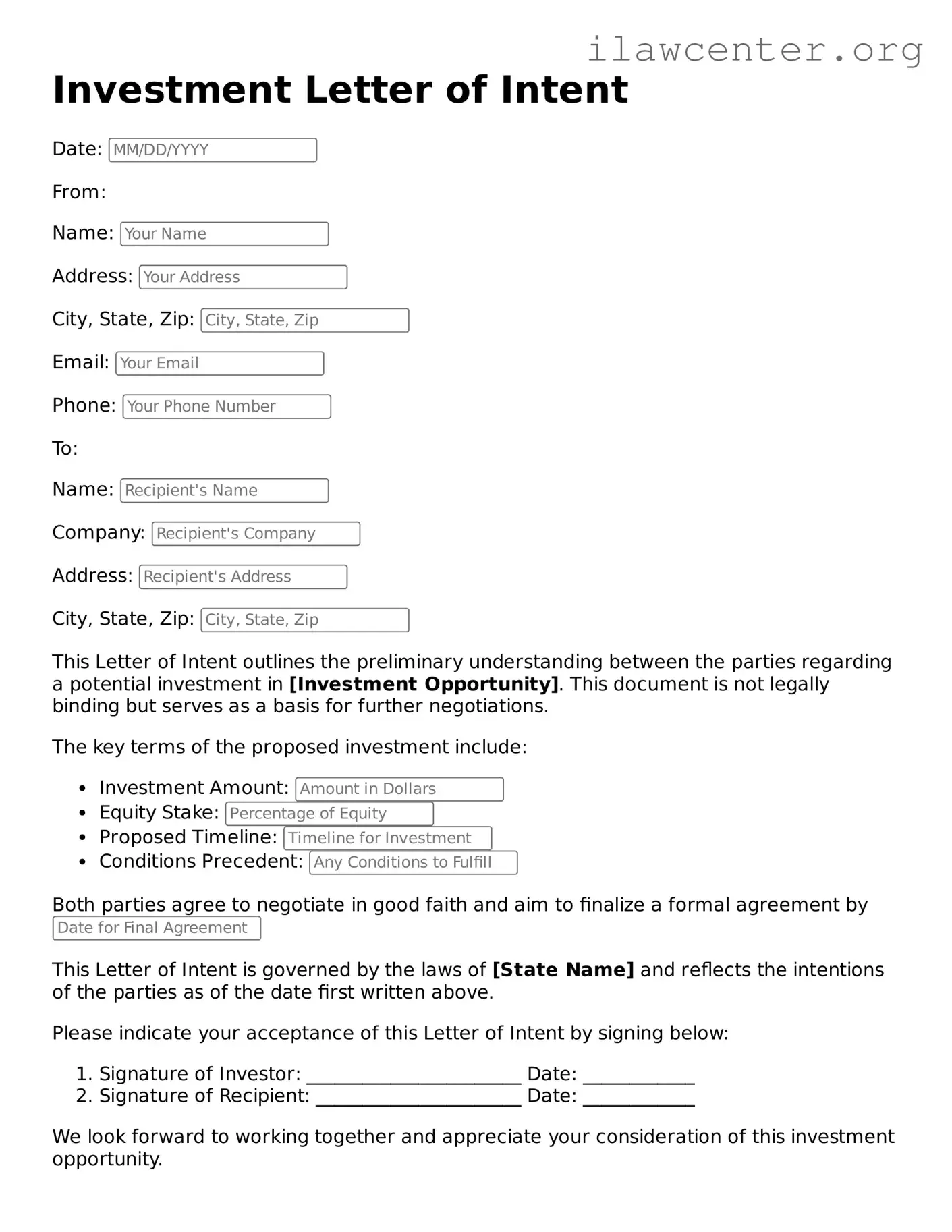
Investment Letter of Intent

Date:

From:

Name:

Address:

City, State, Zip:

Email:

Phone:

To:

Name:

Company:

Address:

City, State, Zip:

This Letter of Intent outlines the preliminary understanding between the parties regarding a potential investment in [Investment Opportunity]. This document is not legally binding but serves as a basis for further negotiations.

The key terms of the proposed investment include:

  • Investment Amount:
  • Equity Stake:
  • Proposed Timeline:
  • Conditions Precedent:

Both parties agree to negotiate in good faith and aim to finalize a formal agreement by

This Letter of Intent is governed by the laws of [State Name] and reflects the intentions of the parties as of the date first written above.

Please indicate your acceptance of this Letter of Intent by signing below:

  1. Signature of Investor: _______________________ Date: ____________
  2. Signature of Recipient: ______________________ Date: ____________

We look forward to working together and appreciate your consideration of this investment opportunity.

PDF Form Characteristics

Fact Name Description
Purpose The Investment Letter of Intent (LOI) serves as a preliminary agreement outlining the basic terms of an investment before formal contracts are drafted.
Non-Binding Nature Generally, an LOI is non-binding, meaning it expresses the intent to negotiate but does not create enforceable obligations.
Key Components Typical components include the investment amount, the structure of the investment, and any conditions precedent to closing.
Confidentiality Many LOIs include confidentiality clauses to protect sensitive information shared during negotiations.
Governing Law State-specific forms may reference governing laws; for example, California LOIs are often governed by California law.
Expiration Date LOIs typically include an expiration date, after which the terms may no longer be valid unless extended by mutual agreement.
Due Diligence The LOI often outlines the due diligence process, allowing the investor to assess the viability of the investment.
Investment Structure Investments can be structured in various ways, such as equity, debt, or convertible notes, depending on the agreement.
Negotiation Tool The LOI serves as a negotiation tool, helping both parties clarify their intentions and expectations before moving forward.
Legal Review While an LOI is often non-binding, it is advisable to have it reviewed by legal counsel to ensure clarity and alignment with the parties' intentions.

Instructions on Utilizing Investment Letter of Intent

Filling out the Investment Letter of Intent form is an important step in your investment process. Once you have completed the form, it will be submitted for review. This will help ensure that your intentions are clearly communicated and understood.

  1. Begin by writing your full name at the top of the form.
  2. Provide your current address, including city, state, and zip code.
  3. Enter your phone number and email address for contact purposes.
  4. Fill in the date of completion of the form.
  5. Clearly state the amount you intend to invest.
  6. Specify the type of investment you are interested in.
  7. Include any relevant details about your investment goals.
  8. Sign the form at the designated space to confirm your intentions.
  9. Review all the information you have provided to ensure accuracy.
  10. Submit the completed form to the appropriate contact as instructed.

Important Facts about Investment Letter of Intent

What is an Investment Letter of Intent form?

An Investment Letter of Intent form is a preliminary document that outlines the intentions of an investor to enter into a potential investment agreement. It typically includes key terms such as the amount of investment, the type of investment, and any conditions that must be met before the investment is finalized. While it is not a legally binding contract, it serves as a foundation for further negotiations and can help clarify the expectations of both parties involved.

Why is an Investment Letter of Intent important?

This form is important because it helps establish a mutual understanding between the investor and the recipient of the investment. It can streamline the negotiation process by clearly laying out the intentions and expectations of both parties. Additionally, it can help identify any potential issues early on, allowing both sides to address them before moving forward with a formal agreement.

What should be included in an Investment Letter of Intent form?

Essential elements of an Investment Letter of Intent form typically include the names of the parties involved, the amount of the proposed investment, the type of investment (such as equity or debt), and any specific conditions or milestones that need to be met. It may also outline the timeline for finalizing the investment and any confidentiality agreements that need to be adhered to during the negotiation process.

Is an Investment Letter of Intent legally binding?

Generally, an Investment Letter of Intent is not legally binding. It serves more as a statement of intent rather than a formal contract. However, certain sections of the letter, such as confidentiality clauses or exclusivity agreements, may be legally enforceable. It's crucial for both parties to understand which parts of the letter are binding and which are not before proceeding.
Common mistakes

Filling out the Investment Letter of Intent form can be a straightforward process, but several common mistakes can lead to complications. One frequent error is providing incomplete information. When applicants fail to fill in all required fields, it can cause delays in processing. Always double-check that every section is filled out completely before submitting.

Another common mistake is not clearly stating the investment amount. Ambiguity can create confusion and lead to misunderstandings. Specify the exact amount you intend to invest. This clarity helps ensure that all parties are on the same page and that there are no surprises later on.

People often overlook the importance of reviewing the terms and conditions associated with the investment. Ignoring these details can lead to unexpected obligations or risks. Make sure to read and understand the terms thoroughly. If something is unclear, seek clarification before signing.

Additionally, some individuals forget to sign the form. A missing signature can render the entire document invalid. Always ensure that you have signed where required. This step is crucial for the form to be legally binding.

Lastly, failing to keep a copy of the submitted form is a mistake that can have repercussions. Without a record, you may find it difficult to track the progress of your investment or address any issues that arise. Always retain a copy for your records, as it will serve as a reference point in the future.

Documents used along the form

When engaging in investment opportunities, various forms and documents are essential to ensure clarity and legal protection for all parties involved. The Investment Letter of Intent is just one part of a larger set of documents that help outline the terms and intentions of the investment. Below is a list of other common forms and documents that are often used in conjunction with the Investment Letter of Intent.

  • Confidentiality Agreement: This document protects sensitive information shared between parties. It ensures that any proprietary or confidential information remains private and cannot be disclosed without consent.
  • Term Sheet: A term sheet outlines the basic terms and conditions of the investment. It serves as a summary of the key points that will be included in the final agreement.
  • Subscription Agreement: This agreement is used when an investor agrees to purchase shares or units in a company or fund. It details the terms of the investment and the rights of the investor.
  • Due Diligence Checklist: This checklist helps investors evaluate the potential risks and benefits of an investment. It includes items that need to be reviewed, such as financial statements, contracts, and other relevant documents.
  • Operating Agreement: For limited liability companies (LLCs), this document outlines the management structure and operational procedures. It defines the roles and responsibilities of the members involved.
  • Shareholders' Agreement: This agreement governs the relationship between shareholders. It addresses issues such as voting rights, dividend distribution, and procedures for selling shares.
  • Investment Management Agreement: This document outlines the relationship between an investor and an investment manager. It specifies the manager's responsibilities, fees, and investment strategies.
  • Closing Statement: A closing statement summarizes the final terms of the investment transaction. It typically includes details about the funds being transferred and the obligations of each party at closing.

Understanding these documents can significantly enhance your investment experience. They provide a framework for collaboration and help mitigate potential disputes. Always consider consulting a professional when preparing or reviewing these documents to ensure your interests are well protected.

Similar forms

The Investment Letter of Intent form shares similarities with several other documents in the investment and business realm. Below is a list of six documents that have comparable functions or purposes:

  • Memorandum of Understanding (MOU): Like the Investment Letter of Intent, an MOU outlines the terms and conditions of a potential agreement between parties. It serves as a preliminary document that expresses mutual intent to collaborate.
  • Term Sheet: A term sheet summarizes the key terms and conditions of an investment deal. It is similar to the Investment Letter of Intent in that both serve as a starting point for negotiations and detail the essential aspects of a proposed transaction.
  • Non-Disclosure Agreement (NDA): An NDA protects confidential information shared between parties during negotiations. While the Investment Letter of Intent may not focus on confidentiality, both documents aim to establish a framework for trust and cooperation.
  • Purchase Agreement: This document formalizes the terms of a sale between a buyer and seller. It is similar to the Investment Letter of Intent in that both outline critical details regarding a transaction, although a Purchase Agreement is typically more binding.
  • Shareholder Agreement: A shareholder agreement governs the relationship between shareholders in a company. It shares similarities with the Investment Letter of Intent by outlining rights and responsibilities, particularly in the context of future investments.
  • Joint Venture Agreement: This agreement defines the terms of a partnership between two or more parties. Like the Investment Letter of Intent, it lays the groundwork for collaboration and specifies each party's contributions and obligations.

Dos and Don'ts

When filling out the Investment Letter of Intent form, it is essential to approach the task with care and attention to detail. Here are seven important do's and don'ts to keep in mind:

  • Do read the entire form carefully before starting. Understanding the requirements will help you provide the necessary information.
  • Don't rush through the process. Taking your time can prevent mistakes that may delay your investment.
  • Do provide accurate and complete information. Incomplete or incorrect details can lead to misunderstandings or complications.
  • Don't use vague language. Be clear and specific in your responses to ensure that your intentions are understood.
  • Do double-check your contact information. Ensure that all details are current and correct, so you can be easily reached.
  • Don't overlook the importance of signatures. Make sure to sign and date the form where required.
  • Do keep a copy of the completed form for your records. This will help you track your investment and serve as a reference in the future.

By following these guidelines, you can ensure that your Investment Letter of Intent is filled out correctly and efficiently, paving the way for a smooth investment process.

Misconceptions

Misconceptions about the Investment Letter of Intent form can lead to confusion among investors and businesses. Here are four common misunderstandings:

  • It is a legally binding document. Many people believe that signing an Investment Letter of Intent (LOI) creates a legally enforceable agreement. In reality, most LOIs are intended to outline the basic terms of a potential investment and are generally non-binding unless explicitly stated otherwise.
  • It guarantees funding. Another misconception is that submitting an LOI guarantees that funding will be provided. An LOI serves as an expression of interest, but it does not ensure that the investment will occur. Due diligence and further negotiations are typically required before any funding is finalized.
  • All terms are set in stone. Some individuals think that the terms outlined in an LOI cannot be changed. However, the purpose of an LOI is to facilitate discussions. Terms can be negotiated and adjusted as both parties move toward a final agreement.
  • It is only for large investments. Many assume that LOIs are only relevant for significant investments. In fact, they can be used for various types of investments, regardless of size. Small businesses and startups can also benefit from the clarity that an LOI provides.

Key takeaways

Filling out the Investment Letter of Intent form is a crucial step in the investment process. Here are some key takeaways to keep in mind:

  • Understand the Purpose: The form serves as a preliminary agreement outlining the terms and intentions of both parties before finalizing an investment.
  • Be Clear and Concise: Clearly state your investment goals and expectations to avoid misunderstandings later on.
  • Review All Sections: Ensure that you complete every section of the form. Incomplete forms can lead to delays or rejection of your investment proposal.
  • Seek Legal Guidance: If you are unsure about any part of the form, consulting a legal professional can provide clarity and help protect your interests.
  • Keep a Copy: Always retain a signed copy of the completed form for your records. This can be important for future reference.
  • Follow Up: After submitting the form, follow up to confirm receipt and discuss any next steps. This demonstrates your commitment and can facilitate the process.

These takeaways can help ensure that you navigate the investment process more effectively and with greater confidence.