Fillable IOU Document

Fillable IOU Document

An IOU form is a simple document that acknowledges a debt between two parties. It serves as a written promise to repay a specified amount of money at a later date. If you need to formalize a loan or debt agreement, consider filling out an IOU form by clicking the button below.

Article Guide

The IOU form is a simple yet powerful tool that plays a crucial role in personal and informal financial transactions. It serves as a written acknowledgment of a debt, enabling individuals to keep track of borrowed amounts and repayment agreements. With its straightforward structure, the form typically includes essential details such as the names of the parties involved, the amount owed, and the date by which repayment is expected. While it may lack the formalities of a legally binding contract, the IOU carries significant weight in establishing trust and accountability between parties. Often used among friends, family members, or colleagues, it fosters transparency in financial dealings and can prevent misunderstandings that might arise from verbal agreements. Moreover, the simplicity of the IOU form allows it to be easily customized to fit various situations, making it a versatile instrument in everyday financial interactions.

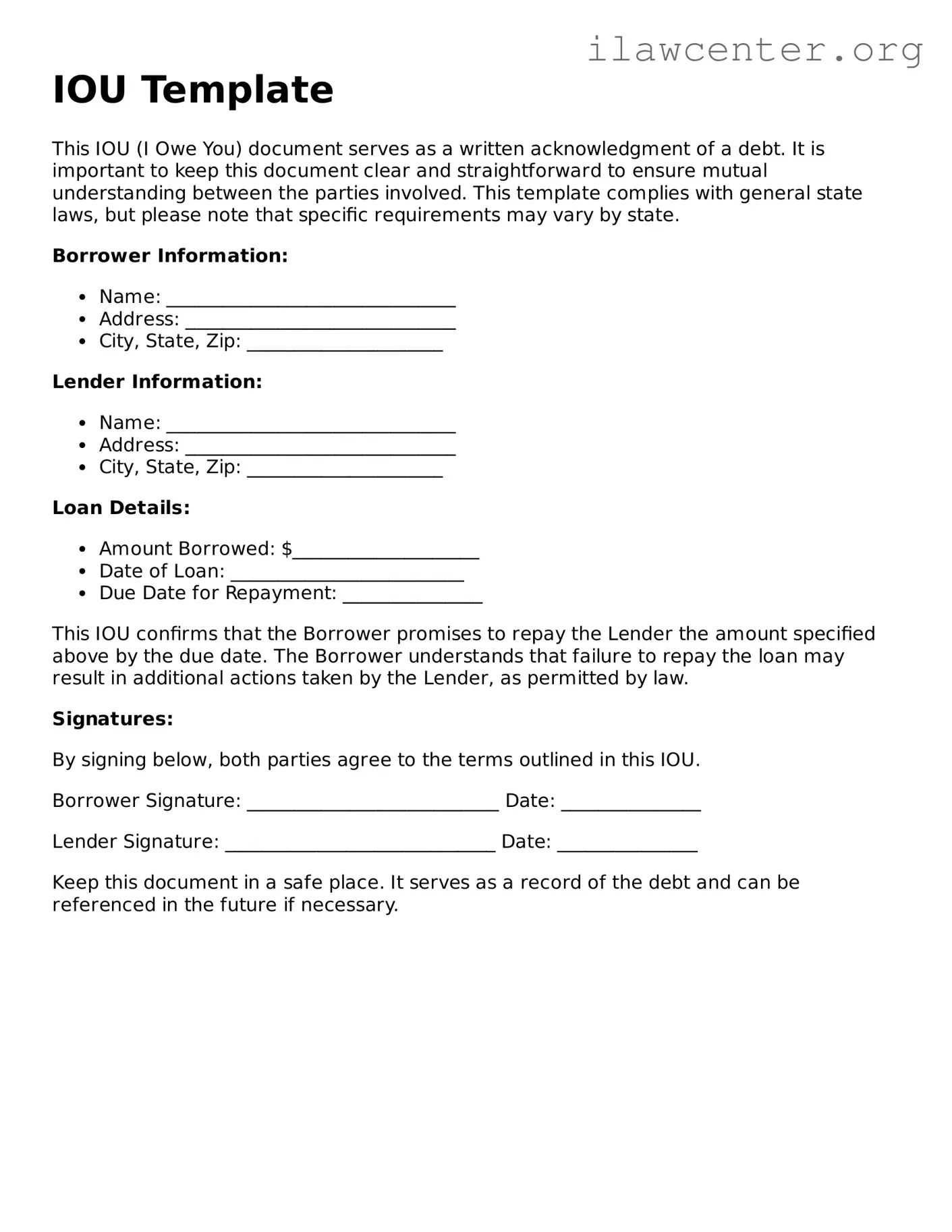
IOU Preview

IOU Template

This IOU (I Owe You) document serves as a written acknowledgment of a debt. It is important to keep this document clear and straightforward to ensure mutual understanding between the parties involved. This template complies with general state laws, but please note that specific requirements may vary by state.

Borrower Information:

  • Name: _______________________________
  • Address: _____________________________
  • City, State, Zip: _____________________

Lender Information:

  • Name: _______________________________
  • Address: _____________________________
  • City, State, Zip: _____________________

Loan Details:

  • Amount Borrowed: $____________________
  • Date of Loan: _________________________
  • Due Date for Repayment: _______________

This IOU confirms that the Borrower promises to repay the Lender the amount specified above by the due date. The Borrower understands that failure to repay the loan may result in additional actions taken by the Lender, as permitted by law.

Signatures:

By signing below, both parties agree to the terms outlined in this IOU.

Borrower Signature: ___________________________ Date: _______________

Lender Signature: _____________________________ Date: _______________

Keep this document in a safe place. It serves as a record of the debt and can be referenced in the future if necessary.

PDF Form Characteristics

Fact Name Description Governing Law
Definition An IOU is a simple document acknowledging a debt. It serves as a written promise to repay borrowed money. Varies by state
Legality IOUs are generally enforceable as contracts, provided they include essential elements like the amount owed and signatures. Contract law, varies by state
Informality Unlike formal loan agreements, IOUs do not require a specific format or legal language. They can be handwritten. N/A
Limitations IOUs may not be sufficient for large sums of money. In some cases, a more formal agreement is advisable. Varies by state
State-Specific Forms Some states may have specific requirements for IOUs, such as notarization or specific wording. State-specific laws

Instructions on Utilizing IOU

Once you have the IOU form in front of you, it’s time to fill it out accurately. Completing this form correctly will ensure that both parties have a clear understanding of the agreement. Follow these steps carefully to make sure all necessary information is included.

  1. Start with the date: Write the date on which the IOU is being created at the top of the form.
  2. Identify the borrower: Clearly print the full name of the person who is borrowing the money.
  3. Identify the lender: Clearly print the full name of the person who is lending the money.
  4. Specify the amount: Write the exact amount of money being borrowed in both numbers and words to avoid any confusion.
  5. State the repayment terms: Include details about when the money will be repaid and any interest that may apply.
  6. Signatures: Both the borrower and the lender should sign the form to make it official. Include the date next to each signature.
  7. Make copies: After filling out the form, make copies for both parties to keep for their records.

Important Facts about IOU

What is an IOU form?

An IOU form is a simple, informal document that acknowledges a debt. It typically includes the amount owed, the names of the parties involved, and the date the debt was incurred. While not a legally binding contract, it serves as a written reminder of the obligation and can help prevent misunderstandings between the borrower and lender.

When should I use an IOU form?

You should consider using an IOU form when you lend money to someone or when you borrow money from someone. It’s particularly useful for personal loans between friends or family members, where a formal contract may feel too formal or unnecessary. An IOU can clarify the terms of the loan and provide a record of the transaction.

Is an IOU form legally binding?

What information should be included in an IOU form?

An effective IOU form should include several key pieces of information. First, clearly state the amount of money owed. Next, include the names of both the lender and the borrower. It’s also helpful to add the date the loan was made and any repayment terms, such as a deadline for repayment or interest rates, if applicable. Finally, both parties should sign and date the document to acknowledge their agreement.

Can an IOU be modified after it is signed?

Yes, an IOU can be modified after it is signed, but both parties must agree to any changes. It’s best to document any modifications in writing and have both parties sign the updated IOU. This helps maintain clarity and ensures that everyone is on the same page regarding the new terms.

What should I do if the borrower does not repay the IOU?

If the borrower fails to repay the IOU, the first step is to communicate with them. Sometimes, a simple reminder is all that’s needed. If that doesn’t work, you may consider discussing a new repayment plan. If the situation does not resolve, you might explore legal options, but keep in mind that enforcing an IOU can be challenging due to its informal nature. Seeking advice from a legal professional can provide guidance tailored to your specific situation.

Common mistakes

Filling out an IOU form can seem straightforward, but many people make common mistakes that can lead to confusion or disputes later on. One frequent error is failing to include the full names of both parties involved. It is essential to clearly identify who owes the money and who is owed to avoid any misunderstandings.

Another mistake is omitting the amount owed. Without a specific dollar figure, the IOU lacks clarity. This can create problems if the borrower and lender have different expectations about the amount. Always write the amount clearly and double-check it for accuracy.

People often forget to include the date of the transaction. The date is crucial as it establishes when the debt was incurred. Not having a date can lead to disputes about when repayment is due.

Additionally, some individuals neglect to specify the repayment terms. Whether the borrower will pay back the debt in full or in installments should be clearly stated. This helps both parties understand the expectations regarding repayment.

Another common oversight is not signing the form. An unsigned IOU can be difficult to enforce. Both parties should sign the document to confirm their agreement and acknowledge the debt.

In some cases, people fail to provide contact information. Including phone numbers or email addresses can facilitate communication if any issues arise regarding the repayment.

Some individuals write the IOU in a vague or informal manner. Using clear and precise language is vital. Ambiguities can lead to different interpretations, which can cause conflicts down the line.

Another mistake is not keeping a copy of the signed IOU. Both parties should retain a copy for their records. This ensures that everyone has access to the same information regarding the debt.

People may also overlook the importance of witnesses. Having a neutral third party sign the IOU can add an extra layer of credibility and serve as proof of the agreement.

Finally, failing to review the completed form before finalizing it is a common error. A thorough review can help catch any mistakes or omissions, ensuring that the IOU is accurate and enforceable.
Documents used along the form

An IOU form is a simple acknowledgment of a debt. While it serves its purpose well, there are several other documents that can complement it or provide additional clarity regarding financial transactions. Below is a list of forms and documents that are often used alongside an IOU.

  • Promissory Note: This is a written promise to pay a specified amount of money to a designated person at a particular time. It includes terms such as interest rates and repayment schedules.
  • Loan Agreement: A more detailed document than an IOU, it outlines the terms of a loan, including the amount borrowed, interest rates, repayment terms, and consequences of default.
  • Payment Plan Agreement: This document details how a borrower will repay a debt over time, including installment amounts and due dates.
  • Receipt: A receipt serves as proof of payment. It confirms that a transaction has occurred and can be useful for both the lender and borrower for record-keeping.
  • Bill of Sale: This document is used to transfer ownership of an item from one party to another. It can be relevant when the debt involves a specific asset.
  • Collateral Agreement: If a loan is secured with collateral, this document specifies the asset being used as security for the loan, along with terms regarding its use.
  • Debt Acknowledgment Letter: This letter serves as a formal acknowledgment of the debt, often used when the IOU is not sufficient for legal purposes.
  • Guarantor Agreement: If someone is backing the loan, this document outlines the responsibilities of the guarantor in case the borrower defaults.
  • Default Notice: This document is issued when a borrower fails to meet the terms of the agreement, detailing the consequences and next steps.
  • Settlement Agreement: If a borrower and lender agree to change the terms of repayment or settle the debt for a lesser amount, this document outlines those new terms.

Understanding these documents can help both lenders and borrowers navigate their financial agreements more effectively. Each serves a unique purpose and can provide additional security and clarity in financial transactions.

Similar forms

The IOU form is a simple yet effective way to acknowledge a debt. It serves as a written promise to pay back a specified amount of money. There are several other documents that share similarities with the IOU form, each serving a unique purpose in financial transactions. Below are four documents that are comparable to the IOU form:

  • Promissory Note: This is a formal document in which one party promises to pay a specific sum of money to another party at a future date or on demand. Like an IOU, it outlines the amount owed and the repayment terms, but it often includes interest rates and specific payment schedules.
  • Loan Agreement: A loan agreement is a comprehensive document that details the terms of a loan between a lender and a borrower. It includes the loan amount, interest rates, repayment terms, and conditions for default. While an IOU is simpler, a loan agreement provides more legal protection and clarity for both parties.
  • Receipt: A receipt is a document that acknowledges payment for goods or services. Although it serves a different purpose than an IOU, it confirms that a transaction has occurred. Both documents serve as proof of financial exchanges, but a receipt indicates that payment has been made, whereas an IOU indicates a promise to pay.
  • Bill of Exchange: This is a written order from one party to another to pay a specified sum of money at a predetermined time. It is similar to an IOU in that it represents a financial obligation. However, a bill of exchange is typically used in international trade and can involve multiple parties, making it more complex than an IOU.

Each of these documents plays a role in financial transactions, providing clarity and structure to the borrowing and lending process. Understanding their similarities and differences can help individuals navigate their financial obligations more effectively.

Dos and Don'ts

When filling out an IOU form, it is essential to approach the task with care and attention to detail. Below are some guidelines that can help ensure the process is smooth and effective.

  • Do provide clear and legible handwriting. This ensures that all parties can easily read the information.
  • Do include the date of the agreement. A specific date helps establish when the debt was incurred.
  • Do specify the amount owed. Clearly stating the sum prevents any misunderstandings later on.
  • Do include the names and contact information of both parties. This promotes accountability and facilitates communication.
  • Don't leave any fields blank. Missing information can lead to confusion and disputes in the future.
  • Don't use vague language. Be precise about the terms of repayment to avoid ambiguity.

By following these guidelines, you can create a clear and effective IOU that protects the interests of all parties involved.

Misconceptions

When it comes to IOU forms, several misconceptions can lead to confusion. Here are four common misunderstandings:

  • IOUs are legally binding contracts. Many people believe that an IOU serves as a formal contract. However, while it indicates a promise to repay a debt, it lacks the detailed terms and conditions typically found in legal contracts. This can make enforcement more complicated.
  • IOUs must be in writing. Some think that an IOU must be a written document to be valid. In reality, an IOU can be verbal. However, having it in writing is always advisable, as it provides clear evidence of the agreement.
  • IOUs are only for small amounts. Another misconception is that IOUs are only appropriate for minor debts. In fact, they can be used for any amount. Whether it's a small favor or a significant loan, an IOU can serve as a record of the agreement.
  • All IOUs are the same. Not all IOUs are created equal. The details included in an IOU can vary widely. Some may specify repayment terms, while others might not. Clarity and specificity can help avoid misunderstandings down the line.

Understanding these misconceptions can help individuals navigate their financial agreements more effectively.

Key takeaways

When dealing with an IOU form, it is essential to understand its purpose and how to use it effectively. Here are some key takeaways:

  • The IOU form serves as a simple acknowledgment of a debt.
  • Both parties should clearly state the amount owed and the purpose of the loan.
  • It is important to include the date when the debt was incurred.
  • Signatures from both the lender and the borrower provide validation to the agreement.
  • Keep a copy of the signed IOU for your records.
  • Be clear about repayment terms, including any interest rates if applicable.
  • Consider discussing repayment timelines to avoid misunderstandings.
  • Using an IOU form can help maintain trust and transparency in personal financial relationships.