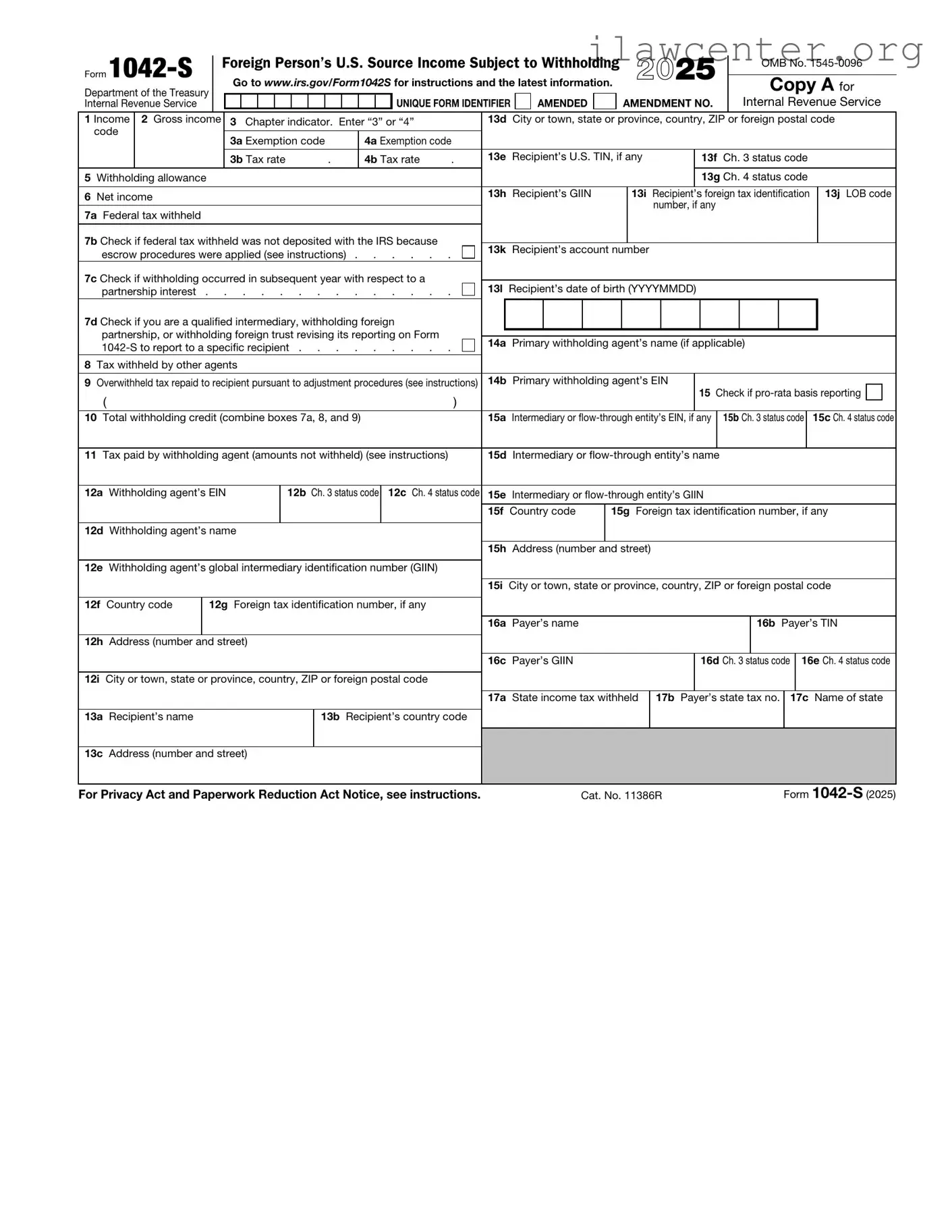



IRS 1042-S PDF Template

IRS 1042-S PDF Template

The IRS 1042-S form is a tax document used to report income paid to foreign persons, including non-resident aliens and foreign entities. This form is essential for ensuring compliance with U.S. tax regulations regarding withholding and reporting of income. If you need to fill out the 1042-S form, click the button below for assistance.

Article Guide

The IRS 1042-S form plays a crucial role in the tax reporting landscape, particularly for foreign individuals and entities receiving income from U.S. sources. This form is primarily used to report income that is subject to withholding, such as interest, dividends, royalties, and certain types of compensation. It serves as a vital tool for ensuring compliance with U.S. tax laws, as it details the amounts paid and the taxes withheld on those payments. For non-resident aliens and foreign entities, understanding the 1042-S form is essential, as it impacts their tax obligations and eligibility for tax treaties. Additionally, payers of such income, often referred to as withholding agents, must accurately complete and submit this form to the IRS and provide copies to the recipients. By doing so, they help maintain transparency in international financial transactions while adhering to regulatory requirements. Overall, the IRS 1042-S form is not just a piece of paperwork; it is a significant component of the broader tax system that ensures fair and lawful reporting of income across borders.

IRS 1042-S Preview


Foreign Person’s U.S. Source Income Subject to Withholding

2025


OMB No. 1545-0096


Department of the Treasury


Copy A for

Form 1042-S


Go to www.irs.gov/Form1042S for instructions and the latest information.


Internal Revenue Service


UNIQUE FORM IDENTIFIER

AMENDED


AMENDMENT NO.


Internal Revenue Service


1 Income

2 Gross income


3 Chapter indicator. Enter “3” or “4”


13d City or town, state or province, country, ZIP or foreign postal code

code


3a Exemption code


4a Exemption code


3b Tax rate

.


4b Tax rate

.


13e Recipient’s U.S. TIN, if any


13f

Ch. 3 status code


5 Withholding allowance


13g Ch. 4 status code


6 Net income


13h

Recipient’s GIIN


13i

Recipient’s foreign tax identification

13j LOB code


number, if any


7a Federal tax withheld


7b Check if federal tax withheld was not deposited with the IRS because


13k Recipient’s account number


escrow procedures were applied (see instructions)


7c Check if withholding occurred in subsequent year with respect to a


13l Recipient’s date of birth (YYYYMMDD)


partnership interest .

. . . . . . . . . . . . .


7d Check if you are a qualified intermediary, withholding foreign


partnership, or withholding foreign trust revising its reporting on Form


14a Primary withholding agent’s name (if applicable)

1042-S to report to a specific recipient


8Tax withheld by other agents

9 Overwithheld tax repaid to recipient pursuant to adjustment procedures (see instructions)

14b

Primary withholding agent’s EIN

15 Check if pro-rata basis reporting


(


)


10

Total withholding credit (combine boxes 7a, 8, and 9)


15a

Intermediary or flow-through entity’s EIN, if any

15b Ch. 3 status code

15c Ch. 4 status code


11

Tax paid by withholding agent (amounts not withheld) (see instructions)

15d

Intermediary or flow-through entity’s name


12a Withholding agent’s EIN

12b Ch. 3 status code

12c Ch. 4 status code

15e

Intermediary or flow-through entity’s GIIN


15f Country code

15g Foreign tax identification number, if any


12d Withholding agent’s name


15h

Address (number and street)

12e Withholding agent’s global intermediary identification number (GIIN)


15i

City or town, state or province, country, ZIP or foreign postal code


12f Country code

12g Foreign tax identification number, if any


16a Payer’s name


16b Payer’s TIN


12h

Address (number and street)


16c Payer’s GIIN

16d Ch. 3 status code


16e Ch. 4 status code


12i

City or town, state or province, country, ZIP or foreign postal code


17a State income tax withheld

17b Payer’s state tax no.


17c Name of state


13a

Recipient’s name


13b Recipient’s country code


13c

Address (number and street)


For Privacy Act and Paperwork Reduction Act Notice, see instructions.

Cat. No. 11386R


Form 1042-S (2025)

Form 1042-S


Foreign Person’s U.S. Source Income Subject to Withholding

2025


OMB No. 1545-0096


Go to www.irs.gov/Form1042S for instructions and the latest information.


Copy B

Department of the Treasury


Internal Revenue Service


UNIQUE FORM IDENTIFIER


AMENDED


AMENDMENT NO.


for Recipient


1 Income

2 Gross income


3 Chapter indicator. Enter “3” or “4”


13d City or town, state or province, country, ZIP or foreign postal code

code


3a Exemption code


4a Exemption code


3b Tax rate

.


4b Tax rate

.


13e Recipient’s U.S. TIN, if any


13f

Ch. 3 status code


5 Withholding allowance


13g Ch. 4 status code


6 Net income


13h

Recipient’s GIIN


13i

Recipient’s foreign tax identification

13j LOB code


number, if any


7a Federal tax withheld


7b Check if federal tax withheld was not deposited with the IRS because


13k Recipient’s account number


escrow procedures were applied (see instructions)


7c Check if withholding occurred in subsequent year with respect to a


13l Recipient’s date of birth (YYYYMMDD)


partnership interest .

. . . . . . . . . . . . .


7d Check if you are a qualified intermediary, withholding foreign


partnership, or withholding foreign trust revising its reporting on Form


14a Primary withholding agent’s name (if applicable)

1042-S to report to a specific recipient


8Tax withheld by other agents

9 Overwithheld tax repaid to recipient pursuant to adjustment procedures (see instructions)

14b

Primary withholding agent’s EIN

15 Check if pro-rata basis reporting


(


)


10

Total withholding credit (combine boxes 7a, 8, and 9)


15a

Intermediary or flow-through entity’s EIN, if any

15b Ch. 3 status code

15c Ch. 4 status code


11

Tax paid by withholding agent (amounts not withheld) (see instructions)

15d

Intermediary or flow-through entity’s name


12a Withholding agent’s EIN

12b Ch. 3 status code

12c Ch. 4 status code

15e

Intermediary or flow-through entity’s GIIN


15f Country code

15g Foreign tax identification number, if any


12d Withholding agent’s name


15h

Address (number and street)

12e Withholding agent’s global intermediary identification number (GIIN)


15i City or town, state or province, country, ZIP or foreign postal code


12f Country code


12g Foreign tax identification number, if any


16a Payer’s name


16b Payer’s TIN


12h

Address (number and street)


16c Payer’s GIIN


16d Ch. 3 status code


16e Ch. 4 status code


12i

City or town, state or province, country, ZIP or foreign postal code


17a State income tax withheld

17b Payer’s state tax no.


17c Name of state


13a

Recipient’s name


13b Recipient’s country code


13c

Address (number and street)


(keep for your records)


Form 1042-S (2025)

Types of Income

U.S. Income Tax Filing Requirements

Generally, every nonresident alien individual, nonresident alien fiduciary, and foreign corporation with U.S. income, including income that is effectively connected with the conduct of a trade or business in the United States, must file a U.S. income tax return. However, a return is generally not required to be filed by a nonresident alien individual, nonresident alien fiduciary, or foreign corporation if such person was not engaged in a trade or business in the United States at any time during the tax year and if the tax liability of such person was fully satisfied by the withholding of U.S. tax at the source. See the instructions for Forms 1120-F and 1040-NR for more information. Corporations file Form 1120-F; all others file Form 1040-NR. You may get the return forms and instructions at IRS.gov, at any U.S. Embassy or consulate, or by writing to: Internal Revenue Service, 1201 N. Mitsubishi Motorway, Bloomington, IL 61705-6613.

En règle générale, toute personne physique étrangère non résidente, tout fiduciaire étranger non résident et toute société étrangère ayant des revenus américains, y compris des revenus effectivement liés à la conduite d’un commerce ou d’une entreprise aux États-Unis, doit déposer une déclaration d’impôt sur le revenu aux États-Unis. Toutefois, une déclaration n’est généralement pas requise de la part d’un particulier étranger non résident, d’un fiduciaire étranger non résident ou d’une société étrangère si cette personne n’a pas exercé d’activité commerciale aux États-Unis à un moment quelconque de l’année fiscale et si l’obligation fiscale de cette personne a été entièrement satisfaite par la retenue à la source de l’impôt américain. Voir les instructions des formulaires 1120F et 1040NR pour plus d’informations. Les sociétés déposent le formulaire 1120-F; toutes les autres déposent le formulaire 1040-NR. Vous pouvez obtenir les formulaires de déclaration et les instructions sur le site IRS.gov, dans n’importe quel bureau de poste des États-Unis, ou en écrivant à l’ambassade ou au consulat de l’Union européenne: Internal Revenue Service, 1201 N. Mitsubishi Motorway, Bloomington, IL 61705-6613.

Explanation of Codes

Box 1. Income Code.

Code

01Interest paid by U.S. obligors—general

02Interest paid on real property mortgages

03Interest paid to controlling foreign corporations

04Interest paid by foreign corporations

05Interest on tax-free covenant bonds


22

Interest paid on deposit with a foreign branch of a domestic

Interest

30

corporation or partnership

Original issue discount (OID)


29

Deposit interest


31

Short-term OID


33

Substitute payment—interest


51

Interest paid on certain actively traded or publicly offered


securities1


54

Substitute payments—interest from certain actively traded


or publicly offered securities1

Dividend

06

Dividends paid by U.S. corporations—general

07

Dividends qualifying for direct dividend rate


08

Dividends paid by foreign corporations

Por lo general, toda persona que es un extranjero no residente, todo fiduciario extranjero no residente, y toda sociedad anónima extranjera que perciba ingresos estadounidenses, inclusive de los ingresos que son efectivamente conectados con la operación de un comercio o negocio ubicado en los Estados Unidos, debe presentar una declaración del impuesto estadounidense sobre los ingresos. Sin embargo, por lo general no se requiere que un individuo extranjero no residente, una sociedad anónima extranjera u organismo fideicomisario extranjero no residente presenten una declaración si dicha persona no participaba en ningún comercio o negocio ubicado en los Estados Unidos en ningún momento durante el año tributario, y la responsabilidad tributaria de dicha persona fuera liquidada completamente mediante la retención del impuesto estadounidense en la fuente del ingreso. Consulte las instrucciones de los Formularios 1120F y 1040-NR para obtener más información. Las sociedades anónimas presentan el Formulario 1120-F, todos los demás presentan el Formulario 1040-NR. Puede obtener los formularios de declaración y sus instrucciones en IRS.gov, en cualquier embajada o consulado de los Estados Unidos, o al escribir al: Internal Revenue Service, 1201 N. Mitsubishi Motorway, Bloomington, IL 61705-6613.

Grundsätzlich muss jede natürliche Person ohne Wohnsitz im Land, jeder Treuhänder ohne Wohnsitz im Land und jede ausländische Gesellschaft mit Einkünften in den USA, einschließlich Einkünften, die tatsächlich mit der Ausübung einer gewerblichen oder geschäftlichen Tätigkeit in den Vereinigten Staaten in Zusammenhang stehen, eine US-Einkommensteuererklärung einreichen. Eine Steuererklärung muss jedoch von einem nicht in den USA ansässigen Ausländer, einem nicht in den USA ansässigen Treuhänder oder einem ausländischen Unternehmen im Allgemeinen nicht eingereicht werden, wenn diese Person zu keinem Zeitpunkt während des Steuerjahres in den Vereinigten Staaten einer gewerblichen oder geschäftlichen Tätigkeit nachgegangen ist und die Steuerschuld dieser Person durch den Einbehalt der US-Quellensteuer vollständig beglichen wurde. Weitere Informationen finden Sie in den Anweisungen für die Formulare 1120F und 1040NR. Unternehmen reichen das Formular 1120-F ein, alle anderen reichen das Formular 1040-NR ein. Sie können die Rücksendeformulare und Anweisungen auf IRS.gov erhalten, auf jeder US-Botschaft oder Konsulat oder schriftlich an: Internal Revenue Service, 1201 N. Mitsubishi Motorway, Bloomington, IL 61705-6613.


34

Substitute payment—dividends


40

Other dividend equivalents under IRC section 871(m)

Dividend

52

Dividends paid on certain actively traded or publicly offered


securities1


53

Substitute payments—dividends from certain actively traded


or publicly offered securities1


56

Dividend equivalents under IRC section 871(m) as a result of


applying the combined transaction rules


09

Capital gains


10

Industrial royalties


11

Motion picture or television copyright royalties


12

Other royalties (for example, copyright, software,


broadcasting, endorsement payments)

Other

13

Royalties paid on certain publicly offered securities1

14

Real property income and natural resources royalties


15

Pensions, annuities, alimony, and/or insurance premiums


16

Scholarship or fellowship grants


17

Compensation for independent personal services2


18

Compensation for dependent personal services2


19

Compensation for teaching2

See back of Copy C for additional codes

1This code should only be used if the income paid is described in Regulations section 1.1441-6(c)(2) and the withholding agent has reduced the rate of withholding under an income tax treaty without the recipient providing a U.S. TIN or an FTIN.

2If compensation that would otherwise be covered under Income Codes 17 through 20 is directly attributable to the recipient’s occupation as an artist or athlete, use Income Code 42 or 43 instead.

File Properties

Fact Name Description
Purpose The IRS 1042-S form is used to report income paid to foreign persons, including non-resident aliens and foreign entities.
Filing Deadline The form must be filed by March 15 of the year following the payment of income.
Income Types It reports various types of income such as interest, dividends, royalties, and compensation for services.
Recipient Information The form requires detailed information about the recipient, including their name, address, and taxpayer identification number.
State-Specific Forms Some states may require additional forms or documentation based on their tax laws. Always check local regulations.
Penalties Failure to file the 1042-S form accurately and on time can result in penalties from the IRS.

Instructions on Utilizing IRS 1042-S

After gathering the necessary information, you can begin filling out the IRS 1042-S form. This form is used for reporting income and withholding for foreign persons. Ensure that all details are accurate to avoid any issues with the IRS.

  1. Obtain a copy of the IRS 1042-S form. This can be downloaded from the IRS website or obtained from a tax professional.
  2. Fill in the recipient's name in the designated field. This should be the name of the foreign person receiving the income.
  3. Provide the recipient's address. Include the street address, city, state, and postal code.
  4. Enter the recipient's country of residence. This should be the country where the recipient is a tax resident.
  5. In the payer's information section, fill in your name or the name of the business that is making the payment.
  6. Complete the payer's address section with the appropriate details, including street address, city, state, and postal code.
  7. Indicate the type of income being reported. This could include amounts like dividends, interest, or royalties.
  8. Report the gross income amount in the appropriate box. This should reflect the total income paid to the recipient.
  9. Enter the withholding tax amount in the designated box. This is the amount withheld from the gross income.
  10. Complete any additional fields as required, such as the tax treaty information if applicable.
  11. Review the form for accuracy. Ensure all information is correct and complete.
  12. Sign and date the form at the bottom. This certifies that the information provided is true and correct.
  13. Submit the form to the IRS and provide a copy to the recipient.

Important Facts about IRS 1042-S

What is the IRS 1042-S form?

The IRS 1042-S form is used to report income that is subject to withholding tax for non-resident aliens and foreign entities. This form is particularly relevant for payments such as interest, dividends, royalties, and certain other types of income. It helps the IRS track tax obligations for foreign individuals or entities receiving income from U.S. sources.

Who needs to file the 1042-S form?

Any U.S. withholding agent, which can be an individual or an entity, that makes payments to non-resident aliens or foreign entities must file the 1042-S form. This includes banks, businesses, and other organizations that pay out income subject to U.S. withholding tax. If you are a foreign recipient of such income, you should receive a copy of this form from the withholding agent.

When is the 1042-S form due?

The 1042-S form must be filed with the IRS by March 15 of the year following the payment. Additionally, recipients of the form should receive their copies by the same date. It’s crucial to adhere to these deadlines to avoid penalties and ensure compliance with tax regulations.

What information is included on the 1042-S form?

The 1042-S form includes several key pieces of information, such as the name and address of the recipient, the amount of income paid, the type of income, and the amount of tax withheld. This data helps both the IRS and the recipient understand the tax implications of the income received.

What should I do if I receive a 1042-S form?

If you receive a 1042-S form, it is important to review it carefully. Ensure that all information is accurate, including your name, address, and the amounts reported. If you believe there are errors, contact the withholding agent for corrections. Additionally, use the information on the form to accurately report your income on your tax return, if applicable.

Common mistakes

Filling out the IRS 1042-S form can be a daunting task for many, especially for those unfamiliar with tax regulations. One common mistake is failing to provide accurate recipient information. This includes the name, address, and taxpayer identification number (TIN) of the foreign person receiving income. If any of this information is incorrect or incomplete, it can lead to significant delays in processing and potential penalties. Ensuring that these details are precise is crucial for compliance.

Another frequent error involves misclassifying the type of income being reported. The IRS 1042-S form is designed to report various types of income, such as interest, dividends, and royalties. Each category has specific rules and tax rates associated with it. Misunderstanding these classifications can lead to incorrect tax withholding rates being applied. It is essential to review the IRS guidelines carefully to ensure that the income is categorized correctly.

Additionally, many individuals overlook the importance of accurate withholding amounts. The form requires the reporting of the amount withheld from payments made to foreign persons. If the withholding amount is underreported, it could result in penalties for both the payer and the recipient. On the other hand, overreporting can lead to unnecessary complications and potential refunds that may not be easily processed. Careful calculations and adherence to the appropriate withholding rates are vital.

Finally, a lack of attention to deadlines can create serious issues. The IRS has specific timelines for when the 1042-S form must be filed, typically by March 15 of the year following the payment. Missing this deadline can result in penalties and interest on any taxes owed. To avoid this mistake, it is advisable to keep a calendar reminder and prepare the form well in advance. Staying organized can help ensure compliance and prevent unnecessary stress.

Documents used along the form

The IRS 1042-S form is crucial for reporting income paid to non-resident aliens and foreign entities. However, it is often accompanied by several other forms and documents that help provide a complete picture of tax obligations and compliance. Below is a list of commonly used forms and documents that may accompany the 1042-S form, each serving a specific purpose in the tax reporting process.

  • Form W-8BEN: This form is used by non-resident aliens to certify their foreign status and claim any applicable tax treaty benefits. It helps determine the correct withholding tax rate on payments received.
  • Form W-8ECI: This form is for foreign entities that receive income effectively connected with a trade or business in the United States. It allows them to avoid withholding on that income.
  • Form 1042: This is the Annual Withholding Tax Return for U.S. Source Income of Foreign Persons. It summarizes the amounts withheld and reported on the 1042-S forms throughout the year.
  • Form 1042-T: This form is a summary of all 1042-S forms filed. It is submitted to the IRS along with the 1042 form, providing a consolidated view of withholding tax information.
  • Form 1099: While the 1042-S is specific to non-residents, the 1099 series is used for reporting various types of income paid to U.S. persons. Understanding both forms is essential for accurate tax reporting.
  • Tax Treaty Documentation: Documentation that outlines the specific provisions of tax treaties between the U.S. and foreign countries can be vital for determining eligibility for reduced withholding rates.
  • Supporting Documentation: This may include invoices, contracts, or payment records that substantiate the income reported on the 1042-S form. Such documentation can be crucial in case of audits or inquiries.

Understanding these forms and documents enhances compliance and accuracy in tax reporting. Each plays a unique role in ensuring that non-resident aliens and foreign entities meet their tax obligations while taking advantage of any benefits afforded by international agreements.

Similar forms

The IRS 1042-S form is used to report income paid to non-resident aliens and foreign entities. Several other tax forms share similarities with the 1042-S in terms of purpose or reporting requirements. Below is a list of nine documents that are comparable to the 1042-S:

  • Form 1099-MISC: This form reports miscellaneous income, including payments to independent contractors and freelancers, similar to how the 1042-S reports income to foreign individuals.
  • Form 1099-INT: Used to report interest income, this form serves a similar function for reporting payments made to individuals, much like the 1042-S for foreign recipients.
  • Form 1099-DIV: This document reports dividends and distributions to shareholders. It parallels the 1042-S in that both forms report income received by individuals from various sources.
  • Form W-2: Issued to employees, the W-2 reports wages and tax withholding. Like the 1042-S, it provides essential information about income, though it focuses on domestic employees.
  • Form 1042: This is the annual return that summarizes all 1042-S forms issued. It is directly related to the 1042-S, as it consolidates the information reported for multiple payees.
  • Form 8804: This form is for reporting income tax liability for partnerships that have foreign partners. It shares similarities with the 1042-S in its focus on foreign entities.
  • Form 1040-NR: Non-resident aliens use this form to file their income tax return. It relates to the 1042-S, as it is often completed based on the income reported on the 1042-S.
  • Form 1099-G: This form reports certain government payments, such as unemployment compensation. Like the 1042-S, it documents income received by individuals from specific sources.
  • Form 1099-R: This form reports distributions from retirement accounts. It is similar to the 1042-S in that it details income received, though it focuses on retirement-related payments.

Dos and Don'ts

When filling out the IRS 1042-S form, it's important to get it right. Here’s a helpful list of things to do and things to avoid.

  • Do double-check all information for accuracy.
  • Do ensure that you have the correct recipient's information.
  • Do use the latest version of the form.
  • Do report all income accurately, including any withholding.
  • Don't leave any fields blank unless instructed.
  • Don't forget to sign and date the form.
  • Don't ignore the submission deadline.

Following these tips can help ensure your form is completed correctly and submitted on time. Good luck!

Misconceptions

The IRS 1042-S form is often misunderstood. Here are ten common misconceptions about this important tax document:

  1. Only foreign individuals need to file the 1042-S.

    In reality, this form is used to report income paid to foreign persons, but U.S. entities may also have to file it if they make payments to non-residents.

  2. The 1042-S is only for non-resident aliens.

    This form applies to any foreign entity or individual receiving U.S. source income, not just non-resident aliens.

  3. You don’t need to file if you didn’t earn income in the U.S.

    If you received U.S. source income, you still need to report it, even if you didn’t earn any income while in the U.S.

  4. The 1042-S replaces the W-2 form.

    These forms serve different purposes. The W-2 is for reporting wages paid to employees, while the 1042-S is for reporting payments to foreign persons.

  5. All payments reported on the 1042-S are subject to withholding tax.

    Not all payments are taxable. Some may be exempt from withholding due to tax treaties.

  6. Filing the 1042-S is optional.

    This is incorrect. If you are required to report payments to foreign persons, filing is mandatory.

  7. You can file the 1042-S at any time.

    There are strict deadlines for filing this form. It must be submitted to the IRS by March 15 of the year following the payment.

  8. Receiving a 1042-S means you owe taxes.

    Receiving this form does not automatically mean you owe taxes. It merely reports income, and your tax liability depends on various factors.

  9. Only one 1042-S can be issued per recipient.

    Multiple 1042-S forms can be issued if a recipient has received different types of income from various sources.

  10. The information on the 1042-S is not important.

    In fact, the information is crucial for the recipient’s tax filings and can affect their tax obligations in their home country.

Understanding these misconceptions can help ensure compliance with tax regulations and avoid potential issues with the IRS.

Key takeaways

The IRS 1042-S form is an important document for reporting certain types of income paid to non-resident aliens and foreign entities. Here are some key takeaways to keep in mind when filling out and using this form:

  • Purpose: The 1042-S form is used to report income that is subject to withholding tax for non-resident aliens and foreign entities.
  • Who Files: U.S. withholding agents, such as employers or financial institutions, are responsible for filing this form when they make payments to foreign recipients.
  • Types of Income: Common types of income reported on the 1042-S include interest, dividends, royalties, and certain types of compensation.
  • Filing Deadline: The form must be filed with the IRS by March 15 of the year following the payment, and recipients should receive their copies by the same date.
  • Withholding Rates: The withholding rate applied may vary depending on the recipient's country of residence and any applicable tax treaties.
  • Multiple Forms: If a withholding agent makes multiple payments to a foreign recipient, separate 1042-S forms may be required for each type of income.
  • Recipient Information: Accurate information about the recipient, including their name, address, and taxpayer identification number (if applicable), is crucial for proper reporting.
  • Corrections: If a mistake is discovered after filing, a corrected 1042-S form must be submitted to the IRS and the recipient.
  • Record Keeping: It is essential for withholding agents to maintain records of all payments made and the corresponding 1042-S forms for at least three years.
  • Consultation: Due to the complexities involved, it may be beneficial to consult a tax professional for guidance on specific situations related to the 1042-S form.

Understanding these key points can help ensure compliance with IRS regulations and facilitate smooth reporting of income to foreign recipients.