IRS 1120 PDF Template

IRS 1120 PDF Template

The IRS 1120 form is a tax return used by corporations to report their income, gains, losses, deductions, and credits. This form is essential for C corporations to calculate their federal tax liability accurately. Understanding how to fill it out can help ensure compliance and optimize tax outcomes, so take the next step and click the button below to get started.

Article Guide

The IRS 1120 form is a crucial document for corporations operating in the United States, serving as the annual income tax return for C corporations. This form allows businesses to report their income, deductions, and tax liability to the Internal Revenue Service. Corporations must provide detailed financial information, including revenue, cost of goods sold, and various expenses. The form also requires the disclosure of any applicable credits and taxes paid throughout the year. Additionally, corporations must indicate their accounting method and provide information about shareholders, if applicable. Filing the IRS 1120 form accurately is essential to ensure compliance with federal tax laws and to avoid penalties. Understanding the requirements and implications of this form can help corporations effectively manage their tax obligations and financial reporting.

IRS 1120 Preview

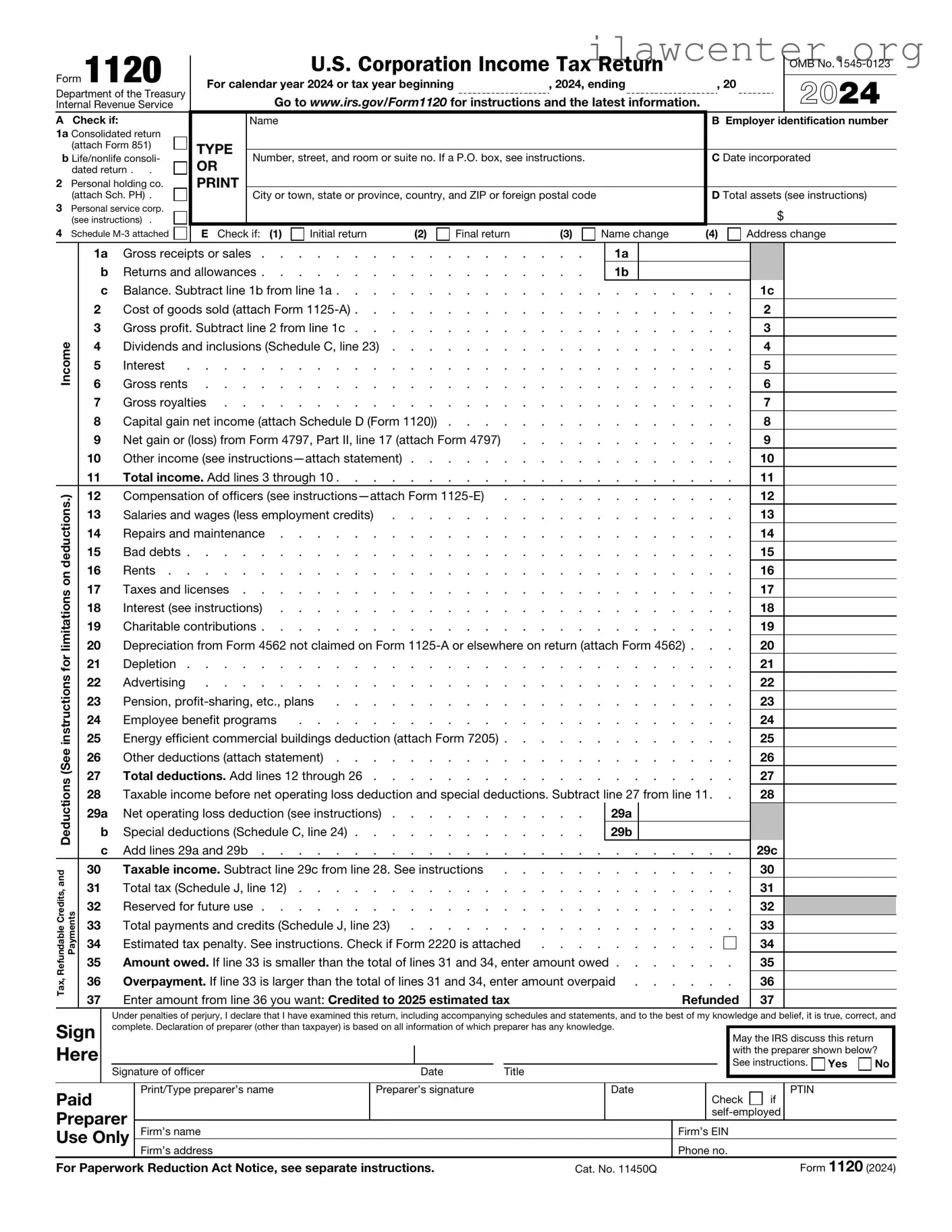
Form 1120

Department of the Treasury

Internal Revenue Service

A Check if:

1a Consolidated return (attach Form 851)

b Life/nonlife consoli- dated return . .

2Personal holding co.

(attach Sch. PH) .

3Personal service corp.

(see instructions) .

4 Schedule M-3 attached


U.S. Corporation Income Tax Return


OMB No. 1545-0123


For calendar year 2024 or tax year beginning


, 2024, ending

, 20


2024


Go to www.irs.gov/Form1120 for instructions and the latest information.


Name


B Employer identification number

TYPE


Number, street, and room or suite no. If a P.O. box, see instructions.


C Date incorporated

OR


PRINT


City or town, state or province, country, and ZIP or foreign postal code


D Total assets (see instructions)


$


E Check if: (1)

Initial return

(2)

Final return

(3)

Name change

(4)

Address change

Income

Deductions (See instructions for limitations on deductions.)

Refundable Credits, and

Payments

Tax,


1a

Gross receipts or sales


1a


b

Returns and allowances


1b


c

Balance. Subtract line 1b from line 1a

. . . . . . .


1c

2

Cost of goods sold (attach Form 1125-A)

. . . . . . .


2


3

Gross profit. Subtract line 2 from line 1c

. . . . . . .


3


4

Dividends and inclusions (Schedule C, line 23)

. . . . . . .


4


5

Interest

. . . . . . . . . . . . . . . . . . . . . . .


. . . . . . .


5


6

Gross rents

. . . . . . .


6


7

Gross royalties

. . . . . . .


7


8

Capital gain net income (attach Schedule D (Form 1120))

. . . . . . .


8


9

Net gain or (loss) from Form 4797, Part II, line 17 (attach Form 4797)

. . . . .


. . . . . . .


9


10

Other income (see instructions—attach statement)

. . . . . . .


10


11

Total income. Add lines 3 through 10

. . . . . . .


11


12

Compensation of officers (see instructions—attach Form 1125-E)

. . . . . . .


12


13

Salaries and wages (less employment credits)

. . . . . . .


13


14

Repairs and maintenance

. . . . . . .


14


15

Bad debts

. . . . . . .


15


16

Rents

. . . . . . .


16


17

Taxes and licenses

. . . . . . .


17


18

Interest (see instructions)

. . . . . . .


18


19

Charitable contributions

. . . . . . .


19


20

Depreciation from Form 4562 not claimed on Form 1125-A or elsewhere on return (attach Form 4562) . . .

20


21

Depletion

. . . . . . .


21


22

Advertising

. . . . . . .


22


23

Pension, profit-sharing, etc., plans

. . . . . . . . . . . . . . .


. . . . . . .


23


24

Employee benefit programs

. . . . . . . . . . . . . . . . .


. . . . . . .


24


25

Energy efficient commercial buildings deduction (attach Form 7205)

. . . . . . .


25


26

Other deductions (attach statement)

. . . . . . .


26


27

Total deductions. Add lines 12 through 26

. . . . . . .


27


28

Taxable income before net operating loss deduction and special deductions. Subtract line 27 from line 11. .

28


29a

Net operating loss deduction (see instructions)


29a


b

Special deductions (Schedule C, line 24)


29b


c

Add lines 29a and 29b

. . . . . . .


29c

30

Taxable income. Subtract line 29c from line 28. See instructions

. . . . . . .


30


31

Total tax (Schedule J, line 12)

. . . . . . .


31


32

Reserved for future use

. . . . . . .


32


33

Total payments and credits (Schedule J, line 23)

. . . . . . .


33


34

Estimated tax penalty. See instructions. Check if Form 2220 is attached . . . .

. . . . . .


34


35

Amount owed. If line 33 is smaller than the total of lines 31 and 34, enter amount owed

. . . . . . .


35


36

Overpayment. If line 33 is larger than the total of lines 31 and 34, enter amount overpaid


36


37

Enter amount from line 36 you want: Credited to 2025 estimated tax


Refunded

37


Sign


Under penalties of perjury, I declare that I have examined this return, including accompanying schedules and statements, and to the best of my knowledge and belief, it is true, correct, and


complete. Declaration of preparer (other than taxpayer) is based on all information of which preparer has any knowledge.


May the IRS discuss this return


Here


with the preparer shown below?


See instructions. Yes

No


Signature of officer


Date


Title


Paid


Print/Type preparer’s name

Preparer’s signature


Date


Check

if

PTIN


Preparer


self-employed


Firm’s name


Firm’s EIN


Use Only


Firm’s address


Phone no.


For Paperwork Reduction Act Notice, see separate instructions.


Cat. No. 11450Q


Form 1120 (2024)

Form 1120 (2024)


Page 2

Schedule C

Dividends, Inclusions, and Special Deductions

(a) Dividends and

(b) %

(c) Special deductions


(see instructions)

inclusions

(a) × (b)


1Dividends from less-than-20%-owned domestic corporations (other than debt-financed

stock)

50

2Dividends from 20%-or-more-owned domestic corporations (other than debt-financed


stock)

65


See

3

Dividends on certain debt-financed stock of domestic and foreign corporations . .

instructions

4

Dividends on certain preferred stock of less-than-20%-owned public utilities . . .

23.3

5

Dividends on certain preferred stock of 20%-or-more-owned public utilities . . . .

26.7

6

Dividends from less-than-20%-owned foreign corporations and certain FSCs . . .

50

7

Dividends from 20%-or-more-owned foreign corporations and certain FSCs . . .

65

8

Dividends from wholly owned foreign subsidiaries

100


See

9

Subtotal. Add lines 1 through 8. See instructions for limitations

instructions

10Dividends from domestic corporations received by a small business investment


company operating under the Small Business Investment Act of 1958

100

11

Dividends from affiliated group members

100

12

Dividends from certain FSCs

100

13Foreign-source portion of dividends received from a specified 10%-owned foreign


corporation (excluding hybrid dividends) (see instructions)


100


14

Dividends from foreign corporations not included on line 3, 6, 7, 8, 11, 12, or 13


(including any hybrid dividends)


15

Reserved for future use


16a

Subpart F inclusions derived from the sale by a controlled foreign corporation (CFC) of


the stock of a lower-tier foreign corporation treated as a dividend (attach Form(s) 5471)

100


(see instructions)


b

Subpart F inclusions derived from hybrid dividends of tiered corporations (attach Form(s)


5471) (see instructions)


c

Other inclusions from CFCs under subpart F not included on line 16a, 16b, or 17 (attach


Form(s) 5471) (see instructions)


17

Global Intangible Low-Taxed Income (GILTI) (attach Form(s) 5471 and Form 8992) . .

18

Gross-up for foreign taxes deemed paid

19

IC-DISC and former DISC dividends not included on line 1, 2, or 3

20

Other dividends

21

Deduction for dividends paid on certain preferred stock of public utilities . . . .

22

Section 250 deduction (attach Form 8993)

23Total dividends and inclusions. Add column (a), lines 9 through 20. Enter here and on page 1, line 4 . . . . . . . . . . . . . . . . . . . . . .

24

Total special deductions. Add column (c), lines 9 through 22. Enter here and on page 1, line 29b

Form 1120 (2024)

Form 1120 (2024)


Page 3

Schedule J

Tax Computation and Payment (see instructions)


1a

Income tax (see instructions)


1a


b

Tax from Form 1120-L (see instructions)


1b


c

Section 1291 tax from Form 8621


1c


d

Tax adjustment from Form 8978


1d


e

Additional tax under section 197(f)


1e


f

Base erosion minimum tax from Form 8991


1f


g

Amount from Form 4255, Part I, line 3, column (q)


1g


z

Other chapter 1 tax


1z


2

Total income tax. Add lines 1a through 1z

. . . . . . . .


2


3

Corporate alternative minimum tax from Form 4626, Part II, line 13 (attach Form 4626) .

. . . . . . . .


3


4

Add lines 2 and 3

. . . . . . . .


4


5a

Foreign tax credit (attach Form 1118)


5a


b

Credit from Form 8834 (see instructions)


5b


c

General business credit (see instructions—attach Form 3800)


5c


d

Credit for prior year minimum tax (attach Form 8827)


5d


e

Bond credits from Form 8912


5e


f

Adjustment from Form 8978


5f


6

Total credits. Add lines 5a through 5f

. . . . . . . .


6


7

Subtract line 6 from line 4

. . . . . . . .


7


8

Personal holding company tax (attach Schedule PH (Form 1120))

. . . . . . . .


8


9a

Amount from Form 4255, Part I, line 3, column (r)


9a


b

Recapture of low-income housing credit (attach Form 8611)


9b


c

Completed long-term contract look-back interest due (attach Form 8697) . . . .


9c


d

Interest due under the look-back method—income forecast method (attach Form 8866)


9d


e

Alternative tax on qualifying shipping activities (attach Form 8902)


9e


f

Interest/tax due under section 453A(c)


9f


g

Interest/tax due under section 453(l)


9g


z

Other (see instructions—attach statement)


9z


10

Total. Add lines 9a through 9z

. . . . . . . .


10


11a

Total tax before deferred taxes. Add lines 7, 8, and 10


11a


bDeferred tax on the corporation's share of undistributed earnings of a qualified electing


fund


11b


c

Deferred LIFO recapture tax (section 1363(d))

. . . . . . . . . . . .


11c


12

Total tax. Subtract the sum of lines 11b and 11c from 11a. Enter here and on page 1, line 31

12


13

Preceding year’s overpayment credited to the current year

. . . . . . . .


13


14

Current year’s estimated tax payments

. . . . . . . .


14


15

Current year’s refund applied for on Form 4466

. . . . . . . .


15

(

)

16

Reserved for future use

. . . . . . . .


16


17

Tax deposited with Form 7004

. . . . . . . .


17


18

Withholding (see instructions)

. . . . . . . .


18


19

Total payments. Combine lines 13 through 18

. . . . . . . .


19


20Refundable credits from:

a

Form 2439

20a

b

Form 4136

20b

cCredit for tax withheld under chapter 3 or 4 from Form 1042-S, Form 8805, or Form


8288 (attach the applicable form)

20c


z

Other (attach statement—see instructions)

20z


21

Total credits. Add lines 20a through 20z

. . . . . . .


21

22

Elective payment election amount from Form 3800

. . . . . . .


22

23

Total payments and credits. Add lines 19, 21, and 22. Enter here and on page 1, line 33 .

. . . . . . .


23

Form 1120 (2024)

Form 1120 (2024)

Page 4

Schedule K Other Information (see instructions)

1

Check accounting method: a

Cash

b

Accrual

c

Other (specify)

2See the instructions and enter the: a Business activity code no.

b Business activity c Product or service

3 Is the corporation a subsidiary in an affiliated group or a parent–subsidiary controlled group? . . . . . . . . . .

If “Yes,” enter name and EIN of the parent corporation

4At the end of the tax year:

aDid any foreign or domestic corporation, partnership (including any entity treated as a partnership), trust, or tax-exempt organization own directly 20% or more, or own, directly or indirectly, 50% or more of the total voting power of all classes of the

corporation’s stock entitled to vote? If “Yes,” complete Part I of Schedule G (Form 1120) (attach Schedule G) . . . . . .

bDid any individual or estate own directly 20% or more, or own, directly or indirectly, 50% or more of the total voting power of all

classes of the corporation’s stock entitled to vote? If “Yes,” complete Part II of Schedule G (Form 1120) (attach Schedule G) .

5At the end of the tax year, did the corporation:

aOwn directly 20% or more, or own, directly or indirectly, 50% or more of the total voting power of all classes of stock entitled to vote of any foreign or domestic corporation not included on Form 851, Affiliations Schedule? For rules of constructive ownership, see instructions If “Yes,” complete (i) through (iv) below.

Yes No

(i)Name of Corporation

(ii)Employer

Identification Number

(if any)

(iii)Country of Incorporation

(iv)Percentage Owned in Voting

Stock

bOwn directly an interest of 20% or more, or own, directly or indirectly, an interest of 50% or more in any foreign or domestic partnership (including an entity treated as a partnership) or in the beneficial interest of a trust? For rules of constructive ownership, see instructions If “Yes,” complete (i) through (iv) below.

(i)Name of Entity

(ii)Employer

Identification Number

(if any)

(iii)Country of Organization

(iv)Maximum

Percentage Owned in Profit, Loss, or Capital

6During this tax year, did the corporation pay dividends (other than stock dividends and distributions in exchange for stock) in

excess of the corporation’s current and accumulated earnings and profits? See sections 301 and 316 . . . . . . . .

If “Yes,” file Form 5452, Corporate Report of Nondividend Distributions. See the instructions for Form 5452. If this is a consolidated return, answer here for the parent corporation and on Form 851 for each subsidiary.

7At any time during this tax year, did one foreign person own, directly or indirectly, at least 25% of the total voting power of all classes of the corporation’s stock entitled to vote or at least 25% of the total value of all classes of the corporation’s stock? .

For rules of attribution, see section 318. If “Yes,” enter:

(a) Percentage owned

and (b) Owner’s country

(c) The corporation may have to file Form 5472, Information Return of a 25% Foreign-Owned U.S. Corporation or a Foreign Corporation Engaged in a U.S. Trade or Business. Enter the number of Forms 5472 attached

8 Check this box if the corporation issued publicly offered debt instruments with original issue discount . . . . . . . If checked, the corporation may have to file Form 8281, Information Return for Publicly Offered Original Issue Discount Instruments.

9Enter the amount of tax-exempt interest received or accrued during this tax year $

10Enter the number of shareholders at the end of the tax year (if 100 or fewer)

11

If the corporation has an NOL for the tax year and is electing to forego the carryback period, check here (see instructions) .


If the corporation is filing a consolidated return, the statement required by Regulations section 1.1502-21(b)(3) must be attached


or the election will not be valid.

12Enter the available NOL carryover from prior tax years (do not reduce it by any deduction reported on page 1, line 29a) $
Form 1120 (2024)

Form 1120 (2024)


Page 5

Schedule K

Other Information (continued from page 4)


13

Are the corporation’s total receipts (page 1, line 1a, plus lines 4 through 10) for the tax year and its total assets at the end of

Yes

No


the tax year less than $250,000?


If “Yes,” the corporation is not required to complete Schedules L, M-1, and M-2. Instead, enter the total amount of cash


distributions and the book value of property distributions (other than cash) made during this tax year $


14

Is the corporation required to file Schedule UTP (Form 1120), Uncertain Tax Position Statement? See instructions . . . .


If “Yes,” complete and attach Schedule UTP.


15a

Did the corporation make any payments that would require it to file Form(s) 1099?


b

If “Yes,” did or will the corporation file required Form(s) 1099?


16

During this tax year, did the corporation have an 80%-or-more change in ownership, including a change due to redemption of


its own stock?


17

During or subsequent to this tax year, but before the filing of this return, did the corporation dispose of more than 65% (by


value) of its assets in a taxable, non-taxable, or tax deferred transaction?


18

Did this corporation receive assets in a section 351 transfer in which any of the transferred assets had a fair market basis or


fair market value of more than $1 million?


19

During this corporation’s tax year, did the corporation make any payments that would require it to file Forms 1042 and 1042-S


under chapter 3 (sections 1441 through 1464) or chapter 4 (sections 1471 through 1474) of the Code?


20

Is the corporation operating on a cooperative basis?


21

During this tax year, did the corporation pay or accrue any interest or royalty for which the deduction is not allowed under


section 267A? See instructions


If “Yes,” enter the total amount of the disallowed deductions $


22Does this corporation have gross receipts of at least $500 million in any of the 3 preceding tax years? (See sections 59A(e)(2) and (3).) If “Yes,” complete and attach Form 8991.

23Did the corporation have an election under section 163(j) for any real property trade or business or any farming business in


effect during this tax year? See instructions

24

Does the corporation satisfy one or more of the following? If “Yes,” complete and attach Form 8990. See instructions . . .

aThe corporation owns a pass-through entity with current, or prior year carryover, excess business interest expense.

bThe corporation’s aggregate average annual gross receipts (determined under section 448(c)) for the 3 tax years preceding the current tax year are more than $30 million and the corporation has business interest expense.

cThe corporation is a tax shelter and the corporation has business interest expense.

25

Is the corporation attaching Form 8996 to certify as a Qualified Opportunity Fund?

. . . . . . . . . . . . .


If “Yes,” enter amount from Form 8996, line 15

. $

26Since December 22, 2017, did a foreign corporation directly or indirectly acquire substantially all of the properties held directly or indirectly by the corporation, and was the ownership percentage (by vote or value) for purposes of section 7874 greater than 50% (for example, the shareholders held more than 50% of the stock of the foreign corporation)? If “Yes,” list the ownership

percentage by vote and by value. See instructions . . . . . . . . . . . . . . . . . . . . . . .

Percentage: By Vote


By Value

27At any time during this tax year, did the corporation (a) receive a digital asset (as a reward, award, or payment for property or


services); or (b) sell, exchange, or otherwise dispose of a digital asset (or a financial interest in a digital asset)? See instructions .

28

Is the corporation a member of a controlled group?


If “Yes,” attach Schedule O (Form 1120). See instructions.

29Corporate Alternative Minimum Tax:

a Was the corporation an applicable corporation under section 59(k)(1) in any prior tax year? . . . . . . . . . . .

If “Yes,” go to question 29b. If “No,” skip to question 29c.

bIs the corporation an applicable corporation under section 59(k)(1) in the current tax year because the corporation was an

applicable corporation in the prior tax year? . . . . . . . . . . . . . . . . . . . . . . . . .

If “Yes,” complete and attach Form 4626. If “No,” continue to question 29c.

cDoes the corporation meet the requirements of the safe harbor method as provided under section 59(k)(3)(A) for the current tax

year? See instructions . . . . . . . . . . . . . . . . . . . . . . . . . . . . . . .

If “No,” complete and attach Form 4626. If “Yes,” the corporation is not required to file Form 4626.

30Is the corporation required to file Form 7208 relating to the excise tax on repurchase of corporate stock (see instructions):

a

Under the rules for stock repurchased by a covered corporation (or stock acquired by its specified affiliate)?

b

Under the applicable foreign corporation rules?

c

Under the covered surrogate foreign corporation rules?


If “Yes” to either 30a, 30b, or 30c, complete Form 7208, Excise Tax on Repurchase of Corporate Stock. See the Instructions


for Form 7208.

31Is this a consolidated return with gross receipts or sales of $1 billion or more and a subchapter K basis adjustment, as

described in the instructions, of $10 million or more? . . . . . . . . . . . . . . . . . . . . . .

If “Yes,” attach a statement. See instructions.

Form 1120 (2024)
Form 1120 (2024)


Page 6

Schedule L


Balance Sheets per Books


Beginning of tax year


End of tax year


Assets


(a)


(b)


(c)


(d)

1

Cash


2a

Trade notes and accounts receivable . . .


b

Less allowance for bad debts . .

. . .


(


)


(

)


3

Inventories


4

U.S. government obligations

. . . . .


5

Tax-exempt securities (see instructions) . .


6

Other current assets (attach statement) . .


7

Loans to shareholders


8

Mortgage and real estate loans


9

Other investments (attach statement) . . .


10a

Buildings and other depreciable assets . .


b

Less accumulated depreciation . .

. . .


(


)


(

)


11a

Depletable assets


b

Less accumulated depletion . . .

. . .


(


)


(

)


12

Land (net of any amortization)


13a

Intangible assets (amortizable only)

. . .


b

Less accumulated amortization . .

. . .


(


)


(

)


14

Other assets (attach statement)


15

Total assets


Liabilities and Shareholders’ Equity


16

Accounts payable


17

Mortgages, notes, bonds payable in less than 1 year


18

Other current liabilities (attach statement) . .


19

Loans from shareholders


20

Mortgages, notes, bonds payable in 1 year or more


21

Other liabilities (attach statement) . . . .


22

Capital stock:

a Preferred stock . . . .


b Common stock . . . .


23

Additional paid-in capital


24

Retained earnings—Appropriated (attach statement)


25

Retained earnings—Unappropriated . . .


26

Adjustments to shareholders’ equity (attach statement)


27

Less cost of treasury stock


(

)


(

)

28

Total liabilities and shareholders’ equity . .


Schedule M-1 Reconciliation of Income (Loss) per Books With Income per Return

Note: The corporation may be required to file Schedule M-3. See instructions.

1

Net income (loss) per books

7

Income recorded on books this year

2

Federal income tax per books


not included on this return (itemize):

3

Excess of capital losses over capital gains .


Tax-exempt interest $

4Income subject to tax not recorded on books this year (itemize):


8


Deductions on this return not charged

5

Expenses recorded on books this year not


against book income this year (itemize):


deducted on this return (itemize):

a

Depreciation . . $

a

Depreciation . . . . $

b

Charitable contributions $

bCharitable contributions . $

cTravel and entertainment . $


9

Add lines 7 and 8

6

Add lines 1 through 5

10

Income (page 1, line 28)—line 6 less line 9

Schedule M-2 Analysis of Unappropriated Retained Earnings per Books (Schedule L, Line 25)

1

Balance at beginning of year

5

Distributions: a Cash

2

Net income (loss) per books


b Stock . . . .

3

Other increases (itemize):


c Property . . . .


6

Other decreases (itemize):


7

Add lines 5 and 6

4

Add lines 1, 2, and 3

8

Balance at end of year (line 4 less line 7)

Form 1120 (2024)

File Properties

Fact Name Description
Purpose The IRS Form 1120 is used by corporations to report their income, gains, losses, deductions, and credits.
Filing Deadline Corporations must file Form 1120 by the 15th day of the 4th month after the end of their tax year.
Tax Rate The corporate tax rate is a flat 21% as of 2023, regardless of income level.
State-Specific Forms Many states require their own corporate tax forms. For example, California uses Form 100, governed by California Revenue and Taxation Code.
Estimated Taxes Corporations may need to pay estimated taxes quarterly if they expect to owe tax of $500 or more.
Electronic Filing Form 1120 can be filed electronically, which is often faster and more efficient.
Amendments If errors are found after filing, corporations can amend their return using Form 1120-X.
Supporting Documents Corporations must attach various schedules and forms, such as Schedule C for dividends and Schedule J for tax computation.
Record Keeping Corporations should keep copies of their filed Form 1120 and supporting documents for at least three years.
Penalties Filing late or underreporting income can result in penalties and interest charges.

Instructions on Utilizing IRS 1120

Completing the IRS 1120 form is a critical task for corporations that need to report their income, gains, losses, deductions, and credits. Make sure to gather all necessary financial information before you start. Follow these steps carefully to ensure accuracy and compliance.

  1. Begin with the basic information section. Enter the corporation's name, address, and employer identification number (EIN).
  2. Fill out the date of incorporation and the total assets of the corporation as of the end of the tax year.
  3. Report the income. This includes gross receipts or sales, cost of goods sold, and any other income. Ensure all amounts are accurate and properly calculated.
  4. Deduct allowable expenses. Include operating expenses, salaries, and other deductions. Double-check your calculations to avoid errors.
  5. Calculate the taxable income. This is done by subtracting total deductions from total income.
  6. Complete the tax computation section. Use the appropriate tax rate to calculate the tax owed based on the taxable income.
  7. Fill out any additional schedules or forms that may be required based on your corporation's specific circumstances.
  8. Review the entire form for accuracy. Ensure all figures are correct and that you have signed and dated the form.
  9. File the completed form by the due date. You can file electronically or by mail, depending on your preference and requirements.

After submitting the form, keep a copy for your records. Be prepared to respond to any inquiries from the IRS if necessary. Timely and accurate filing can help avoid penalties and ensure compliance with tax obligations.

Important Facts about IRS 1120

What is the IRS Form 1120?

The IRS Form 1120 is the U.S. Corporation Income Tax Return. It is used by corporations to report their income, gains, losses, deductions, and credits. This form is essential for determining the corporation's tax liability for the year. Corporations must file this form annually, regardless of whether they have any taxable income or not.

Who needs to file Form 1120?

Any corporation that is recognized as a separate legal entity for tax purposes must file Form 1120. This includes C corporations, which are taxed separately from their owners. If your business is structured as a partnership, sole proprietorship, or an S corporation, you will need to use different forms. Non-profit organizations and certain other entities may also be exempt from filing.

When is Form 1120 due?

Form 1120 is typically due on the 15th day of the fourth month following the end of the corporation's tax year. For most corporations that operate on a calendar year, this means the due date is April 15. If the deadline falls on a weekend or holiday, it will be extended to the next business day. Corporations can request an automatic six-month extension, but they must still pay any taxes owed by the original due date to avoid penalties and interest.

What information do I need to complete Form 1120?

To complete Form 1120, you will need to gather several key pieces of information. This includes your corporation's name, address, and Employer Identification Number (EIN). You will also need to provide details about your income, deductions, and credits. Additionally, financial statements, such as balance sheets and profit-and-loss statements, will help support the information reported on the form.

What are the penalties for not filing Form 1120?

Failure to file Form 1120 on time can result in significant penalties. The IRS may impose a penalty of $210 for each month or part of a month that the return is late, up to a maximum of 12 months. If the corporation owes taxes and does not pay them, interest will accrue on the unpaid balance. It is crucial to file on time, even if you cannot pay the full amount due.

Can I file Form 1120 electronically?

Yes, Form 1120 can be filed electronically. The IRS encourages electronic filing as it speeds up processing and reduces errors. Many tax preparation software programs support e-filing for Form 1120. If you choose to file by mail, ensure that you send it to the correct address based on your corporation's location to avoid delays in processing.

Common mistakes

Filling out the IRS 1120 form can be a complex task, and many people make mistakes that can lead to delays or even penalties. One common error is failing to provide accurate information about the corporation’s income. It’s essential to report all sources of income, including sales, dividends, and interest. Omitting any income can raise red flags and trigger an audit.

Another frequent mistake is not properly categorizing expenses. Corporations can deduct many business expenses, but they must be classified correctly. Misclassifying expenses can lead to incorrect tax calculations. For example, mixing personal expenses with business expenses can result in disallowed deductions.

Some individuals neglect to sign the form. A signature is a critical component of the IRS 1120. Without it, the IRS may consider the form incomplete, leading to delays in processing. Always double-check that the form is signed and dated before submission.

Many people also forget to check the box indicating whether the corporation is a member of a controlled group. This detail is important for tax calculations and compliance. Ignoring this requirement can lead to misunderstandings regarding tax liabilities.

Inaccurate calculations are another common pitfall. Whether it’s adding up income or expenses, errors in math can lead to incorrect tax amounts. It’s advisable to review all figures carefully and, if necessary, use a calculator or accounting software to ensure accuracy.

Some filers fail to include all required schedules and attachments. The IRS 1120 may require additional forms depending on the corporation’s activities. Missing these documents can result in processing delays or requests for more information.

Another mistake involves not keeping adequate records. Corporations should maintain thorough documentation to support the figures reported on the form. In the event of an audit, having organized records can make a significant difference.

People sometimes overlook the importance of filing on time. The IRS imposes penalties for late filings, which can add up quickly. It’s crucial to be aware of the deadlines and plan accordingly to avoid unnecessary fees.

Additionally, some individuals fail to consult a tax professional when needed. Tax laws can be complicated, and professional advice can help ensure compliance and maximize deductions. Seeking assistance can prevent costly mistakes.

Lastly, not staying informed about changes in tax laws can lead to errors. Tax regulations can change from year to year, and it’s important to be aware of any updates that may affect the IRS 1120 form. Regularly reviewing IRS publications or consulting with a tax advisor can help keep you informed.

Documents used along the form

The IRS Form 1120 is essential for corporations to report their income, gains, losses, deductions, and credits. However, several other forms and documents are often needed alongside it to ensure compliance with tax regulations. Here’s a list of some common forms that might be required.

  • Schedule C: This form is used to report income or loss from a business operated as a sole proprietorship. It details business expenses and net profit.
  • Schedule G: Corporations use this schedule to report income from certain sources, such as dividends, interest, and royalties.
  • Form 941: Employers file this quarterly form to report income taxes, Social Security tax, and Medicare tax withheld from employee paychecks.
  • Form 1099: This form is used to report various types of income other than wages, salaries, and tips. It includes payments made to independent contractors.
  • Form W-2: Employers provide this form to report wages paid to employees and the taxes withheld from them. It is essential for employees to file their personal tax returns.
  • Form 4562: This form allows businesses to claim depreciation and amortization on their assets. It helps in reducing taxable income.
  • Form 1125-A: Used to report the cost of goods sold, this form is crucial for businesses that manufacture or sell products.
  • Form 1125-E: This form is necessary for reporting compensation of officers, ensuring transparency about how much corporate officers are paid.
  • Form 7004: Corporations use this form to request an automatic extension of time to file their income tax return, providing additional time to gather necessary documents.

Each of these forms plays a significant role in the overall tax filing process for corporations. Ensuring that all necessary documents are prepared and submitted accurately can help avoid potential issues with the IRS.

Similar forms

The IRS Form 1120 is the U.S. Corporation Income Tax Return, and it shares similarities with several other tax-related documents. Each of these forms serves a unique purpose but follows a similar structure in reporting income, expenses, and tax liabilities. Here are four documents that are similar to Form 1120:

  • IRS Form 1065: This form is used by partnerships to report income, deductions, gains, and losses. Like Form 1120, it requires a detailed account of the partnership's financial activities, but it distributes income among partners rather than taxing the entity itself.
  • IRS Form 1040: This is the standard individual income tax return form. While it is designed for individuals rather than corporations, both forms require taxpayers to report their income and calculate their tax liabilities based on various deductions and credits.
  • IRS Form 1120-S: This form is specifically for S corporations, which pass corporate income, losses, deductions, and credits through to their shareholders. Similar to Form 1120, it requires detailed financial reporting but is structured to avoid double taxation.
  • IRS Form 990: Nonprofit organizations use this form to report their financial activities. Like Form 1120, it requires comprehensive financial information, but its focus is on transparency and accountability rather than on income tax liability.

Dos and Don'ts

Filling out the IRS 1120 form can be a straightforward process if you follow some essential guidelines. Here’s a helpful list of things to do and avoid:

  • Do ensure all information is accurate and complete. Double-check your entries to avoid errors.
  • Do use the latest version of the form. Always download the most current form from the IRS website.
  • Do report all income. Include all sources of revenue to ensure compliance.
  • Do keep copies of all documentation. Maintain records of your submissions for future reference.
  • Don’t forget to sign and date the form. An unsigned form may be considered invalid.
  • Don’t overlook deadlines. Submit your form on time to avoid penalties and interest.

By following these simple guidelines, you can navigate the process with confidence and ease. Remember, accuracy and attention to detail are key when dealing with tax forms.

Misconceptions

The IRS Form 1120 is essential for corporations filing their federal income tax returns. However, there are several misconceptions surrounding this form. Here are ten common myths explained:

  1. Only large corporations need to file Form 1120. Many small corporations also need to file this form, regardless of their size or revenue.
  2. Form 1120 is only for C Corporations. While primarily used by C Corporations, certain entities like LLCs may also need to file if they elect to be taxed as a corporation.
  3. Filing Form 1120 is optional. For corporations, filing this form is mandatory to report income, gains, losses, and deductions.
  4. Form 1120 is the same as individual tax returns. This form is specifically designed for corporations and has different requirements than individual tax returns.
  5. All income must be reported on Form 1120. Only income generated by the corporation is reported; personal income should not be included.
  6. Filing Form 1120 guarantees a refund. Filing does not guarantee a refund; it depends on the corporation's financial situation and tax liability.
  7. Corporations can file Form 1120 at any time. There are specific deadlines for filing, typically the 15th day of the fourth month after the end of the corporation's tax year.
  8. Once filed, the information on Form 1120 cannot be changed. Corrections can be made by filing an amended return if necessary.
  9. Form 1120 is only for U.S. corporations. Foreign corporations with U.S. income may also be required to file this form.
  10. There are no penalties for late filing. Late filing can result in significant penalties and interest charges, so timely submission is crucial.

Understanding these misconceptions can help ensure compliance and avoid potential issues with the IRS.

Key takeaways

The IRS Form 1120 is essential for corporations operating in the United States. It serves as the federal income tax return for corporations and requires careful attention to detail. Below are key takeaways regarding the use and completion of this form.

  • Eligibility: Only corporations, including C corporations, are required to file Form 1120. Partnerships and sole proprietorships must use different forms.
  • Filing Deadline: The form is generally due on the 15th day of the fourth month after the end of the corporation's tax year.
  • Tax Year Selection: Corporations can choose a calendar year or a fiscal year as their tax year, impacting when they file Form 1120.
  • Income Reporting: All sources of income, including sales, dividends, and interest, must be reported on the form.
  • Deductible Expenses: Corporations can deduct ordinary and necessary business expenses, which can reduce taxable income.
  • Tax Rates: The current corporate tax rate is a flat 21%, applicable to taxable income reported on the form.
  • Schedule C: This schedule is used to report dividends and special deductions, which can be critical for tax planning.
  • Filing Options: Corporations can file Form 1120 electronically or via paper submission, with electronic filing often being more efficient.
  • Penalties: Failure to file on time can result in penalties, so timely submission is crucial to avoid additional costs.

Understanding these key aspects of Form 1120 can help corporations navigate their tax obligations effectively.