IRS 433-A PDF Template

IRS 433-A PDF Template

The IRS 433-A form is a crucial document used by the Internal Revenue Service to gather financial information from individuals who owe back taxes. This form helps the IRS assess your ability to pay and determine suitable payment arrangements. Understanding how to complete the 433-A is essential for anyone facing tax issues, so take action now by filling out the form through the button below.

Article Guide

The IRS 433-A form plays a crucial role for individuals facing tax issues, particularly when it comes to resolving outstanding debts with the Internal Revenue Service. This form is primarily used to provide a comprehensive overview of a taxpayer's financial situation. By detailing income, expenses, assets, and liabilities, the IRS 433-A helps the IRS assess a person's ability to pay their tax debts. It is often a necessary step for those seeking an installment agreement or an offer in compromise. Completing this form accurately is essential, as it directly impacts negotiations with the IRS. Taxpayers must be prepared to disclose personal financial information, including bank statements and pay stubs, to support their claims. Understanding the significance of the IRS 433-A can help taxpayers navigate the complexities of tax resolution more effectively.

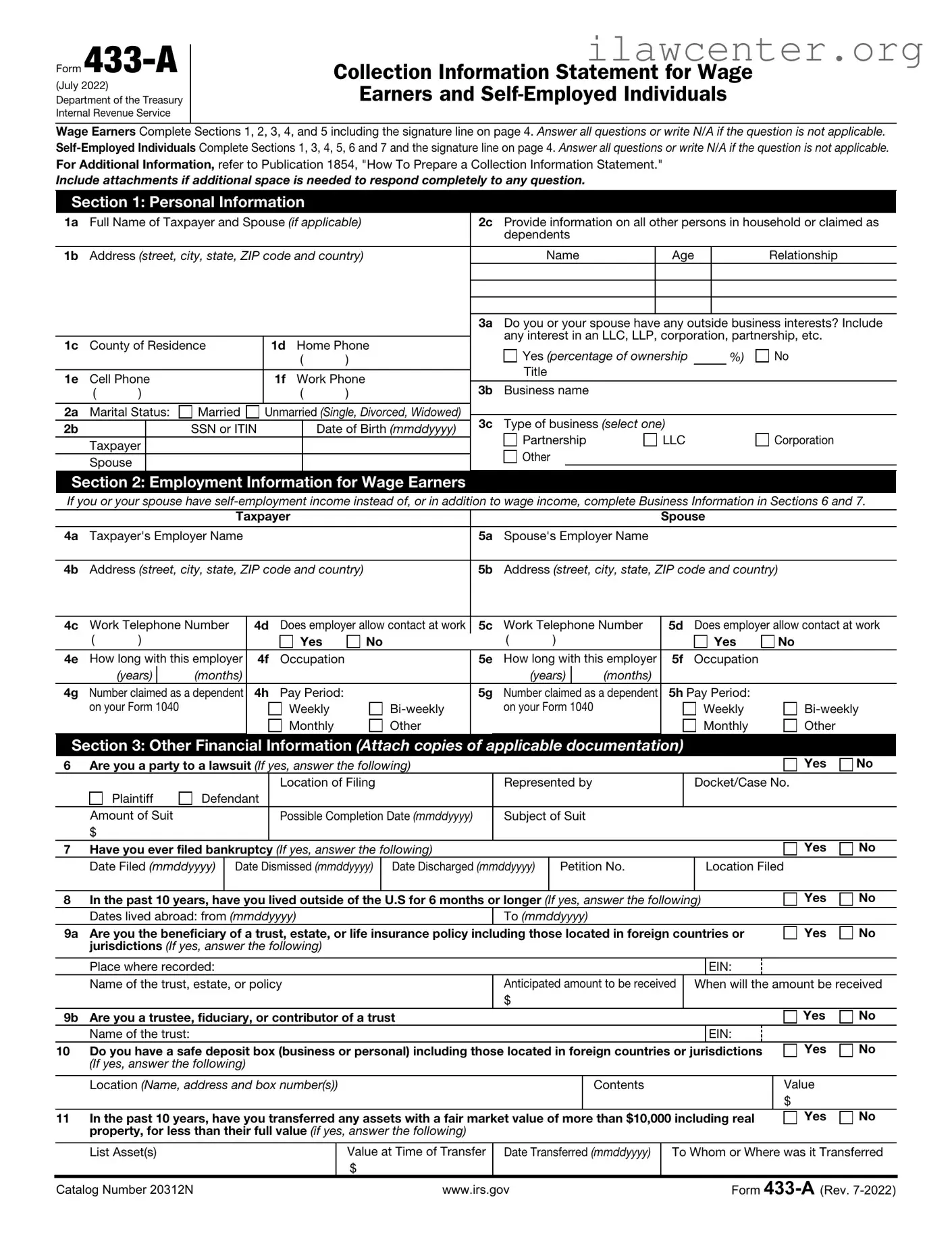
IRS 433-A Preview

Form 433-A

Collection Information Statement for Wage

(July 2022)

Earners and Self-Employed Individuals

Department of the Treasury

Internal Revenue Service


Wage Earners Complete Sections 1, 2, 3, 4, and 5 including the signature line on page 4. Answer all questions or write N/A if the question is not applicable. Self-Employed Individuals Complete Sections 1, 3, 4, 5, 6 and 7 and the signature line on page 4. Answer all questions or write N/A if the question is not applicable. For Additional Information, refer to Publication 1854, "How To Prepare a Collection Information Statement."

Include attachments if additional space is needed to respond completely to any question.

Section 1: Personal Information

1a

Full Name of Taxpayer and Spouse (if applicable)

2c

Provide information on all other persons in household or claimed as


dependents


1b

Address (street, city, state, ZIP code and country)


Name

Age


Relationship


3a

Do you or your spouse have any outside business interests? Include


any interest in an LLC, LLP, corporation, partnership, etc.

1c

County of Residence

1d

Home Phone


Yes (percentage of ownership


%)

No


(

)


Title


1e

Cell Phone


1f

Work Phone


3b

Business name


(

)


(

)


2a

Marital Status:

Married

Unmarried (Single, Divorced, Widowed)


3c

Type of business (select one)


2b


SSN or ITIN


Date of Birth (mmddyyyy)


Partnership

LLC


Corporation


Taxpayer


Other


Spouse


Section 2: Employment Information for Wage Earners

If you or your spouse have self-employment income instead of, or in addition to wage income, complete Business Information in Sections 6 and 7.


Taxpayer


Spouse


4a

Taxpayer's Employer Name


5a

Spouse's Employer Name


4b

Address (street, city, state, ZIP code and country)


5b

Address (street, city, state, ZIP code and country)


4c

Work Telephone Number

4d

Does employer allow contact at work

5c

Work Telephone Number

5d Does employer allow contact at work


(

)


Yes

No


(

)


Yes

No

4e

How long with this employer

4f

Occupation


5e

How long with this employer

5f Occupation


(years)


(months)


(years)


(months)


4g

Number claimed as a dependent

4h

Pay Period:


5g

Number claimed as a dependent

5h Pay Period:


on your Form 1040


Weekly

Bi-weekly


on your Form 1040


Weekly

Bi-weekly


Monthly

Other


Monthly

Other

Section 3: Other Financial Information (Attach copies of applicable documentation)

6

Are you a party to a lawsuit (If yes, answer the following)


Yes

No


Location of Filing

Represented by


Docket/Case No.


Plaintiff

Defendant


Amount of Suit


Possible Completion Date (mmddyyyy)

Subject of Suit


$


7

Have you ever filed bankruptcy (If yes, answer the following)


Yes

No


Date Filed (mmddyyyy)

Date Dismissed (mmddyyyy)

Date Discharged (mmddyyyy)

Petition No.


Location Filed


8

In the past 10 years, have you lived outside of the U.S for 6 months or longer (If yes, answer the following)

Yes

No

Dates lived abroad: from (mmddyyyy)

To (mmddyyyy)

9a Are you the beneficiary of a trust, estate, or life insurance policy including those located in foreign countries or jurisdictions (If yes, answer the following)

Yes No


Place where recorded:


EIN:


Name of the trust, estate, or policy


Anticipated amount to be received

When will the amount be received


$


9b

Are you a trustee, fiduciary, or contributor of a trust


Yes

No


Name of the trust:


EIN:


10

Do you have a safe deposit box (business or personal) including those located in foreign countries or jurisdictions

Yes

No


(If yes, answer the following)


Location (Name, address and box number(s))


Contents


Value


$


11

In the past 10 years, have you transferred any assets with a fair market value of more than $10,000 including real

Yes

No


property, for less than their full value (if yes, answer the following)


List Asset(s)


Value at Time of Transfer

Date Transferred (mmddyyyy)

To Whom or Where was it Transferred


$


Catalog Number 20312N

www.irs.gov


Form 433-A (Rev. 7-2022)

Form 433-A (Rev. 7-2022)

Page 2

Section 4: Personal Asset Information for all Individuals (Foreign and Domestic). Include assets located in foreign countries or jurisdictions and add attachment(s) if additional space is needed to respond

12 CASH ON HAND Include cash that is not in a bank

Total Cash on Hand

$

PERSONAL BANK ACCOUNTS Include all checking, online and mobile (e.g., PayPal etc.) accounts, money market accounts, savings accounts, and stored value cards (e.g., payroll cards, government benefit cards, etc.).


Full Name & Address (Street, City, State, ZIP code and


Account Balance


Type of Account

Country) of Bank, Savings & Loan, Credit Union, or

Account Number

As of


Financial Institution


mmddyyyy

13a


$


13b


$


13c

Total Cash (Add lines 13a, 13b, and amounts from any attachments)


$


INVESTMENTS Include stocks, bonds, mutual funds, stock options, certificates of deposit, and retirement assets such as IRAs, Keogh, 401(k) plans and commodities (e.g., gold, silver, copper, etc.). Include all corporations, partnerships, limited liability companies, or other business entities in which you are an officer, director, owner, member, or otherwise have a financial interest.

Type of Investment

Full Name & Address


Loan Balance (if applicable)

Equity

Current Value

As of

or Financial Interest

(Street, City, State, ZIP code and Country) of Company

Value minus Loan


mmddyyyy


14a


Phone

$

$


$

14b


Phone

$

$

$

DIGITAL ASSETS List all digital assets such as virtual currency (cryptocurrency), non-fungible token (NFT), and smart contracts you own or in which you have a financial interest (e.g., Bitcoin, Ethereum, Litecoin, Ripple, etc.) If applicable, attach a statement with each virtual currency’s public key.

14c List the name(s) of individuals who have access to the private key(s) and/or digital wallets


Name of Digital Asset such as

Email Address Used to Set-up


Digital Asset Amount


Location(s) of Digital Assets

and Value in US

Type of Digital Asset

Virtual Currency Wallet, Exchange

With the Digital Assets such as

(Mobile Wallet, Online, and/or

dollars as of today

or Digital Currency Exchange

Virtual Currency Exchange or


External Hardware storage)

(e.g., 1 Bitcoins


(DCE)

DCE


$38,000.00 USD)


14d


$

14e


$

14f Total Equity (Add lines 14a, 14b, 14d and 14e. Also include any amounts from any attachments to your total equity)

$

AVAILABLE CREDIT Include all lines of credit and bank issued credit cards.


Full Name & Address


Amount Owed


Available Credit


Credit Limit

As of


As of


(Street, City, State, ZIP code and Country) of Credit Institution


mmddyyyy


mmddyyyy


15a


Acct. No


$

$


$


15b


Acct. No


$

$


$


15c

Total Available Credit (Add lines 15a, 15b and amounts from any attachments)


$


16a

LIFE INSURANCE Do you own or have any interest in any life insurance policies with cash value


Yes

No

If yes, complete blocks 16b through 16f for each policy.


16b

Name and Address of Insurance


Company(ies):


16c

Policy Number(s)


16d

Owner of Policy


16e

Current Cash Value


$


$


$


16f

Outstanding Loan Balance


$


$


$


16g

Total Available Cash (Subtract amounts on line 16f from line 16e and include amounts from any attachments)


$


Catalog Number 20312N


www.irs.gov


Form 433-A (Rev. 7-2022)

Form 433-A (Rev. 7-2022)

Page 3

Section 4: Personal Asset Information for all Individuals (Foreign and Domestic) (Continued)

REAL PROPERTY Include all real property owned or being purchased


Purchase Date


Current Fair

Current Loan

Amount of

Date of Final

Equity


Market Value

Payment


(mmddyyyy)


Balance

Monthly Payment

FMV Minus Loan


(FMV)

(mmddyyyy)


17a

Property Description


$


$

$


$


Location (street, city, state, ZIP code, county and country)


Lender/Contract Holder Name, Address (street, city, state, ZIP code), and Phone


Phone


17b

Property Description


$


$

$


$


Location (street, city, state, ZIP code, county and country)


Lender/Contract Holder Name, Address (street, city, state, ZIP code), and Phone


Phone


17c Total Equity (Add lines 17a, 17b and amounts from any attachments)


$


PERSONAL VEHICLES LEASED AND PURCHASED Include boats, RVs, motorcycles, all-terrain and off-road vehicles, trailers, etc.


Description (Year, Mileage, Make/Model,

Purchase/


Current Fair

Current Loan

Amount of

Date of Final

Equity

Lease Date


Market Value

Payment

Tag Number, Vehicle Identification Number)


Balance

Monthly Payment

FMV Minus Loan

(mmddyyyy)


(FMV)

(mmddyyyy)


18a Year

Make/Model


$


$

$


$


Mileage

License/Tag Number

Lender/Lessor Name, Address (street, city, state, ZIP code and country), and Phone


Vehicle Identification Number


Phone


18b Year

Make/Model


$


$

$


$


Mileage

License/Tag Number

Lender/Lessor Name, Address (street, city, state, ZIP code and country), and Phone


Vehicle Identification Number


Phone


18c Total Equity (Add lines 18a, 18b and amounts from any attachments)

$

PERSONAL ASSETS Include all furniture, personal effects, artwork, jewelry, collections (coins, guns, etc.), antiques or other assets. Include intangible assets such as licenses, domain names, patents, copyrights, mining claims, etc.


Purchase/


Current Fair

Current Loan

Amount of

Date of Final

Equity


Lease Date


Market Value

Payment


Balance

Monthly Payment

FMV Minus Loan


(mmddyyyy)


(FMV)

(mmddyyyy)


19a Property Description


$


$

$


$

Location (street, city, state, ZIP code, county and country)


Lender/Lessor Name, Address (street, city, state, ZIP code), and Phone


Phone


19b Property Description


$


$

$


$

Location (street, city, state, ZIP code, county and country)


Lender/Lessor Name, Address (street, city, state, ZIP code), and Phone


Phone


19c Total Equity (Add lines 19a, 19b and amounts from any attachments)


$


Catalog Number 20312N

www.irs.gov

Form 433-A (Rev. 7-2022)

Form 433-A (Rev. 7-2022)

Page 4


If you are self-employed, sections 6 and 7 must be completed before continuing.

Section 5: Monthly Income and Expenses (Foreign and Domestic)

Monthly Income/Expense Statement (For additional information, refer to Publication 1854.)


Total Income (Amounts reported in U.S. dollars)


Total Living Expenses (Amounts reported in U.S. dollars)

IRS USE ONLY


Source

Gross Monthly


Expense Items 6

Actual Monthly

Allowable Expenses

20

Wages (Taxpayer) 1

$

35

Food, Clothing and Misc. 7

$


21

Wages (Spouse) 1

$

36

Housing and Utilities 8

$


22

Interest - Dividends

$

37

Vehicle Ownership Costs 9

$


23

Net Business Income 2

$

38

Vehicle Operating Costs 10

$


24

Net Rental Income 3

$

39

Public Transportation 11

$


25

Distributions (K-1, IRA, etc.) 4

$

40

Health Insurance

$


26

Pension (Taxpayer)

$

41

Out of Pocket Health Care Costs 12

$


27

Pension (Spouse)

$

42

Court Ordered Payments

$


28

Social Security (Taxpayer)

$

43

Child/Dependent Care

$


29

Social Security (Spouse)

$

44

Life Insurance

$


30

Child Support

$

45

Current year taxes (Income/FICA) 13

$


31

Alimony

$

46

Secured Debts (Attach list)

$


Other Income (Specify below) 5


47

Delinquent State or Local Taxes

$


32


$

48

Other Expenses (Attach list)

$


33


$

49 Total Living Expenses (add lines 35-48)

$


34

Total Income (add lines 20-33)

$

50

Net difference (Line 34 minus 49)

$


1Wages, salaries, pensions, and social security: Enter gross monthly wages and/or salaries. Do not deduct tax withholding or allotments taken out of pay, such as insurance payments, credit union deductions, car payments, etc. To calculate the gross monthly wages and/or salaries:

If paid weekly - multiply weekly gross wages by 4.3. Example: $425.89 x 4.3 = $1,831.33

If paid biweekly (every 2 weeks) - multiply biweekly gross wages by 2.17. Example: $972.45 x 2.17 = $2,110.22

If paid semimonthly (twice each month) - multiply semimonthly gross wages by 2. Example: $856.23 x 2 = $1,712.46

2Net Income from Business: Enter monthly net business income. This is the amount earned after ordinary and necessary monthly business expenses are paid. This figure is the amount from page 6, line 89. If the net business income is a loss, enter “0”. Do not enter a negative number. If this amount is more or less than previous years, attach an explanation.

3Net Rental Income: Enter monthly net rental income. This is the amount earned after ordinary and necessary monthly rental expenses are paid. Do not include deductions for depreciation or depletion. If the net rental income is a loss, enter “0.” Do not enter a negative number.

4Distributions: Enter the total distributions from partnerships and subchapter S corporations reported on Schedule K-1, and from limited liability companies reported on Form 1040, Schedule C, D or E. Enter total distributions from IRAs if not included under pension income.

5Other Income: Include agricultural subsidies, unemployment compensation, gambling income, oil credits, rent subsidies, sharing economy income from providing on-demand work, services or goods (e.g., Uber, Lyft, AirBnB, VRBO) and income through digital platforms like an app or website (e.g., YouTube, TikTok), etc. Recurring capital gains from the sale of securities including cryptocurrency and non-fungible tokens.

6Expenses not generally allowed: We generally do not allow tuition for private schools, public or private college expenses, charitable contributions, voluntary retirement contributions or payments on unsecured debts. However, we may allow the expenses if proven that they are necessary for the health and welfare of the individual or family or the production of income. See Publication 1854 for exceptions.

7Food, Clothing and Miscellaneous: Total of food, clothing, housekeeping supplies, and personal care products for one month. The miscellaneous allowance is for expenses incurred that are not included in any other allowable living expense items. Examples are credit card payments, bank fees and charges, reading material, and school supplies.

8Housing and Utilities: For principal residence: Total of rent or mortgage payment. Add the average monthly expenses for the following: property taxes, homeowner’s or renter’s insurance, maintenance, dues, fees, and utilities. Utilities include gas, electricity, water, fuel, oil, other fuels, trash collection, telephone, cell phone, cable television and internet services.

9Vehicle Ownership Costs: Total of monthly lease or purchase/loan payments.

10Vehicle Operating Costs: Total of maintenance, repairs, insurance, fuel, registrations, licenses, inspections, parking, and tolls for one month.

11Public Transportation: Total of monthly fares for mass transit (e.g., bus, train, ferry, taxi, etc.)

12Out of Pocket Health Care Costs: Monthly total of medical services, prescription drugs and medical supplies (e.g., eyeglasses, hearing aids, etc.)

13Current Year Taxes: Include state and Federal taxes withheld from salary or wages, or paid as estimated taxes.

Certification: Under penalties of perjury, I declare that to the best of my knowledge and belief this statement of assets, liabilities, and other information is true, correct, and complete.

Taxpayer's Signature

Spouse's signature

Date

After we review the completed Form 433-A, you may be asked to provide verification for the assets, encumbrances, income and expenses reported. Documentation may include previously filed income tax returns, pay statements, self-employment records, bank and investment statements, loan statements, bills or statements for recurring expenses, etc.

IRS USE ONLY (Notes)

Catalog Number 20312N

www.irs.gov

Form 433-A (Rev. 7-2022)

File Properties

Fact Name Description
Purpose The IRS 433-A form is used to collect financial information from individuals for tax-related purposes, particularly when setting up payment plans or offers in compromise.
Who Must File Individuals who owe taxes and wish to negotiate payment arrangements with the IRS may need to submit this form.
Information Required The form requires detailed information about income, expenses, assets, and liabilities to assess the taxpayer's financial situation.
Filing Method The form can be submitted electronically or via mail, depending on the specific instructions provided by the IRS.
State-Specific Forms Some states may have their own versions of financial disclosure forms, governed by state tax laws, such as California Revenue and Taxation Code.
Deadline There is no specific deadline for submitting the IRS 433-A form, but it should be filed as soon as possible when negotiating with the IRS.

Instructions on Utilizing IRS 433-A

Filling out the IRS 433-A form can be a straightforward process if you approach it step by step. This form is essential for individuals who need to provide financial information to the IRS, often in relation to resolving tax debts. To make the process easier, follow the steps outlined below carefully.

  1. Gather necessary documents. Collect your financial records, including bank statements, pay stubs, and any other relevant financial information.
  2. Start with your personal information. Fill in your name, Social Security number, and address at the top of the form.
  3. Provide information about your income. List all sources of income, including wages, self-employment income, and any other earnings. Be sure to include the amounts and frequency of payment.
  4. Detail your monthly expenses. Break down your living expenses, such as housing, utilities, food, transportation, and any other necessary costs. Use accurate estimates to reflect your current situation.
  5. List your assets. Include information about any real estate, vehicles, bank accounts, and other valuable items you own. Provide estimated values for each asset.
  6. Complete the liabilities section. Document any debts you owe, such as loans, credit card balances, and other financial obligations.
  7. Review the form for accuracy. Double-check all entries to ensure that your information is complete and correct.
  8. Sign and date the form. Make sure to provide your signature at the bottom of the form, as well as the date of completion.

Once you have completed the form, you will be ready to submit it to the IRS. Ensure that you keep a copy for your records, as it may be useful for future reference or discussions with the IRS.

Important Facts about IRS 433-A

What is the IRS 433-A form?

The IRS 433-A form is a financial statement used by the Internal Revenue Service to gather information about an individual’s or business’s financial situation. This form helps the IRS assess a taxpayer's ability to pay their tax liabilities. It is often required when taxpayers request an installment agreement or offer in compromise.

Who needs to fill out the IRS 433-A form?

Taxpayers who owe back taxes and wish to negotiate payment terms with the IRS typically need to fill out this form. This includes individuals who are seeking an installment agreement or an offer in compromise. If you are facing financial hardship and cannot pay your tax debt in full, completing this form is essential.

What information is required on the IRS 433-A form?

The form requires detailed information about your financial situation. This includes personal information, income sources, monthly expenses, assets, and liabilities. You will need to provide documentation to support your claims, such as pay stubs, bank statements, and bills. Accurate and complete information is crucial for the IRS to evaluate your request.

How do I submit the IRS 433-A form?

You can submit the IRS 433-A form by mailing it to the appropriate address provided in the IRS instructions. Ensure that you keep a copy for your records. If you are working with a tax professional, they may submit it on your behalf. Be mindful of any deadlines related to your tax situation to avoid penalties.

What happens after I submit the IRS 433-A form?

After submission, the IRS will review your financial information. They may contact you for additional information or clarification. The processing time can vary, so patience is important. You will receive a notification regarding the outcome of your request, whether it’s an approval, denial, or a request for more information.

Can I appeal a decision made after submitting the IRS 433-A form?

Yes, if the IRS denies your request based on the information provided in the IRS 433-A form, you have the right to appeal. The IRS will provide instructions on how to proceed with the appeal process. It’s advisable to gather any additional supporting documentation that may strengthen your case during the appeal.

Common mistakes

Completing the IRS 433-A form can be a straightforward process, but many individuals make common mistakes that can lead to delays or complications. Understanding these pitfalls can help ensure a smoother experience when submitting this important document.

One frequent mistake is failing to provide accurate income information. It is essential to report all sources of income, including wages, self-employment earnings, and any other forms of revenue. Incomplete or incorrect income reporting can lead to misunderstandings with the IRS.

Another common error involves underestimating monthly expenses. Individuals often forget to include necessary expenses such as healthcare, transportation, and childcare. Accurately documenting these expenses is crucial, as it helps the IRS understand your financial situation better.

Some people neglect to update their financial information. If there have been changes in income or expenses since the last time the form was filled out, it is important to reflect those updates. Failing to do so may result in the IRS making decisions based on outdated information.

Additionally, individuals may overlook the importance of signing the form. A signature is required to validate the information provided. Without it, the IRS will not process the form, leading to unnecessary delays.

Providing inconsistent information is another mistake that can complicate matters. When details about income, expenses, or assets do not match other documents submitted to the IRS, it can raise red flags. Consistency is key to maintaining credibility with the agency.

Some filers forget to include all assets. This includes bank accounts, real estate, and other valuable items. The IRS uses this information to assess financial capability, so omitting any assets can lead to an inaccurate representation of one's financial situation.

Another common oversight is not keeping copies of the completed form. It is vital to retain a copy for personal records. This can be helpful for future reference or if any questions arise regarding the submission.

Individuals may also fail to seek assistance when needed. The IRS provides resources and support for those who may have questions about completing the form. Utilizing these resources can help prevent errors and ensure a more accurate submission.

Lastly, not reviewing the form thoroughly before submission can lead to mistakes. Taking the time to double-check all entries can help catch errors that may have been overlooked during the initial completion. A careful review is essential for ensuring accuracy and completeness.

Documents used along the form

The IRS 433-A form is a crucial document used by individuals to provide detailed financial information to the IRS, especially when negotiating payment arrangements or settling tax debts. To support the submission of this form, several other documents may be required. Below is a list of commonly used forms and documents that accompany the IRS 433-A form.

  • IRS 9465: Installment Agreement Request - This form is used to request a monthly installment plan to pay off tax liabilities. It outlines the proposed payment amount and schedule, making it easier for the IRS to evaluate the request.
  • IRS Form 1040: Individual Income Tax Return - This is the standard form used by individuals to file their annual income tax returns. It provides the IRS with a comprehensive overview of income, deductions, and tax owed or refunded.
  • IRS Form 433-B: Collection Information Statement for Businesses - For business owners, this form collects financial information specific to business operations. It helps the IRS assess the business's ability to pay outstanding taxes.
  • Bank Statements - Recent bank statements are often required to verify income and expenses. They provide a clear picture of an individual’s or business's financial situation, supporting the information provided on the IRS 433-A form.

Gathering these documents in advance can facilitate a smoother process when submitting the IRS 433-A form. Ensuring that all information is accurate and complete will help in negotiating a favorable outcome with the IRS.

Similar forms

The IRS 433-A form is used to provide financial information to the IRS, especially when a taxpayer is unable to pay their tax liabilities. Several other documents serve similar purposes in different contexts. Here are five documents that share similarities with the IRS 433-A form:

  • IRS Form 433-B: This form is used by businesses to report financial information. Like the 433-A, it helps the IRS assess a taxpayer's ability to pay their tax debts, but it focuses on business finances instead of personal finances.
  • IRS Form 656: This form is used to apply for an Offer in Compromise. It requires financial disclosure similar to the 433-A, allowing the IRS to evaluate whether a taxpayer qualifies to settle their tax debt for less than the full amount owed.
  • IRS Form 8821: This form allows taxpayers to authorize a third party to receive confidential tax information. While it does not directly assess financial status, it often accompanies financial disclosures like the 433-A when a representative is involved.
  • Financial Statement for Individuals: Used in various financial contexts, this document outlines an individual's assets, liabilities, income, and expenses. It serves a similar purpose to the 433-A by providing a comprehensive view of a taxpayer's financial situation.
  • Bankruptcy Schedules: When individuals file for bankruptcy, they must complete schedules that detail their financial status. These schedules, like the 433-A, require a thorough disclosure of income, expenses, and debts to evaluate the individual's financial condition.

Dos and Don'ts

When filling out the IRS 433-A form, it is important to follow specific guidelines to ensure accuracy and compliance. Below is a list of dos and don'ts to help you navigate the process effectively.

  • Do provide complete and accurate information. Incomplete forms can lead to delays.
  • Do list all sources of income. This includes wages, self-employment income, and any other earnings.
  • Do disclose all assets. Include bank accounts, real estate, and personal property.
  • Do sign and date the form. An unsigned form is not valid.
  • Do keep a copy of the completed form for your records.
  • Don't omit any liabilities. Be transparent about debts and obligations.
  • Don't provide misleading information. This can result in penalties or legal issues.
  • Don't ignore the instructions. Follow them carefully to avoid mistakes.
  • Don't submit the form without reviewing it. Double-check for errors before sending.

By adhering to these guidelines, you can improve your chances of a smooth process with the IRS. Take your time, be thorough, and ensure that your information is correct.

Misconceptions

Understanding the IRS 433-A form can be tricky, and several misconceptions can lead to confusion. Here are nine common myths about this important form:

  1. Only the wealthy need to file IRS 433-A. Many people believe that this form is only for high-income earners. In reality, anyone who owes back taxes and is seeking to negotiate a payment plan may need to fill it out.
  2. Filing IRS 433-A guarantees tax debt forgiveness. Some think that simply submitting this form will erase their tax liabilities. However, the form is used to assess financial situations, and forgiveness is not guaranteed.
  3. You can ignore the IRS if you file IRS 433-A. This is a dangerous misconception. Filing the form does not stop collection efforts. It’s essential to stay engaged with the IRS throughout the process.
  4. IRS 433-A is the same as IRS 433-F. While both forms deal with financial disclosures, they serve different purposes. IRS 433-A is more detailed and is used primarily for individuals with more complex financial situations.
  5. Completing IRS 433-A is quick and easy. Many underestimate the time and effort required. Gathering the necessary documentation and accurately reporting financial information can take time.
  6. You can submit IRS 433-A online. Some people believe that they can file this form electronically. Currently, it must be submitted by mail or in person.
  7. Once submitted, the IRS will not contact you again. After filing, you may still receive calls or letters from the IRS. They may need additional information or clarification regarding your financial situation.
  8. The IRS will automatically approve your payment plan after submitting IRS 433-A. Approval is not automatic. The IRS reviews each case individually, and they may propose different terms based on their assessment.
  9. IRS 433-A is only for individuals. This form is often associated with individuals, but it can also apply to certain business situations. Understanding the context is crucial.

By addressing these misconceptions, individuals can better navigate the process of dealing with tax liabilities and understand the role of IRS 433-A in their financial planning.

Key takeaways

Filling out the IRS 433-A form can be a crucial step in managing your tax obligations and negotiating with the IRS. Here are some key takeaways to keep in mind:

  • Understand the Purpose: The IRS 433-A form is primarily used to provide the IRS with a comprehensive overview of your financial situation. This information helps the IRS assess your ability to pay taxes owed.
  • Gather Necessary Information: Before starting the form, collect all relevant financial documents, including bank statements, pay stubs, and any other income sources. This preparation will streamline the process.
  • Be Honest and Accurate: When filling out the form, honesty is crucial. Misrepresentation can lead to serious consequences, including penalties or legal action.
  • Detail Your Income: Clearly list all sources of income, including wages, self-employment earnings, and any other income streams. This transparency is vital for the IRS to understand your financial landscape.
  • List All Assets: Include a detailed inventory of your assets, such as real estate, vehicles, and savings accounts. This helps the IRS gauge your overall financial health.
  • Document Your Expenses: Provide a breakdown of your monthly expenses. This information can be used to negotiate a more manageable payment plan or settlement.
  • Consider Professional Help: If the form feels overwhelming, consider seeking assistance from a tax professional. They can help ensure that your form is filled out correctly and that you are fully compliant with IRS requirements.
  • Follow Up: After submitting the form, keep track of any correspondence from the IRS. Timely follow-ups can prevent misunderstandings and keep your case moving forward.

Taking the time to carefully fill out the IRS 433-A form can significantly impact your financial future. Act promptly and ensure all information is accurate to avoid complications down the line.