IRS 8332 PDF Template

IRS 8332 PDF Template

The IRS 8332 form is a document that allows a custodial parent to release their claim to a child's tax exemption to the non-custodial parent. This form is essential for ensuring that both parents can benefit from tax deductions related to their children. To learn more about how to fill out the form, click the button below.

Article Guide

The IRS 8332 form plays a crucial role in determining who gets to claim a child as a dependent for tax purposes. This form is particularly important for divorced or separated parents, as it allows one parent to release their claim to the child’s dependency exemption to the other parent. Understanding how to properly fill out and submit this form can lead to significant tax benefits. It outlines the conditions under which the custodial parent can transfer their right to claim the child, ensuring that both parents are clear on their responsibilities and rights. Additionally, the form must be signed and dated by both parents, which helps to prevent misunderstandings or disputes later on. Overall, the IRS 8332 form is an essential tool for parents navigating the complexities of tax season, especially in situations involving shared custody arrangements.

IRS 8332 Preview

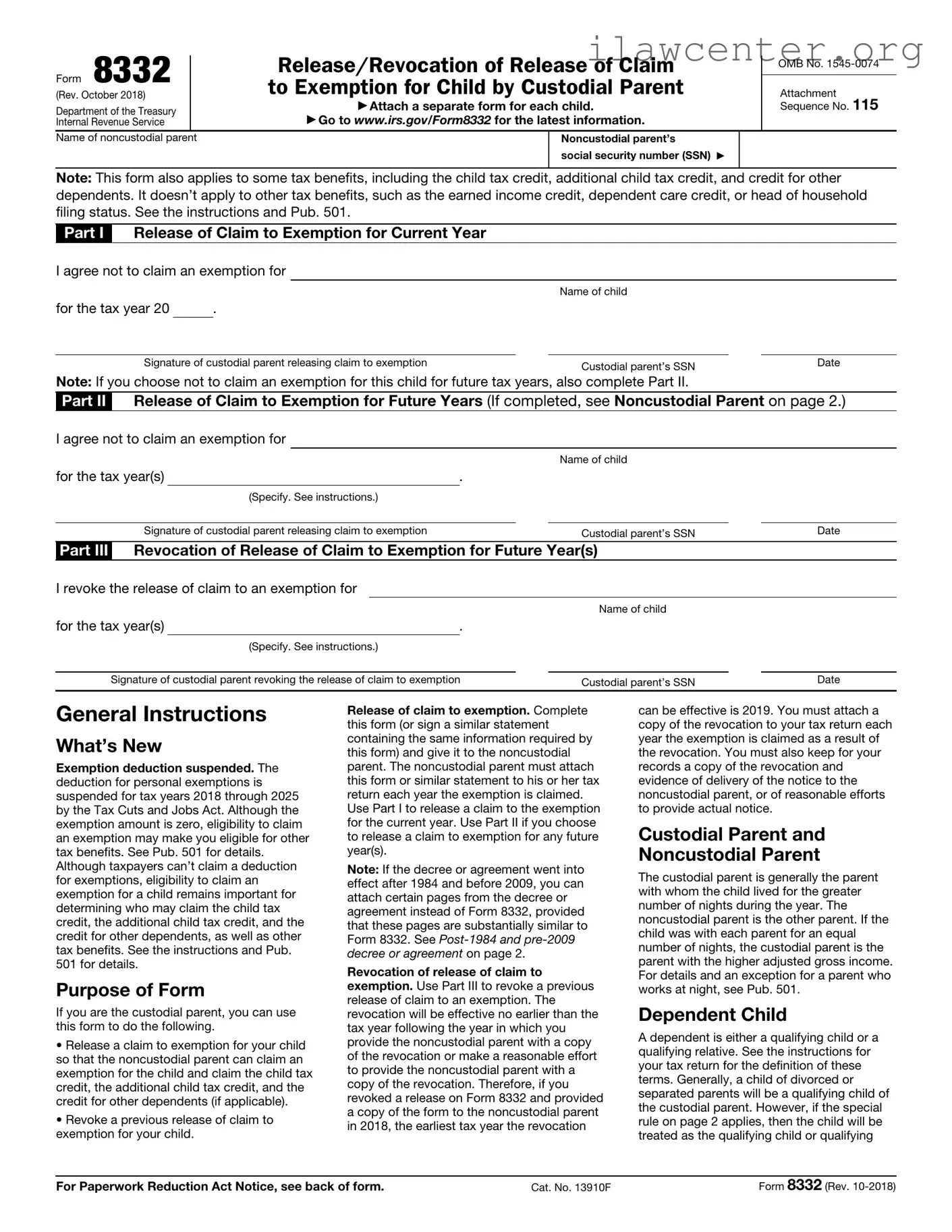
Form 8332


Release/Revocation of Release of Claim


OMB No. 1545-0074


to Exemption for Child by Custodial Parent


(Rev. October 2018)


Attachment

115

Department of the Treasury


Attach a separate form for each child.


Sequence No.


Go to www.irs.gov/Form8332 for the latest information.


Internal Revenue Service


Name of noncustodial parent


Noncustodial parent’s


social security number (SSN)


Note: This form also applies to some tax benefits, including the child tax credit, additional child tax credit, and credit for other dependents. It doesn’t apply to other tax benefits, such as the earned income credit, dependent care credit, or head of household filing status. See the instructions and Pub. 501.

Part I Release of Claim to Exemption for Current Year

I agree not to claim an exemption for

Name of child

for the tax year 20


.

Signature of custodial parent releasing claim to exemption


Custodial parent’s SSN


Date


Note: If you choose not to claim an exemption for this child for future tax years, also complete Part II.

Part II Release of Claim to Exemption for Future Years (If completed, see Noncustodial Parent on page 2.)

I agree not to claim an exemption for


Name of child


for the tax year(s)

.


(Specify. See instructions.)


Signature of custodial parent releasing claim to exemption


Custodial parent’s SSN


Date

Part III Revocation of Release of Claim to Exemption for Future Year(s)

I revoke the release of claim to an exemption for


Name of child


for the tax year(s)

.


(Specify. See instructions.)


Signature of custodial parent revoking the release of claim to exemption


Custodial parent’s SSN


Date

General Instructions

What’s New

Exemption deduction suspended. The deduction for personal exemptions is suspended for tax years 2018 through 2025 by the Tax Cuts and Jobs Act. Although the exemption amount is zero, eligibility to claim an exemption may make you eligible for other tax benefits. See Pub. 501 for details. Although taxpayers can’t claim a deduction for exemptions, eligibility to claim an exemption for a child remains important for determining who may claim the child tax credit, the additional child tax credit, and the credit for other dependents, as well as other tax benefits. See the instructions and Pub. 501 for details.

Purpose of Form

If you are the custodial parent, you can use this form to do the following.

Release a claim to exemption for your child so that the noncustodial parent can claim an exemption for the child and claim the child tax credit, the additional child tax credit, and the credit for other dependents (if applicable).

Revoke a previous release of claim to exemption for your child.

Release of claim to exemption. Complete this form (or sign a similar statement containing the same information required by this form) and give it to the noncustodial parent. The noncustodial parent must attach this form or similar statement to his or her tax return each year the exemption is claimed. Use Part I to release a claim to the exemption for the current year. Use Part II if you choose to release a claim to exemption for any future year(s).

Note: If the decree or agreement went into effect after 1984 and before 2009, you can attach certain pages from the decree or agreement instead of Form 8332, provided that these pages are substantially similar to Form 8332. See Post-1984 and pre-2009 decree or agreement on page 2.

Revocation of release of claim to exemption. Use Part III to revoke a previous release of claim to an exemption. The revocation will be effective no earlier than the tax year following the year in which you provide the noncustodial parent with a copy of the revocation or make a reasonable effort to provide the noncustodial parent with a copy of the revocation. Therefore, if you revoked a release on Form 8332 and provided a copy of the form to the noncustodial parent in 2018, the earliest tax year the revocation

can be effective is 2019. You must attach a copy of the revocation to your tax return each year the exemption is claimed as a result of the revocation. You must also keep for your records a copy of the revocation and evidence of delivery of the notice to the noncustodial parent, or of reasonable efforts to provide actual notice.

Custodial Parent and

Noncustodial Parent

The custodial parent is generally the parent with whom the child lived for the greater number of nights during the year. The noncustodial parent is the other parent. If the child was with each parent for an equal number of nights, the custodial parent is the parent with the higher adjusted gross income. For details and an exception for a parent who works at night, see Pub. 501.

Dependent Child

A dependent is either a qualifying child or a qualifying relative. See the instructions for your tax return for the definition of these terms. Generally, a child of divorced or separated parents will be a qualifying child of the custodial parent. However, if the special rule on page 2 applies, then the child will be treated as the qualifying child or qualifying

For Paperwork Reduction Act Notice, see back of form.

Cat. No. 13910F

Form 8332 (Rev. 10-2018)

Form 8332 (Rev. 10-2018)

Page 2

relative of the noncustodial parent for purposes of the dependency exemption, the child tax credit, the additional child tax credit, and the credit for other dependents.

Special Rule for Children of Divorced or Separated Parents

A child is treated as a qualifying child or a qualifying relative of the noncustodial parent if all of the following apply.

1.The child received over half of his or her support for the year from one or both of the parents (see the Exception below). If you received payments under the Temporary Assistance for Needy Families (TANF) program or other public assistance program and you used the money to support the child, see Pub. 501.

2.The child was in the custody of one or both of the parents for more than half of the year.

3.Either of the following applies.

a. The custodial parent agrees not to claim an exemption for the child by signing this form or a similar statement. If the decree or agreement went into effect after 1984 and before 2009, see Post-1984 and pre-2009 decree or agreement below.

b. A pre-1985 decree of divorce or separate maintenance or written separation agreement states that the noncustodial parent can claim the child as a dependent. But the noncustodial parent must provide at least $600 for the child’s support during the year. This rule does not apply if the decree or agreement was changed after 1984 to say that the noncustodial parent cannot claim the child as a dependent.

For this rule to apply, the parents must be one of the following.

Divorced or legally separated under a decree of divorce or separate maintenance.

Separated under a written separation agreement.

Living apart at all times during the last 6 months of the year.

If this rule applies, and the other dependency tests in the instructions for your tax return are also met, the noncustodial parent can claim an exemption for the child.

Exception. If the support of the child is determined under a multiple support agreement, this special rule does not apply, and this form should not be used.

Post-1984 and pre-2009 decree or agreement. If the divorce decree or separation agreement went into effect after 1984 and before 2009, the noncustodial parent can attach certain pages from the decree or agreement

instead of Form 8332, provided that these pages are substantially similar to Form 8332. To be able to do this, the decree or agreement must state all three of the following.

1.The noncustodial parent can claim the child as a dependent without regard to any condition (such as payment of support).

2.The other parent will not claim the child as a dependent.

3.The years for which the claim is released.

The noncustodial parent must attach all of the following pages from the decree or agreement.

Cover page (include the other parent’s SSN on that page).

The pages that include all of the information identified in (1) through (3) above.

Signature page with the other parent’s signature and date of agreement.

The noncustodial parent must ! attach the required information

even if it was filed with a return in CAUTION an earlier year.

Post-2008 decree or agreement. If the divorce decree or separation agreement went into effect after 2008, the noncustodial parent can’t attach certain pages from the decree or agreement instead of Form 8332.

Specific Instructions

Custodial Parent

Part I. Complete Part I to release a claim to exemption for your child for the current tax year.

Part II. Complete Part II to release a claim to exemption for your child for one or more future years. Write the specific future year(s) or “all future years” in the space provided in Part II.

To help ensure future support, you TIP may not want to release your

claim to the exemption for the child for future years.

Part III. Complete Part III if you are revoking a previous release of claim to exemption for your child. Write the specific future year(s) or “all future years” in the space provided in Part III.

The revocation will be effective no earlier than the tax year following the year you provide the noncustodial parent with a copy of the revocation or make a reasonable effort to provide the noncustodial parent with a copy of the revocation. Also, you must attach a copy of the revocation to your tax return for each year you are claiming the exemption as a result of the revocation. You must also keep for your records a copy of the revocation and evidence of delivery of the notice to the noncustodial parent, or of reasonable efforts to provide actual notice.

Example. In 2015, you released a claim to exemption for your child on Form 8332 for the years 2016 through 2020. In 2018, you decided to revoke the previous release of exemption. If you completed Part III of Form 8332 and provided a copy of the form to the noncustodial parent in 2018, the revocation will be effective for 2019 and 2020. You must attach a copy of the revocation to your 2019 and 2020 tax returns and keep certain records as stated earlier.

Noncustodial Parent

Attach this form or similar statement to your tax return for each year you claim the exemption for your child. You can claim the exemption only if the other dependency tests in the instructions for your tax return are met.

If the custodial parent released his TIP or her claim to the exemption for

the child for any future year, you must attach a copy of this form or similar statement to your tax return

for each future year that you claim the exemption. Keep a copy for your records.

Note: If you are filing your return electronically, you must file Form 8332 with Form 8453, U.S. Individual Income Tax Transmittal for an IRS e-file Return. See Form 8453 and its instructions for more details.

Paperwork Reduction Act Notice. We ask for the information on this form to carry out the Internal Revenue laws of the United States. You are required to give us the information. We need it to ensure that you are complying with these laws and to allow us to figure and collect the right amount of tax.

You aren’t required to provide the information requested on a form that is subject to the Paperwork Reduction Act unless the form displays a valid OMB control number. Books or records relating to a form or its instructions must be retained as long as their contents may become material in the administration of any Internal Revenue law. Generally, tax returns and return information are confidential, as required by Internal Revenue Code section 6103.

The average time and expenses required to complete and file this form will vary depending on individual circumstances. For the estimated averages, see the instructions for your income tax return.

If you have suggestions for making this form simpler, we would be happy to hear from you. See the instructions for your income tax return.
File Properties

Fact Name Description
Purpose The IRS Form 8332 allows a custodial parent to release their claim to a child’s tax exemption to the non-custodial parent.
Eligibility To use Form 8332, parents must be divorced or legally separated and have a written agreement regarding the child’s tax exemption.
Filing Process The form must be completed and signed by the custodial parent and submitted with the non-custodial parent's tax return.
State-Specific Forms Some states have their own forms for similar purposes. For example, California has the Form 8332A under California Family Code Section 4057.
Revocation The custodial parent can revoke the release of the tax exemption by providing a written notice to the non-custodial parent.
Deadline Form 8332 should be filed with the tax return by the non-custodial parent by the federal tax filing deadline, typically April 15.

Instructions on Utilizing IRS 8332

Completing the IRS Form 8332 is an essential step for parents who wish to transfer their claim for a child’s dependency exemption. After filling out the form, it must be submitted along with your tax return to ensure that the correct parent is recognized for the exemption. Follow these steps carefully to ensure accurate completion.

  1. Begin by downloading the IRS Form 8332 from the official IRS website or obtain a physical copy from a tax professional.
  2. In the first section, provide the name of the custodial parent. This is the parent who has primary custody of the child.
  3. Next, fill in the Social Security Number of the custodial parent. This information is crucial for tax identification purposes.
  4. Enter the name of the non-custodial parent. This parent is the one who will claim the dependency exemption.
  5. Provide the Social Security Number of the non-custodial parent. Ensure this is accurate to avoid any issues with the IRS.
  6. In the section regarding the child, fill in the child’s name, date of birth, and Social Security Number.
  7. Indicate the tax year for which the exemption is being claimed. This is typically the year the tax return is being filed for.
  8. Sign and date the form. The custodial parent must sign to authorize the release of the dependency exemption.
  9. Make a copy of the completed form for your records before submitting it with your tax return.

After completing these steps, ensure that the form is submitted along with your tax return. This will help avoid any delays or complications with your tax filing process.

Important Facts about IRS 8332

What is IRS Form 8332?

IRS Form 8332 is a document that allows a custodial parent to release their claim to a child's tax exemption to the non-custodial parent. This form is essential for parents who share custody and want to clarify who can claim the child on their tax return.

Who needs to file Form 8332?

The custodial parent, who has primary physical custody of the child, must file Form 8332 if they choose to allow the non-custodial parent to claim the child as a dependent. This situation often arises in divorce or separation cases.

How do I complete Form 8332?

To complete Form 8332, you need to provide the names and Social Security numbers of both the custodial and non-custodial parents, as well as the child. You will also need to indicate the tax year for which the exemption is being released. Follow the instructions carefully to ensure accuracy.

Is Form 8332 required every year?

Form 8332 must be filed for each tax year that the non-custodial parent wishes to claim the child as a dependent. If the agreement changes, or if the custodial parent no longer wishes to release the exemption, a new form must be completed.

What if the custodial parent refuses to sign Form 8332?

If the custodial parent refuses to sign Form 8332, the non-custodial parent cannot claim the child as a dependent. In such cases, it may be necessary to seek legal assistance to resolve the issue, especially if there is a court order in place regarding tax exemptions.

Can Form 8332 be revoked?

Yes, Form 8332 can be revoked. The custodial parent can cancel the release of the exemption by providing a written statement to the non-custodial parent. This statement should include the date of revocation and the tax year for which the exemption is no longer valid.

Where do I send Form 8332?

Form 8332 should be attached to the non-custodial parent's tax return when it is filed. There is no need to send it separately to the IRS. However, both parents should keep a copy for their records.

Can I use Form 8332 for multiple children?

Yes, Form 8332 can be used for multiple children. You can list all eligible children on the form. Ensure that you provide the necessary details for each child to avoid any confusion during tax filing.

What happens if I don’t file Form 8332 but claim the child?

If you claim a child without filing Form 8332 when required, the IRS may disallow your claim. This can lead to penalties, additional taxes owed, and complications in future filings. Always ensure compliance with IRS regulations to avoid these issues.

Common mistakes

When filling out the IRS Form 8332, many people make common mistakes that can lead to delays or complications in their tax filings. One frequent error is neglecting to sign and date the form. The IRS requires a signature from the custodial parent, and without it, the form is considered incomplete. This simple oversight can prevent the non-custodial parent from claiming the child as a dependent.

Another mistake involves failing to provide accurate information about the child. It is essential to include the child's full name, Social Security number, and the correct year for which the exemption is being claimed. Inaccuracies in this information can result in the IRS rejecting the form or requiring further clarification, which can prolong the process.

Some individuals mistakenly believe that the IRS Form 8332 is a one-time submission. In reality, this form must be submitted for each tax year that the non-custodial parent wishes to claim the child as a dependent. Failing to submit a new form each year can lead to confusion and potential tax liabilities.

Additionally, people often overlook the importance of understanding the custody agreement. The IRS Form 8332 is only valid if it aligns with the terms of the custody arrangement. If the custodial parent does not have the legal right to release the exemption, the non-custodial parent cannot claim it, regardless of the form submission.

Lastly, some filers forget to keep a copy of the completed form for their records. Retaining a copy is crucial, as it serves as proof of the agreement between parents regarding the dependency claim. In case of an audit or dispute, having this documentation can be invaluable.

Documents used along the form

The IRS Form 8332 is essential for divorced or separated parents who wish to clarify who can claim a child as a dependent for tax purposes. When navigating the complexities of tax deductions related to children, several other forms and documents often come into play. Here’s a brief overview of these important documents.

  • Form 1040: This is the standard individual income tax return form used by U.S. taxpayers. It reports income, calculates taxes owed, and claims any deductions or credits, including those related to dependents.
  • Form 8862: If a taxpayer has previously been denied the Earned Income Tax Credit (EITC), this form is required to claim the credit again. It helps the IRS determine eligibility based on prior disqualifications.
  • Form 2441: This form is used to claim the Child and Dependent Care Credit. It details expenses incurred for the care of children or dependents while the taxpayer works or looks for work.
  • Form 8812: This form is for claiming the Additional Child Tax Credit. It allows taxpayers to receive a refund even if they do not owe any tax, based on their qualifying children.

Understanding these forms can simplify the tax filing process and ensure that you maximize your benefits. Always keep your documents organized and consult with a tax professional if you have questions about your specific situation.

Similar forms

  • Form 1040: This is the standard individual income tax return form used by taxpayers in the United States. Like the IRS 8332, it is essential for claiming dependents, as it determines eligibility for various tax benefits.
  • Form 8862: This form is used to claim the Earned Income Credit after a disallowance. Similar to IRS 8332, it involves proving eligibility for tax benefits related to dependents.
  • Form 2441: This document is used to claim the Child and Dependent Care Credit. It also requires information about dependents, much like the IRS 8332, which is necessary for claiming certain tax credits.
  • Form 8812: This form helps taxpayers claim the Additional Child Tax Credit. It shares similarities with IRS 8332 in that both forms require details about qualifying children.
  • Form 8863: This form is utilized for education credits, including the American Opportunity and Lifetime Learning Credits. Both IRS 8332 and this form require information about dependents to access tax benefits.
  • Form 8333: This form is used for claiming tax benefits related to certain tax treaty provisions. Similar to IRS 8332, it involves providing documentation to support claims for dependent-related benefits.
  • Form W-4: This is the Employee's Withholding Certificate. Like the IRS 8332, it helps determine tax benefits, specifically in terms of withholding allowances based on dependents.
  • Form 1098-T: This form is issued by educational institutions to report tuition payments. It connects to IRS 8332 through the need to verify dependent status for education-related tax credits.

Dos and Don'ts

When filling out the IRS 8332 form, it's important to follow specific guidelines to ensure accuracy and compliance. Here are five things you should and shouldn't do:

  • Do ensure that you are eligible to claim the child as a dependent.
  • Don't forget to provide the correct Social Security Number for the child.
  • Do sign and date the form before submitting it.
  • Don't leave any sections blank; fill out all required information.
  • Do keep a copy of the completed form for your records.

Misconceptions

The IRS Form 8332 is often misunderstood. Here are five common misconceptions about this form:

  1. Form 8332 is only for divorced parents.

    This form can be used by any custodial parent who wants to allow a non-custodial parent to claim a child as a dependent. It is not limited to situations involving divorce.

  2. Filing Form 8332 guarantees a tax benefit.

    While the form allows a non-custodial parent to claim a child as a dependent, it does not automatically ensure a tax refund or credit. The actual benefit depends on various factors, including the taxpayer's overall financial situation.

  3. Once Form 8332 is signed, it cannot be revoked.

    A custodial parent can revoke the release of the dependency exemption by providing a written notice to the non-custodial parent. However, this must be done according to IRS guidelines.

  4. Only one Form 8332 can be filed for each child.

    Multiple Forms 8332 can be filed over the years, especially if custody arrangements change. Each form must be properly completed and submitted according to the current custody agreement.

  5. Form 8332 is the only requirement to claim a child.

    In addition to submitting Form 8332, the non-custodial parent must meet other IRS requirements to claim the child as a dependent, such as providing financial support and meeting residency requirements.

Key takeaways

The IRS Form 8332 is an important document for parents who share custody of their children and want to clarify the tax benefits related to child support. Here are some key takeaways about filling out and using this form:

  • Purpose: The form allows a custodial parent to release their claim to the child’s tax exemption for a specific tax year, enabling the non-custodial parent to claim it instead.
  • Eligibility: Only the custodial parent can complete this form, and it is applicable when parents are divorced, legally separated, or living apart.
  • Filing Process: The completed form should be attached to the non-custodial parent's tax return for the year the exemption is claimed.
  • Specificity: The form can be used for one year or multiple years, but it must clearly state the years for which the exemption is being released.
  • Signature Requirement: The custodial parent must sign the form to validate the release of the exemption. Without this signature, the form is not valid.
  • Revocation: The custodial parent can revoke the release at any time, but they must provide written notice to the non-custodial parent.
  • Record Keeping: Both parents should keep a copy of the signed form for their records in case of future disputes or questions from the IRS.

Understanding these key points can help ensure that both parents correctly navigate the tax benefits associated with their children. Proper use of Form 8332 can lead to significant tax savings, so it’s essential to fill it out accurately and follow the guidelines provided by the IRS.