IRS 8879 PDF Template

IRS 8879 PDF Template

The IRS 8879 form is a document that allows taxpayers to electronically sign their tax returns prepared by a tax professional. This form serves as a declaration that the information provided is accurate and complete, ensuring compliance with IRS regulations. Understanding how to properly fill out this form is crucial for a smooth filing process, so be sure to click the button below to get started.

Article Guide

The IRS 8879 form plays a crucial role in the electronic filing process for individual tax returns. It serves as an e-signature document, allowing taxpayers to authorize their tax preparers to submit their returns electronically on their behalf. This form simplifies the filing process, ensuring that both parties have a clear understanding of the submission. Taxpayers must provide their personal information, including their Social Security number, and confirm that they have reviewed their tax return for accuracy. Once completed, the form must be signed by the taxpayer, which can be done electronically. The IRS 8879 is not submitted to the IRS itself but must be retained by the tax preparer for verification purposes. Understanding this form is essential for anyone looking to streamline their tax filing experience while ensuring compliance with IRS regulations.

IRS 8879 Preview

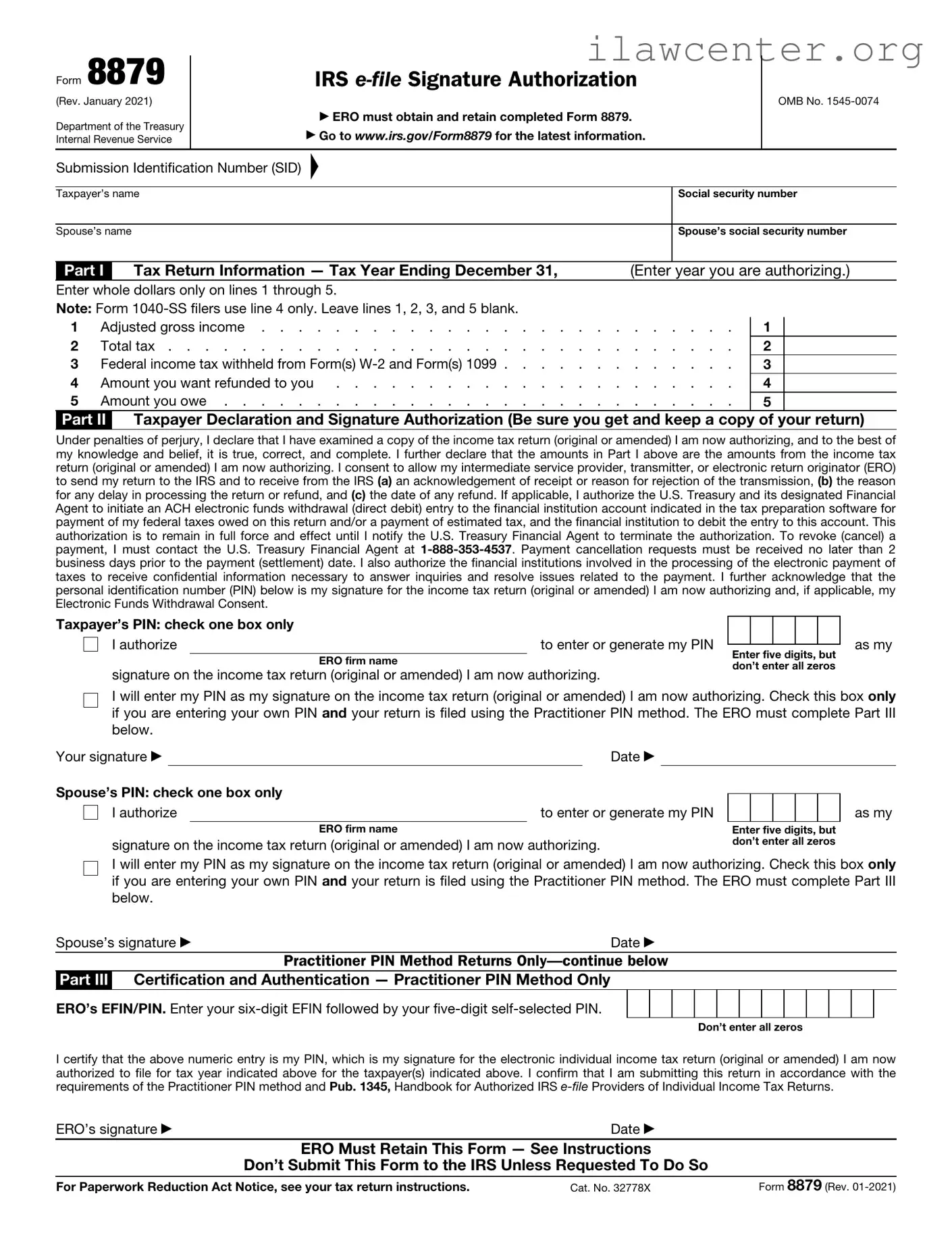
Form 8879

(Rev. January 2021)

Department of the Treasury Internal Revenue Service

IRS e-file Signature Authorization

ERO must obtain and retain completed Form 8879.

Go to www.irs.gov/Form8879 for the latest information.

OMB No. 1545-0074

Submission Identification Number (SID)

Taxpayer’s name


Social security number


Spouse’s name


Spouse’s social security number


Part I


Tax Return Information — Tax Year Ending December 31,


(Enter

year you are authorizing.)

Enter whole dollars only on lines 1 through 5.


Note: Form 1040-SS filers use line 4 only. Leave lines 1, 2, 3, and 5 blank.


1

Adjusted gross income

.

. .

.

. . .

1

2

Total tax

.

. .

.

. . .

2

3

Federal income tax withheld from Form(s) W-2 and Form(s) 1099

.

. .

.

. . .

3

4

Amount you want refunded to you

.

. .

.

. . .

4

5

Amount you owe

.

. .

.

. . .

5

Part II Taxpayer Declaration and Signature Authorization (Be sure you get and keep a copy of your return)

Under penalties of perjury, I declare that I have examined a copy of the income tax return (original or amended) I am now authorizing, and to the best of my knowledge and belief, it is true, correct, and complete. I further declare that the amounts in Part I above are the amounts from the income tax return (original or amended) I am now authorizing. I consent to allow my intermediate service provider, transmitter, or electronic return originator (ERO) to send my return to the IRS and to receive from the IRS (a) an acknowledgement of receipt or reason for rejection of the transmission, (b) the reason for any delay in processing the return or refund, and (c) the date of any refund. If applicable, I authorize the U.S. Treasury and its designated Financial Agent to initiate an ACH electronic funds withdrawal (direct debit) entry to the financial institution account indicated in the tax preparation software for payment of my federal taxes owed on this return and/or a payment of estimated tax, and the financial institution to debit the entry to this account. This authorization is to remain in full force and effect until I notify the U.S. Treasury Financial Agent to terminate the authorization. To revoke (cancel) a payment, I must contact the U.S. Treasury Financial Agent at 1-888-353-4537. Payment cancellation requests must be received no later than 2 business days prior to the payment (settlement) date. I also authorize the financial institutions involved in the processing of the electronic payment of taxes to receive confidential information necessary to answer inquiries and resolve issues related to the payment. I further acknowledge that the personal identification number (PIN) below is my signature for the income tax return (original or amended) I am now authorizing and, if applicable, my Electronic Funds Withdrawal Consent.

Taxpayer’s PIN: check one box only


I authorize


to enter or generate my PIN


Enter five digits, but


ERO firm name


don’t enter all zeros

signature on the income tax return (original or amended) I am now authorizing.


as my

I will enter my PIN as my signature on the income tax return (original or amended) I am now authorizing. Check this box only if you are entering your own PIN and your return is filed using the Practitioner PIN method. The ERO must complete Part III below.

Your signature


Date


Spouse’s PIN: check one box only


I authorize

to enter or generate my PIN


ERO firm name


Enter five digits, but

signature on the income tax return (original or amended) I am now authorizing.

don’t enter all zeros

as my

I will enter my PIN as my signature on the income tax return (original or amended) I am now authorizing. Check this box only if you are entering your own PIN and your return is filed using the Practitioner PIN method. The ERO must complete Part III below.

Spouse’s signature

Date


Practitioner PIN Method Returns Only—continue below

Part III Certification and Authentication — Practitioner PIN Method Only

ERO’s EFIN/PIN. Enter your six-digit EFIN followed by your five-digit self-selected PIN.

Don’t enter all zeros

I certify that the above numeric entry is my PIN, which is my signature for the electronic individual income tax return (original or amended) I am now authorized to file for tax year indicated above for the taxpayer(s) indicated above. I confirm that I am submitting this return in accordance with the requirements of the Practitioner PIN method and Pub. 1345, Handbook for Authorized IRS e-file Providers of Individual Income Tax Returns.

ERO’s signature

Date


ERO Must Retain This Form — See Instructions


Don’t Submit This Form to the IRS Unless Requested To Do So


For Paperwork Reduction Act Notice, see your tax return instructions.

Cat. No. 32778X

Form 8879 (Rev. 01-2021)

Form 8879 (Rev. 01-2021)

Page 2

General Instructions

Section references are to the Internal Revenue Code unless otherwise noted.

Future developments. For the latest information about developments related to Form 8879 and its instructions, such as legislation enacted after they were published, go to www.irs.gov/Form8879.

What's New. Form 8879 is used to authorize the electronic filing (e-file) of original and amended returns. Use this Form 8879 (Rev. January 2021) to authorize e-file of your Form 1040, 1040-SR, 1040-NR, 1040-SS, or 1040- X, for tax years beginning with 2019.

Purpose of Form

Form 8879 is the declaration document and signature authorization for an e-filed return filed by an electronic return originator (ERO). Complete Form 8879 when the Practitioner PIN method is used or when the taxpayer authorizes the ERO to enter or generate the taxpayer’s personal identification number (PIN) on his or her e-filed individual income tax return.


!

Don’t send this form to the IRS.

The ERO must retain Form 8879.

CAUTION


When and How To Complete

Use this chart to determine when and how to complete Form 8879.

IF the ERO is . . .

THEN . . .


Not using the Practitioner

Don’t complete

PIN method and the

Form 8879.

taxpayer enters his or her


own PIN


Not using the Practitioner

Complete Form

PIN method and is

8879, Parts I and II.

authorized to enter or


generate the taxpayer’s


PIN


Using the Practitioner PIN

Complete Form 8879,

method and is authorized

Parts I, II, and III.

to enter or generate the


taxpayer’s PIN


Using the Practitioner PIN

Complete Form 8879,

Parts I, II, and III.

method and the taxpayer


enters his or her own PIN


ERO Responsibilities

The ERO must:

1.Enter the name(s) and social security number(s) of the taxpayer(s) at the top of the form.

2.Complete Part I using the amounts (zeros may be entered when appropriate) from the taxpayer’s tax return. Form 1040-SS filers leave lines 1 through 3 and line 5 blank.

3.Enter or generate, if authorized by the taxpayer, the taxpayer’s PIN and enter it in the boxes provided in Part II.

4.Enter on the authorization line in Part II the ERO firm name (not the name of the individual preparing the return) if the ERO is authorized to enter the taxpayer’s PIN.

5.Provide the taxpayer(s) Form 8879 by hand delivery, U.S. mail, private delivery service, email, Internet website, or fax.

6.Enter the 20-digit Submission Identification Number (SID) assigned to the tax return, or associate Form 9325, Acknowledgement and General Information for Taxpayers Who File Returns Electronically, with Form 8879 after filing. If Form 9325 is used to provide the SID, it isn’t required to be physically attached to Form 8879. However, it must be kept in accordance with published retention requirements for Form 8879. See Pub. 4164, Modernized e-File (MeF) Guide for Software Developers and Transmitters, for more details.

You must receive the completed ! and signed Form 8879 from the

taxpayer before the electronic CAUTION return is transmitted (or released

for transmission).

For additional information, see Pub. 1345.

Taxpayer Responsibilities

Taxpayers must:

1.Verify the accuracy of the prepared income tax return, including direct deposit information.

2.Check the appropriate box in Part II to authorize the ERO to enter or generate your PIN or to do it yourself.

3.Indicate or verify your PIN when authorizing the ERO to enter or generate it (the PIN must be five digits other than all zeros).

4.Sign and date Form 8879. Taxpayers must sign Form 8879 by handwritten signature, or electronic signature if supported by computer software.

5.Return the completed Form 8879 to the ERO by hand delivery, U.S. mail, private delivery service, email, Internet website, or fax.

Your return won’t be transmitted to the IRS until the ERO receives your signed Form 8879.

Refund information. You can check on the status of your refund if it has been at least 72 hours since the IRS acknowledged receipt of your e-filed return. But if you filed Form 8379 with your return, allow 11 weeks. To check the status of your refund, do one of the following.

Go to www.irs.gov/Refunds.

Call 1-800-829-4477 for automated refund information and follow the recorded instructions.

Call 1-800-829-1954.

Important Notes for EROs

Don’t send Form 8879 to the IRS unless requested to do so. Retain the completed Form 8879 for 3 years from the return due date or IRS received date, whichever is later. Form 8879 may be retained electronically in accordance with the recordkeeping guidelines in Rev. Proc. 97-22, which is on page 9 of Internal Revenue Bulletin 1997-13 at www.irs.gov/pub/irs-irbs/irb97-13.pdf.

Confirm the identity of the taxpayer(s).

Complete Part III only if you are filing the return using the Practitioner PIN method. You aren’t required to enter the taxpayer’s date of birth, prior year adjusted gross income, or PIN in the Authentication Record of the electronically filed return.

If you aren’t using the Practitioner PIN method, enter the taxpayer(s) date of birth and either the adjusted gross income or the PIN, or both, from the taxpayer’s prior year originally filed return in the Authentication Record of the taxpayer’s electronically filed return. Don’t use an amount from an amended return or a math error correction made by the IRS.

Enter the taxpayer’s PIN(s) on the input screen only if the taxpayer has authorized you to do so. If married filing jointly, it is acceptable for one spouse to authorize you to enter his or her PIN, and for the other spouse to enter his or her own PIN. It isn’t acceptable for a taxpayer to select or enter the PIN of an absent spouse.

Taxpayers must use a PIN to sign their

e-filed individual income tax return transmitted by an ERO.

Provide the taxpayer with a copy of the signed Form 8879 for his or her records upon request.

Provide the taxpayer with a corrected copy of Form 8879 if changes are made to the return (for example, based on taxpayer review).

EROs can sign the form using a rubber stamp, mechanical device (such as a signature pen), or computer software program. See Notice 2007-79, 2007-42 I.R.B. 809, available at www.irs.gov/ irb/2007-42_IRB/ar10.html, for more information.

Go to www.irs.gov/Efile for the latest information.
File Properties

Fact Name Description
Purpose The IRS Form 8879 is used to authorize an e-filed tax return. It allows taxpayers to sign their return electronically.
Eligibility Taxpayers who file their returns electronically can use Form 8879. This includes individuals and businesses.
Signature Requirement Form 8879 requires the taxpayer's signature, which can be provided electronically. This signature verifies the accuracy of the return.
Filing Deadline The form must be completed and retained by the tax preparer by the due date of the tax return. This ensures compliance with IRS regulations.
Retention Period Taxpayers should keep Form 8879 for at least three years from the date the tax return is filed. This is important for record-keeping.
State-Specific Forms Some states have their own versions of Form 8879. For example, California uses Form 8879-C for corporations, governed by California Revenue and Taxation Code.
Electronic Filing Benefits Using Form 8879 for electronic filing can speed up the processing of tax returns. It also helps reduce errors associated with paper filing.

Instructions on Utilizing IRS 8879

Once you have gathered the necessary information and documents, you can begin filling out the IRS 8879 form. This form is used to authorize an electronic return originator (ERO) to file your tax return electronically. After completing the form, you will need to sign it, which confirms your consent for the ERO to submit your tax return on your behalf.

  1. Start by entering your name and Social Security number in the designated fields at the top of the form.
  2. Provide your spouse's name and Social Security number if you are filing jointly.
  3. Fill in your address, including city, state, and ZIP code.
  4. Indicate the tax year for which you are filing the return.
  5. In the section labeled "Filing Status," check the box that corresponds to your filing status (e.g., single, married filing jointly, etc.).
  6. Enter the total income amount from your tax return in the appropriate field.
  7. Review the refund or balance due amounts from your tax return and enter them as instructed.
  8. Sign and date the form in the designated area. If you are filing jointly, your spouse should also sign and date the form.
  9. Provide the ERO's name, firm name, and EFIN (Electronic Filing Identification Number) in the specified fields.

After completing these steps, ensure that all information is accurate before submitting the form to your ERO. The ERO will then use this authorization to file your tax return electronically.

Important Facts about IRS 8879

What is the IRS Form 8879?

The IRS Form 8879, also known as the "IRS e-file Signature Authorization," is a document that allows taxpayers to authorize their tax preparers to electronically file their federal tax returns on their behalf. By signing this form, you give permission for your tax preparer to submit your tax return electronically, which can speed up the processing time and often leads to quicker refunds.

Who needs to use Form 8879?

How do I complete Form 8879?

To complete Form 8879, you will need to provide basic information such as your name, Social Security number, and the tax year for which you are filing. Your tax preparer will also need to fill in their details. Once all the necessary information is filled out, you will sign the form to authorize the e-filing. It is essential to review the information carefully before signing to ensure everything is accurate.

Is Form 8879 required for all e-filed returns?

Form 8879 is not required for every e-filed return, but it is a necessary document when a tax preparer is submitting your return on your behalf. If you are e-filing your own return without a preparer, you do not need to fill out this form. However, if you choose to use a tax professional, they will typically require this authorization to proceed with e-filing.

What happens if I do not sign Form 8879?

If you do not sign Form 8879, your tax preparer cannot e-file your return. This could delay the filing process and potentially push back your refund. Instead, you would need to file your return via paper, which can take longer for the IRS to process. Therefore, signing this form is crucial for a smooth and timely filing experience.

Can I revoke my authorization after signing Form 8879?

Yes, you can revoke your authorization after signing Form 8879. If you decide to change your mind about allowing your tax preparer to e-file your return, you should inform them immediately. Depending on the timing, you may need to file your return using a paper method instead. Always communicate your wishes clearly to avoid any confusion.

How long is Form 8879 valid?

Form 8879 is valid only for the tax year for which it is signed. Once the tax return has been filed, the authorization is no longer in effect. If you require your tax preparer to e-file for future tax years, you will need to complete a new Form 8879 each year. This ensures that your authorization is up to date and reflects any changes in your tax situation.

Where can I find IRS Form 8879?

You can find IRS Form 8879 on the official IRS website. The form is available for download in PDF format, allowing you to print and fill it out. Additionally, your tax preparer should have access to this form and can provide it to you as part of their services. Always ensure you are using the most current version of the form to avoid any issues with your tax filing.

Common mistakes

The IRS 8879 form, also known as the e-file Signature Authorization, is a critical document for taxpayers who choose to file their returns electronically. However, many individuals make mistakes when filling out this form, which can lead to delays in processing or even potential issues with the IRS. Here are ten common errors to avoid.

First, one frequent mistake is failing to provide a valid Social Security Number (SSN). The form requires the taxpayer's SSN, and entering an incorrect number can result in rejection of the e-filed return. Always double-check the SSN for accuracy.

Another common error is neglecting to sign the form. The IRS requires both the taxpayer and the paid preparer, if applicable, to sign the form. Without these signatures, the form is incomplete, and the return cannot be processed.

Some individuals overlook the importance of the date. The form must be dated at the time of signing. An unsigned or undated form can lead to complications, as the IRS will not accept it as valid.

In addition, taxpayers often forget to indicate whether they are filing jointly or separately. This designation is crucial for the IRS to understand the filing status. Failing to specify this can lead to confusion and potential miscalculations of tax liabilities.

Moreover, not providing a correct email address is a mistake that can hinder communication with the IRS. The email address is used for confirmation and updates regarding the e-filed return. Ensure that it is accurate and current.

Some filers make the error of not checking for consistency between the IRS 8879 and the tax return. Any discrepancies between the two documents can raise red flags and may lead to an audit. It is essential to ensure that all information matches.

Additionally, individuals sometimes use outdated versions of the form. The IRS periodically updates its forms, and using an old version can result in rejection. Always download the latest version from the IRS website.

Another mistake is failing to provide a phone number. While it may seem minor, having a contact number can facilitate communication if the IRS needs to reach out regarding the return.

Taxpayers also often neglect to review the entire form before submission. A thorough review can catch simple errors, such as typos or missing information, which can prevent delays in processing.

Finally, some individuals may not keep a copy of the completed form for their records. Retaining a copy is essential for future reference and can be helpful if any questions arise about the filed return.

By being aware of these common mistakes, taxpayers can ensure that their IRS 8879 form is completed accurately and submitted without complications. Taking the time to review each section carefully can save time and prevent issues with the IRS.

Documents used along the form

The IRS 8879 form, known as the "IRS e-file Signature Authorization," is an important document used by taxpayers to authorize the electronic filing of their tax returns. However, it is often accompanied by several other forms and documents that are essential for a complete and accurate tax filing. Below is a list of commonly used forms and documents that may be needed alongside the IRS 8879 form.

  • Form 1040: This is the standard individual income tax return form used by most taxpayers to report their annual income and calculate their tax liability.
  • Schedule A: This form is used to itemize deductions, allowing taxpayers to detail their eligible expenses, such as medical costs and mortgage interest, instead of taking the standard deduction.
  • Schedule C: Self-employed individuals use this form to report income and expenses related to their business activities, providing a detailed account of profit or loss.
  • Form W-2: Employers issue this form to employees, summarizing their annual earnings and the taxes withheld, which is necessary for accurate tax reporting.
  • Form 1099: Various versions of this form report income received from sources other than employment, such as freelance work or interest income, which must also be included in tax filings.
  • Form 4868: This form is used to request an automatic extension of time to file a tax return, providing taxpayers with additional time to submit their documents without incurring penalties.
  • Form 8889: Taxpayers with Health Savings Accounts (HSAs) use this form to report contributions, distributions, and any taxable amounts related to their HSAs.
  • Form 8862: This form is required for taxpayers who previously had their Earned Income Tax Credit (EITC) denied and wish to claim it again in a subsequent year.

In summary, while the IRS 8879 form plays a crucial role in the electronic filing process, it is important to gather and complete the other necessary forms to ensure compliance and accuracy in your tax return. Proper preparation can help alleviate stress during tax season and facilitate a smoother filing experience.

Similar forms

The IRS Form 8879, also known as the e-file Signature Authorization, allows taxpayers to authorize an electronic return originator to file their tax returns electronically. Several other documents serve similar purposes, facilitating the authorization process or providing necessary information for tax-related actions. Below is a list of nine documents that share similarities with Form 8879:

  • Form 8453: This form is used to authenticate the electronic filing of a tax return. It requires the taxpayer's signature and can be submitted with certain types of returns.
  • Form 4868: The application for an automatic extension of time to file a U.S. individual income tax return. It allows taxpayers to extend their filing deadline while maintaining their authorization for electronic filing.
  • Form 8821: This document grants the IRS permission to disclose tax information to a third party. It is similar in that it requires taxpayer authorization for another entity to act on their behalf.
  • Form 2848: Known as the Power of Attorney and Declaration of Representative, this form allows a designated individual to represent the taxpayer before the IRS, similar to how Form 8879 authorizes electronic filing.
  • Form 1040: The standard individual income tax return form. While it serves a different primary purpose, it ultimately requires taxpayer authorization and information for filing.
  • Form 1065: Used by partnerships to report income, deductions, and other information. Like Form 8879, it involves signatures and authorizations for electronic filing.
  • Form 1120: This form is for corporations to report their income tax. It includes similar elements of authorization, especially when filed electronically.
  • Form 990: Nonprofit organizations use this form to report financial information. It also requires authorization for electronic filing, paralleling the purpose of Form 8879.
  • Form 941: Employers use this form to report income taxes, Social Security tax, or Medicare tax withheld from employee paychecks. It shares the need for authorization and submission processes, similar to Form 8879.

Each of these documents plays a crucial role in the tax filing process, ensuring that the necessary authorizations are in place for compliance and efficiency.

Dos and Don'ts

When filling out the IRS 8879 form, it is essential to follow specific guidelines to ensure accuracy and compliance. Here are six important do's and don'ts:

  • Do double-check your personal information for accuracy, including your name, Social Security number, and address.
  • Do ensure that the form is signed by both the taxpayer and the paid preparer, if applicable.
  • Do keep a copy of the signed form for your records.
  • Don't leave any required fields blank; incomplete forms can lead to processing delays.
  • Don't forget to review the instructions provided by the IRS for any specific requirements related to your situation.
  • Don't submit the form electronically without verifying that it has been signed correctly.

Misconceptions

The IRS Form 8879, also known as the e-file Signature Authorization, is often misunderstood. Here are eight common misconceptions about this form:

  1. Form 8879 is only for business tax returns.

    This form is used for both individual and business tax returns. It allows taxpayers to electronically sign their tax returns, regardless of the type.

  2. Filing Form 8879 is mandatory for all e-filers.

    While it is a common practice for e-filing, it is not mandatory for every taxpayer. Some individuals may choose to e-file without using this form.

  3. Form 8879 can be submitted separately from the tax return.

    This form must be submitted together with the tax return. It serves as the authorization for the e-filing process.

  4. Signing Form 8879 is the same as filing the tax return.

    Signing the form does not constitute filing the return. It simply authorizes the tax preparer to submit the return electronically.

  5. Form 8879 can be signed by anyone.

    Only the taxpayer or an authorized representative can sign this form. It must reflect the correct taxpayer information.

  6. Once signed, Form 8879 cannot be revoked.

    Taxpayers can revoke their authorization at any time before the tax return is filed. Communication with the tax preparer is essential in this case.

  7. Form 8879 is only relevant during tax season.

    This form is relevant whenever a taxpayer chooses to e-file their return, not just during the traditional tax season.

  8. All tax preparers use Form 8879.

    While many tax preparers do use this form, not all do. Some may have alternative methods for obtaining authorization for e-filing.

Key takeaways

The IRS 8879 form is essential for e-filing your tax return. Here are some key takeaways to keep in mind:

  • The form is known as the "IRS e-file Signature Authorization." It allows you to authorize an e-file provider to submit your tax return electronically.
  • Both you and your tax preparer must sign the form for it to be valid. This signature is your electronic approval.
  • Ensure that all information on the form is accurate. Errors can delay your tax return processing.
  • The IRS requires that you keep a copy of the signed form for your records. This is important in case of future inquiries.
  • Filing the form is a critical step if you want your refund processed quickly. Delays can occur without it.
  • Check the form for any missing information before submission. Incomplete forms can lead to rejection of your e-filed return.
  • Be aware of deadlines. Submit the form promptly to avoid any last-minute issues with your tax filing.
  • Using the form helps protect your identity. It ensures that only authorized individuals can file on your behalf.
  • Keep your e-file provider's contact information handy. This will help resolve any issues that may arise during the filing process.

By following these takeaways, you can navigate the IRS 8879 form with confidence and ensure a smoother tax filing experience.