IRS 8962 PDF Template

IRS 8962 PDF Template

The IRS Form 8962, also known as the Premium Tax Credit form, is used to calculate and claim the premium tax credit for health insurance purchased through the Health Insurance Marketplace. This form helps individuals and families determine their eligibility for financial assistance based on their income and household size. Understanding how to accurately fill out this form is essential for ensuring you receive the correct amount of tax credits.

Ready to tackle your tax credits? Start filling out the form by clicking the button below.

Article Guide

The IRS Form 8962, also known as the Premium Tax Credit (PTC) form, plays a crucial role in the healthcare landscape for individuals and families who have obtained health insurance through the Health Insurance Marketplace. This form is essential for those who are eligible for the premium tax credit, as it helps to reconcile the amount of credit received during the year with what they actually qualify for based on their final income. When completing Form 8962, taxpayers must provide information about their household income, the number of individuals in their household, and the type of health coverage they had. Additionally, the form requires details about any advance premium tax credits that were applied to monthly insurance premiums. Understanding how to accurately fill out this form is vital, as it directly impacts tax returns and can influence future health coverage options. Navigating the intricacies of Form 8962 can seem daunting, but with the right information, taxpayers can ensure they receive the benefits they are entitled to while avoiding potential pitfalls in their tax filings.

IRS 8962 Preview

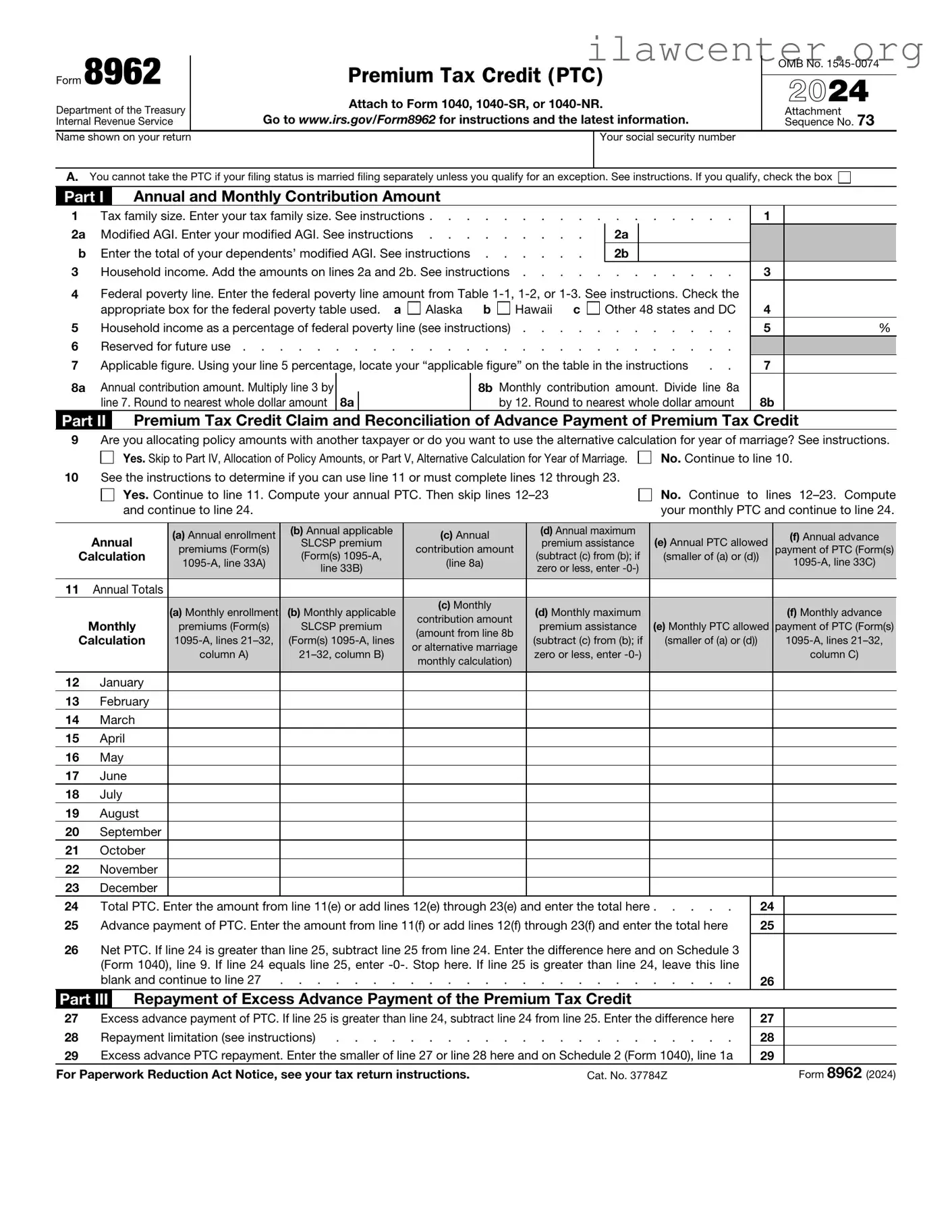
Form 8962

Department of the Treasury Internal Revenue Service

Name shown on your return

Premium Tax Credit (PTC)

Attach to Form 1040, 1040-SR, or 1040-NR.

Go to www.irs.gov/Form8962 for instructions and the latest information.

Your social security number

OMB No. 1545-0074

2024

Attachment Sequence No. 73

A.You cannot take the PTC if your filing status is married filing separately unless you qualify for an exception. See instructions. If you qualify, check the box

Part I Annual and Monthly Contribution Amount

1

Tax family size. Enter your tax family size. See instructions

. . . . . . . .


1


2a

Modified AGI. Enter your modified AGI. See instructions


2a


b

Enter the total of your dependents’ modified AGI. See instructions


2b


3

Household income. Add the amounts on lines 2a and 2b. See instructions . . . .

. . . . . . . .


3


4Federal poverty line. Enter the federal poverty line amount from Table 1-1, 1-2, or 1-3. See instructions. Check the


appropriate box for the federal poverty table used. a

Alaska

b

Hawaii

c

Other 48 states and DC

4


5

Household income as a percentage of federal poverty line (see instructions)

5

%

6

Reserved for future use


7

Applicable figure. Using your line 5 percentage, locate your “applicable figure” on the table in the instructions

. .

7


8a

Annual contribution amount. Multiply line 3 by


8b Monthly contribution amount. Divide line 8a


line 7. Round to nearest whole dollar amount 8a


by 12. Round to nearest whole dollar amount

8b


Part II Premium Tax Credit Claim and Reconciliation of Advance Payment of Premium Tax Credit

9Are you allocating policy amounts with another taxpayer or do you want to use the alternative calculation for year of marriage? See instructions.

Yes. Skip to Part IV, Allocation of Policy Amounts, or Part V, Alternative Calculation for Year of Marriage.

No. Continue to line 10.

10See the instructions to determine if you can use line 11 or must complete lines 12 through 23.

Yes. Continue to line 11. Compute your annual PTC. Then skip lines 12–23 and continue to line 24.

No. Continue to lines 12–23. Compute your monthly PTC and continue to line 24.

Annual

(a) Annual enrollment

(b) Annual applicable

(c) Annual

(d) Annual maximum

(e) Annual PTC allowed

(f) Annual advance

SLCSP premium

premium assistance

premiums (Form(s)

contribution amount

payment of PTC (Form(s)

Calculation

1095-A, line 33A)

(Form(s) 1095-A,

(line 8a)

(subtract (c) from (b); if

(smaller of (a) or (d))

1095-A, line 33C)


line 33B)

zero or less, enter -0-)


11Annual Totals


(a) Monthly enrollment

(b) Monthly applicable

(c) Monthly

(d) Monthly maximum


(f) Monthly advance


contribution amount


Monthly

premiums (Form(s)

SLCSP premium

premium assistance

(e) Monthly PTC allowed

payment of PTC (Form(s)

(amount from line 8b

Calculation

1095-A, lines 21–32,

(Form(s) 1095-A, lines

(subtract (c) from (b); if

(smaller of (a) or (d))

1095-A, lines 21–32,

or alternative marriage


column A)

21–32, column B)

zero or less, enter -0-)


column C)


monthly calculation)


12January

13February

14March

15April

16May

17June

18July

19August

20September

21October

22November

23December

24

Total PTC. Enter the amount from line 11(e) or add lines 12(e) through 23(e) and enter the total here

24

25

Advance payment of PTC. Enter the amount from line 11(f) or add lines 12(f) through 23(f) and enter the total here

25

26Net PTC. If line 24 is greater than line 25, subtract line 25 from line 24. Enter the difference here and on Schedule 3 (Form 1040), line 9. If line 24 equals line 25, enter -0-. Stop here. If line 25 is greater than line 24, leave this line


blank and continue to line 27

26


Part III

Repayment of Excess Advance Payment of the Premium Tax Credit


27

Excess advance payment of PTC. If line 25 is greater than line 24, subtract line 24 from line 25. Enter the difference here

27


28

Repayment limitation (see instructions)

28


29

Excess advance PTC repayment. Enter the smaller of line 27 or line 28 here and on Schedule 2 (Form 1040), line 1a

29


For Paperwork Reduction Act Notice, see your tax return instructions.

Cat. No. 37784Z


Form 8962 (2024)

Form 8962 (2024)

Page 2

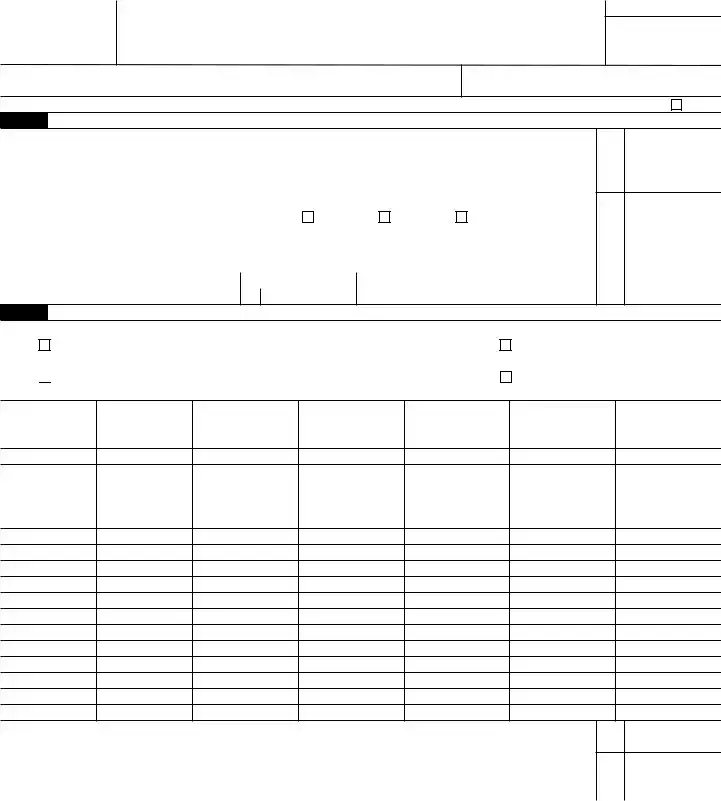
Part IV

Allocation of Policy Amounts


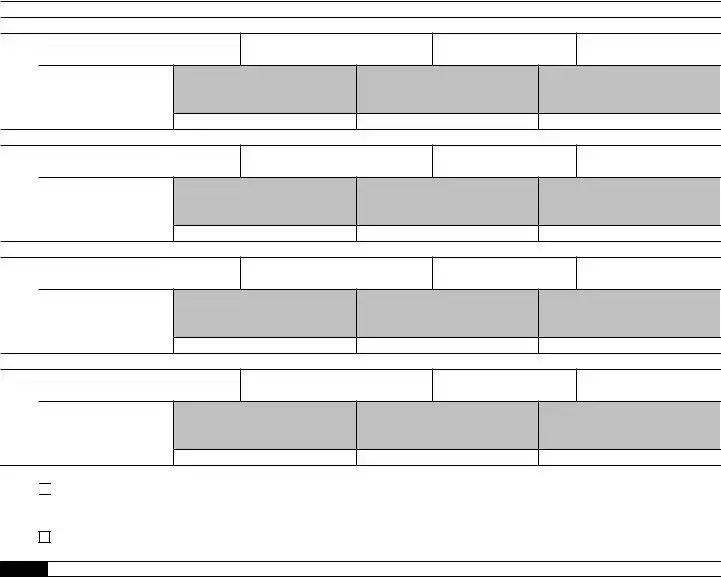
Complete the following information for up to four policy amount allocations. See instructions for allocation details.

Allocation 1

30(a) Policy Number (Form 1095-A, line 2)

(b)SSN of other taxpayer

(c)Allocation start month

(d)Allocation stop month

Allocation percentage applied to monthly amounts

(e)Premium Percentage

(f)SLCSP Percentage

(g)Advance Payment of the PTC Percentage

Allocation 2

31(a) Policy Number (Form 1095-A, line 2)

(b)SSN of other taxpayer

(c)Allocation start month

(d)Allocation stop month

Allocation percentage applied to monthly amounts

(e)Premium Percentage

(f)SLCSP Percentage

(g)Advance Payment of the PTC Percentage

Allocation 3

32(a) Policy Number (Form 1095-A, line 2)

(b)SSN of other taxpayer

(c)Allocation start month

(d)Allocation stop month

Allocation percentage applied to monthly amounts

(e)Premium Percentage

(f)SLCSP Percentage

(g)Advance Payment of the PTC Percentage

Allocation 4

33(a) Policy Number (Form 1095-A, line 2)

(b)SSN of other taxpayer

(c)Allocation start month

(d)Allocation stop month

Allocation percentage applied to monthly amounts

(e)Premium Percentage

(f)SLCSP Percentage

(g)Advance Payment of the PTC Percentage

34Have you completed all policy amount allocations?

Yes. Multiply the amounts on Form 1095-A by the allocation percentages entered by policy. Add all allocated policy amounts and non- allocated policy amounts from Forms 1095-A, if any, to compute a combined total for each month. Enter the combined total for each month on lines 12–23, columns (a), (b), and (f). Compute the amounts for lines 12–23, columns (c)–(e), and continue to line 24.

No. See the instructions to report additional policy amount allocations.

Part V Alternative Calculation for Year of Marriage

Complete line(s) 35 and/or 36 to elect the alternative calculation for year of marriage. For eligibility to make the election, see the instructions for line 9. To complete line(s) 35 and/or 36 and compute the amounts for lines 12–23, see the instructions for this Part V.

35

Alternative entries

(a)

Alternative family size

(b) Alternative monthly

(c)

Alternative start month

(d)

Alternative stop month


contribution amount


for your SSN


36

Alternative entries

(a)

Alternative family size

(b) Alternative monthly

(c)

Alternative start month

(d)

Alternative stop month


contribution amount


for your spouse’s


SSN


Form 8962 (2024)

File Properties

Fact Name Description
Purpose The IRS Form 8962 is used to calculate the Premium Tax Credit (PTC) for individuals and families who purchased health insurance through the Health Insurance Marketplace.
Eligibility Taxpayers must have received Form 1095-A, which provides information about their health coverage, to complete Form 8962.
Filing Requirement Form 8962 must be filed with your federal income tax return if you received advance payments of the premium tax credit.
Calculation of Credit The form helps determine the amount of premium tax credit you are eligible for based on your household income and the size of your family.
State-Specific Forms Some states have their own forms for state-level premium tax credits, governed by state laws. Check your state's Department of Revenue for details.
Deadline Form 8962 must be submitted by the tax filing deadline, typically April 15, unless an extension is filed.
Common Mistakes Errors often occur when taxpayers fail to accurately report their annual income or household size, leading to incorrect credit calculations.
Impact of Not Filing If you do not file Form 8962 when required, you may lose your eligibility for the premium tax credit and face penalties.

Instructions on Utilizing IRS 8962

After you gather your information, you can begin filling out the IRS Form 8962. This form is used to calculate the Premium Tax Credit and reconcile it with the advance payments you may have received. Follow the steps below to complete the form accurately.

  1. Start with your personal information at the top of the form. Enter your name, Social Security Number, and the tax year.
  2. In Part I, provide information about your household income. Fill in the required fields, including the number of people in your household.
  3. Proceed to Part II. Here, you will need to enter the amounts of any advance premium tax credits you received during the year.
  4. In Part III, calculate your annual contribution amount. This will help determine how much of the premium tax credit you are eligible for.
  5. Next, move to Part IV. This section requires you to enter your premium amounts for each month of the year. Be sure to fill this out for all 12 months.
  6. In Part V, compare your premium tax credit to the advance payments you received. This helps you see if you owe money or are due a refund.
  7. Finally, review the entire form for accuracy. Make sure all numbers are correct and all necessary fields are filled out.

Once you have completed the form, you can submit it along with your tax return. Make sure to keep a copy for your records.

Important Facts about IRS 8962

What is IRS Form 8962?

IRS Form 8962, also known as the Premium Tax Credit (PTC) form, is used to determine your eligibility for the premium tax credit. This credit helps lower the cost of health insurance purchased through the Health Insurance Marketplace. If you received advance payments of the premium tax credit, you must file this form to reconcile those payments with the actual credit you qualify for based on your annual income.

Who needs to file Form 8962?

If you, your spouse, or any dependents enrolled in a health plan through the Health Insurance Marketplace and received premium tax credits, you must file Form 8962. This includes anyone who received advance payments to help pay for their health insurance premiums. Even if you did not receive advance payments but want to claim the premium tax credit, you will still need to file this form.

How do I fill out Form 8962?

Filling out Form 8962 involves several steps. First, you need to gather information from your Form 1095-A, which details the health insurance coverage you had. Then, you will calculate your premium tax credit using your household income and the federal poverty line. The form guides you through the calculations, so be sure to follow the instructions closely. If you find any part confusing, consider seeking help from a tax professional.

What if I didn't receive Form 1095-A?

If you did not receive Form 1095-A, you should contact the Health Insurance Marketplace where you purchased your coverage. They can provide you with a copy of the form. It’s crucial to have this form to accurately complete Form 8962. Without it, you may not be able to claim the premium tax credit or reconcile your advance payments.

What happens if I don’t file Form 8962?

Failing to file Form 8962 when required can lead to several issues. You may not receive the premium tax credit you are entitled to, and if you received advance payments, the IRS could require you to repay those amounts. Additionally, your tax return could be delayed, which may affect any potential refund you are expecting. It’s essential to file this form to avoid complications.

Can I amend my tax return if I made a mistake on Form 8962?

Yes, if you discover an error on Form 8962 after filing your tax return, you can amend your return. Use Form 1040-X to make corrections. Be sure to include the correct version of Form 8962 with your amended return. It’s important to act quickly to resolve any mistakes, as this can impact your tax obligations and any refunds.

Where can I find more information about Form 8962?

For more information about Form 8962, you can visit the IRS website. The IRS provides detailed instructions and resources that can help you understand how to complete the form and what to do if you have specific questions. Additionally, consider reaching out to a tax professional for personalized assistance.
Common mistakes

Filling out the IRS 8962 form can be a challenging task for many. One common mistake is failing to accurately report household income. This form is used to reconcile premium tax credits for health insurance purchased through the Health Insurance Marketplace. If the income reported does not match the information on your tax return, it can lead to delays or even penalties. Always ensure that the income figures are complete and consistent.

Another frequent error is not including all eligible members of the household. When determining eligibility for premium tax credits, it’s essential to list everyone who is part of the household. Omitting someone can result in incorrect calculations. Make sure to review who qualifies as part of your household before submitting the form.

Many individuals also overlook the importance of entering the correct Marketplace plan details. The form requires specific information about the health insurance plan, including the policy number and the amount of premium tax credits received. Double-check these details to avoid discrepancies that could complicate your tax filing process.

Lastly, some people neglect to sign and date the form. A signature is a crucial part of the submission process. Without it, the IRS may consider the form incomplete, which can lead to further issues. Ensure that you take a moment to sign and date the form before sending it off.

Documents used along the form

The IRS Form 8962 is used to calculate the Premium Tax Credit for those who purchased health insurance through the Health Insurance Marketplace. This form helps individuals determine if they are eligible for a tax credit that can lower their monthly premiums. To complete Form 8962 accurately, several other forms and documents may be required. Here’s a list of common forms and documents that are often used alongside Form 8962.

  • Form 1040: This is the standard individual income tax return form. It reports your annual income and is where you will ultimately include the information from Form 8962.
  • Form 1095-A: This form provides information about your health insurance coverage obtained through the Marketplace. It includes details such as the months you were covered and the premium amounts.
  • Form 1095-B: This form is used to report health coverage provided by insurers or government programs. It may help confirm your coverage status.
  • Form 1095-C: This form is issued by large employers and shows the health insurance coverage they offered to employees. It is important for understanding your eligibility for coverage.
  • Form 8965: This form is used to claim a health coverage exemption. If you qualify for an exemption, you may not need to file Form 8962.
  • Schedule A: If you are itemizing deductions, this schedule helps you report medical expenses, which could be relevant if you are calculating your tax credit.
  • Schedule C: For self-employed individuals, this schedule reports income and expenses from a business. It can affect your adjusted gross income, impacting your Premium Tax Credit.
  • W-2 Forms: These forms report your annual wages and the taxes withheld from your paycheck. They are crucial for determining your total income.
  • 1099 Forms: If you have income from freelance work or investments, these forms report that income and are important for your overall tax calculations.
  • Tax Return Transcripts: These documents summarize your tax return information and can be useful for verifying income or other details if needed.

Gathering these forms and documents is essential for accurately completing Form 8962 and ensuring you receive the correct amount of Premium Tax Credit. By understanding the purpose of each document, you can simplify the tax filing process and avoid potential issues with your return.

Similar forms

The IRS Form 8962, known as the Premium Tax Credit form, is essential for individuals who want to claim the premium tax credit for health insurance purchased through the Health Insurance Marketplace. Several other forms share similarities with Form 8962, primarily in terms of purpose, function, or the information they collect. Here’s a list of nine documents that are similar to Form 8962:

  • Form 1040: This is the standard individual income tax return form. Like Form 8962, it is used to report income, claim deductions, and determine tax liability.
  • Form 1095-A: This form provides information about health insurance coverage obtained through the Marketplace. It is crucial for completing Form 8962, as it contains details needed to calculate the premium tax credit.
  • Form 1095-B: Similar to Form 1095-A, this document provides information about health coverage but is issued by insurance providers. It helps individuals verify their coverage when filing taxes.
  • Form 1095-C: Employers use this form to report health insurance coverage offered to employees. It is relevant for understanding employer-sponsored coverage when determining eligibility for the premium tax credit.
  • Form 8862: This form is used to claim the Earned Income Credit after it was previously disallowed. Both forms require documentation to support claims for tax credits.
  • Form 8863: This form is used to claim education credits. Like Form 8962, it is designed to help taxpayers access credits that reduce their tax liability.
  • Form 8880: This form allows taxpayers to claim a credit for contributions to retirement savings. It shares the goal of providing tax relief through credits, similar to the premium tax credit.
  • Form 8889: This form is for Health Savings Accounts (HSAs). It is similar in that it addresses health-related tax benefits, allowing individuals to claim deductions and credits related to health expenses.
  • Form 8949: This form is used to report capital gains and losses. While its focus is different, it also requires accurate reporting of financial information, just as Form 8962 does for health coverage.

Each of these forms plays a role in the broader tax system, helping taxpayers navigate their obligations and benefits. Understanding their similarities can help individuals better manage their tax filings and maximize available credits.

Dos and Don'ts

When filling out the IRS Form 8962, it's important to follow certain guidelines to ensure accuracy and compliance. Here are some things you should and shouldn't do:

  • Do gather all necessary documents before starting the form. This includes your Form 1095-A, which provides information about your health coverage.
  • Don't leave any fields blank. If a question does not apply to you, write "N/A" instead of leaving it empty.
  • Do double-check your calculations. Errors in your premium tax credit calculations can lead to delays or issues with your tax return.
  • Don't forget to sign and date the form. An unsigned form may be considered incomplete and could delay processing.
  • Do use the correct tax year when filling out the form. Ensure that you are completing the form for the appropriate tax year.
  • Don't ignore instructions. Review the IRS guidelines for Form 8962 to ensure you understand what is required.
  • Do keep a copy of the completed form for your records. This can be helpful for future reference or in case of an audit.
  • Don't submit the form without reviewing it thoroughly. Mistakes can be costly and may require amendments later.

Misconceptions

The IRS Form 8962, also known as the Premium Tax Credit form, is essential for those who received health insurance through the Health Insurance Marketplace. However, several misconceptions surround this form that can lead to confusion. Here’s a list of common misunderstandings:

  1. Form 8962 is only for low-income individuals.

    This is not true. While the Premium Tax Credit is designed to help lower-income families afford health insurance, anyone who purchased insurance through the Marketplace may need to file this form, regardless of their income level.

  2. You don’t need to file Form 8962 if you didn’t receive a premium tax credit.

    Actually, if you received health coverage through the Marketplace, you still need to file Form 8962 even if you didn’t qualify for the premium tax credit. It helps the IRS verify your coverage.

  3. Form 8962 is only required for tax returns filed by individuals.

    This is a misconception. Families and dependents who received Marketplace coverage also need to file Form 8962, regardless of whether they are filing taxes individually or jointly.

  4. You can ignore Form 8962 if you receive other types of health insurance.

    This is misleading. If you had Marketplace coverage at any point during the year, you must file Form 8962, even if you also had other health insurance.

  5. Filing Form 8962 guarantees you a tax refund.

    Filing the form does not guarantee a refund. The amount of your refund depends on various factors, including your overall tax situation and eligibility for credits.

  6. Form 8962 is a one-time requirement.

    This is incorrect. If you continue to receive Marketplace coverage, you will need to file Form 8962 every year you file your taxes.

  7. Completing Form 8962 is straightforward and doesn’t require any documentation.

    In reality, you will need documentation, such as Form 1095-A, to accurately complete Form 8962. This form provides essential information about your health coverage.

  8. Only the person who purchased the insurance needs to file Form 8962.

    This is a misconception. All members of the household who were covered under the Marketplace plan need to be included on the form, even if they did not purchase the insurance themselves.

  9. Form 8962 is not important for future tax filings.

    This is misleading. Errors on Form 8962 can lead to issues with your tax return, including delays in processing and potential audits. It is crucial to complete it accurately.

Understanding these misconceptions can help you navigate the complexities of tax filing related to health insurance. Always consult with a tax professional if you have specific questions or concerns regarding your situation.

Key takeaways

Filling out the IRS Form 8962 can seem daunting, but understanding its purpose and requirements can simplify the process. Here are some key takeaways to keep in mind:

  • The IRS Form 8962 is used to calculate the Premium Tax Credit (PTC) for those who purchased health insurance through the Health Insurance Marketplace.
  • Ensure that you have your Form 1095-A, Health Insurance Marketplace Statement, as it contains essential information needed to complete Form 8962.
  • Eligibility for the Premium Tax Credit is based on your household income and family size. Accurate reporting is crucial.
  • Form 8962 must be filed with your federal tax return. It cannot be submitted separately.
  • Completing the form requires entering your annual household income and the number of individuals in your household.
  • Be mindful of the deadlines. Filing your tax return, including Form 8962, on time is essential to avoid penalties.
  • If you received advance payments of the Premium Tax Credit, you must reconcile those amounts on Form 8962.
  • Keep copies of your completed Form 8962 and any supporting documents for your records.
  • Double-check all calculations on the form to ensure accuracy, as mistakes can lead to delays in processing your tax return.
  • If you have questions or need assistance, consider reaching out to a tax professional for guidance.

By following these takeaways, you can navigate the process of completing IRS Form 8962 with greater confidence.