IRS Power of Attorney ( 2848) PDF Template

IRS Power of Attorney ( 2848) PDF Template

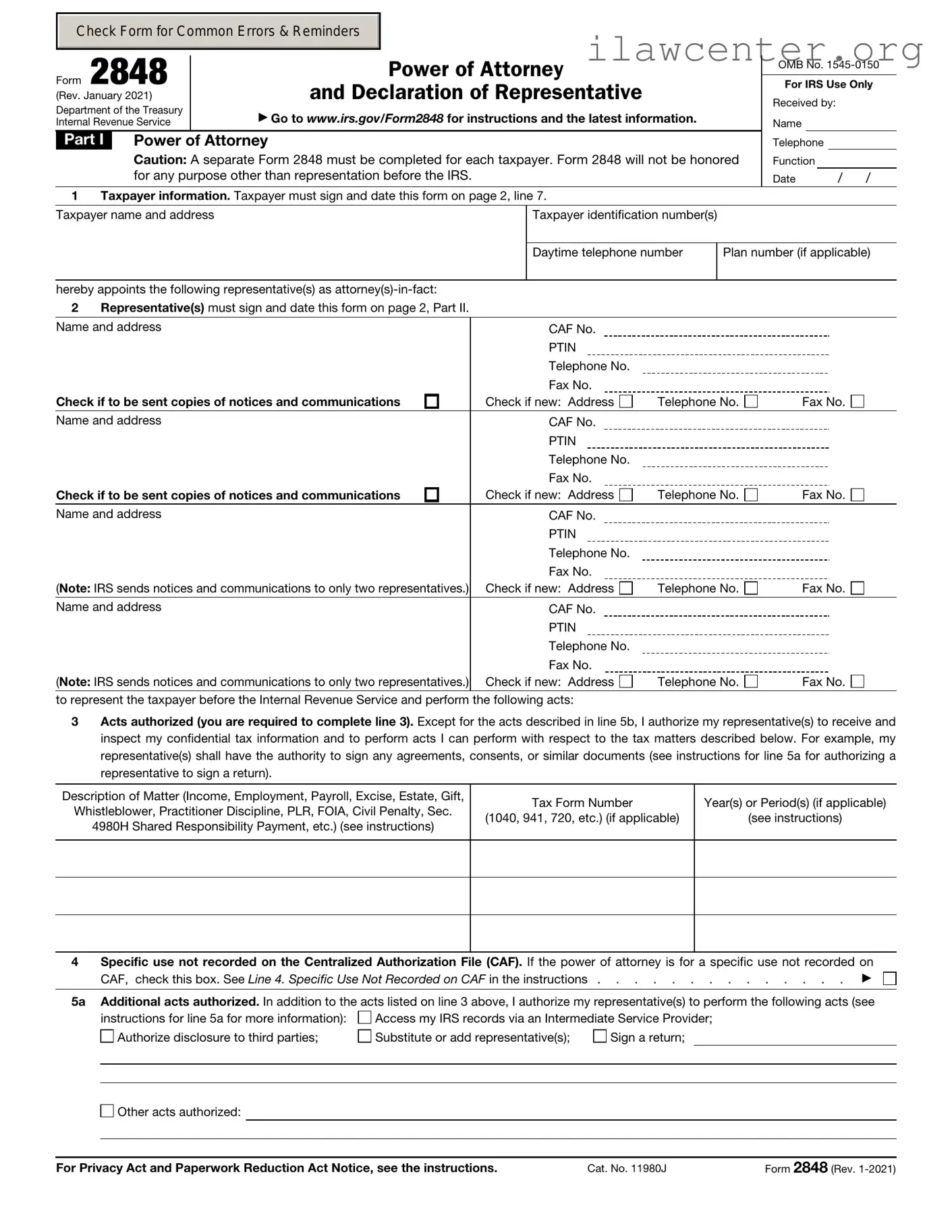
The IRS Power of Attorney (Form 2848) allows individuals to designate someone to represent them before the IRS. This form grants authority to handle tax matters, ensuring that your interests are protected during interactions with the agency. To get started, fill out the form by clicking the button below.

Article Guide

The IRS Power of Attorney (Form 2848) is a crucial tool for taxpayers who need assistance in managing their tax matters. This form allows individuals to appoint someone, such as a tax professional or attorney, to represent them before the IRS. By completing Form 2848, you grant your representative the authority to discuss your tax issues, receive confidential information, and even sign documents on your behalf. It covers various tax matters, including income tax, employment tax, and estate tax, ensuring that your representative can act effectively in your interests. Additionally, the form requires specific information about both the taxpayer and the representative, including their names, addresses, and taxpayer identification numbers. It's important to note that the authority granted through this form can be limited to specific tax years or types of tax, providing flexibility based on your unique situation. Understanding how to properly complete and submit Form 2848 can help streamline communication with the IRS and alleviate some of the stress associated with tax issues.

IRS Power of Attorney ( 2848) Preview

hereby appoints the following representative(s) as attorney(s)-in-fact:
2 Representative(s) must sign and date this form on page 2, Part II.

Check Form for Common Errors & Reminders

Form 2848


Power of Attorney

For IRS Use Only


OMB No. 1545-0150

(Rev. January 2021)

and Declaration of Representative


Received by:


Department of the Treasury


Go to www.irs.gov/Form2848 for instructions and the latest information.


Internal Revenue Service

Name


Part I

Power of Attorney

Telephone


Caution: A separate Form 2848 must be completed for each taxpayer. Form 2848 will not be honored

Function


for any purpose other than representation before the IRS.

Date

/ /

1Taxpayer information. Taxpayer must sign and date this form on page 2, line 7.

Taxpayer name and address

Taxpayer identification number(s)

Daytime telephone number

Plan number (if applicable)

Name and address

CAF No.


PTIN


Telephone No.


Fax No.


Check if to be sent copies of notices and communications

Check if new: Address

Telephone No.

Fax No.

Name and address

CAF No.


PTIN


Telephone No.


Fax No.


Check if to be sent copies of notices and communications

Check if new: Address

Telephone No.

Fax No.

Name and address

CAF No.


PTIN


Telephone No.


Fax No.


(Note: IRS sends notices and communications to only two representatives.)

Check if new: Address

Telephone No.

Fax No.

Name and address

CAF No.


PTIN


Telephone No.


Fax No.


(Note: IRS sends notices and communications to only two representatives.)

Check if new: Address

Telephone No.

Fax No.

to represent the taxpayer before the Internal Revenue Service and perform the following acts:

3Acts authorized (you are required to complete line 3). Except for the acts described in line 5b, I authorize my representative(s) to receive and inspect my confidential tax information and to perform acts I can perform with respect to the tax matters described below. For example, my representative(s) shall have the authority to sign any agreements, consents, or similar documents (see instructions for line 5a for authorizing a representative to sign a return).

Description of Matter (Income, Employment, Payroll, Excise, Estate, Gift,

Tax Form Number

Year(s) or Period(s) (if applicable)

Whistleblower, Practitioner Discipline, PLR, FOIA, Civil Penalty, Sec.

(1040, 941, 720, etc.) (if applicable)

(see instructions)

4980H Shared Responsibility Payment, etc.) (see instructions)


4

Specific use not recorded on the Centralized Authorization File (CAF). If the power of attorney is for a specific use not recorded on


CAF, check this box. See Line 4. Specific Use Not Recorded on CAF in the instructions .

. . . . . . . . . . . . .


5a

Additional acts authorized. In addition to the acts listed on line 3 above, I authorize my representative(s) to perform the following acts (see


instructions for line 5a for more information):

Access my IRS records via an Intermediate Service Provider;


Authorize disclosure to third parties;

Substitute or add representative(s);

Sign a return;


Other acts authorized:

For Privacy Act and Paperwork Reduction Act Notice, see the instructions.

Cat. No. 11980J

Form 2848 (Rev. 1-2021)

Form 2848 (Rev. 1-2021)

Page 2

bSpecific acts not authorized. My representative(s) is (are) not authorized to endorse or otherwise negotiate any check (including directing or accepting payment by any means, electronic or otherwise, into an account owned or controlled by the representative(s) or any firm or other entity with whom the representative(s) is (are) associated) issued by the government in respect of a federal tax liability.

List any other specific deletions to the acts otherwise authorized in this power of attorney (see instructions for line 5b):

6Retention/revocation of prior power(s) of attorney. The filing of this power of attorney automatically revokes all earlier power(s) of attorney on file with the Internal Revenue Service for the same matters and years or periods covered by this form. If you do not want to

revoke a prior power of attorney, check here . . . . . . . . . . . . . . . . . . . . . . . . . . .

YOU MUST ATTACH A COPY OF ANY POWER OF ATTORNEY YOU WANT TO REMAIN IN EFFECT.

7Taxpayer declaration and signature. If a tax matter concerns a year in which a joint return was filed, each spouse must file a separate power of attorney even if they are appointing the same representative(s). If signed by a corporate officer, partner, guardian, tax matters partner, partnership representative (or designated individual, if applicable), executor, receiver, administrator, trustee, or individual other than the taxpayer, I certify I have the legal authority to execute this form on behalf of the taxpayer.

IF NOT COMPLETED, SIGNED, AND DATED, THE IRS WILL RETURN THIS POWER OF ATTORNEY TO THE TAXPAYER.

Signature

Date

Title (if applicable)

Print name


Print name of taxpayer from line 1 if other than individual

Part II Declaration of Representative

Under penalties of perjury, by my signature below I declare that:

I am not currently suspended or disbarred from practice, or ineligible for practice, before the Internal Revenue Service;

I am subject to regulations in Circular 230 (31 CFR, Subtitle A, Part 10), as amended, governing practice before the Internal Revenue Service;

I am authorized to represent the taxpayer identified in Part I for the matter(s) specified there; and

I am one of the following:

aAttorney—a member in good standing of the bar of the highest court of the jurisdiction shown below.

bCertified Public Accountant—a holder of an active license to practice as a certified public accountant in the jurisdiction shown below.

cEnrolled Agent—enrolled as an agent by the IRS per the requirements of Circular 230.

dOfficer—a bona fide officer of the taxpayer organization.

eFull-Time Employee—a full-time employee of the taxpayer.

fFamily Member—a member of the taxpayer’s immediate family (spouse, parent, child, grandparent, grandchild, step-parent, step-child, brother, or sister).

gEnrolled Actuary—enrolled as an actuary by the Joint Board for the Enrollment of Actuaries under 29 U.S.C. 1242 (the authority to practice before the IRS is limited by section 10.3(d) of Circular 230).

hUnenrolled Return Preparer—Authority to practice before the IRS is limited. An unenrolled return preparer may represent, provided the preparer (1) prepared and signed the return or claim for refund (or prepared if there is no signature space on the form); (2) was eligible to sign the return or claim for refund; (3) has a valid PTIN; and (4) possesses the required Annual Filing Season Program Record of Completion(s). See Special Rules and Requirements for Unenrolled Return Preparers in the instructions for additional information.

kQualifying Student or Law Graduate—receives permission to represent taxpayers before the IRS by virtue of his/her status as a law, business, or accounting student, or law graduate working in a LITC or STCP. See instructions for Part II for additional information and requirements.

rEnrolled Retirement Plan Agent—enrolled as a retirement plan agent under the requirements of Circular 230 (the authority to practice before the Internal Revenue Service is limited by section 10.3(e)).

IF THIS DECLARATION OF REPRESENTATIVE IS NOT COMPLETED, SIGNED, AND DATED, THE IRS WILL RETURN THE POWER OF ATTORNEY. REPRESENTATIVES MUST SIGN IN THE ORDER LISTED IN PART I, LINE 2.

Note: For designations d–f, enter your title, position, or relationship to the taxpayer in the “Licensing jurisdiction” column.

Designation—

Insert above

letter (a–r).

Licensing jurisdiction

(State) or other

licensing authority

(if applicable)

Bar, license, certification, registration, or enrollment number (if applicable)

Signature

Date

Form 2848 (Rev. 1-2021)

File Properties

Fact Name Description
Purpose The IRS Power of Attorney (Form 2848) allows individuals to authorize someone else to represent them in dealings with the IRS. This includes the ability to receive and inspect confidential tax information.
Eligibility Any individual or entity can be designated as a representative using Form 2848, provided they are eligible to practice before the IRS. This includes attorneys, certified public accountants, and enrolled agents.
State-Specific Forms Some states have their own power of attorney forms for tax matters. For example, California uses Form FTB 3520, governed by the California Revenue and Taxation Code.
Duration The authority granted through Form 2848 remains in effect until it is revoked, the taxpayer dies, or the representative is no longer eligible to practice before the IRS.

Instructions on Utilizing IRS Power of Attorney ( 2848)

Filling out the IRS Power of Attorney form (Form 2848) is a straightforward process. Once completed, this form allows your designated representative to act on your behalf regarding tax matters. Follow the steps below to ensure you fill it out correctly.

  1. Download the IRS Form 2848 from the IRS website or obtain a physical copy.
  2. In the top section, provide your name, address, and taxpayer identification number (such as your Social Security Number or Employer Identification Number).
  3. Next, fill in the name and address of the person you are authorizing to represent you. This individual must have a valid PTIN (Preparer Tax Identification Number) or a CAF (Centralized Authorization File) number.
  4. Specify the tax matters for which you are granting authority. You can check the appropriate boxes for income tax, employment tax, or other types of taxes.
  5. Indicate the years or periods for which this authorization applies. Be specific to avoid any confusion.
  6. Sign and date the form at the bottom. Ensure that the signature matches the name provided at the top.
  7. If applicable, provide your spouse’s information and signature if you are filing jointly.
  8. Review the completed form for accuracy before submission.
  9. Send the form to the appropriate IRS office, which can be found on the IRS website or in the form instructions.

After submission, you can expect the IRS to process the form and notify you if there are any issues. It’s a good idea to keep a copy for your records and follow up if you do not receive confirmation within a reasonable time frame.

Important Facts about IRS Power of Attorney ( 2848)

What is the IRS Power of Attorney (Form 2848)?

The IRS Power of Attorney (Form 2848) is a document that allows you to authorize someone else to represent you before the IRS. This could be a tax professional, such as an accountant or attorney, who can handle your tax matters on your behalf. By completing this form, you grant the representative the authority to receive and inspect your tax information and communicate with the IRS regarding your tax issues.

How do I complete the Form 2848?

To complete Form 2848, you need to provide your personal information, including your name, address, and Social Security number or Employer Identification Number. Next, you will list the name and address of your representative. Specify the tax matters they are authorized to handle, including the type of tax and the years involved. Finally, both you and your representative must sign and date the form. Make sure to double-check all information for accuracy before submitting it to the IRS.

How long does the Power of Attorney remain in effect?

The Power of Attorney remains in effect until you revoke it, the representative withdraws, or the IRS accepts a new Form 2848 that replaces the previous one. You can revoke the Power of Attorney at any time by submitting a written statement to the IRS. It’s important to keep a copy of the revocation for your records.

Can I authorize more than one representative on Form 2848?

Yes, you can authorize multiple representatives on Form 2848. When filling out the form, list each representative’s name, address, and identifying number. However, each representative must sign the form as well. Keep in mind that each representative will have equal authority to act on your behalf, so choose wisely.

Common mistakes

Filling out the IRS Power of Attorney (Form 2848) can be a straightforward process, but many individuals make critical mistakes that can delay their requests or lead to complications. One common error is failing to provide accurate information about the taxpayer. This includes not using the full legal name, Social Security number, or the correct address. Such inaccuracies can result in the IRS rejecting the form or sending correspondence to the wrong address.

Another frequent mistake involves the selection of the representative. Taxpayers often overlook the importance of listing the correct representative or fail to include all necessary representatives. If multiple individuals are assisting with the taxpayer’s case, each must be clearly identified on the form. Omitting a representative can lead to confusion and hinder communication between the IRS and the taxpayer.

Many people also neglect to specify the tax matters for which they are granting power of attorney. This section is crucial because it outlines the specific areas in which the representative can act. Failing to detail these matters can result in limitations on the representative's authority, preventing them from fully assisting the taxpayer with their needs.

Finally, not signing the form correctly is a significant oversight. The taxpayer's signature must match the name listed on the form. Additionally, if the taxpayer is a business entity, an authorized person must sign on behalf of the business. A missing or incorrect signature can render the entire form invalid, causing unnecessary delays in the resolution of tax issues.

Documents used along the form

The IRS Power of Attorney form, known as Form 2848, allows individuals to designate someone to represent them before the IRS. This form is often used in conjunction with other documents to ensure that all necessary information is provided and to facilitate various tax-related processes. Below is a list of additional forms and documents commonly associated with Form 2848.

  • Form 4506-T: This form is used to request a transcript of tax returns. It allows the appointed representative to obtain necessary tax information directly from the IRS.
  • Form 8821: Unlike Form 2848, this document allows for the disclosure of tax information without granting representation rights. It is useful when a taxpayer wants to share information with someone but does not need them to act on their behalf.
  • Form 1040: This is the standard individual income tax return form. It may be necessary to submit this form when representing a client in tax matters, particularly if there are issues related to their personal income taxes.
  • Form 941: Employers use this form to report income taxes, Social Security tax, or Medicare tax withheld from employee's paychecks. It may be relevant for representatives handling employer tax matters.
  • Form 1120: This is the corporate income tax return form. If a representative is managing a corporation's tax issues, this form may be crucial in the process.
  • Form 1065: Partnerships use this form to report income, deductions, gains, and losses from the operation of a partnership. It may be relevant for representatives dealing with partnership tax matters.
  • Form 8862: This form is used to claim the Earned Income Credit after a prior disallowance. If a representative is helping a client navigate issues related to tax credits, this form may be necessary.
  • Form 1040-X: This is the amended U.S. individual income tax return form. It is important for making corrections to previously filed tax returns and may be needed when representing clients who wish to amend their filings.

Understanding the various forms and documents that accompany the IRS Power of Attorney (Form 2848) is essential for effective representation in tax matters. Each form serves a specific purpose, and together they help ensure that all aspects of a taxpayer's situation are addressed comprehensively.

Similar forms

  • Durable Power of Attorney: This document allows an individual to designate someone else to make decisions on their behalf, particularly in financial matters, even if they become incapacitated.
  • General Power of Attorney: Similar to the durable version, this document grants broad authority to another person to act on behalf of the principal in various matters, including financial and legal affairs.
  • Limited Power of Attorney: This form restricts the authority granted to specific tasks or situations, unlike the broader powers given in the general power of attorney.
  • Medical Power of Attorney: This document allows an individual to appoint someone to make healthcare decisions on their behalf if they are unable to do so themselves.
  • Tax Information Authorization (Form 8821): This IRS form allows a designated individual to receive confidential tax information but does not grant them the authority to represent the taxpayer before the IRS.
  • Trust Agreement: A trust document allows a trustee to manage assets on behalf of beneficiaries, similar to how a power of attorney allows an agent to manage affairs for the principal.
  • Advance Healthcare Directive: This document combines a living will and a medical power of attorney, allowing individuals to outline their healthcare preferences and designate someone to make decisions on their behalf.
  • Living Will: This document specifies an individual's wishes regarding medical treatment in situations where they cannot communicate their preferences, paralleling the decision-making authority of a medical power of attorney.
  • Corporate Resolution: This document authorizes an individual to act on behalf of a corporation, similar to how a power of attorney allows someone to act for an individual.
  • Legal Representation Agreement: This contract outlines the relationship between a client and their attorney, granting the attorney authority to act on the client's behalf in legal matters, akin to the authority granted in a power of attorney.

Dos and Don'ts

Filling out the IRS Power of Attorney (Form 2848) can be a crucial step in managing your tax matters. To ensure the process goes smoothly, here are nine things you should and shouldn’t do when completing this form.

  • Do provide complete and accurate information for both the taxpayer and the representative.
  • Do sign and date the form. Without your signature, the form is not valid.
  • Do specify the tax matters for which you are granting power of attorney. Be clear about the types of taxes and tax years involved.
  • Do keep a copy of the completed form for your records. This can be important for future reference.
  • Do ensure that your representative is eligible to practice before the IRS. This includes attorneys, certified public accountants, and enrolled agents.
  • Don’t leave any required fields blank. Incomplete forms may be rejected by the IRS.
  • Don’t use outdated versions of the form. Always check for the most current version on the IRS website.
  • Don’t assume that the IRS will contact you if there are issues. Follow up to confirm that your form has been processed.
  • Don’t provide personal information that is not necessary for the form. This includes sensitive details that could lead to identity theft.

By adhering to these guidelines, you can help ensure that your Power of Attorney form is completed correctly and accepted by the IRS.

Misconceptions

The IRS Power of Attorney form, known as Form 2848, is often misunderstood. Below are five common misconceptions about this form, along with explanations to clarify each one.

  • Misconception 1: The Power of Attorney allows an agent to make decisions on behalf of the taxpayer.
  • While Form 2848 grants an agent the authority to represent a taxpayer before the IRS, it does not allow the agent to make decisions unrelated to tax matters. The agent can only act on behalf of the taxpayer regarding IRS issues.

  • Misconception 2: The Power of Attorney is permanent and does not require renewal.
  • This form is not permanent. The authority granted through Form 2848 can be revoked by the taxpayer at any time. Additionally, it may need to be resubmitted if the taxpayer changes their representative or if the form is outdated.

  • Misconception 3: Only attorneys can be designated as representatives on Form 2848.
  • In fact, taxpayers can designate various types of representatives, including certified public accountants and enrolled agents. The representative does not have to be an attorney to act on behalf of the taxpayer.

  • Misconception 4: The IRS requires a Power of Attorney form for all communications.
  • Taxpayers do not need to submit Form 2848 for every interaction with the IRS. It is only necessary when a taxpayer wishes to authorize someone else to represent them in specific matters.

  • Misconception 5: Submitting Form 2848 guarantees a favorable outcome with the IRS.
  • Submitting this form does not guarantee any specific outcome. The form simply allows the designated representative to advocate for the taxpayer. The resolution of tax issues depends on the facts and circumstances of each case.

Key takeaways

The IRS Power of Attorney (Form 2848) allows individuals to authorize someone to act on their behalf regarding tax matters. Here are some key takeaways about filling out and using this form:

  • Purpose: The form enables a designated representative to communicate with the IRS on your behalf, ensuring they can handle your tax issues effectively.
  • Eligibility: You can appoint any individual as your representative, including an attorney, accountant, or family member, as long as they are qualified to represent you.
  • Specificity: Clearly specify the tax matters and years you want your representative to handle. This ensures they have the authority to act in the areas you need assistance.
  • Signature Requirement: Both you and your representative must sign the form. Your signature confirms your consent for the representative to act on your behalf.
  • Submission: After completing the form, submit it directly to the IRS office handling your tax matters. You can also provide a copy to your representative.
  • Revocation: You can revoke the power of attorney at any time by submitting a written notice to the IRS. This ensures you maintain control over who represents you.
  • Duration: The authority granted remains in effect until you revoke it or the IRS processes a new power of attorney form. Keep this in mind for ongoing tax issues.