IRS Schedule B 941 PDF Template

IRS Schedule B 941 PDF Template

The IRS Schedule B 941 form is used by employers to report their federal payroll tax liabilities. This form provides essential information about the wages paid and the taxes withheld for each quarter. Understanding how to complete this form accurately is crucial for compliance and avoiding penalties, so get started by filling it out through the button below.

Article Guide

The IRS Schedule B (Form 941) is an essential document for employers who need to report their payroll tax liabilities. This form specifically tracks the amount of federal income tax withheld from employee wages and the employer's share of Social Security and Medicare taxes. It is submitted alongside Form 941, which is the quarterly federal tax return. Employers must complete Schedule B if they have reported more than $50,000 in employment tax liability during the lookback period. This form provides a detailed breakdown of the tax amounts owed for each pay period within the quarter, ensuring that the IRS receives accurate and timely information. Understanding how to fill out this form correctly is crucial for compliance and avoiding penalties. Missing deadlines or errors can lead to significant fines, making it imperative for employers to stay informed and organized when handling their payroll taxes.

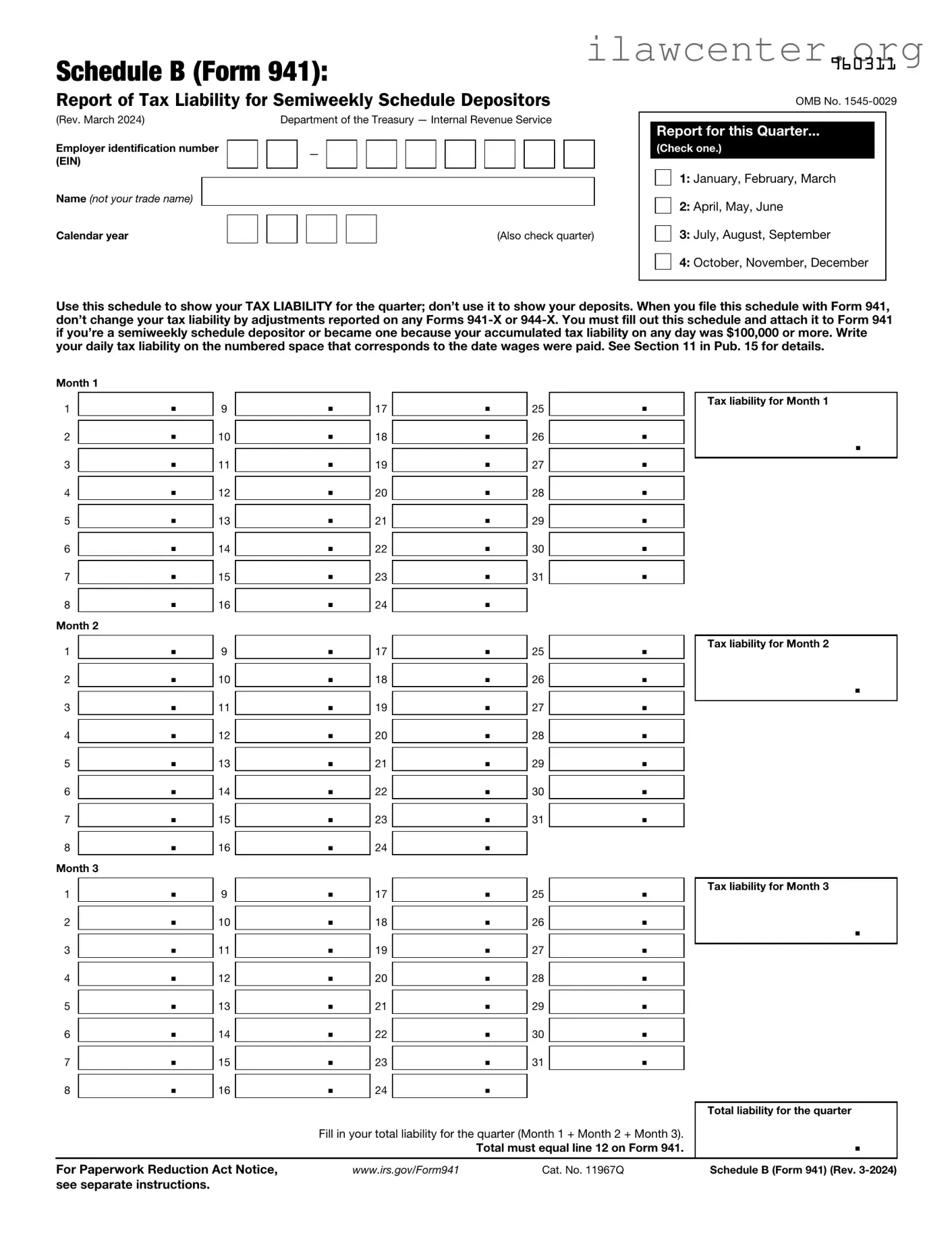
IRS Schedule B 941 Preview

Schedule B (Form 941):

Report of Tax Liability for Semiweekly Schedule Depositors

(Rev. March 2024)


Department of the Treasury — Internal Revenue Service

Employer identification number


(EIN)


Name (not your trade name)


Calendar year


(Also check quarter)


960311

OMB No. 1545-0029

Report for this Quarter...

(Check one.)

1: January, February, March

2: April, May, June

3: July, August, September

4: October, November, December

Use this schedule to show your TAX LIABILITY for the quarter; don’t use it to show your deposits. When you file this schedule with Form 941, don’t change your tax liability by adjustments reported on any Forms 941-X or 944-X. You must fill out this schedule and attach it to Form 941 if you’re a semiweekly schedule depositor or became one because your accumulated tax liability on any day was $100,000 or more. Write your daily tax liability on the numbered space that corresponds to the date wages were paid. See Section 11 in Pub. 15 for details.

Month 1


1


.

9


.


17


.

25


.


Tax liability for Month 1


.

2


.

10


.


18


.

26


.


3


.

11


.


19


.

27


.


4


.

12


.


20


.

28


.


5


.

13


.


21


.

29


.


6


.

14


.


22


.

30


.


7


.

15


.


23


.

31


.


8


.

16


.


24


.


Month 2


1


.

9


.


17


.

25


.


Tax liability for Month 2


.

2


.

10


.


18


.

26


.


3


.

11


.


19


.

27


.


4


.

12


.


20


.

28


.


5


.

13


.


21


.

29


.


6


.

14


.


22


.

30


.


7


.

15


.


23


.

31


.


8


.

16


.


24


.


Month 3


1


.

9


.


17


.

25


.


Tax liability for Month 3


.

2


.

10


.


18


.

26


.


3


.

11


.


19


.

27


.


4


.

12


.


20


.

28


.


5


.

13


.


21


.

29


.


6


.

14


.


22


.

30


.


7


.

15


.


23


.

31


.


8


.

16


.


24


.


Total liability for the quarter


Fill in your total liability for the quarter (Month 1 + Month 2 + Month 3).


.


Total must equal line 12 on Form 941.


For Paperwork Reduction Act Notice,


www.irs.gov/Form941


Cat. No. 11967Q


Schedule B (Form 941) (Rev. 3-2024)

see separate instructions.


File Properties

Fact Name Description
Purpose The IRS Schedule B (Form 941) is used by employers to report their federal income tax withholding and the employee's share of Social Security and Medicare taxes.
Filing Frequency This form is typically filed quarterly, along with Form 941, which is the Employer's Quarterly Federal Tax Return.
State-Specific Requirements Some states may have additional requirements for reporting payroll taxes. For example, California requires employers to file the California Employer Payroll Tax Report (DE 9) in conjunction with federal forms.
Governing Laws The IRS Schedule B is governed by federal tax laws, specifically the Internal Revenue Code, and is subject to regulations set forth by the Internal Revenue Service.

Instructions on Utilizing IRS Schedule B 941

After you complete the IRS Schedule B (Form 941), you will submit it along with your Form 941. This form is essential for reporting your tax liabilities and ensuring compliance with federal tax regulations. Follow these steps to fill out the form accurately.

  1. At the top of the form, enter your employer identification number (EIN) and the quarter for which you are filing.
  2. Fill in your business name and address in the designated fields.
  3. In Part I, check the box that applies to your business regarding your tax liability.
  4. Complete Part II by entering the total number of employees for the quarter.
  5. List the wages paid to employees and the corresponding taxes withheld in the appropriate sections.
  6. Calculate the total taxes owed for the quarter, ensuring all entries are accurate.
  7. Sign and date the form at the bottom. Ensure that the signature is from an authorized person.
  8. Review the entire form for any errors before submitting it.

Once you have completed these steps, you can file the form electronically or by mail, depending on your preference and the IRS guidelines.

Important Facts about IRS Schedule B 941

What is the IRS Schedule B (Form 941)?

The IRS Schedule B (Form 941) is a form used by employers to report their federal payroll tax liabilities. Specifically, it details the amount of federal income tax withheld and the employer's share of Social Security and Medicare taxes for each quarter. It is an attachment to Form 941, which is the Employer's Quarterly Federal Tax Return.

Who needs to file Schedule B (Form 941)?

Employers who accumulate $100,000 or more in payroll tax liability during a deposit period must file Schedule B. This form helps the IRS track the employer's tax liabilities and ensure timely payments. If your business meets this threshold, you are required to include Schedule B with your Form 941 submission.

When is Schedule B (Form 941) due?

Schedule B is due on the same date as Form 941. Generally, Form 941 must be filed quarterly. The deadlines are April 30 for the first quarter, July 31 for the second quarter, October 31 for the third quarter, and January 31 for the fourth quarter. Timely filing is crucial to avoid penalties.

How do I complete Schedule B (Form 941)?

To complete Schedule B, begin by entering your employer identification number (EIN) and the quarter for which you are filing. Next, list your tax liability for each pay period within the quarter. You will calculate the total tax liability and ensure it matches the amounts reported on Form 941. Be sure to double-check all calculations for accuracy.

What information is required on Schedule B (Form 941)?

Schedule B requires information about your payroll tax liabilities for each pay period. This includes the date of each pay period, the amount of federal income tax withheld, and the total Social Security and Medicare taxes owed. Accurate reporting is essential for compliance with IRS regulations.

What happens if I don’t file Schedule B (Form 941)?

If you are required to file Schedule B and fail to do so, you may face penalties from the IRS. These can include fines for late filing and interest on any unpaid taxes. Additionally, not filing can lead to further scrutiny from the IRS, which may result in audits or additional penalties.

Can I amend Schedule B (Form 941) if I make a mistake?

Yes, if you discover an error after submitting Schedule B, you can amend it. To do this, you will need to file a corrected Schedule B along with an amended Form 941. Be sure to clearly indicate that you are amending the form and provide accurate information to rectify the mistake.

Where can I find Schedule B (Form 941) and instructions?

You can find Schedule B (Form 941) and its instructions on the IRS website. The forms are available for download in PDF format. Additionally, the IRS provides detailed instructions to help you complete the form accurately. It’s important to use the most current version of the form to ensure compliance.
Common mistakes

Filling out the IRS Schedule B (Form 941) can be a daunting task for many. Mistakes can lead to delays, penalties, or even audits. Here are eight common errors that people often make when completing this important form.

One frequent mistake is failing to report all wages accurately. Employers must include all taxable wages paid during the quarter. Omitting even a small amount can trigger discrepancies in tax calculations, leading to potential penalties. Always double-check your records to ensure completeness.

Another common error involves incorrect tax calculations. Some individuals miscalculate the amount of federal income tax withheld or Social Security and Medicare taxes. It’s essential to use the correct rates and ensure that the totals match the amounts reported on other forms, such as the W-2.

People often forget to sign and date the form. This might seem trivial, but an unsigned form is considered incomplete and may result in rejection by the IRS. Always take a moment to review and ensure that you have signed and dated the form before submission.

Inaccurate reporting of tax periods can also cause issues. Schedule B requires specific information about the tax period being reported. Failing to align the dates correctly can lead to confusion and misreporting. Pay close attention to the tax period listed at the top of the form.

Another mistake is neglecting to keep copies of the submitted forms. While it’s not a requirement, having a copy for your records can be invaluable. In the event of an audit or inquiry, having access to your past submissions can save time and stress.

Some individuals mistakenly assume that all employees are subject to the same withholding rules. This is not always the case. Different employees may have different withholding allowances, and failing to account for this can lead to errors in reported wages and taxes.

Additionally, people sometimes overlook the importance of reviewing the instructions provided by the IRS. These instructions offer guidance and clarify any doubts about how to fill out the form correctly. Ignoring them can lead to unnecessary mistakes.

Lastly, many individuals fail to file the form on time. The IRS imposes strict deadlines for submitting Schedule B. Missing these deadlines can result in penalties. Setting reminders can help ensure that you meet your filing obligations promptly.

Documents used along the form

The IRS Schedule B (Form 941) is used by employers to report their tax liability for federal income tax withheld and Social Security and Medicare taxes. When filing this form, there are several other documents that may be needed to ensure compliance and accuracy. Below is a list of these forms and documents, each described briefly for clarity.

  • Form 941: This is the Employer's Quarterly Federal Tax Return. It reports the amount of federal income tax withheld from employees and the employer's share of Social Security and Medicare taxes.
  • Form W-2: This form is used to report wages paid to employees and the taxes withheld from those wages. Employers must provide a W-2 to each employee by January 31 each year.
  • Form W-3: This is the Transmittal of Wage and Tax Statements. It summarizes the information reported on all W-2 forms and is submitted to the Social Security Administration.
  • Form 940: This is the Employer's Annual Federal Unemployment (FUTA) Tax Return. It reports the unemployment taxes owed by the employer for the year.
  • Form 1099-MISC: This form is used to report payments made to independent contractors or other non-employee compensation. It is important for tracking payments that may not be subject to withholding.
  • Form 1096: This is the Annual Summary and Transmittal of U.S. Information Returns. It summarizes all 1099 forms submitted for the year and is sent to the IRS.
  • Form 8822: This form is used to notify the IRS of a change of address. Keeping the IRS updated ensures that all correspondence reaches the employer.
  • Form SS-4: This is the Application for Employer Identification Number (EIN). An EIN is necessary for businesses to report taxes and file returns.
  • Form 941-X: This is the Adjusted Employer's Quarterly Federal Tax Return or Claim for Refund. It is used to correct errors made on previously filed Form 941s.
  • Payroll Records: These include detailed records of employee wages, hours worked, and deductions. Maintaining accurate payroll records is essential for tax reporting and compliance.

Having these documents ready can streamline the filing process and help ensure that all tax obligations are met accurately and on time. It is important to keep these records organized and accessible for reference and compliance purposes.

Similar forms

The IRS Schedule B (Form 941) is a document used by employers to report their federal income tax withholdings and Social Security and Medicare taxes. Several other forms share similarities with Schedule B, particularly in their purpose of reporting tax information. Here are eight documents that are similar to the IRS Schedule B 941 form:

  • Form 941: This is the main form for reporting payroll taxes. Schedule B is an attachment to Form 941 that provides additional details about tax liabilities.
  • Form 940: This form is used to report federal unemployment taxes (FUTA). Like Schedule B, it focuses on employer tax obligations.
  • Form W-2: Employers use this form to report wages paid and taxes withheld for each employee. Both forms are crucial for accurate tax reporting.
  • Form W-3: This is a summary of all W-2 forms issued by an employer. It consolidates information similar to what is detailed in Schedule B.
  • Form 1099-MISC: This form reports various types of income other than wages. While it serves a different purpose, both forms involve reporting income and tax information.
  • Form 944: Designed for smaller employers, this form allows them to report annual payroll taxes. It provides a similar function in a different format.
  • Form 943: This form is specifically for agricultural employers to report payroll taxes. It shares the same objective of tax reporting as Schedule B.
  • Form 945: Used to report backup withholding, this form also relates to employer tax responsibilities, similar to the information provided in Schedule B.

Each of these forms plays a critical role in the overall tax reporting process for employers, ensuring compliance with federal regulations.

Dos and Don'ts

When filling out the IRS Schedule B (Form 941), it’s important to follow specific guidelines to ensure accuracy and compliance. Here are six key dos and don’ts to keep in mind:

  • Do double-check your employer identification number (EIN) for accuracy.
  • Do report all tax liabilities accurately for the reporting period.
  • Do ensure that your totals match the amounts reported on Form 941.
  • Do sign and date the form before submission.
  • Don't leave any fields blank; fill in all required information.
  • Don't forget to keep a copy of the completed form for your records.

Following these guidelines can help you avoid common mistakes and ensure that your filing process goes smoothly.

Misconceptions

The IRS Schedule B (Form 941) is an important document for employers, but there are several misconceptions surrounding its purpose and requirements. Here are five common misunderstandings:

  1. Only large employers need to file Schedule B.

    This is not true. Any employer who has a tax liability of $100,000 or more during a deposit period must file Schedule B, regardless of the size of their workforce.

  2. Schedule B is only for reporting wages.

    While it does include wage information, Schedule B is primarily used to report the employer's tax liability and to reconcile the amount of payroll taxes deposited with the IRS.

  3. Filing Schedule B is optional.

    For employers who meet the criteria for filing, it is mandatory. Failing to file can result in penalties and interest on unpaid taxes.

  4. Schedule B can be filed separately from Form 941.

    Schedule B must be filed with Form 941. It is an integral part of the overall reporting process for payroll taxes.

  5. Once filed, Schedule B cannot be amended.

    This is a misconception. If errors are discovered after filing, employers can submit an amended Form 941, which includes the corrected Schedule B.

Understanding these misconceptions can help employers stay compliant and avoid potential issues with the IRS.

Key takeaways

When filling out and using the IRS Schedule B (Form 941), consider these key takeaways:

  • Schedule B is used to report the tax liability for employment taxes for each pay period during the quarter.
  • It is essential to complete Schedule B accurately to avoid potential penalties and ensure compliance with IRS regulations.
  • Employers must keep track of their payroll dates and the corresponding tax liabilities to fill out this form correctly.
  • Submit Schedule B along with Form 941 by the due date to avoid interest and penalties on late payments.