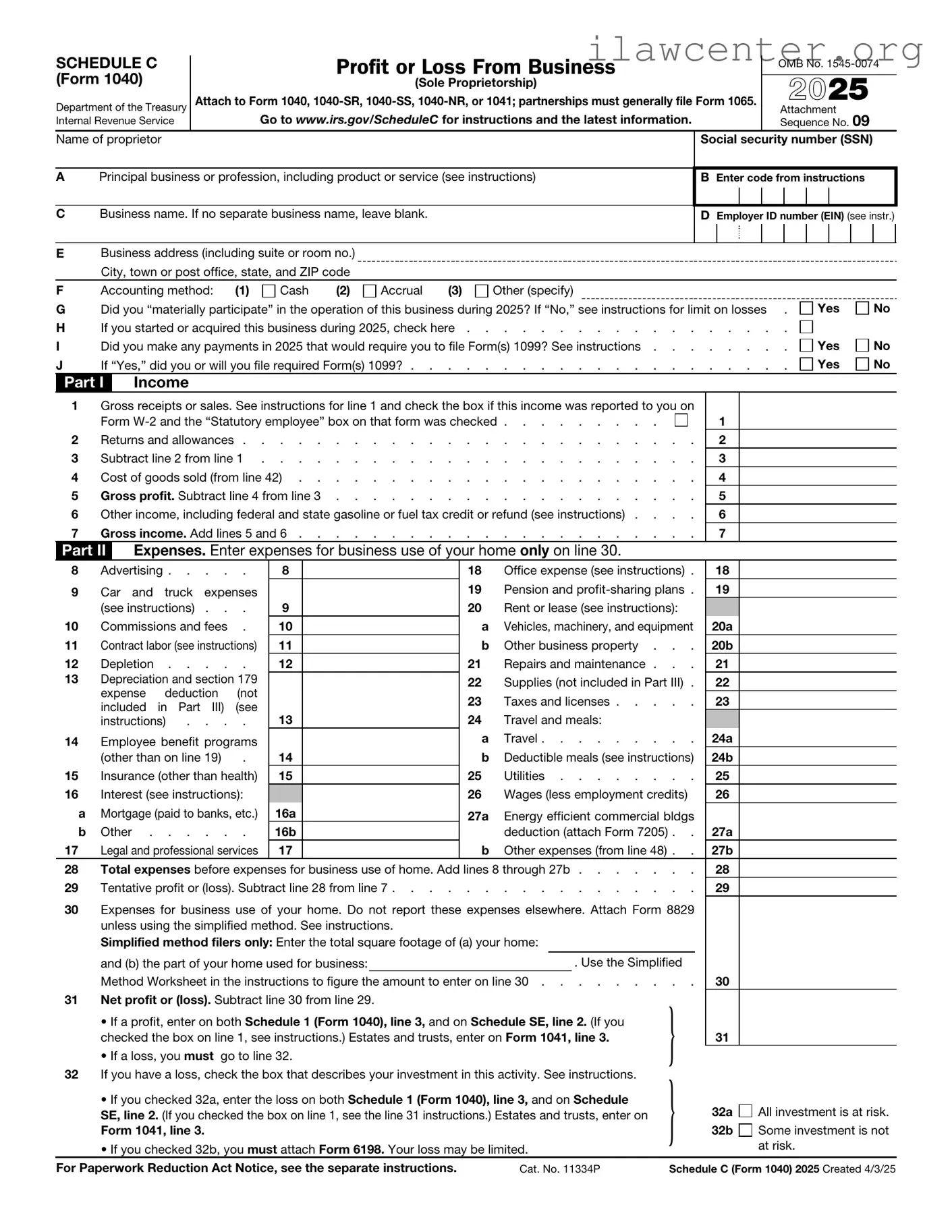
IRS Schedule C 1040 PDF Template

IRS Schedule C 1040 PDF Template

The IRS Schedule C is a tax form used by sole proprietors to report income or loss from their business. This form allows individuals to detail their business expenses and calculate their net profit or loss, which is then transferred to their personal tax return. Understanding how to accurately complete Schedule C is essential for ensuring compliance and maximizing deductions.

Ready to fill out your Schedule C form? Click the button below to get started!

Article Guide

The IRS Schedule C (Form 1040) serves as a crucial document for individuals who operate their own businesses as sole proprietors. This form enables taxpayers to report income and expenses related to their business activities, ultimately influencing their overall tax liability. It encompasses various aspects of a business, including gross receipts, cost of goods sold, and operating expenses such as rent, utilities, and supplies. Additionally, it allows for the deduction of certain business-related expenses, which can significantly reduce taxable income. Understanding how to accurately complete Schedule C is essential for ensuring compliance with tax regulations while maximizing potential deductions. This form also requires careful attention to detail, as errors can lead to audits or penalties. Taxpayers must maintain thorough records of their business transactions to support the figures reported on Schedule C, thereby underscoring the importance of diligent bookkeeping practices. Overall, the Schedule C form plays a vital role in the financial landscape of sole proprietors, providing a structured way to report income and manage tax obligations.

IRS Schedule C 1040 Preview

SCHEDULE C (Form 1040)

Department of the Treasury Internal Revenue Service

Profit or Loss From Business

(Sole Proprietorship)

Attach to Form 1040, 1040-SR, 1040-SS, 1040-NR, or 1041; partnerships must generally file Form 1065.

Go to www.irs.gov/ScheduleC for instructions and the latest information.

OMB No. 1545-0074

2025

Attachment Sequence No. 09

Name of proprietor

APrincipal business or profession, including product or service (see instructions)

CBusiness name. If no separate business name, leave blank.

Social security number (SSN)

BEnter code from instructions

DEmployer ID number (EIN) (see instr.)

EBusiness address (including suite or room no.) City, town or post office, state, and ZIP code

F

Accounting method:

(1)

Cash

(2)

Accrual

(3)

Other (specify)

G

Did you “materially participate” in the operation of this business during 2025? If “No,” see instructions for limit on losses .

H

If you started or acquired this business during 2025, check here

I

Did you make any payments in 2025 that would require you to file Form(s) 1099? See instructions

J

If “Yes,” did you or will you file required Form(s) 1099?

Yes No

Yes No

Yes No

Part I


Income


1

Gross receipts or sales. See instructions for line 1 and check the box if this income was reported to you on


Form W-2 and the “Statutory employee” box on that form was checked

. . . . . . . . .

1


2

Returns and allowances

. . . . . . . . . . .

2


3

Subtract line 2 from line 1

. . . . . . . . . . .

3


4

Cost of goods sold (from line 42)

. . . . . . . . . . .

4


5

Gross profit. Subtract line 4 from line 3

. . . . . . . . . . .

5


6

Other income, including federal and state gasoline or fuel tax credit or refund (see instructions) . . . .

6


7

Gross income. Add lines 5 and 6

. . . . . . . . . . .

7


Part II


Expenses. Enter expenses for business use of your home only on line 30.


8

Advertising

8


18

Office expense (see instructions) .

18


9

Car

and

truck expenses


19

Pension and profit-sharing plans .

19


(see instructions) . . .

9


20

Rent or lease (see instructions):


10

Commissions and fees .

10


a

Vehicles, machinery, and equipment

20a

11

Contract labor (see instructions)

11


b

Other business property . . .

20b

12

Depletion

12


21

Repairs and maintenance . . .

21


13

Depreciation and section 179


22

Supplies (not included in Part III) .

22


expense

deduction

(not


23

Taxes and licenses

23


included in Part III) (see


instructions) . . . .

13


24

Travel and meals:


14

Employee benefit programs


a

Travel

24a


(other than on line 19)

.

14


b

Deductible meals (see instructions)

24b

15

Insurance (other than health)

15


25

Utilities

25


16

Interest (see instructions):


26

Wages (less employment credits)

26


a

Mortgage (paid to banks, etc.)

16a


27a

Energy efficient commercial bldgs


b

Other

16b


deduction (attach Form 7205) . .

27a

17

Legal and professional services

17


b

Other expenses (from line 48) . .

27b

28

Total expenses before expenses for business use of home. Add lines 8 through 27b

28


29

Tentative profit or (loss). Subtract line 28 from line 7

. . . . . . . . . . .

29


30Expenses for business use of your home. Do not report these expenses elsewhere. Attach Form 8829 unless using the simplified method. See instructions.

Simplified method filers only: Enter the total square footage of (a) your home:


and (b) the part of your home used for business:


. Use the Simplified


Method Worksheet in the instructions to figure the amount to enter on line 30

. .

30


31

Net profit or (loss). Subtract line 30 from line 29.


}


• If a profit, enter on both Schedule 1 (Form 1040), line 3, and on Schedule SE, line 2. (If you


checked the box on line 1, see instructions.) Estates and trusts, enter on Form 1041, line 3.

31


• If a loss, you must go to line 32.


32

If you have a loss, check the box that describes your investment in this activity. See instructions.

}


• If you checked 32a, enter the loss on both Schedule 1 (Form 1040), line 3, and on Schedule

32a

All investment is at risk.


SE, line 2. (If you checked the box on line 1, see the line 31 instructions.) Estates and trusts, enter on


Form 1041, line 3.


32b

Some investment is not


• If you checked 32b, you must attach Form 6198. Your loss may be limited.


at risk.

For Paperwork Reduction Act Notice, see the separate instructions.

Cat. No. 11334P

Schedule C (Form 1040) 2025 Created 4/3/25

Schedule C (Form 1040) 2025

Page 2

Part III

Cost of Goods Sold (see instructions)


33

Method(s) used to


value closing inventory:

a

Cost

b

Lower of cost or market

c

Other (attach explanation)

34Was there any change in determining quantities, costs, or valuations between opening and closing inventory?

If “Yes,” attach explanation

Yes

No

35

Inventory at beginning of year. If different from last year’s closing inventory, attach explanation . . .

35

36

Purchases less cost of items withdrawn for personal use

36

37

Cost of labor. Do not include any amounts paid to yourself

37

38

Materials and supplies

38

39

Other costs

39

40

Add lines 35 through 39

40

41

Inventory at end of year

41

42

Cost of goods sold. Subtract line 41 from line 40. Enter the result here and on line 4

42

Part IV Information on Your Vehicle. Complete this part only if you are claiming car or truck expenses on line 9 and are not required to file Form 4562 for this business. See the instructions for line 13 to find out if you must file Form 4562.

43

When did you place your vehicle in service for business purposes? (month/day/year)

/

/

44Of the total number of miles you drove your vehicle during 2025, enter the number of miles you used your vehicle for:

a Business

b Commuting (see instructions)

c Other

45 Was your vehicle available for personal use during off-duty hours? . . . . . . . . . . . . . . .

46 Do you (or your spouse) have another vehicle available for personal use?. . . . . . . . . . . . . .

47a Do you have evidence to support your deduction? . . . . . . . . . . . . . . . . . . . .

b If “Yes,” is the evidence written? . . . . . . . . . . . . . . . . . . . . . . . . .

Part V Other Expenses. List below business expenses not included on lines 8-27a, or line 30.

Yes

Yes

Yes

Yes

No

No

No

No

48

Total other expenses. Enter here and on line 27b

48

Schedule C (Form 1040) 2025

File Properties

Fact Name Description
Purpose The IRS Schedule C (Form 1040) is used by sole proprietors to report income and expenses from their business activities.
Filing Requirement If you earn income from self-employment, you must file Schedule C along with your Form 1040.
Business Expenses Schedule C allows you to deduct various business expenses, such as supplies, utilities, and travel costs, which can lower your taxable income.
Net Profit or Loss The form calculates your net profit or loss by subtracting total expenses from total income, which affects your overall tax liability.
Record Keeping Maintaining accurate records is essential, as the IRS may require documentation for the expenses you claim on Schedule C.
State-Specific Forms Some states require additional forms for self-employment income. For example, California requires Form 540 and follows the California Revenue and Taxation Code.
Self-Employment Tax Income reported on Schedule C is subject to self-employment tax, which covers Social Security and Medicare contributions.

Instructions on Utilizing IRS Schedule C 1040

Filling out the IRS Schedule C (Form 1040) is a crucial step for self-employed individuals or those with a side business. This form allows you to report income and expenses related to your business activities. Once completed, it will be submitted along with your personal tax return.

  1. Gather all necessary documents, including your business income records, receipts for expenses, and any other relevant financial statements.
  2. Begin by entering your name and Social Security number at the top of the form.
  3. Provide your business name, if applicable, and the business address.
  4. Indicate the principal business activity by selecting the appropriate code from the provided list.
  5. Report your gross receipts or sales in the designated section. This should reflect the total income earned from your business.
  6. List your business expenses in the corresponding categories. Common expenses include advertising, car and truck expenses, contract labor, and supplies.
  7. Calculate your total expenses by adding all the amounts from the expense categories.
  8. Subtract your total expenses from your gross income to determine your net profit or loss.
  9. Complete the rest of the form as required, including any additional sections that may apply to your specific situation.
  10. Review the entire form for accuracy and completeness before signing and dating it.

After filling out the form, ensure that you keep a copy for your records. This will be important for future reference and in case of any inquiries from the IRS.

Important Facts about IRS Schedule C 1040

What is the IRS Schedule C 1040 form?

The IRS Schedule C 1040 form is used by sole proprietors to report income or loss from their business. This form allows individuals to detail their earnings, expenses, and ultimately determine their net profit or loss. It is an essential part of the individual income tax return for those who operate a business as a sole proprietorship.

Who needs to file Schedule C?

What types of income should be reported on Schedule C?

What expenses can be deducted on Schedule C?

How do I calculate my net profit or loss on Schedule C?

When is Schedule C due?

Common mistakes

Filling out the IRS Schedule C (Form 1040) can be a daunting task for many individuals who are self-employed. Mistakes made during this process can lead to delays in processing, potential audits, or even penalties. Awareness of common pitfalls can help ensure a smoother experience.

One frequent mistake is failing to report all income. Self-employed individuals often have multiple income streams, and it is crucial to include every dollar earned. Omitting even a small amount can raise red flags with the IRS.

Another common error involves misclassifying expenses. Self-employed individuals can deduct various business expenses, but they must be directly related to the business. Misunderstanding what qualifies can lead to incorrect deductions, which may trigger scrutiny.

Many people also neglect to keep thorough records. Documentation is essential when claiming deductions. Without proper receipts and records, it can be challenging to substantiate claims if the IRS requests additional information.

Additionally, some individuals fail to separate personal and business expenses. Mixing these can complicate the filing process and may result in disallowed deductions. It is advisable to maintain separate accounts for business and personal finances.

Another mistake is not using the correct accounting method. The IRS allows for either cash or accrual accounting, and selecting the wrong method can lead to inaccuracies in income reporting and expense deductions.

Moreover, some self-employed individuals overlook the importance of calculating self-employment taxes. While Schedule C helps report income and expenses, it does not calculate the self-employment tax. This oversight can lead to an unexpected tax bill.

Finally, failing to sign and date the form is a simple yet critical error. An unsigned form is considered incomplete, and the IRS will not process it until the necessary signatures are provided. Taking a moment to review the form before submission can help avoid this mistake.

Documents used along the form

The IRS Schedule C (Form 1040) is a crucial document for self-employed individuals and sole proprietors to report income and expenses from their business. Alongside this form, several other documents are often required to provide a complete picture of an individual's financial situation. Below is a list of five commonly used forms and documents that complement the Schedule C.

  • Form 1040: This is the standard individual income tax return form used by all taxpayers in the United States. It summarizes an individual’s total income, tax deductions, and tax liability.
  • Schedule SE: This form is used to calculate self-employment tax for individuals who earn income from self-employment. It ensures that self-employed individuals contribute to Social Security and Medicare.
  • Form 4562: This document is utilized to claim depreciation and amortization of business assets. It allows taxpayers to deduct the cost of certain property over time rather than all at once.
  • Form 8829: This form is used to calculate the expenses for business use of a home. It helps self-employed individuals determine the portion of their home expenses that can be deducted for business purposes.
  • Form 1099-MISC: This form reports miscellaneous income, such as payments made to independent contractors. It is important for self-employed individuals to report all income received throughout the year.

These documents work in tandem with the Schedule C to ensure accurate reporting of income and expenses. Proper documentation is essential for compliance with tax laws and for maximizing potential deductions.

Similar forms

The IRS Schedule C (Form 1040) is primarily used by sole proprietors to report income and expenses from their business activities. Several other documents serve similar purposes in various contexts. Here is a list of seven documents that share similarities with the Schedule C form:

  • IRS Schedule F (Form 1040): This form is used by farmers to report income and expenses related to farming activities. Like Schedule C, it focuses on net profit or loss from the business.
  • IRS Form 1065: Partnerships use this form to report income, deductions, gains, and losses. Similar to Schedule C, it provides a detailed breakdown of business financials, but it is intended for multi-member entities.
  • IRS Form 1120: Corporations file this form to report their income, gains, losses, deductions, and credits. While Schedule C is for sole proprietors, Form 1120 serves a similar purpose for corporations.
  • IRS Form 1120-S: This form is for S corporations, allowing them to report income, deductions, and credits. Like Schedule C, it aims to determine the taxable income of the business.
  • IRS Schedule E (Form 1040): Used to report income or loss from rental real estate, partnerships, S corporations, estates, trusts, and residual interests in REMICs. It parallels Schedule C in that it captures income and expenses, though it focuses on different types of income sources.
  • IRS Form 990: Nonprofit organizations use this form to provide the IRS with financial information. While it is for a different type of entity, it shares the goal of transparency regarding income and expenditures.
  • IRS Schedule SE (Form 1040): This schedule is used to calculate self-employment tax for individuals who earn income from self-employment. It is closely related to Schedule C, as it often accompanies it to assess overall tax liability.

Dos and Don'ts

When filling out the IRS Schedule C (Form 1040), it is essential to follow certain guidelines to ensure accuracy and compliance. Here are seven important do's and don'ts to consider:

  • Do keep detailed records of all income and expenses related to your business.
  • Do report all income, even if you did not receive a 1099 form.
  • Do separate personal and business expenses to avoid confusion.
  • Do use the correct accounting method (cash or accrual) consistently.
  • Don't exaggerate deductions; only claim what you can substantiate with receipts.
  • Don't forget to sign and date the form before submission.
  • Don't ignore deadlines; timely filing can prevent penalties and interest.

Following these guidelines will help ensure that your Schedule C is filled out correctly, reducing the risk of audits and penalties. Always consult with a tax professional if you have specific questions or concerns.

Misconceptions

Many people have misunderstandings about the IRS Schedule C 1040 form. Here are five common misconceptions, along with explanations to clarify them.

  • Schedule C is only for full-time business owners. Many believe that only those running a full-time business need to file Schedule C. In reality, anyone who is self-employed, including freelancers and part-time business owners, must use this form to report their income and expenses.
  • You can only deduct expenses if you have a profit. Some think that if their business does not make a profit, they cannot deduct expenses. However, you can still report expenses even if you have a loss. This can help offset other income on your tax return.
  • All income must be reported on Schedule C. A common belief is that only income from sales or services needs to be reported. In fact, any income related to your business, including bartering or side jobs, should be included.
  • Only large businesses need to keep detailed records. Many assume that only big companies are required to maintain thorough records. However, all self-employed individuals should keep accurate records of income and expenses, regardless of their business size.
  • Filing Schedule C guarantees a tax audit. Some worry that submitting this form will automatically trigger an audit. While self-employed individuals may be scrutinized more closely, filing Schedule C itself does not guarantee an audit.

Understanding these misconceptions can help ensure that you file your taxes correctly and take advantage of all available deductions.

Key takeaways

When filling out and using the IRS Schedule C (Form 1040), keep these key takeaways in mind:

  • Accurate Record-Keeping is Essential: Maintain detailed records of all income and expenses related to your business. This will simplify the process and ensure accuracy when reporting.
  • Understand Your Deductions: Familiarize yourself with the various deductions available. Common deductions include home office expenses, vehicle costs, and supplies.
  • Self-Employment Tax: Remember that as a self-employed individual, you are responsible for paying self-employment tax. This tax covers Social Security and Medicare contributions.
  • Filing Deadlines: Be aware of the deadlines for filing your Schedule C. Missing the deadline can result in penalties and interest on any taxes owed.