



IRS W-2 PDF Template

IRS W-2 PDF Template

The IRS W-2 form is a tax document that employers use to report an employee's annual wages and the taxes withheld from their paycheck. This form is essential for employees when filing their income tax returns, as it provides crucial information about earnings and tax contributions. To ensure accurate tax filing, it is important to complete the W-2 form correctly; click the button below to get started.

Article Guide

The IRS W-2 form is a crucial document for both employers and employees in the United States, serving as a summary of annual wages and tax withholdings. Each year, employers must provide this form to their employees by the end of January, detailing the income earned and the taxes deducted throughout the previous year. The W-2 includes important information such as the employee's Social Security number, the employer's identification number, and various tax-related figures, including federal income tax withheld, Social Security wages, and Medicare wages. Understanding the W-2 is essential for accurately filing tax returns, as it directly impacts the amount of taxes owed or refunds expected. Additionally, the form plays a significant role in ensuring compliance with federal tax regulations. Overall, the W-2 is not just a piece of paper; it is a vital part of the tax process that helps individuals understand their financial standing and responsibilities. Familiarity with this form can simplify tax season and promote financial awareness.

IRS W-2 Preview

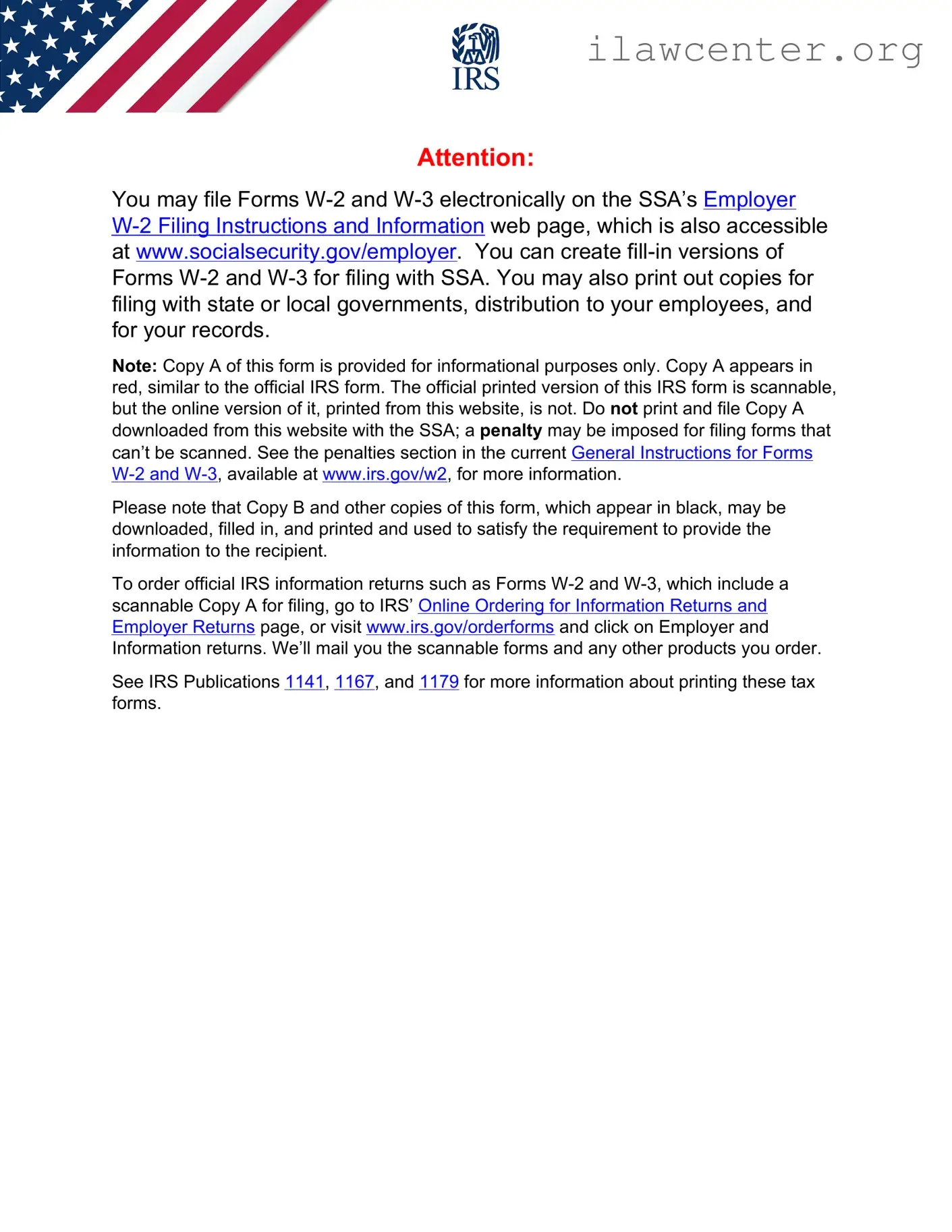
Attention:

You may file Forms W-2 and W-3 electronically on the SSA’s Employer W-2 Filing Instructions and Information web page, which is also accessible at www.socialsecurity.gov/employer. You can create fill-in versions of Forms W-2 and W-3 for filing with SSA. You may also print out copies for filing with state or local governments, distribution to your employees, and for your records.

Note: Copy A of this form is provided for informational purposes only. Copy A appears in red, similar to the official IRS form. The official printed version of this IRS form is scannable, but the online version of it, printed from this website, is not. Do not print and file Copy A downloaded from this website with the SSA; a penalty may be imposed for filing forms that can’t be scanned. See the penalties section in the current General Instructions for Forms W-2 and W-3, available at www.irs.gov/w2, for more information.

Please note that Copy B and other copies of this form, which appear in black, may be downloaded, filled in, and printed and used to satisfy the requirement to provide the information to the recipient.

To order official IRS information returns such as Forms W-2 and W-3, which include a scannable Copy A for filing, go to IRS’ Online Ordering for Information Returns and Employer Returns page, or visit www.irs.gov/orderforms and click on Employer and Information returns. We’ll mail you the scannable forms and any other products you order.

See IRS Publications 1141, 1167, and 1179 for more information about printing these tax forms.


a Employee’s social security number


22222

VOID


For Official Use Only


OMB No. 1545-0029


b Employer identification number (EIN)


1 Wages, tips, other compensation

2 Federal income tax withheld


c Employer’s name, address, and ZIP code


3

Social security wages


4 Social security tax withheld


5 Medicare wages and tips

6

Medicare tax withheld


7

Social security tips


8

Allocated tips


d Control number


9


10

Dependent care benefits


11

Nonqualified plans


e Employee’s first name and initial

Last name


Suff.


12a See instructions for box 12


C


13

Statutory

Retirement

Third-party

o


d


employee

plan

sick pay

e


12b


C


14a Other


o


d


e


12c


C


o


d


e


12d


C


14b Treasury Tipped Occupation Code(s)

o


d


e


f Employee’s address and ZIP code


15 State Employer’s state ID number


16 State wages, tips, etc.

17 State income tax


18 Local wages, tips, etc.

19 Local income tax

20 Locality name


W-2


2026


Form

Wage and Tax Statement


Department of the Treasury—Internal Revenue Service


For Privacy Act and Paperwork Reduction


Copy A—For Social Security Administration. Send this entire page with


Act Notice, see the separate instructions.


Form W-3 to the Social Security Administration; photocopies are not acceptable.


Cat. No. 10134D

Created 1/7/26

Do Not Cut, Fold, or Staple Forms on This Page

22222

a Employee’s social security number


OMB No. 1545-0029


b Employer identification number (EIN)


1 Wages, tips, other compensation

2 Federal income tax withheld


c Employer’s name, address, and ZIP code


3

Social security wages


4 Social security tax withheld


5 Medicare wages and tips

6

Medicare tax withheld


7

Social security tips


8

Allocated tips


d Control number


9


10

Dependent care benefits


11

Nonqualified plans


e Employee’s first name and initial

Last name

Suff.


12a


C


13

Statutory

Retirement

Third-party

o


d


employee

plan

sick pay

e


12b


C


14a Other


o


d


e


12c


C


o


d


e


12d


C


14b Treasury Tipped Occupation Code(s)

o


d


e


f Employee’s address and ZIP code


15 State Employer’s state ID number


16 State wages, tips, etc.

17 State income tax


18 Local wages, tips, etc.

19 Local income tax

20 Locality name


Form W-2 Wage and Tax Statement

2026


Department of the Treasury—Internal Revenue Service


Copy 1—For State, City, or Local Tax Department

a Employee’s social security number

bEmployer identification number (EIN)


Safe, accurate,

Visit the IRS website at

OMB No. 1545-0029 FAST! Use

www.irs.gov/efile.


1 Wages, tips, other compensation

2 Federal income tax withheld


c Employer’s name, address, and ZIP code


3

Social security wages


4 Social security tax withheld


5 Medicare wages and tips

6

Medicare tax withheld


7

Social security tips


8

Allocated tips


d Control number


9


10

Dependent care benefits


11

Nonqualified plans


e Employee’s first name and initial

Last name

Suff.


12a See instructions for box 12


C


13

Statutory

Retirement

Third-party

o


d


employee

plan

sick pay

e


12b


C


14a Other


o


d


e


12c


C


o


d


e


12d


C


14b Treasury Tipped Occupation Code(s)

o


d


e


f Employee’s address and ZIP code


15 State Employer’s state ID number


16 State wages, tips, etc.

17 State income tax


18 Local wages, tips, etc.

19 Local income tax

20 Locality name


Form W-2 Wage and Tax Statement

2026


Department of the Treasury—Internal Revenue Service


Copy B—To Be Filed With Employee’s FEDERAL Tax Return.

This information is being furnished to the Internal Revenue Service.

Future developments. For the latest information about developments related to Form W-2, such as legislation enacted after it was published, go to www.irs.gov/FormW2.

Notice to Employee

Do you have to file? Refer to the Form 1040 instructions to determine if you are required to file a tax return. Even if you don’t have to file a tax return, you may be eligible for a refund if box 2 shows an amount or if you are eligible for any credit.

Earned income tax credit (EITC). You may be able to take the EITC for 2026 if your adjusted gross income (AGI) is less than a certain amount. The amount of the credit is based on income and family size. Workers without children could qualify for a smaller credit. You and any qualifying children must have valid social security numbers (SSNs). You can’t take the EITC if your investment income is more than the specified amount for 2026 or if income is earned for services provided while you were an inmate at a penal institution. For 2026 income limits and more information, visit www.irs.gov/EITC. See also Pub. 596. Any

EITC that is more than your tax liability is refunded to you, but only if you file a tax return.

Employee’s social security number (SSN). For your protection, this form may show only the last four digits of your SSN. However, your employer has reported your complete SSN to the IRS and the Social Security Administration (SSA).

Clergy and religious workers. If you aren’t subject to social security and Medicare taxes, see Pub. 517.

Corrections. If your name, SSN, or address is incorrect, correct Copies B, C, and 2 and ask your employer to correct your employment record. Be sure to ask the employer to file Form W-2c, Corrected Wage and Tax Statement, with the SSA to correct any name, SSN, or money amount error reported to the SSA on Form W-2. Be sure to get your copies of Form W-2c from your employer for all corrections made so you may file them with your tax return. If your name and SSN are correct but aren’t the same as shown on your social security card, you should ask for a new card that displays your correct name at any SSA office or by calling 800-772-1213. You may also visit the SSA website at www.SSA.gov.

Cost of employer-sponsored health coverage (if such cost is provided by the employer). The reporting in box 12, using code DD, of the cost of employer-sponsored health coverage is for your information only. The amount reported with code DD is not taxable.

Credit for excess taxes. If you had more than one employer in 2026 and more than $11,439.00 in social security and/or Tier 1 railroad retirement (RRTA) taxes were withheld, you may be able to claim a credit for the excess against your federal income tax. See the Form 1040 instructions. If you had more than one railroad employer and more than $6,717.90 in Tier 2 RRTA tax was withheld, you may be able to claim a refund on Form 843. See the Instructions for Form 843.

(See also Instructions for Employee on the back of Copy C.)

File Properties

Fact Name Description
Purpose The W-2 form reports an employee's annual wages and the amount of taxes withheld from their paycheck.
Filing Deadline Employers must provide W-2 forms to employees by January 31 of the following year.
Recipient The form is sent to the employee and the Social Security Administration (SSA) for record-keeping.
State-Specific Forms Many states require their own versions of the W-2 form, governed by state tax laws.
Information Included The W-2 includes details such as total earnings, Social Security wages, Medicare wages, and federal/state tax withheld.
Importance for Tax Filing The W-2 is essential for employees when preparing their annual tax returns, as it provides necessary income information.

Instructions on Utilizing IRS W-2

Once you have gathered all necessary information, you are ready to begin filling out the IRS W-2 form. This form is essential for reporting wages paid to employees and the taxes withheld from those wages. Completing it accurately ensures compliance with tax regulations and provides important information for both the employer and the employee.

  1. Begin by entering your employer's name, address, and Employer Identification Number (EIN) in the designated boxes at the top of the form.
  2. Next, fill in your name, address, and Social Security Number (SSN) in the appropriate fields. Make sure to use your legal name as it appears on your Social Security card.
  3. In Box 1, report your total wages, tips, and other compensation for the year. This amount should reflect your earnings before any deductions.
  4. Move to Box 2, where you will enter the total amount of federal income tax withheld from your paychecks throughout the year.
  5. In Box 3, indicate the total amount of Social Security wages. This may differ from the amount in Box 1 due to certain pre-tax deductions.
  6. Box 4 requires you to list the total Social Security tax withheld from your earnings.
  7. Next, complete Box 5 by entering your Medicare wages, which may also differ from your total wages.
  8. In Box 6, record the total Medicare tax withheld.
  9. For Boxes 7 through 12, report any additional information such as tips, retirement plan contributions, and other benefits as applicable.
  10. Finally, review the entire form for accuracy, ensuring all amounts and information are correct before submitting it to the IRS and providing copies to your employees.

Important Facts about IRS W-2

What is a W-2 form?

The W-2 form, officially known as the Wage and Tax Statement, is a document that employers in the United States must provide to their employees. It summarizes an employee's annual wages and the taxes withheld from their paycheck. This form is crucial for employees when they file their income tax returns, as it provides the necessary information to report earnings and calculate tax obligations.

Who receives a W-2 form?

Any employee who has earned wages from an employer during the tax year should receive a W-2 form. This includes full-time, part-time, and seasonal workers. If you were an independent contractor or self-employed, you would not receive a W-2; instead, you would receive a 1099 form. Employers are required to send W-2 forms to their employees by January 31 of each year.

What information is included on a W-2 form?

A W-2 form contains several key pieces of information. This includes the employee's total earnings for the year, the amount of federal, state, and local taxes withheld, Social Security and Medicare contributions, and the employer's identification information. Each box on the form serves a specific purpose, helping to ensure accurate reporting of income and taxes to the IRS.

How do I use my W-2 form when filing taxes?

When filing your taxes, you will need to include the information from your W-2 form on your tax return. This typically involves entering the amounts from the form into the appropriate sections of your tax return, whether you are using tax software or filing manually. It's important to double-check that all information is accurate to avoid any issues with the IRS.

What should I do if I don't receive my W-2 form?

If you have not received your W-2 form by mid-February, you should first contact your employer to inquire about it. Sometimes, forms can be lost in the mail or sent to the wrong address. If your employer cannot provide it or if you still do not receive it, you can contact the IRS directly for assistance. They may ask you to file your taxes using your last pay stub of the year as a reference.

Can I access my W-2 form online?

Many employers now provide electronic access to W-2 forms through payroll or HR platforms. If your employer offers this option, you can log in to your account and download your W-2 form. If you cannot find it online, reach out to your HR department for guidance on accessing your W-2 electronically.

What if I notice an error on my W-2 form?

If you find an error on your W-2 form, such as incorrect wages or tax withholdings, it's important to address it promptly. Contact your employer to request a corrected form, known as a W-2c. This corrected form will ensure that your tax return reflects accurate information, helping you avoid potential issues with the IRS.

Common mistakes

Filling out the IRS W-2 form can be a straightforward process, but mistakes can easily occur. One common error is providing incorrect personal information. This includes misspelling names or entering the wrong Social Security number. Such inaccuracies can lead to delays in processing and may complicate tax filings.

Another frequent mistake is miscalculating earnings. Employees must ensure that the amounts in Box 1, which reports wages, tips, and other compensation, are accurate. If the figures do not match the actual earnings for the year, it can create confusion for both the employee and the IRS.

Many individuals overlook the importance of checking their filing status. The W-2 form does not ask for filing status, but the information reported can affect the tax return. It is essential to understand how different statuses can influence tax obligations and refunds.

Some people forget to review the state and local tax information on the W-2. Boxes 17 and 19 report state wages and local wages, respectively. If these amounts are incorrect, it could lead to additional taxes owed or missed credits.

Another mistake is neglecting to check for multiple W-2 forms. Employees who have worked for more than one employer during the year should ensure they receive a W-2 from each. Failing to report all income can result in penalties and interest from the IRS.

In addition, individuals often misinterpret the instructions for withholding allowances. The W-2 does not indicate how many allowances were claimed, but it is essential to understand how this affects tax withholdings throughout the year.

People sometimes forget to keep copies of their W-2 forms. It is important to retain these documents for personal records and future reference. They can be crucial if any discrepancies arise during tax preparation or if the IRS requests additional information.

Lastly, many individuals submit their W-2 forms without verifying all information is complete. Missing information can lead to processing delays. Taking the time to double-check each entry can save a lot of hassle in the long run.

Documents used along the form

The IRS W-2 form is a crucial document for employees in the United States, as it reports annual wages and the amount of taxes withheld from their paychecks. Several other forms and documents are often used in conjunction with the W-2 to provide a comprehensive overview of an individual's income and tax situation. Below are some of these important documents.

  • IRS W-4 Form: This form is used by employees to indicate their tax situation to their employer. It helps determine the amount of federal income tax to withhold from paychecks. Employees can adjust their withholding allowances based on personal circumstances, such as marital status or number of dependents.
  • IRS 1099 Form: This form is issued to independent contractors and freelancers. It reports various types of income other than wages, salaries, and tips. The 1099 form comes in several variations, depending on the nature of the income, such as 1099-MISC for miscellaneous income or 1099-INT for interest income.
  • IRS 1040 Form: The 1040 form is the standard individual income tax return form used by U.S. taxpayers. It summarizes income, deductions, and credits to calculate the tax owed or refund due. Taxpayers use information from the W-2 and other forms to complete this document.
  • State Tax Return: Most states require residents to file a state income tax return. This document is similar to the federal 1040 form but is specific to state tax laws and rates. It often uses information from the W-2 and may have different deductions and credits available.
  • IRS Schedule C: For self-employed individuals, Schedule C is used to report income or loss from a business. This form details revenue, expenses, and net profit or loss, and it is often submitted alongside the 1040 form.

These documents work together to provide a complete picture of an individual's financial situation for tax purposes. Understanding each form's role can help ensure accurate reporting and compliance with tax regulations.

Similar forms

The IRS W-2 form is a crucial document for reporting income earned by employees. Several other documents serve similar purposes in different contexts. Below is a list of ten documents that share similarities with the W-2 form:

  • 1099-MISC: This form reports income earned by independent contractors and freelancers, similar to how the W-2 reports wages for employees.
  • 1099-NEC: Specifically used for reporting non-employee compensation, this form is akin to the W-2 in that it details earnings but for self-employed individuals.
  • W-3: This is a summary form that accompanies the W-2 when submitted to the IRS, providing a total of all W-2s issued by an employer.
  • 1040: The individual income tax return form that incorporates information from the W-2 to calculate total taxable income.
  • W-4: While primarily a withholding allowance certificate, it influences the information reported on the W-2 by determining how much tax is withheld from an employee's paycheck.
  • Schedule C: Used by sole proprietors to report income and expenses, this document parallels the W-2 in detailing income sources, though for self-employed individuals.
  • K-1: This form reports income, deductions, and credits from partnerships and S corporations, similar to how the W-2 reports income from employment.
  • Form 940: This is an annual federal unemployment tax return, which, while not a direct income report, relates to employee compensation and benefits.
  • Form 941: This is the employer's quarterly federal tax return, which tracks payroll taxes and is linked to the W-2 information reported for employees.
  • Form 1095-C: This form provides information about health insurance coverage offered by employers, which can be relevant for tax reporting alongside W-2 earnings.

Dos and Don'ts

When filling out the IRS W-2 form, it is essential to approach the task with care. This form is critical for reporting wages and taxes withheld, and accuracy is paramount. Below are some guidelines to help ensure the process goes smoothly.

Things You Should Do:

  • Double-check all personal information, including your name, address, and Social Security number, to ensure accuracy.
  • Use the correct year for the tax return to avoid confusion or delays.
  • Keep a copy of the W-2 for your records after submission.
  • Report all income accurately, including tips and any additional earnings.

Things You Shouldn't Do:

  • Do not leave any boxes blank; fill in all required fields to prevent processing issues.
  • Avoid using incorrect or outdated forms; always use the latest version available.
  • Do not forget to sign and date the form, as this is essential for validation.
  • Refrain from guessing your tax withholding amounts; consult with your employer if unsure.

By following these guidelines, you can ensure that your W-2 form is completed accurately and efficiently, leading to a smoother tax filing experience.

Misconceptions

The IRS W-2 form is an essential document for employees and employers alike. However, several misconceptions surround it. Here are six common misunderstandings:

  • W-2 forms are only for full-time employees. Many believe that only full-time workers receive W-2 forms. In reality, any employee who earns wages from an employer should receive a W-2, regardless of their work hours.
  • W-2 forms are optional for employers. Some employers think they can choose whether to issue W-2 forms. This is not true; employers are legally required to provide W-2s to their employees by January 31 each year.
  • W-2 forms are the same as 1099 forms. While both forms report income, they serve different purposes. W-2 forms are for employees, while 1099 forms are for independent contractors and freelancers.
  • Receiving a W-2 means you are not self-employed. This is a common misconception. Some individuals may receive a W-2 from one job while being self-employed in another capacity, requiring them to report income from both sources.
  • All income is reported on the W-2. While the W-2 includes wages, tips, and other compensation, it does not account for all types of income, such as rental income or investment earnings, which must be reported separately.
  • You can only file your taxes after receiving your W-2. Although the W-2 is important for filing taxes, you can estimate your taxes and file using other records if your W-2 is delayed. However, you will need the W-2 for accurate reporting.

Understanding these misconceptions can help ensure proper tax filing and compliance with IRS regulations.

Key takeaways

The IRS W-2 form is a crucial document for both employees and employers in the United States. It serves to report wages paid and taxes withheld. Here are some key takeaways regarding its use and completion:

  • The W-2 form must be provided by employers to employees by January 31 of each year.
  • Employees use the W-2 to report their income when filing federal and state tax returns.
  • The form includes important information such as total earnings, Social Security wages, and federal income tax withheld.
  • Employers must file copies of the W-2 with the Social Security Administration (SSA) by the end of January.
  • Any errors on the W-2 can lead to complications in tax filing; therefore, it is essential to review the form carefully.
  • Employees should keep a copy of their W-2 for their records, as it may be needed for future reference.
  • If an employee does not receive their W-2 by mid-February, they should contact their employer to request it.