IRS W-2 PDF Template

IRS W-2 PDF Template

The IRS W-2 form is a crucial document that employers use to report an employee's annual wages and the taxes withheld from their paycheck. This form provides essential information for both employees and the Internal Revenue Service, ensuring accurate tax filing and compliance. To learn more about how to fill out the W-2 form correctly, click the button below.

Article Guide

The IRS W-2 form plays a crucial role in the annual tax filing process for millions of American workers. This document, provided by employers, details an employee's earnings and the taxes withheld throughout the year. It includes essential information such as wages, tips, and other compensation, alongside federal, state, and local tax deductions. Employees rely on the W-2 to accurately report their income when filing their tax returns, ensuring compliance with federal and state tax laws. Additionally, the form is not just a record of earnings; it also serves as a vital tool for the IRS to track income and tax payments. Understanding the components of the W-2, such as the various boxes that indicate different types of income and deductions, is essential for anyone navigating the complexities of tax season. By grasping how to read and interpret this form, employees can better prepare for their financial responsibilities and avoid potential pitfalls during tax filing.

IRS W-2 Preview

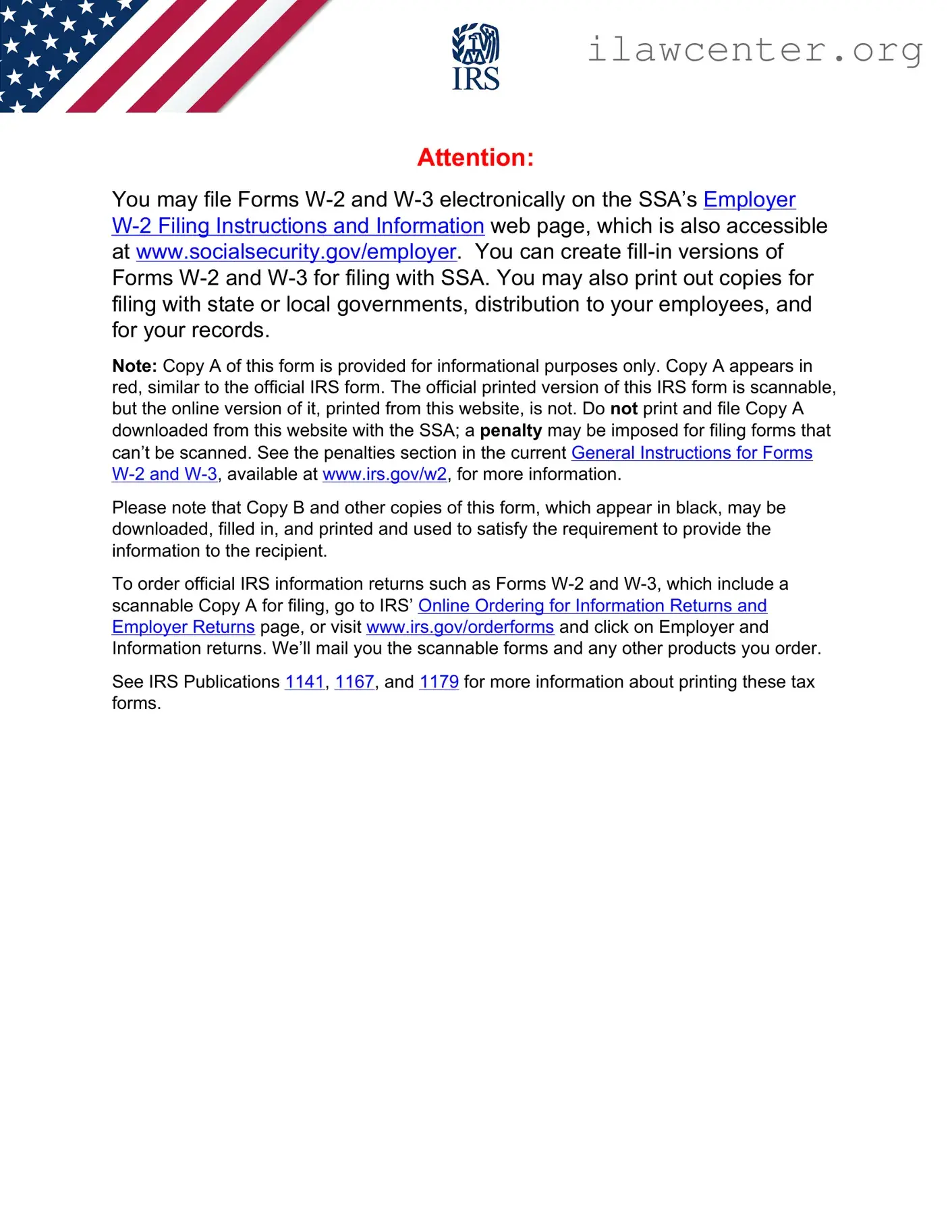
Attention:

You may file Forms W-2 and W-3 electronically on the SSA’s Employer W-2 Filing Instructions and Information web page, which is also accessible at www.socialsecurity.gov/employer. You can create fill-in versions of Forms W-2 and W-3 for filing with SSA. You may also print out copies for filing with state or local governments, distribution to your employees, and for your records.

Note: Copy A of this form is provided for informational purposes only. Copy A appears in red, similar to the official IRS form. The official printed version of this IRS form is scannable, but the online version of it, printed from this website, is not. Do not print and file Copy A downloaded from this website with the SSA; a penalty may be imposed for filing forms that can’t be scanned. See the penalties section in the current General Instructions for Forms W-2 and W-3, available at www.irs.gov/w2, for more information.

Please note that Copy B and other copies of this form, which appear in black, may be downloaded, filled in, and printed and used to satisfy the requirement to provide the information to the recipient.

To order official IRS information returns such as Forms W-2 and W-3, which include a scannable Copy A for filing, go to IRS’ Online Ordering for Information Returns and Employer Returns page, or visit www.irs.gov/orderforms and click on Employer and Information returns. We’ll mail you the scannable forms and any other products you order.

See IRS Publications 1141, 1167, and 1179 for more information about printing these tax forms.



a Employee’s social security number


22222

VOID


For Official Use Only


OMB No. 1545-0029


b Employer identification number (EIN)


1 Wages, tips, other compensation

2 Federal income tax withheld


c Employer’s name, address, and ZIP code


3

Social security wages


4 Social security tax withheld


5 Medicare wages and tips

6

Medicare tax withheld


7

Social security tips


8

Allocated tips


d Control number


9


10

Dependent care benefits


11

Nonqualified plans


e Employee’s first name and initial

Last name


Suff.


12a See instructions for box 12


C


13

Statutory

Retirement

Third-party

o


d


employee

plan

sick pay

e


12b


C


14a Other


o


d


e


12c


C


o


d


e


12d


C


14b Treasury Tipped Occupation Code(s)

o


d


e


f Employee’s address and ZIP code


15 State Employer’s state ID number


16 State wages, tips, etc.

17 State income tax


18 Local wages, tips, etc.

19 Local income tax

20 Locality name


W-2


2026


Form

Wage and Tax Statement


Department of the Treasury—Internal Revenue Service


For Privacy Act and Paperwork Reduction


Copy A—For Social Security Administration. Send this entire page with


Act Notice, see the separate instructions.


Form W-3 to the Social Security Administration; photocopies are not acceptable.


Cat. No. 10134D

Created 1/7/26

Do Not Cut, Fold, or Staple Forms on This Page

22222

a Employee’s social security number


OMB No. 1545-0029


b Employer identification number (EIN)


1 Wages, tips, other compensation

2 Federal income tax withheld


c Employer’s name, address, and ZIP code


3

Social security wages


4 Social security tax withheld


5 Medicare wages and tips

6

Medicare tax withheld


7

Social security tips


8

Allocated tips


d Control number


9


10

Dependent care benefits


11

Nonqualified plans


e Employee’s first name and initial

Last name

Suff.


12a


C


13

Statutory

Retirement

Third-party

o


d


employee

plan

sick pay

e


12b


C


14a Other


o


d


e


12c


C


o


d


e


12d


C


14b Treasury Tipped Occupation Code(s)

o


d


e


f Employee’s address and ZIP code


15 State Employer’s state ID number


16 State wages, tips, etc.

17 State income tax


18 Local wages, tips, etc.

19 Local income tax

20 Locality name


Form W-2 Wage and Tax Statement

2026


Department of the Treasury—Internal Revenue Service


Copy 1—For State, City, or Local Tax Department

a Employee’s social security number

bEmployer identification number (EIN)


Safe, accurate,

Visit the IRS website at

OMB No. 1545-0029 FAST! Use

www.irs.gov/efile.


1 Wages, tips, other compensation

2 Federal income tax withheld


c Employer’s name, address, and ZIP code


3

Social security wages


4 Social security tax withheld


5 Medicare wages and tips

6

Medicare tax withheld


7

Social security tips


8

Allocated tips


d Control number


9


10

Dependent care benefits


11

Nonqualified plans


e Employee’s first name and initial

Last name

Suff.


12a See instructions for box 12


C


13

Statutory

Retirement

Third-party

o


d


employee

plan

sick pay

e


12b


C


14a Other


o


d


e


12c


C


o


d


e


12d


C


14b Treasury Tipped Occupation Code(s)

o


d


e


f Employee’s address and ZIP code


15 State Employer’s state ID number


16 State wages, tips, etc.

17 State income tax


18 Local wages, tips, etc.

19 Local income tax

20 Locality name


Form W-2 Wage and Tax Statement

2026


Department of the Treasury—Internal Revenue Service


Copy B—To Be Filed With Employee’s FEDERAL Tax Return.

This information is being furnished to the Internal Revenue Service.
Future developments. For the latest information about developments related to Form W-2, such as legislation enacted after it was published, go to www.irs.gov/FormW2.

Notice to Employee

Do you have to file? Refer to the Form 1040 instructions to determine if you are required to file a tax return. Even if you don’t have to file a tax return, you may be eligible for a refund if box 2 shows an amount or if you are eligible for any credit.

Earned income tax credit (EITC). You may be able to take the EITC for 2026 if your adjusted gross income (AGI) is less than a certain amount. The amount of the credit is based on income and family size. Workers without children could qualify for a smaller credit. You and any qualifying children must have valid social security numbers (SSNs). You can’t take the EITC if your investment income is more than the specified amount for 2026 or if income is earned for services provided while you were an inmate at a penal institution. For 2026 income limits and more information, visit www.irs.gov/EITC. See also Pub. 596. Any

EITC that is more than your tax liability is refunded to you, but only if you file a tax return.

Employee’s social security number (SSN). For your protection, this form may show only the last four digits of your SSN. However, your employer has reported your complete SSN to the IRS and the Social Security Administration (SSA).

Clergy and religious workers. If you aren’t subject to social security and Medicare taxes, see Pub. 517.

Corrections. If your name, SSN, or address is incorrect, correct Copies B, C, and 2 and ask your employer to correct your employment record. Be sure to ask the employer to file Form W-2c, Corrected Wage and Tax Statement, with the SSA to correct any name, SSN, or money amount error reported to the SSA on Form W-2. Be sure to get your copies of Form W-2c from your employer for all corrections made so you may file them with your tax return. If your name and SSN are correct but aren’t the same as shown on your social security card, you should ask for a new card that displays your correct name at any SSA office or by calling 800-772-1213. You may also visit the SSA website at www.SSA.gov.

Cost of employer-sponsored health coverage (if such cost is provided by the employer). The reporting in box 12, using code DD, of the cost of employer-sponsored health coverage is for your information only. The amount reported with code DD is not taxable.

Credit for excess taxes. If you had more than one employer in 2026 and more than $11,439.00 in social security and/or Tier 1 railroad retirement (RRTA) taxes were withheld, you may be able to claim a credit for the excess against your federal income tax. See the Form 1040 instructions. If you had more than one railroad employer and more than $6,717.90 in Tier 2 RRTA tax was withheld, you may be able to claim a refund on Form 843. See the Instructions for Form 843.

(See also Instructions for Employee on the back of Copy C.)

File Properties

Fact Name Description
Purpose The W-2 form reports an employee's annual wages and the taxes withheld from their paycheck.
Who Issues It Employers are responsible for issuing W-2 forms to their employees by January 31 each year.
Filing Requirement Employers must file W-2 forms with the Social Security Administration (SSA) and provide copies to employees.
Information Included The form includes details such as total earnings, Social Security wages, Medicare wages, and federal/state tax withheld.
States with Specific Forms Some states require additional forms, such as the California DE 6, which is governed by California Employment Development Department regulations.
Deadline for Filing Employers must file W-2 forms with the SSA by January 31, and copies must be provided to employees by the same date.
Penalties for Non-Compliance Failure to file W-2 forms on time can result in penalties, which increase the longer the delay.
Electronic Filing Employers can file W-2 forms electronically, which is often required for those filing 250 or more forms.
Importance for Tax Returns Employees use the information on the W-2 form to complete their federal and state income tax returns.

Instructions on Utilizing IRS W-2

Once you have the IRS W-2 form in front of you, it’s time to fill it out accurately. This form is essential for reporting your earnings and taxes withheld. Follow these steps to ensure you complete it correctly.

  1. Begin with your personal information. In the top left box, enter your name, address, and Social Security number.
  2. In the top right box, fill in your employer's name, address, and Employer Identification Number (EIN).
  3. Next, indicate your wages in box 1. This should reflect your total taxable income for the year.
  4. In box 2, enter the total federal income tax withheld from your paychecks.
  5. Complete boxes 3 through 6. These boxes cover Social Security wages, Social Security tax withheld, Medicare wages, and Medicare tax withheld.
  6. Fill in any additional information required in boxes 10 through 20, such as dependent care benefits and retirement plan contributions.
  7. Review the completed form for accuracy. Ensure all numbers are correct and legible.
  8. Sign and date the form at the bottom if required, and keep a copy for your records.

Important Facts about IRS W-2

What is the IRS W-2 form?

The IRS W-2 form, also known as the Wage and Tax Statement, is an essential document that employers provide to their employees at the end of each tax year. It details the employee's earnings, taxes withheld, and other important financial information. This form is crucial for accurately reporting income to the IRS and for filing your federal and state tax returns. Essentially, it helps you understand how much you earned and how much tax was taken out of your paycheck throughout the year.

Who receives a W-2 form?

Any employee who has earned wages or salaries from an employer during the tax year should receive a W-2 form. This includes full-time, part-time, and seasonal workers. If you worked for multiple employers, you would receive a separate W-2 from each one. It's important to keep track of these forms, as they will be necessary when you prepare your tax return.

When should I expect to receive my W-2 form?

Employers are required to send out W-2 forms by January 31st of each year. This deadline ensures that employees have enough time to review their earnings and prepare their tax returns before the April filing deadline. If you haven’t received your W-2 by mid-February, it's a good idea to reach out to your employer's payroll department to check on its status.

What should I do if my W-2 form has incorrect information?

If you notice any errors on your W-2, such as incorrect earnings or tax withholdings, it’s important to address them as soon as possible. Contact your employer to request a corrected form, known as a W-2c. This corrected form will reflect the accurate information and should be used when filing your taxes. Failing to correct these errors could lead to complications with the IRS and potential penalties.

How do I use my W-2 form when filing my taxes?

Your W-2 form contains several key pieces of information that you will need when preparing your tax return. You will find your total earnings, federal income tax withheld, Social Security wages, and Medicare wages, among other details. When using tax preparation software or working with a tax professional, you will input this information to ensure your tax return is accurate. Always double-check that the figures match those on your W-2 to avoid any discrepancies with the IRS.

Common mistakes

Filling out the IRS W-2 form accurately is crucial for both employers and employees. One common mistake occurs when individuals fail to double-check their personal information. Errors in names, Social Security numbers, or addresses can lead to significant complications. If the IRS cannot match the information on the W-2 with its records, it may trigger delays in tax refunds or even audits. Therefore, verifying this information before submission is essential.

Another frequent error involves miscalculating wages or withholding amounts. Employees may not be aware of their total earnings for the year, especially if they have multiple jobs. When these figures are incorrectly reported, it can result in underpayment or overpayment of taxes. This mistake not only affects the employee’s tax liability but can also lead to penalties. Keeping accurate records throughout the year can help mitigate this issue.

Additionally, many individuals overlook the importance of selecting the correct filing status. The W-2 form requires employees to indicate whether they are single, married, or head of household. Choosing the wrong status can lead to incorrect tax calculations. It is vital to understand how each status impacts tax rates and potential deductions. Consulting IRS guidelines or a tax professional can provide clarity in this area.

Finally, some people neglect to keep a copy of their W-2 forms for their records. While employers are required to send copies to the IRS, having personal copies is beneficial for reference and verification purposes. In the event of discrepancies or audits, individuals may find themselves at a disadvantage without this documentation. Maintaining a well-organized record-keeping system can help avoid future complications.

Documents used along the form

The IRS W-2 form is a crucial document that summarizes an employee's annual wages and the taxes withheld from their paychecks. However, it is often accompanied by other important forms and documents that help provide a complete picture of an individual's financial situation. Here are some commonly used forms that you might encounter alongside the W-2:

  • IRS W-3: This form serves as a summary of all W-2 forms submitted by an employer. It is used to transmit the W-2 forms to the Social Security Administration and provides a total of the wages and taxes withheld for all employees.
  • 1099-MISC: For independent contractors or freelancers, the 1099-MISC form reports income earned outside of traditional employment. It is essential for individuals who receive payments for services rendered but are not classified as employees.
  • 1040 Form: This is the standard individual income tax return form used by taxpayers to report their annual income. The information from the W-2 and other income documents is used to complete this form, which determines tax liability.
  • Schedule C: Self-employed individuals use this form to report income and expenses related to their business activities. It is often filed along with the 1040 form, providing a detailed account of business earnings.
  • Form 8889: If you have a Health Savings Account (HSA), this form is used to report contributions and distributions. It is important for understanding how HSA funds impact your overall tax situation.

Understanding these forms can help you navigate your tax responsibilities more effectively. Each document plays a role in ensuring that your financial records are accurate and complete, making the tax filing process smoother.

Similar forms

The IRS W-2 form is a crucial document for employees and employers alike, serving as a record of wages earned and taxes withheld. However, it is not the only form that serves a similar purpose. Here are eight other documents that share similarities with the W-2 form:

  • 1099-MISC: This form is used to report income earned by independent contractors and freelancers. Like the W-2, it details the amount earned and any taxes withheld, but it is specifically for non-employee compensation.
  • 1099-NEC: Similar to the 1099-MISC, this form is used exclusively for reporting non-employee compensation. It provides information about payments made to independent contractors, much like the W-2 does for employees.
  • W-3: This is a summary form that accompanies the W-2 when submitted to the IRS. It consolidates the total earnings and taxes withheld for all employees, similar to how the W-2 summarizes individual employee information.
  • 1040: The individual income tax return form, where taxpayers report their total income, including wages from the W-2. It uses the information from the W-2 to calculate tax liability.
  • 1098-T: This form is used by educational institutions to report tuition payments and related expenses. While it serves a different purpose, it helps individuals track financial information for tax purposes, similar to how the W-2 tracks employment income.
  • W-4: This form is filled out by employees to determine how much tax should be withheld from their paychecks. It influences the information reported on the W-2, linking the two documents in the payroll process.
  • Schedule C: Used by self-employed individuals to report income and expenses from their business. While not a direct employee income report like the W-2, it serves a similar function for freelancers and business owners.
  • Form 941: This is the employer's quarterly tax return that reports income taxes, Social Security tax, and Medicare tax withheld from employee wages. It provides a broader view of payroll taxes, similar to how the W-2 details individual employee earnings.

Understanding these documents can help individuals navigate their financial responsibilities and ensure compliance with tax regulations.

Dos and Don'ts

When filling out the IRS W-2 form, it is important to follow certain guidelines to ensure accuracy and compliance. Below is a list of things to do and avoid.

Things You Should Do:

  • Review your personal information for accuracy, including your name, address, and Social Security number.
  • Ensure that all income amounts are correctly reported, reflecting your earnings for the year.
  • Check that any withholdings for federal and state taxes are accurately recorded.
  • Use clear and legible handwriting if filling out the form by hand.
  • Keep a copy of the completed W-2 form for your records.
  • Submit the form to the IRS by the deadline to avoid penalties.
  • Consult a tax professional if you have questions or need assistance.

Things You Shouldn't Do:

  • Do not leave any fields blank; all required information must be filled out.
  • Avoid using incorrect or outdated information from previous years.
  • Do not forget to sign and date the form if required.
  • Do not submit the form without double-checking for errors.
  • Refrain from altering the form in any way that could lead to misinterpretation.
  • Do not ignore the importance of deadlines; timely submission is crucial.
  • Do not hesitate to ask for help if you are unsure about any part of the form.

Misconceptions

The IRS W-2 form is an essential document for employees and employers alike, yet several misconceptions surround it. Understanding these misconceptions can help clarify its purpose and importance. Here are six common misunderstandings about the W-2 form:

  • Only full-time employees receive W-2 forms. This is not true. Both part-time and full-time employees receive a W-2 if they are classified as employees and earn wages subject to income tax withholding.
  • The W-2 form is only for federal taxes. While the W-2 is primarily used for reporting federal income taxes, it also reports state and local taxes withheld. Employees need to be aware of all tax obligations reflected on the form.
  • Employers must provide W-2 forms only if the employee requests one. Employers are legally required to issue W-2 forms to all employees by January 31 of the following year, regardless of whether the employee requests it.
  • The W-2 form is the same as a 1099 form. This is a common misconception. A W-2 is used for employees, while a 1099 form is used for independent contractors. Each serves a different purpose in tax reporting.
  • W-2 forms are only necessary for filing federal taxes. In addition to federal tax filings, the W-2 is crucial for state and local tax filings. Ignoring it can lead to discrepancies and potential penalties.
  • Once you receive your W-2, you don’t need to keep it. This is misleading. It is essential to keep your W-2 for your records, as you may need it for future reference or in case of an audit.

By clearing up these misconceptions, individuals can better understand their responsibilities and rights when it comes to tax reporting and compliance.

Key takeaways

The IRS W-2 form is a crucial document for both employers and employees in the United States. Understanding how to fill it out and use it correctly can simplify the tax filing process significantly. Here are some key takeaways:

  • Purpose of the W-2: The W-2 form reports an employee's annual wages and the taxes withheld from their paycheck. Employers must provide this form to their employees by January 31 each year.
  • Employee Information: Ensure that your name, address, and Social Security number are accurate on the form. Errors can lead to delays in processing your tax return.
  • Employer Information: The employer's name, address, and Employer Identification Number (EIN) must also be correct. This information helps the IRS identify the source of your income.
  • Boxes on the Form: Familiarize yourself with the various boxes on the W-2. Each box contains specific information, such as wages, tips, and other compensation, as well as federal, state, and local taxes withheld.
  • Multiple W-2s: If you worked for more than one employer during the year, you will receive a W-2 from each. Collect all W-2s before filing your tax return to ensure accurate reporting.
  • Filing Taxes: Use the information from your W-2 to complete your federal and state tax returns. The figures reported on the W-2 will directly impact your tax calculations.
  • Keep Records: Retain a copy of your W-2 for your records. This is important for future reference, especially if you are audited by the IRS.
  • Corrections: If you notice an error on your W-2, contact your employer immediately. They can issue a corrected form, known as a W-2c, which you will need for accurate tax filing.

By understanding these key aspects of the W-2 form, employees can navigate their tax obligations with greater confidence and clarity.