IRS W-8BEN PDF Template

IRS W-8BEN PDF Template

The IRS W-8BEN form is a crucial document used by foreign individuals to certify their non-U.S. status for tax purposes. By submitting this form, individuals can claim tax treaty benefits and potentially reduce withholding tax on income received from U.S. sources. Ensure you fill out the form accurately to avoid any complications; click the button below to get started.

Article Guide

The IRS W-8BEN form plays a crucial role for non-U.S. individuals and entities engaged in transactions with U.S. sources of income. Designed primarily for foreign individuals, this form certifies their foreign status and claims any applicable benefits under tax treaties between their country of residence and the United States. By submitting the W-8BEN, individuals can potentially reduce or eliminate U.S. tax withholding on certain types of income, such as dividends, interest, and royalties. The form requires personal identification details, including name, country of citizenship, and address, along with a signature certifying the accuracy of the information provided. Additionally, it must be submitted to the withholding agent or financial institution rather than the IRS directly. Understanding the implications of the W-8BEN is essential for foreign individuals seeking to navigate the complexities of U.S. tax obligations effectively.

IRS W-8BEN Preview

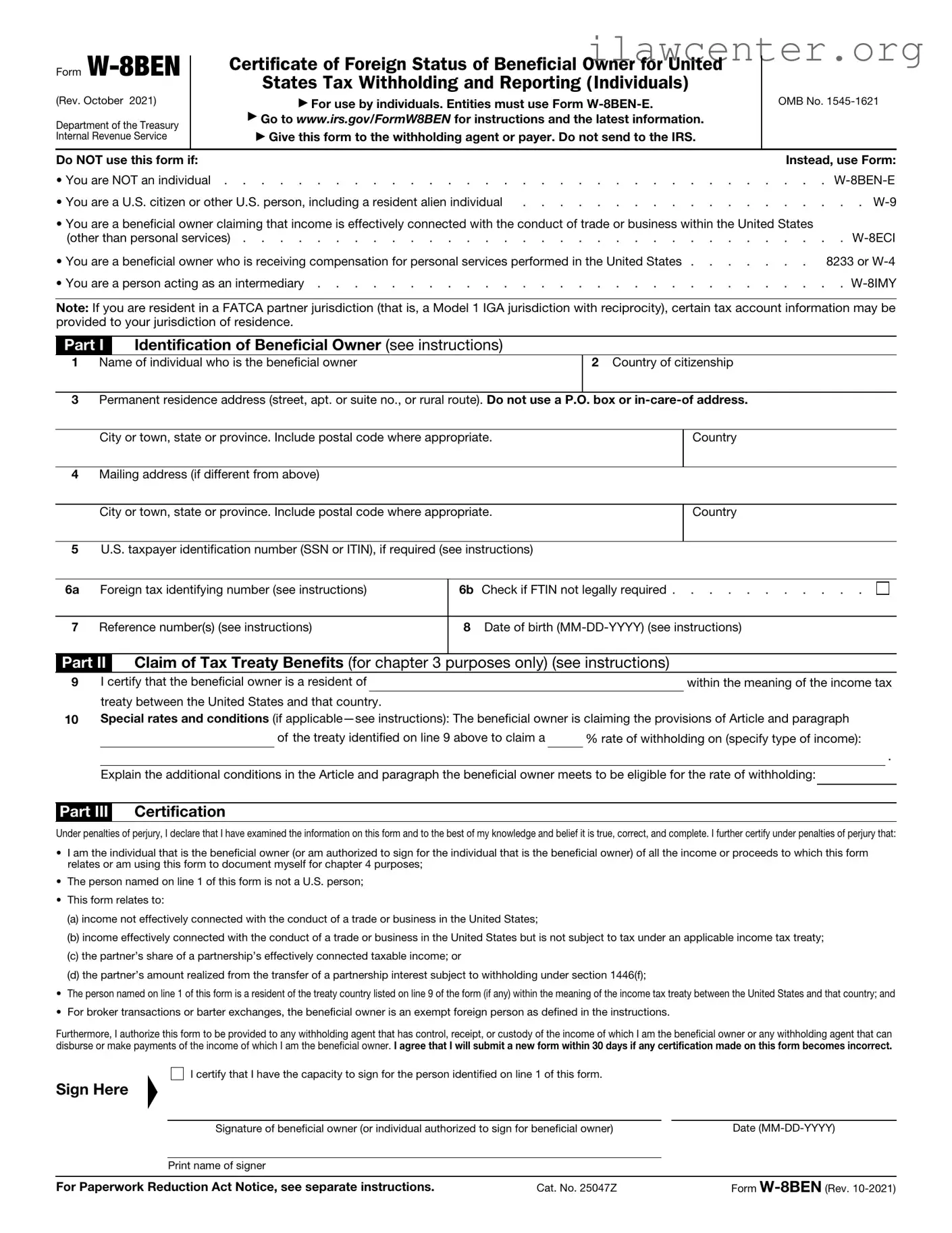
Form W-8BEN
(Rev. October 2021)
Department of the Treasury
Internal Revenue Service
Certificate of Foreign Status of Beneficial Owner for United
States Tax Withholding and Reporting (Individuals)
For use by individuals. Entities must use Form W-8BEN-E.
Go to www.irs.gov/FormW8BEN for instructions and the latest information.
Give this form to the withholding agent or payer. Do not send to the IRS.
OMB No. 1545-1621
Do NOT use this form if: Instead, use Form:
• You are NOT an individual . . . . . . . . . . . . . . . . . . . . . . . . . . . . . . . . . W-8BEN-E
• You are a U.S. citizen or other U.S. person, including a resident alien individual . . . . . . . . . . . . . . . . . . . W-9
• You are a beneficial owner claiming that income is effectively connected with the conduct of trade or business within the United States
(other than personal services) . . . . . . . . . . . . . . . . . . . . . . . . . . . . . . . . . W-8ECI
• You are a beneficial owner who is receiving compensation for personal services performed in the United States . . . . . . . 8233 or W-4
• You are a person acting as an intermediary . . . . . . . . . . . . . . . . . . . . . . . . . . . . . W-8IMY
Note: If you are resident in a FATCA partner jurisdiction (that is, a Model 1 IGA jurisdiction with reciprocity), certain tax account information may be
provided to your jurisdiction of residence.
Part I Identification of Beneficial Owner (see instructions)
1 Name of individual who is the beneficial owner 2 Country of citizenship
3 Permanent residence address (street, apt. or suite no., or rural route). Do not use a P.O. box or in-care-of address.
City or town, state or province. Include postal code where appropriate. Country
4 Mailing address (if different from above)
City or town, state or province. Include postal code where appropriate. Country
5 U.S. taxpayer identification number (SSN or ITIN), if required (see instructions)
6a Foreign tax identifying number (see instructions)
6b Check if FTIN not legally required . . . . . . . . . . .
7 Reference number(s) (see instructions)
8 Date of birth (MM-DD-YYYY) (see instructions)
Part II Claim of Tax Treaty Benefits (for chapter 3 purposes only) (see instructions)
9
I certify that the beneficial owner is a resident of
within the meaning of the income tax
treaty between the United States and that country.
10
Special rates and conditions (if applicable—see instructions): The beneficial owner is claiming the provisions of Article and paragraph
of the treaty identified on line 9 above to claim a
% rate of withholding on (specify type of income):
.
Explain the additional conditions in the Article and paragraph the beneficial owner meets to be eligible for the rate of withholding:
Part III Certification
Under penalties of perjury, I declare that I have examined the information on this form and to the best of my knowledge and belief it is true, correct, and complete. I further certify under penalties of perjury that:
I am the individual that is the beneficial owner (or am authorized to sign for the individual that is the beneficial owner) of all the income or proceeds to which this form
relates or am using this form to document myself for chapter 4 purposes;
The person named on line 1 of this form is not a U.S. person;
This form relates to:
(a) income not effectively connected with the conduct of a trade or business in the United States;
(b) income effectively connected with the conduct of a trade or business in the United States but is not subject to tax under an applicable income tax treaty;
(c) the partner’s share of a partnership’s effectively connected taxable income; or
(d) the partner’s amount realized from the transfer of a partnership interest subject to withholding under section 1446(f);
The person named on line 1 of this form is a resident of the treaty country listed on line 9 of the form (if any) within the meaning of the income tax treaty between the United States and that country; and
For broker transactions or barter exchanges, the beneficial owner is an exempt foreign person as defined in the instructions.
Furthermore, I authorize this form to be provided to any withholding agent that has control, receipt, or custody of the income of which I am the beneficial owner or any withholding agent that can
disburse or make payments of the income of which I am the beneficial owner. I agree that I will submit a new form within 30 days if any certification made on this form becomes incorrect.
Sign Here
I certify that I have the capacity to sign for the person identified on line 1 of this form.
Signature of beneficial owner (or individual authorized to sign for beneficial owner)
Date (MM-DD-YYYY)
Print name of signer
For Paperwork Reduction Act Notice, see separate instructions.
Cat. No. 25047Z
Form W-8BEN (Rev. 10-2021)
File Properties

Fact Name Description
Purpose The W-8BEN form certifies a foreign individual's status for tax purposes in the United States, allowing them to claim a reduced rate of withholding tax on certain types of income.
Eligibility This form is specifically for non-U.S. persons, including individuals and entities, who receive income from U.S. sources.
Income Types Common income types that may require a W-8BEN include dividends, interest, royalties, and certain types of compensation.
Validity Period The W-8BEN form remains valid for three years from the date of signature, unless there is a change in circumstances that affects the information provided.
Filing Requirement While the form itself is not filed with the IRS, it must be provided to the withholding agent or financial institution that is responsible for paying the income.
Governing Law The W-8BEN form is governed by U.S. federal tax law, specifically the Internal Revenue Code.
Common Mistakes Errors often occur in the form of incomplete information or incorrect identification of residency, which can lead to incorrect withholding rates.
Updates The IRS periodically updates the W-8BEN form and its instructions, so it is essential to use the most current version available.

Instructions on Utilizing IRS W-8BEN

Completing the IRS W-8BEN form is an essential step for non-U.S. persons to certify their foreign status and claim any applicable tax treaty benefits. After filling out the form, it should be submitted to the withholding agent or financial institution that requested it. This process ensures that the correct amount of tax is withheld from any income received in the United States.

  1. Obtain the IRS W-8BEN form. You can download it from the IRS website or request a copy from the withholding agent.
  2. Begin by entering your name in the first field. Make sure to use your full legal name as it appears on your official documents.
  3. In the next field, provide your country of citizenship. This should be the country where you hold citizenship.
  4. Fill in your permanent address. This should be the address where you reside, including the street, city, and postal code.
  5. If you have a mailing address different from your permanent address, include it in the designated field. Otherwise, you can leave it blank.
  6. Enter your U.S. taxpayer identification number (if applicable). If you do not have one, you can skip this step.
  7. Next, indicate your foreign tax identifying number. This number is usually issued by your country of residence.
  8. If applicable, provide the reference number associated with your account or the transaction.
  9. In Part II, check the box that corresponds to your claim of tax treaty benefits. You may need to refer to the IRS guidelines to determine your eligibility.
  10. Complete the certification section by signing and dating the form. Your signature confirms that the information provided is accurate and complete.

Once you have filled out the form, review it for accuracy before submission. Ensure that all required fields are completed and that your signature is included. This will help prevent any delays in processing your information.

Important Facts about IRS W-8BEN

What is the IRS W-8BEN form?

The IRS W-8BEN form is a document used by foreign individuals and entities to certify their foreign status for tax purposes. It allows non-U.S. persons to claim a reduced rate of, or exemption from, withholding taxes on certain types of income received from U.S. sources. This form is crucial for ensuring compliance with U.S. tax laws while preventing double taxation on income that may also be taxed in the individual's home country.

Who needs to fill out the W-8BEN form?

Foreign individuals who receive income from U.S. sources, such as dividends, interest, or royalties, are typically required to complete the W-8BEN form. This includes non-resident aliens and foreign entities. If you are not a U.S. citizen or resident and you receive income that is subject to U.S. tax withholding, you will likely need to submit this form to the withholding agent or financial institution handling your income.

How do I complete the W-8BEN form?

Completing the W-8BEN form involves providing personal information, such as your name, country of citizenship, and address. You will also need to indicate the type of income you are receiving and any applicable tax treaty benefits. It is important to ensure that all information is accurate and up-to-date. After filling out the form, sign and date it before submitting it to the relevant U.S. entity. Keep in mind that the form does not need to be sent to the IRS directly; it should be given to the withholding agent instead.

How long is the W-8BEN form valid?

The W-8BEN form remains valid for three years from the date it is signed. However, if there are any changes in circumstances, such as a change in residency status or a change in the type of income being received, a new form must be submitted. It is advisable to review the form periodically to ensure that the information remains accurate and to re-submit it if necessary.

What happens if I do not submit the W-8BEN form?

If you fail to submit the W-8BEN form when required, the withholding agent may be obligated to withhold taxes at the maximum rate on your income. This could result in a higher tax liability than if you had submitted the form and claimed any applicable tax treaty benefits. Additionally, not submitting the form may lead to delays in receiving your payments, as the withholding agent may withhold funds until the necessary documentation is provided.

Common mistakes

Filling out the IRS W-8BEN form can be a straightforward process, but many individuals make common mistakes that can lead to delays or complications. One frequent error is providing incorrect personal information. This includes misspellings of names or inaccuracies in the country of citizenship. Such mistakes can cause the IRS to reject the form, requiring the individual to start over.

Another common mistake involves failing to check the appropriate box regarding the individual's status. The W-8BEN form is designed for foreign individuals, and selecting the wrong category can result in incorrect withholding tax rates. It is crucial to carefully review each option and select the one that accurately reflects the individual’s situation.

Some people neglect to provide a valid taxpayer identification number (TIN). While not always required, a TIN can expedite the processing of the form. Without it, the IRS may impose higher withholding rates, which can be financially burdensome. Always ensure that a valid TIN is included when applicable.

Additionally, individuals sometimes overlook the importance of signing and dating the form. An unsigned or undated form is considered incomplete, and the IRS will not accept it. This can lead to unnecessary delays in processing and potential issues with tax compliance.

Another mistake is not updating the form when personal circumstances change. Changes in residency, citizenship status, or tax identification can all affect the validity of the W-8BEN. Individuals should submit a new form whenever there is a significant change to ensure compliance with IRS regulations.

Some individuals also fail to understand the implications of the form. The W-8BEN certifies foreign status and claims benefits under tax treaties. Not fully grasping these implications can lead to misunderstandings about tax obligations and potential penalties.

Moreover, many people do not keep a copy of the submitted form. This can create issues if there are questions or disputes later. Retaining a copy provides a reference point and can be crucial for resolving any discrepancies that may arise.

Another mistake is submitting the form to the wrong entity. The W-8BEN must be provided to the withholding agent or financial institution, not the IRS directly. Sending it to the wrong place can cause significant delays in processing and tax withholding.

Finally, some individuals rush through the form without reading the instructions. Each section of the W-8BEN has specific requirements and guidance. Taking the time to understand these instructions can prevent many of the aforementioned mistakes and ensure a smoother filing process.

Documents used along the form

The IRS W-8BEN form is essential for non-U.S. persons to certify their foreign status and claim benefits under an income tax treaty. However, it is often accompanied by other forms and documents that help clarify tax obligations and ensure compliance. Below is a list of commonly used documents alongside the W-8BEN form.

  • W-8BEN-E: This form is used by foreign entities, such as corporations or partnerships, to establish their foreign status and claim tax treaty benefits. It serves a similar purpose as the W-8BEN but is tailored for businesses rather than individuals.
  • W-8ECI: This form is for foreign persons receiving income that is effectively connected with a trade or business in the United States. It allows them to report that income and avoid withholding taxes on it.
  • W-9: U.S. persons use this form to provide their taxpayer identification number (TIN) to payers. It is often requested by businesses or financial institutions when they need to report income to the IRS.
  • Form 1042-S: This is used to report income paid to foreign persons and the amount of tax withheld. It provides details necessary for non-residents to file their tax returns in the U.S.
  • Form 1040-NR: Non-resident aliens use this form to file their U.S. tax returns. It allows them to report their income and claim any applicable deductions or credits.
  • Form 8833: This document is used to disclose treaty-based return positions. It helps taxpayers explain their reliance on a tax treaty when filing their tax returns.

Understanding these forms and documents can help non-U.S. persons navigate the complexities of U.S. tax obligations. Being well-informed ensures compliance and can help maximize potential tax benefits.

Similar forms

The IRS W-8BEN form is an important document for foreign individuals and entities who receive income from U.S. sources. It serves to establish foreign status and claim any applicable tax treaty benefits. There are several other forms that share similarities with the W-8BEN. Below are four such documents:

  • IRS W-8BEN-E: This form is similar to the W-8BEN but is specifically designed for foreign entities rather than individuals. It also certifies foreign status and claims tax treaty benefits, ensuring that the correct withholding tax rates are applied.
  • IRS W-9: The W-9 form is used by U.S. persons to provide their taxpayer identification information. While the W-9 establishes U.S. status, it serves a similar purpose in identifying the taxpayer and ensuring proper reporting to the IRS.
  • IRS 1042-S: This form is used to report income paid to foreign persons, including the amounts withheld. Like the W-8BEN, it is part of the process to ensure compliance with U.S. tax laws regarding foreign income recipients.
  • IRS 8833: The Treaty-Based Return Position Disclosure Under Section 6114 or 7701(b) form is used by individuals or entities claiming a tax treaty benefit. Similar to the W-8BEN, it helps establish eligibility for reduced withholding rates based on treaty provisions.

Understanding these forms can help ensure compliance with U.S. tax regulations and optimize tax obligations for foreign individuals and entities. Each document plays a unique role in the broader context of tax reporting and withholding, but they all share the common goal of clarifying taxpayer status and ensuring proper tax treatment.

Dos and Don'ts

When filling out the IRS W-8BEN form, it’s important to approach the process with care. This form is crucial for non-U.S. persons to claim tax benefits. Here are some essential dos and don’ts to keep in mind:

  • Do ensure that all personal information is accurate and complete.
  • Do provide your foreign tax identifying number, if applicable.
  • Do sign and date the form to validate it.
  • Don't leave any sections blank; incomplete forms can lead to delays.
  • Don't use outdated versions of the form; always check for the most current version on the IRS website.

By following these guidelines, you can help ensure that your form is processed smoothly. Taking the time to fill out the W-8BEN correctly can save you from potential issues down the line.

Misconceptions

The IRS W-8BEN form is an important document for foreign individuals receiving income from U.S. sources. However, many misconceptions surround it. Below are some common misunderstandings about the W-8BEN form.

  1. It is only for non-resident aliens. Many believe the W-8BEN is exclusively for non-resident aliens. In reality, it can also be used by foreign entities, such as corporations and partnerships.
  2. Filing the W-8BEN means I don’t have to pay taxes. Some think that submitting this form exempts them from all U.S. taxes. While it may reduce withholding tax rates, it does not eliminate tax obligations entirely.
  3. Once submitted, the W-8BEN never needs to be updated. This is false. The form must be updated every three years or whenever there are changes in circumstances.
  4. The W-8BEN is the same as the W-9 form. This is a common misconception. The W-9 form is for U.S. persons, while the W-8BEN is specifically for foreign individuals and entities.
  5. I can submit the W-8BEN to any U.S. entity. Not true. The W-8BEN should only be submitted to the withholding agent or financial institution that requires it.
  6. Only U.S. citizens need to worry about the W-8BEN. This is misleading. Foreign individuals and entities receiving U.S. income must be aware of this form and its implications.
  7. The W-8BEN is a tax return. This is incorrect. The W-8BEN is not a tax return; it is a declaration of foreign status and claim for reduced withholding rates.
  8. I can ignore the W-8BEN if I am not living in the U.S. This is a mistake. If you receive income from U.S. sources, you still need to complete and submit the form, regardless of your residency.
  9. Submitting the W-8BEN guarantees lower taxes. This is not guaranteed. The form may reduce withholding rates, but the final tax liability depends on various factors, including tax treaties.

Understanding these misconceptions is crucial for compliance and to avoid unnecessary tax burdens. If you have questions about the W-8BEN form, seeking professional advice is recommended.

Key takeaways

The IRS W-8BEN form is essential for non-U.S. individuals receiving income from U.S. sources. Here are some key takeaways to keep in mind:

  • The form certifies your foreign status, allowing you to claim tax treaty benefits.
  • Ensure that all information provided is accurate and complete to avoid delays or issues with processing.
  • This form does not need to be submitted to the IRS directly; instead, it should be given to the U.S. payer or withholding agent.
  • It is important to renew the form periodically, as it may expire after a certain period.