Job Briefing PDF Template

Job Briefing PDF Template

The Job Briefing form is a crucial document designed to ensure safety and preparedness before commencing any work project. This form facilitates a structured discussion among the work crew, allowing them to identify potential hazards and emergency procedures. To enhance workplace safety, please take a moment to fill out the form by clicking the button below.

Article Guide

The Job Briefing form is an essential tool designed to enhance safety and communication before commencing work on a project. This form captures vital information, including job details such as the date, job number, and physical address, ensuring that all team members are on the same page. It also outlines emergency procedures, highlighting important contact numbers and evacuation points, which can be critical in a crisis. Moreover, the form categorizes the type of work being performed, ranging from incidental lifts to heavy and critical lifts, which helps in identifying specific safety measures required for each task. Additionally, it identifies potential job site exposures, including physical and health hazards, while detailing necessary hazard control measures and personal protective equipment (PPE). For civil work, the form emphasizes the need for proper trenching plans and safety protocols, particularly for excavations greater than five feet. Lastly, it ensures that all personnel acknowledge their understanding of the job briefing by signing off, fostering a culture of safety and accountability on the job site.

Job Briefing Preview

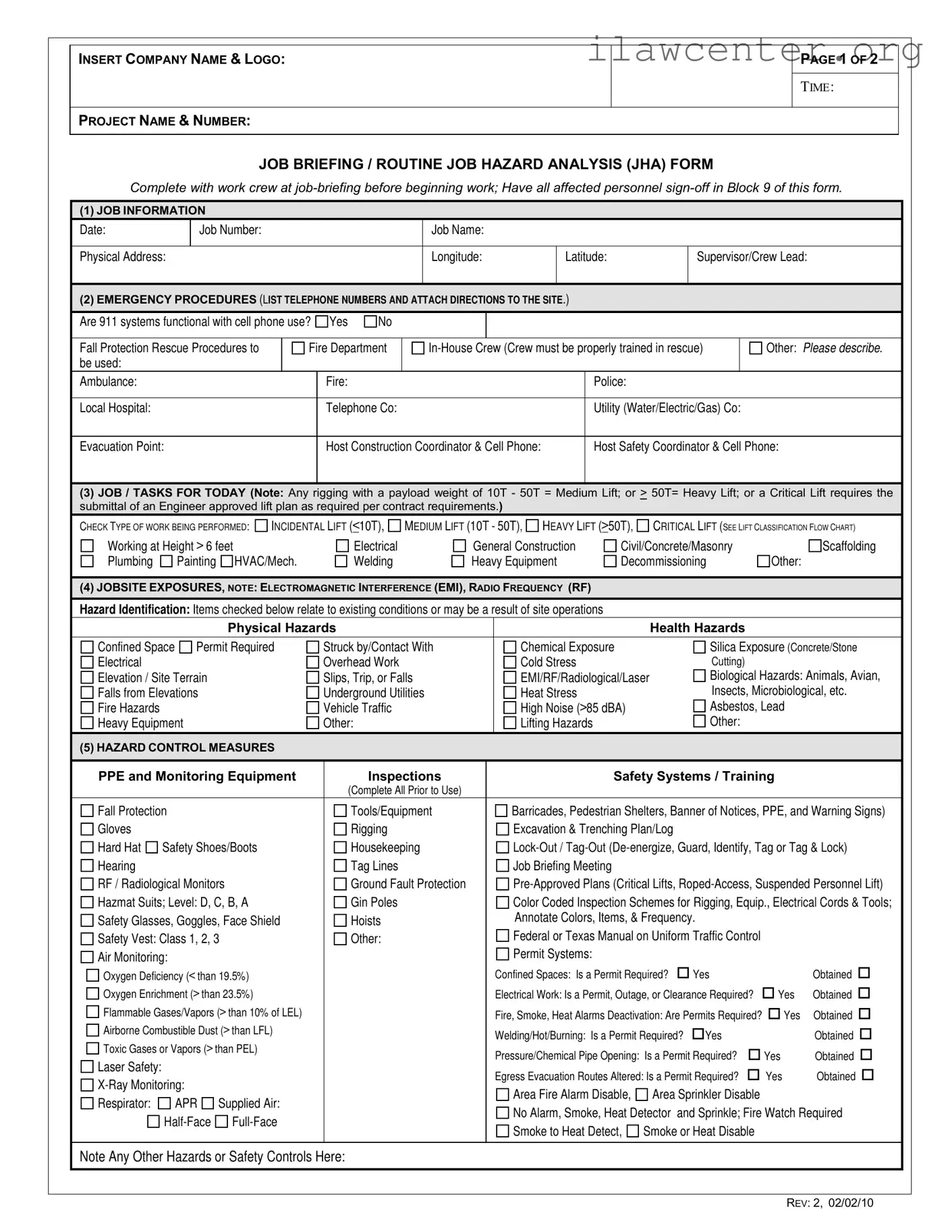
INSERT COMPANY NAME & LOGO:
PAGE 1 OF 2
TIME :
PROJECT NAME & NUMBER:
REV: 2, 02/02/10
JOB BRIEFING / ROUTINE JOB HAZARD ANALYSIS (JHA) FORM
Complete with work crew at job-briefing before beginning work; Have all affected personnel sign-off in Block 9 of this form.
(1) JOB INFORMATION
Date:
Job Number:
Job Name:
Physical Address:
Longitude:
Supervisor/Crew Lead:
(2) EMERGENCY PROCEDURES (LIST TELEPHONE NUMBERS AND ATTACH DIRECTIONS TO THE SITE.)
Are 911 systems functional with cell phone use? Yes No
Fall Protection Rescue Procedures to
be used:
Fire Department
In-House Crew (Crew must be properly trained in rescue)
Other: Please describe.
Ambulance:
Fire:
Police:
Local Hospital:
Telephone Co:
Utility (Water/Electric/Gas) Co:
Evacuation Point:
Host Construction Coordinator & Cell Phone:
Host Safety Coordinator & Cell Phone:
(3)
JOB
/
TASKS
FOR
TODAY (Note: Any rigging with a payload weight of 10T - 50T = Medium Lift; or > 50T= Heavy Lift; or a Critical Lift requires the
submittal of an Engineer approved lift plan as required per contract requirements.
)
C
HECK
T
YPE OF WORK BEING PERFORMED
:
I
NCIDENTAL
L
IFT
(<10T),
M
EDIUM
L
IFT
(10T
-
50T),
H
EAVY
L
IFT
(>50T),
C
RITICAL
L
IFT
(
SEE LIFT CLASSIFICATION FLOW CHART)
Working at Height > 6 feet
Plumbing Painting HVAC/Mech.
Electrical General Construction
Welding Heavy Equipment
Civil/Concrete/Masonry
Decommissioning
Scaffolding
Other:
(4)
JOBSITE
EXPOSURES,
NOTE
:
E
LECTROMAGNETIC
I
NTERFERENCE
(EMI),
R
ADIO
F
REQUENCY
(RF)
Hazard Identification: Items checked below relate to existing conditions or may be a result of site operations
Physical Hazards
Health Hazards
Confined Space Permit Required
Electrical
Elevation / Site Terrain
Falls from Elevations
Fire Hazards
Heavy Equipment
Struck by/Contact With
Overhead Work
Slips, Trip, or Falls
Underground Utilities
Vehicle Traffic
Other:
Chemical Exposure
Cold Stress
EMI/RF/Radiological/Laser
Heat Stress
High Noise (>85 dBA)
Lifting Hazards
Silica Exposure (Concrete/Stone
Cutting)
Biological Hazards: Animals, Avian,
Insects, Microbiological, etc.
Asbestos, Lead
Other:
(5) HAZARD CONTROL MEASURES
PPE and Monitoring Equipment Inspections
(Complete All Prior to Use)
Safety Systems / Training
Fall Protection
Gloves
Hard Hat Safety Shoes/Boots
Hearing
RF / Radiological Monitors
Hazmat Suits; Level: D, C, B, A
Safety Glasses, Goggles, Face Shield
Safety Vest: Class 1, 2, 3
Air Monitoring:
Oxygen Deficiency (< than 19.5%)
Oxygen Enrichment (> than 23.5%)
Flammable Gases/Vapors (> than 10% of LEL)
Airborne Combustible Dust (> than LFL)
Toxic Gases or Vapors (> than PEL)
Laser Safety:
X-Ray Monitoring:
Respirator: APR Supplied Air:
Half-Face Full-Face
Tools/Equipment
Rigging
Housekeeping
Tag Lines
Ground Fault Protection
Gin Poles
Hoists
Other:
Barricades, Pedestrian Shelters, Banner of Notices, PPE, and Warning Signs)
Excavation & Trenching Plan/Log
Lock-Out / Tag-Out (De-energize, Guard, Identify, Tag or Tag & Lock)
Job Briefing Meeting
Pre-Approved Plans (Critical Lifts, Roped-Access, Suspended Personnel Lift)
Color Coded Inspection Schemes for Rigging, Equip., Electrical Cords & Tools;
Annotate Colors, Items, & Frequency.
Federal or Texas Manual on Uniform Traffic Control
Permit Systems:
Confined Spaces: Is a Permit Required? Yes Obtained
Electrical Work: Is a Permit, Outage, or Clearance Required?
Yes Obtained
Fire, Smoke, Heat Alarms Deactivation: Are Permits Required?
Yes Obtained
Welding/Hot/Burning: Is a Permit Required?
Yes Obtained
Pressure/Chemical Pipe Opening: Is a Permit Required?
Yes Obtained
Egress Evacuation Routes Altered: Is a Permit Required? Yes Obtained
Area Fire Alarm Disable, Area Sprinkler Disable
No Alarm, Smoke, Heat Detector and Sprinkle; Fire Watch Required
Smoke to Heat Detect, Smoke or Heat Disable
Note Any Other Hazards or Safety Controls Here:
INSERT COMPANY NAME & LOGO:
PAGE 2 OF 2
TIME :
PROJECT NAME & NUMBER:
REV: 2, 02/02/10
JOB BRIEFING / ROUTINE JOB HAZARD ANALYSIS (JHA) FORM
(6) COMPLETE FOR CIVIL WORK (PLEASE NOTE: ENGINEER APPROVED TRENCHING PLAN REQUIRED FOR TRENCHES > 5’) NOT APPLICABLE
NOTE: Notify and confirm proper procedures, mitigation and/or protective steps taken with your company’s designated Safety Representative & Site Manager before
entering: any trench or any general excavation that is greater than 5’ deep; or any Confined Space.
1. Describe type and depth of excavations Type A Soil/Rock Type B Soil/Rock Type C Soil/Rock: Dig-Tess / One Call
2. Cave-in / Engulfment control measures to be used if excavation will be greater than 5 feet and personnel are entering the trench. Sloping Benching
Shoring Trench Shield/Box Ladder in Trench > 5 Feet & Every 25’ Sump Pump LOTO:
3. Describe elevation/site terrain/environmental concerns or hazards:
4. Describe hazards with site/vehicle access (High Traffic, Heavy Haul, Boom Cranes, and Storage of Materials/HazMat:
5. Describe the type of electrical or gas concerns or hazards (e.g. Electrical/Gas/Fiber Optic Lines):
(7) FALL PROTECTION & USING SUSPENDED PERSONNEL PLATFORM (Complete for Working at Heights and Roped-Access) NOT APPLICABLE
Type of Elevated Work & Height: Type of Tower or Building:
Describe the fall protection system to be used when working aloft. Lifeline Personal Fall Arrest Safety Monitor Qualified Climber Safety Net
Ladder Safety Device Roped Access (Requires Roped Access JHA):
Fall protection to be used. Full Body Harness One Lanyard Two Lanyards (100%) Rope Grab Cable Grab Retractable Lifeline
Ropes
Ascenders/Descenders Anchorage Points, Belay, & Straps:
Has each employee inspected his or her fall protection equipment? Yes No
Hoisting Equipment to be used: < 20’ Encroachment of Power Lines, Yes No; If yes, ID Voltage _______KV; De-energize/Test/Ground Lines Yes No
Suspended Personnel Platform/basket Forklift Platform Crane/Boom/Aerial Truck Scissor/Snorkel Lift Gin Pole Roped Access
Suspended Personnel Platform Checklist and/or Critical Lift Plan Completed? Yes No
(8) REVIEWS AND SIGNATURES
GC Superintendent /Foreman
Lower-tier Subcontractor Supervisor
Name
Signature/Date
Name
Signature/Date
(9) PROJECT PERSONNEL ACKNOWLEDGEMENT (ALL AFFECTED PERSONNEL SIGN AFTER JOB BRIEFING)
Name:
Company:
CPR / First Aid
Name:
Company:
Yes Yes
Yes Yes
Yes Yes
Yes Yes
Yes Yes
Yes
Yes

File Properties

Fact Name Description
Purpose The Job Briefing form is designed to ensure that all personnel are aware of job hazards and safety procedures before starting work.
Required Signatures All affected personnel must sign off in Block 9 to acknowledge understanding of the job briefing and safety measures.
Emergency Procedures The form requires listing emergency contact numbers and confirming the functionality of 911 systems, ensuring quick access to help if needed.
Job Information Essential details such as job name, number, date, and supervisor information must be filled out to maintain clear records.
Hazard Identification The form includes sections to identify physical and health hazards, such as electrical risks, chemical exposure, and fall risks.
Governing Laws This form adheres to OSHA regulations, particularly 29 CFR 1926, which outlines safety and health standards in construction.

Instructions on Utilizing Job Briefing

Filling out the Job Briefing form requires careful attention to detail and collaboration with the work crew. This form is essential for ensuring safety and compliance before starting any job. The following steps will guide you through the process of completing the form accurately.

  1. Begin by entering the company name and logo at the top of the form.
  2. Fill in the project name and number in the designated fields.
  3. Record the date of the job in the job information section.
  4. Input the job number and job name.
  5. Provide the physical address of the job site, including longitude and latitude.
  6. Identify the supervisor or crew lead responsible for the job.
  7. List emergency procedures, including relevant telephone numbers and directions to the site.
  8. Indicate whether the 911 systems are functional with cell phone use.
  9. Check the type of work being performed from the options provided, such as incidental lift, medium lift, or heavy lift.
  10. Identify any jobsite exposures related to physical or health hazards.
  11. Detail the hazard control measures that will be implemented, including personal protective equipment (PPE).
  12. If applicable, complete the section for civil work, including trenching plans and safety measures.
  13. For work at heights, describe the fall protection system and equipment to be used.
  14. Gather the necessary reviews and signatures from the general contractor superintendent or foreman and lower-tier subcontractor supervisor.
  15. Ensure that all affected personnel sign the project personnel acknowledgment section after the job briefing.

Important Facts about Job Briefing

What is the purpose of the Job Briefing form?

The Job Briefing form is designed to ensure that all personnel involved in a project are informed about the specific tasks, hazards, and safety measures before work begins. It serves as a communication tool to outline job details, emergency procedures, and potential hazards. By completing this form, the crew can identify risks and implement safety controls, promoting a safer work environment for everyone involved.

Who needs to sign the Job Briefing form?

All affected personnel must sign the Job Briefing form after the briefing has been conducted. This includes everyone who will be working on the project, ensuring that they acknowledge their understanding of the job tasks and associated hazards. The signatures in Block 9 confirm that each individual has participated in the briefing and is aware of the safety measures in place.

What information is required on the Job Briefing form?

The form requires several key pieces of information. This includes the date, job number, job name, and physical address of the work site. Additionally, it asks for details about the supervisor or crew lead, emergency procedures, and the specific tasks to be performed. It also covers jobsite exposures and hazard control measures. All of this information helps to create a comprehensive overview of the job and its safety requirements.

What should be done if hazards are identified on the Job Briefing form?

If hazards are identified, it is crucial to address them before starting work. The form includes sections for noting physical and health hazards, as well as control measures to mitigate these risks. The crew should discuss these hazards during the briefing and ensure that appropriate safety equipment and procedures are in place. If necessary, further training or adjustments to the work plan may be required to ensure safety for all personnel involved.

Common mistakes

Filling out the Job Briefing form accurately is crucial for ensuring safety and compliance on the job site. However, there are common mistakes that individuals often make when completing this form. Understanding these errors can help improve the process and enhance safety protocols.

One common mistake is failing to include all necessary information. The form requires specific details such as the project name, job number, and physical address. Omitting any of this information can lead to confusion and potential safety hazards. Ensure that all fields are filled out completely before moving forward.

Another frequent error is not updating emergency procedures. Emergency contact numbers and procedures should be current and easily accessible. If these details are outdated, it could delay response times in critical situations. Make it a habit to verify and update this information regularly.

People also often neglect to check the type of work being performed. It’s essential to select the appropriate work type, whether it’s a heavy lift or working at heights. This classification impacts the safety measures that need to be implemented. Be diligent in making the correct selections to ensure all necessary precautions are taken.

Additionally, inadequate hazard identification can be a significant oversight. The form includes sections for identifying various hazards present at the job site. Failing to thoroughly assess and document these risks can leave workers unprotected. Take the time to evaluate the site carefully and note any potential hazards.

Another mistake is overlooking the need for personal protective equipment (PPE). The form has a section dedicated to listing required PPE. Ignoring this section can lead to unsafe working conditions. Always ensure that the necessary safety gear is identified and available for all personnel on site.

Furthermore, not obtaining the required signatures can render the form incomplete. All affected personnel must sign off in Block 9 after the job briefing. This step is not just a formality; it confirms that everyone is aware of the hazards and safety measures in place. Make sure to collect all signatures before proceeding with the work.

Lastly, failing to review the form before submission can lead to mistakes going unnoticed. A thorough review can catch any errors or omissions that need to be corrected. It’s always a good practice to double-check the form to ensure everything is accurate and complete.

By being aware of these common mistakes, individuals can fill out the Job Briefing form more effectively, promoting a safer work environment for everyone involved.

Documents used along the form

When conducting a job briefing, several other forms and documents may be necessary to ensure safety and compliance on the job site. These documents help to communicate vital information, manage risks, and establish protocols. Below is a list of common forms that often accompany the Job Briefing form.

  • Job Hazard Analysis (JHA): This document identifies potential hazards associated with specific tasks and outlines control measures to mitigate risks. It serves as a proactive approach to safety by assessing job tasks before work begins.
  • Safety Data Sheets (SDS): SDS provide detailed information about hazardous materials used on the job site. They include handling instructions, emergency measures, and health risks, ensuring that all workers are informed about the substances they may encounter.
  • Incident Report Form: If an accident occurs, this form documents the details of the incident, including what happened, who was involved, and any injuries sustained. This helps in analyzing the cause and preventing future occurrences.
  • Permit to Work: This form is essential for high-risk activities, ensuring that all safety measures are in place before work begins. It outlines the specific tasks, hazards, and safety protocols required for the job.
  • Emergency Response Plan: This document outlines procedures to follow in case of an emergency. It includes evacuation routes, emergency contacts, and actions to take for various emergency scenarios.
  • Toolbox Talks: These brief safety meetings focus on specific topics relevant to the day's work. They reinforce safety practices and encourage open communication among crew members.
  • Personal Protective Equipment (PPE) Assessment: This form assesses the need for PPE based on the job tasks and hazards present. It ensures that all workers are equipped with the necessary protective gear.
  • Training Records: Keeping track of employee training ensures that all workers are qualified for the tasks they are performing. This document verifies that employees have received necessary safety training.
  • Site Safety Inspection Checklist: This checklist is used to evaluate the job site for safety compliance. It helps identify any hazards or unsafe conditions that need to be addressed before work can commence.

Using these documents in conjunction with the Job Briefing form promotes a culture of safety and accountability on the job site. Each form plays a crucial role in ensuring that workers are informed, prepared, and protected while they perform their duties.

Similar forms

  • Job Hazard Analysis (JHA) Form: Similar to the Job Briefing form, the JHA focuses on identifying hazards related to specific tasks. Both documents require input from the work crew to ensure everyone is aware of potential risks before starting work.
  • Safety Data Sheet (SDS): An SDS provides detailed information about hazardous materials on a job site. Like the Job Briefing form, it emphasizes safety precautions and emergency procedures to protect workers.
  • Incident Report Form: This document records details of workplace accidents. Both the Incident Report and Job Briefing forms aim to enhance safety by documenting information that can help prevent future incidents.
  • Permit to Work: A Permit to Work is required for high-risk activities. It shares similarities with the Job Briefing form in that both ensure that safety measures are in place before work begins.
  • Daily Safety Checklist: This checklist is used to verify that safety protocols are being followed each day. Like the Job Briefing form, it serves as a proactive measure to identify and mitigate hazards.
  • Toolbox Talk Record: Toolbox talks are informal safety meetings. They align with the Job Briefing form in promoting communication about safety practices and potential hazards among crew members.
  • Emergency Action Plan (EAP): An EAP outlines procedures for responding to emergencies. Both documents stress the importance of preparedness and provide critical information to ensure worker safety.
  • Worksite Inspection Report: This report documents safety inspections of the worksite. Like the Job Briefing form, it identifies hazards and outlines necessary corrective actions to maintain a safe environment.
  • Training Attendance Record: This record tracks employee participation in safety training. Similar to the Job Briefing form, it emphasizes the importance of training in maintaining a safe workplace.

Dos and Don'ts

When filling out the Job Briefing form, it is essential to follow specific guidelines to ensure accuracy and compliance. Below are eight important dos and don'ts to consider.

  • Do include the correct company name and logo at the top of the form.
  • Do fill in all job information completely, including date, job number, and physical address.
  • Do ensure that all affected personnel sign off in Block 9 after the job briefing.
  • Do list all emergency contact numbers and attach clear directions to the site.
  • Don't leave any sections blank; incomplete information can lead to confusion and safety risks.
  • Don't forget to check and mark the type of work being performed accurately.
  • Don't skip the hazard identification section; this is critical for worker safety.
  • Don't overlook the need for permits when required, especially for high-risk tasks.

Misconceptions

Misconceptions about the Job Briefing form can lead to misunderstandings and potential safety risks. Below are some common misconceptions, along with clarifications to help ensure that everyone involved understands the importance and proper use of this form.

  • It is optional to complete the Job Briefing form. Many believe that filling out this form is not mandatory. In reality, it is a crucial part of ensuring safety and compliance before beginning any work.
  • Only the supervisor needs to sign the form. Some individuals think that only the supervisor’s signature is required. However, all affected personnel must sign off to acknowledge their understanding of the hazards and procedures outlined.
  • The form is only about listing hazards. While identifying hazards is a significant part of the form, it also includes emergency procedures, job tasks, and required safety measures, making it a comprehensive tool for safety planning.
  • Once filled out, the form does not need to be reviewed. There is a misconception that the form is a one-time document. In fact, it should be reviewed regularly, especially if conditions change or new personnel are involved.
  • Emergency procedures are not necessary for all jobs. Some believe that emergency procedures are only needed for high-risk jobs. Regardless of the job's perceived risk level, having emergency procedures documented is essential for every task.
  • Only one person needs to understand the Job Briefing form. It is often assumed that if one person understands the form, everyone else does not need to. In truth, every team member should comprehend the form to ensure collective safety and preparedness.
  • The Job Briefing form is too complex to be useful. While the form contains detailed information, it is designed to be user-friendly. With proper training, all personnel can effectively utilize it to enhance workplace safety.

Key takeaways

When filling out and using the Job Briefing form, keep these key takeaways in mind:

  • Complete the form before work begins. Ensure that the entire work crew is present during the job briefing.
  • Gather signatures. Have all affected personnel sign off in Block 9 to confirm they understand the job and its hazards.
  • Detail emergency procedures. List important contact numbers and directions to the site for quick access in case of emergencies.
  • Identify job tasks clearly. Specify the type of work being performed and any necessary lift plans for heavy or critical lifts.
  • Assess jobsite exposures. Check for physical and health hazards, including environmental conditions that could impact safety.
  • Implement hazard control measures. Ensure proper personal protective equipment (PPE) and safety systems are in place before starting work.