Fillable Job Letter of Intent Document

Fillable Job Letter of Intent Document

The Job Letter of Intent form is a crucial document that expresses your interest in a specific job position. It serves as a formal introduction to potential employers, outlining your qualifications and intentions. If you are ready to take the next step in your career, fill out the form by clicking the button below.

Article Guide

When pursuing a new job opportunity, a Job Letter of Intent serves as a crucial stepping stone in the application process. This document allows candidates to express their interest in a position while highlighting their qualifications and unique attributes. Typically, it includes key components such as the applicant's contact information, a personalized greeting, and a clear statement of intent. Additionally, it showcases relevant experience and skills, articulating how they align with the job requirements. The letter often concludes with a call to action, inviting the employer to consider the candidate for an interview. Understanding the importance of this form can significantly enhance one’s chances of making a positive impression on potential employers, setting the stage for further discussions about career aspirations and organizational fit.

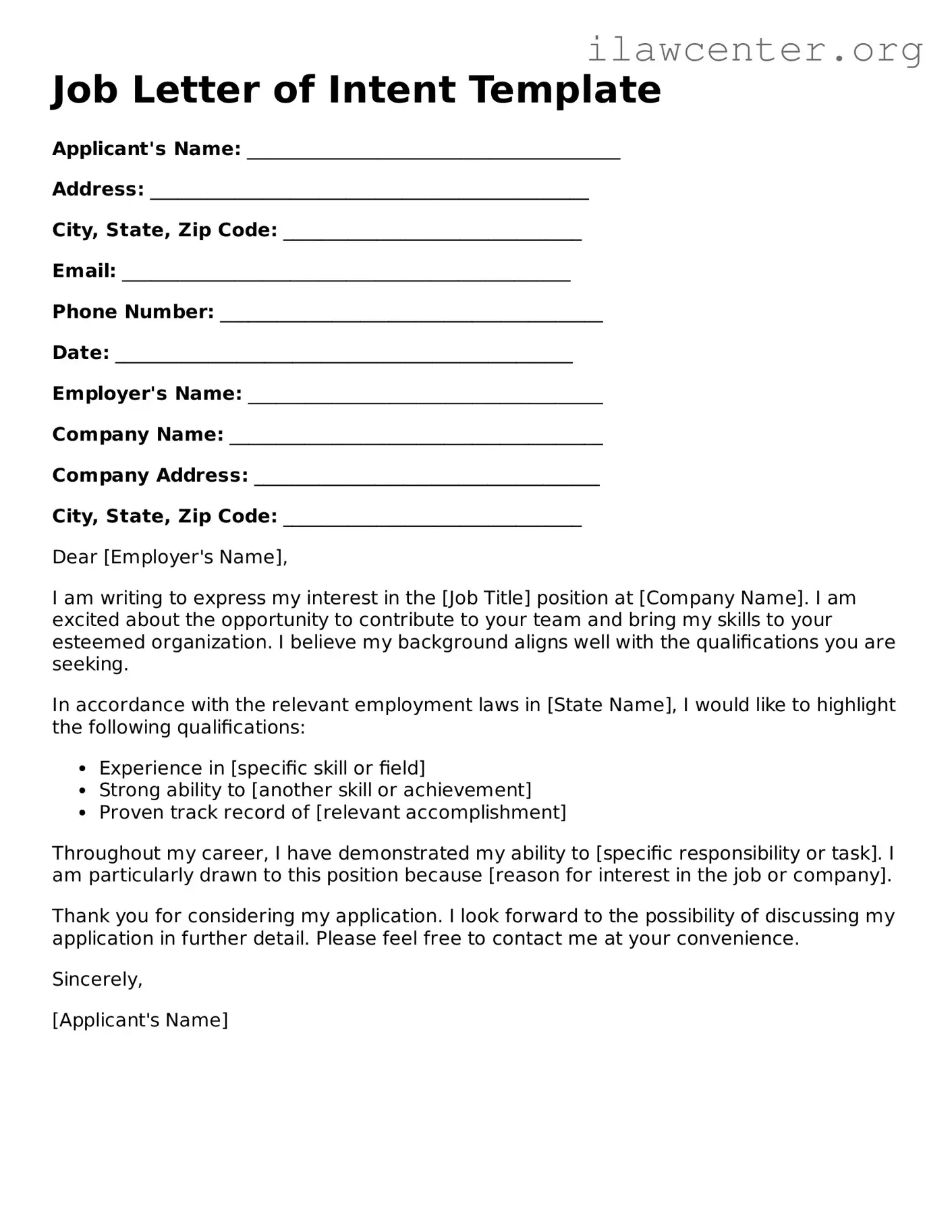
Job Letter of Intent Preview

Job Letter of Intent Template

Applicant's Name: ________________________________________

Address: _______________________________________________

City, State, Zip Code: ________________________________

Email: ________________________________________________

Phone Number: _________________________________________

Date: _________________________________________________

Employer's Name: ______________________________________

Company Name: ________________________________________

Company Address: _____________________________________

City, State, Zip Code: ________________________________

Dear [Employer's Name],

I am writing to express my interest in the [Job Title] position at [Company Name]. I am excited about the opportunity to contribute to your team and bring my skills to your esteemed organization. I believe my background aligns well with the qualifications you are seeking.

In accordance with the relevant employment laws in [State Name], I would like to highlight the following qualifications:

  • Experience in [specific skill or field]
  • Strong ability to [another skill or achievement]
  • Proven track record of [relevant accomplishment]

Throughout my career, I have demonstrated my ability to [specific responsibility or task]. I am particularly drawn to this position because [reason for interest in the job or company].

Thank you for considering my application. I look forward to the possibility of discussing my application in further detail. Please feel free to contact me at your convenience.

Sincerely,

[Applicant's Name]
PDF Form Characteristics

Fact Name Description
Purpose A Job Letter of Intent form expresses a candidate's interest in a position and outlines their qualifications.
Content Requirements The form typically includes the applicant's contact information, a brief introduction, and a summary of relevant experience.
State-Specific Forms Some states may have specific requirements for job letters, governed by local employment laws.
Governing Laws In California, for instance, the Fair Employment and Housing Act may influence the content and use of such forms.

Instructions on Utilizing Job Letter of Intent

After completing the Job Letter of Intent form, you'll submit it to the appropriate department for review. This will help ensure that your application is considered promptly.

  1. Start by entering your full name in the designated field.
  2. Provide your current job title and department.
  3. Include the date you are submitting the form.
  4. Clearly state the position you are interested in applying for.
  5. Write a brief statement explaining your interest in the position.
  6. List any relevant skills or experiences that support your application.
  7. Sign and date the form at the bottom to certify your intent.

Important Facts about Job Letter of Intent

What is a Job Letter of Intent form?

A Job Letter of Intent form is a document that expresses an individual's interest in a specific job or position within an organization. It typically outlines the applicant's qualifications, skills, and reasons for wanting to join the company. This form serves as a preliminary step in the job application process, allowing candidates to convey their enthusiasm and intent to apply for a role before submitting a formal application or resume.

When should I use a Job Letter of Intent form?

This form is particularly useful in situations where a job opening has not yet been publicly advertised. If you learn about a potential job opportunity through networking or other means, submitting a Job Letter of Intent can help you stand out. It demonstrates initiative and can open doors to positions that may not be actively seeking applicants. Additionally, if you are interested in a specific company but there are no current openings, a letter of intent can express your interest and potentially lead to future opportunities.

What should I include in my Job Letter of Intent?

Your Job Letter of Intent should include several key components. Start with a brief introduction that states your purpose for writing. Follow this with a summary of your relevant skills and experiences that align with the job you are interested in. Be sure to articulate why you are drawn to the company and how you believe you can contribute to its success. Finally, conclude with a call to action, inviting the reader to discuss potential opportunities or to review your resume when it becomes available.

Is a Job Letter of Intent the same as a cover letter?

While both documents serve to express interest in a job, they have different purposes. A Job Letter of Intent is more general and can be sent even when no specific job opening exists. It expresses interest in the company as a whole. In contrast, a cover letter is tailored to a specific job listing and accompanies a resume during the formal application process. Both documents are important, but they should be used in appropriate contexts to maximize their effectiveness.

Common mistakes

Filling out a Job Letter of Intent form can be a crucial step in the job application process. However, many people make common mistakes that can hinder their chances of landing the position. Understanding these pitfalls can help you present a strong and compelling letter.

One frequent mistake is failing to tailor the letter to the specific job or company. A generic letter can come across as impersonal and uninspired. Instead, take the time to research the organization and reflect on how your skills and experiences align with their values and goals. This personal touch can make a significant difference.

Another common error is neglecting to proofread. Spelling and grammatical mistakes can create a negative impression. Before submitting your letter, read it carefully. Consider asking a friend or colleague to review it as well. A fresh pair of eyes can catch errors you might overlook.

Many applicants also forget to include relevant details about their qualifications. A Job Letter of Intent should highlight your skills and experiences that are pertinent to the role. Instead of simply stating your job history, use specific examples to illustrate how you can contribute to the company.

In addition, some people make the mistake of being overly formal or overly casual in their tone. Striking the right balance is essential. Aim for a professional yet approachable tone that reflects your personality while still respecting the formality of the job application process.

Another misstep is not including a clear call to action. After expressing your interest and qualifications, let the employer know what you hope to happen next. Whether you want to schedule an interview or discuss your application further, being direct can help guide the next steps.

Finally, many individuals underestimate the importance of formatting. A cluttered or unorganized letter can distract from your message. Use clear headings, bullet points, and a clean layout to ensure that your letter is easy to read and visually appealing. A well-structured letter can enhance your professionalism.

Documents used along the form

The Job Letter of Intent form is often accompanied by several other documents that help provide a comprehensive view of a candidate's qualifications and intentions. Below is a list of commonly used forms and documents that may be submitted alongside the Job Letter of Intent.

  • Resume: A detailed account of a candidate's work history, education, skills, and accomplishments. It serves as a summary of qualifications and experiences relevant to the job being applied for.
  • Cover Letter: A personalized letter addressed to the employer. It explains the candidate's interest in the position and highlights specific skills or experiences that make them a suitable fit.
  • References List: A document that includes names and contact information for individuals who can vouch for the candidate's professional abilities and character. This list is typically provided upon request.
  • Portfolio: A collection of work samples or projects that demonstrate the candidate's skills and expertise. This is particularly useful for creative roles or positions requiring specific technical abilities.
  • Application Form: A standardized form provided by the employer that collects essential information about the candidate, including personal details, work history, and education. It is often required as part of the job application process.

These documents collectively enhance the application process, allowing employers to gain a better understanding of each candidate's qualifications and suitability for the position. Submitting a complete set of materials can improve the chances of making a positive impression.

Similar forms

The Job Letter of Intent form serves as a formal communication tool in various professional contexts. It shares similarities with several other documents commonly used in job applications and professional settings. Below are seven documents that resemble the Job Letter of Intent, along with explanations of their similarities.

  • Cover Letter: Like the Job Letter of Intent, a cover letter accompanies a resume and introduces the applicant to a potential employer. Both documents highlight the candidate's qualifications and express interest in a specific position.
  • Letter of Recommendation: This document is typically written by someone who can vouch for the candidate's skills and experiences. Similar to the Job Letter of Intent, it aims to persuade the reader of the applicant's suitability for a role.
  • Statement of Purpose: Often required for academic programs, a statement of purpose outlines an individual's goals and motivations. Both documents share the goal of articulating intentions and aspirations clearly and convincingly.
  • Resume: While a resume lists qualifications and experiences, it complements the Job Letter of Intent by providing detailed background information. Both documents work together to present a complete picture of the candidate.
  • Job Application Form: This form collects essential information from candidates. Similar to the Job Letter of Intent, it serves as a formal request for consideration for a job, often requiring a statement of interest.
  • Follow-Up Letter: After an interview or submission of an application, a follow-up letter expresses gratitude and reiterates interest in the position. Like the Job Letter of Intent, it aims to maintain communication and strengthen the candidate's candidacy.
  • Networking Letter: This document is used to reach out to industry professionals for advice or opportunities. It resembles the Job Letter of Intent in that it seeks to establish a connection and express interest in potential job openings.

Dos and Don'ts

When filling out a Job Letter of Intent form, it’s essential to approach the task thoughtfully. Here are some key do's and don'ts to keep in mind:

  • Do clearly state your interest in the position.
  • Do highlight relevant skills and experiences that align with the job.
  • Do keep the tone professional and respectful.
  • Don't use overly casual language or slang.
  • Don't forget to proofread for spelling and grammar errors.

By following these guidelines, you can enhance your chances of making a positive impression on potential employers.

Misconceptions

Many people have misunderstandings about the Job Letter of Intent form. Here are eight common misconceptions:

  • It is the same as a cover letter. A Job Letter of Intent is not a cover letter. While both documents express interest in a position, a letter of intent often outlines broader career goals and intentions.
  • It is only needed for academic positions. This form is not limited to academia. Professionals in various fields can benefit from submitting a letter of intent to express their interest in a job or organization.
  • It guarantees an interview. Submitting a letter of intent does not guarantee an interview. It is simply a way to express interest and provide additional context to your application.
  • It should be lengthy and detailed. A letter of intent should be concise. Focus on key points and avoid unnecessary details to maintain the reader's interest.
  • It is only necessary for specific job openings. You can submit a letter of intent even when no specific position is advertised. This can show initiative and interest in the organization.
  • It is a formal requirement. A letter of intent is not always a formal requirement. However, it can enhance your application and make you stand out.
  • It is only for entry-level positions. Individuals at all career levels can use a letter of intent. It can help articulate your experience and aspirations, regardless of your position.
  • It should be a generic template. A successful letter of intent should be tailored to the specific organization and role. Personalization demonstrates genuine interest and effort.

Key takeaways

When filling out and using the Job Letter of Intent form, consider the following key takeaways:

  1. Be Clear and Concise: Clearly state your intentions and qualifications. Avoid unnecessary jargon.
  2. Tailor Your Letter: Customize the letter for each job application. Highlight relevant skills and experiences.
  3. Proofread Thoroughly: Check for spelling and grammatical errors. A polished letter reflects professionalism.
  4. Follow Submission Guidelines: Adhere to any specific instructions regarding format and submission method.
  5. Express Enthusiasm: Convey your passion for the position and the organization. A positive tone can make a difference.
  6. Include Contact Information: Ensure your contact details are up-to-date. Make it easy for employers to reach you.

These tips can enhance the effectiveness of your Job Letter of Intent and improve your chances of securing an interview.