

Kaiser Records Request PDF Template

Kaiser Records Request PDF Template

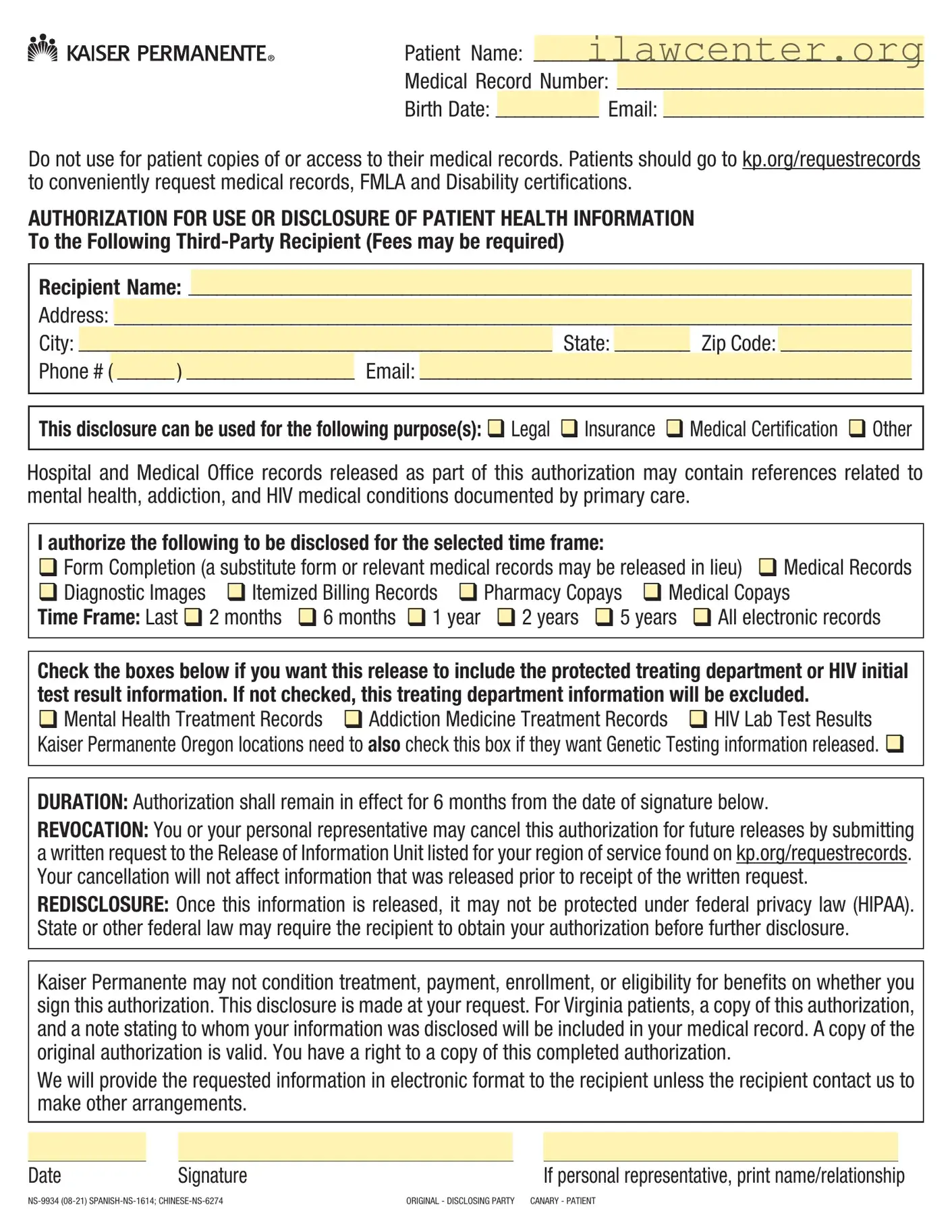
The Kaiser Records Request form is a document that allows patients to authorize the release of their medical records to a third party. This form is essential for individuals needing to share their health information for various purposes, such as legal or insurance matters. To get started, fill out the form by clicking the button below.

Article Guide

The Kaiser Records Request form is an essential document for individuals seeking to authorize the release of their health information to a third party. This form captures vital patient details, including the patient's name, medical record number, and birth date, ensuring accurate identification. It is important to note that this form is not intended for patients to request their own medical records; instead, patients should visit kp.org/requestrecords for direct access to their records, Family and Medical Leave Act (FMLA) certifications, and disability certifications. The form allows patients to specify a third-party recipient and the purpose of the disclosure, which can range from legal and insurance needs to medical certification. Additionally, patients can select the types of information to be disclosed, such as medical records, diagnostic images, and billing records, along with a designated time frame for the requested information. Special considerations for sensitive health information, such as mental health treatment records and HIV lab test results, can also be included by checking the appropriate boxes. The authorization remains valid for six months from the date of signature, and patients have the right to revoke this authorization at any time. It is crucial for patients to understand that once their information is released, it may not be protected under federal privacy law, and they should keep a copy of the completed authorization for their records.

Kaiser Records Request Preview

Patient Name:
__________________________________________
Medical Record Number:
_________________________________
Birth Date:
___________
Email:
____________________________
Do not use for patient copies of or access to their medical records. Patients should go to kp.org/requestrecords
to conveniently request medical records, FMLA and Disability certifications.
AUTHORIZATION FOR USE OR DISCLOSURE OF PATIENT HEALTH INFORMATION
To the Following Third-Party Recipient (Fees may be required)
Recipient Name:
______________________________________________________________________________
Address: ______________________________________________________________________________________
City:
___________________________________________________
State:
________
Zip Code:
______________
Phone # (
______
)
__________________
Email:
_____________________________________________________
This disclosure can be used for the following purpose(s):
Legal
Insurance
Medical Certification
Other
Hospital and Medical Office records released as part of this authorization may contain references related to
mental health, addiction, and HIV medical conditions documented by primary care.
I authorize the following to be disclosed for the selected time frame:
Form Completion (a substitute form or relevant medical records may be released in lieu)
Medical Records
Diagnostic Images
Itemized Billing Records
Pharmacy Copays
Medical Copays
Time Frame: Last
2 months
6 months
1 year
2 years
5 years
All electronic records
Check the boxes below if you want this release to include the protected treating department or HIV initial
test result information. If not checked, this treating department information will be excluded.
Mental Health Treatment Records
Addiction Medicine Treatment Records
HIV Lab Test Results
Kaiser Permanente Oregon locations need to also check this box if they want Genetic Testing information released.
DURATION: Authorization shall remain in effect for 6 months from the date of signature below.
REVOCATION:
You or your personal representative may cancel this authorization for future releases by submitting
a written request to the Release of Information Unit listed for your region of service found on kp.org/requestrecords.
Your cancellation will not affect information that was released prior to receipt of the written request.
REDISCLOSURE: Once this information is released, it may not be protected under federal privacy law (HIPAA).
State or other federal law may require the recipient to obtain your authorization before further disclosure.
Kaiser Permanente may not condition treatment, payment, enrollment, or eligibility for benefits on whether you
sign this authorization. This disclosure is made at your request. For Virginia patients, a copy of this authorization,
and a note stating to whom your information was disclosed will be included in your medical record. A copy of the
original authorization is valid. You have a right to a copy of this completed authorization.
We will provide the requested information in electronic format to the recipient unless the recipient contact us to
make other arrangements.
Date Signature If personal representative, print name/relationship
NS-9934 (08-21) SPANISH-NS-1614; CHINESE-NS-6274
ORIGINAL - DISCLOSING PARTY CANARY - PATIENT
Instructions:
1) Complete the patient identification information on the top right-hand corner
2) Complete all required information for the recipient including a valid email address
3) Check the box for purpose of disclosure
4) Check the box(es) for the type of information to be disclosed and also check the box for a timeframe
5) If you want specially protected information to be included, check the appropriate box(es)
6) Enter the date you are signing the authorization
7) Sign the form
8) If you are a personal representative, print your name and relationship. We may reach out for you to provide
additional documentation if needed.
9) Submit this form to the third party you are authorizing to obtain records
10) Keep a copy for your records
“Kaiser Permanente” means both your insurance company (a Kaiser Permanente health plan) and your doctors
(a Permanente medical or dental group). It also includes different groups depending on where you live.
To find contact information go to kp.org and search locations for your region/market listed below or alternatively
go to kp.org/requestrecords and indicate your region/market.
All states where we do business:
Kaiser Foundation Hospitals
Kaiser Permanente Insurance Company
Colorado:
Kaiser Foundation Health Plan of Colorado
Colorado Permanente Medical Group, P.C.
Georgia:
Kaiser Foundation Health Plan of Georgia, Inc.
The Southeast Permanente Medical Group, Inc.
Mid-Atlantic (Maryland/Virginia/Washington, D.C.):
Kaiser Foundation Health Plan of the
Mid-Atlantic States, Inc.
Mid-Atlantic Permanente Medical Group, P.C.
Washington:
Kaiser Foundation Health Plan of Washington
Washington Permanente Medical Group, P.C.
California - North:
Kaiser Foundation Health Plan, Inc., Northern California Region
The Permanente Medical Group, Inc.
California - South:
Kaiser Foundation Health Plan, Inc., Southern California Region
Southern California Permanente Medical Group
Hawaii:
Kaiser Foundation Health Plan, Inc., Hawaii
Region
Hawaii Permanente Medical Group, Inc.
Maui Health Systems
Northwest (Oregon/SW Washington):
Kaiser Foundation Health Plan of the Northwest
Northwest Permanente, P.C.
Permanente Dental Associates, P.C.
Patient Name:
__________________________________________
Medical Record Number:
_________________________________
Birth Date:
___________
Email:
____________________________
Do not use for patient copies of or access to their medical records. Patients should go to kp.org/requestrecords
to conveniently request medical records, FMLA and Disability certifications.
AUTHORIZATION FOR USE OR DISCLOSURE OF PATIENT HEALTH INFORMATION
To the Following Third-Party Recipient (Fees may be required)
Recipient Name:
______________________________________________________________________________
Address: ______________________________________________________________________________________
City:
___________________________________________________
State:
________
Zip Code:
______________
Phone # (
______
)
__________________ _____________________________________________________
Email:
This disclosure can be used for the following purpose(s):
Legal
Insurance
Medical Certification
Other
Hospital and Medical Office records released as part of this authorization may contain references related to
mental health, addiction, and HIV medical conditions documented by primary care.
I authorize the following to be disclosed for the selected time frame:
Form Completion (a substitute form or relevant medical records may be released in lieu)
Medical Records
Diagnostic Images
Itemized Billing Records
Pharmacy Copays
Medical Copays
Time Frame: Last
2 months
6 months
1 year
2 years
5 years
All electronic records
Check the boxes below if you want this release to include the protected treating department or HIV initial
test result information. If not checked, this treating department information will be excluded.
Mental Health Treatment Records
Addiction Medicine Treatment Records
HIV Lab Test Results
Kaiser Permanente Oregon locations need to also check this box if they want Genetic Testing information released.
DURATION: Authorization shall remain in effect for 6 months from the date of signature below.
REVOCATION:
You or your personal representative may cancel this authorization for future releases by submitting
a written request to the Release of Information Unit listed for your region of service found on kp.org/requestrecords.
Your cancellation will not affect information that was released prior to receipt of the written request.
REDISCLOSURE: Once this information is released, it may not be protected under federal privacy law (HIPAA).
State or other federal law may require the recipient to obtain your authorization before further disclosure.
Kaiser Permanente may not condition treatment, payment, enrollment, or eligibility for benefits on whether you
sign this authorization. This disclosure is made at your request. For Virginia patients, a copy of this authorization,
and a note stating to whom your information was disclosed will be included in your medical record. A copy of the
original authorization is valid. You have a right to a copy of this completed authorization.
We will provide the requested information in electronic format to the recipient unless the recipient contact us to
make other arrangements.
Date Signature If personal representative, print name/relationship
NS-9934 (08-21) SPANISH-NS-1614; CHINESE-NS-6274
ORIGINAL - DISCLOSING PARTY CANARY - PATIENT

File Properties

Fact Name Description
Patient Identification The form requires the patient's name, medical record number, birth date, and email address for identification purposes.
Third-Party Disclosure Patients can authorize the disclosure of their health information to a specified third-party recipient, which may include legal, insurance, or medical certification purposes.
Duration of Authorization The authorization remains valid for six months from the date of signature, allowing for the release of specified medical records during this period.
Revocation Process Patients can revoke their authorization at any time by submitting a written request, which will not affect information already released.
State-Specific Regulations In Virginia, a copy of the authorization is included in the patient's medical record, detailing to whom the information was disclosed, in compliance with state laws.

Instructions on Utilizing Kaiser Records Request

Once you have gathered the necessary information, you can begin filling out the Kaiser Records Request form. This process involves providing personal details and specifying the information you wish to authorize for release. After completing the form, it will need to be submitted to the designated third party.

  1. Complete the patient identification information at the top right-hand corner, including your name, medical record number, birth date, and email.
  2. Fill in all required details for the recipient, ensuring you include a valid email address.
  3. Check the box for the purpose of disclosure, selecting from options such as Legal, Insurance, or Medical Certification.
  4. Indicate the type of information to be disclosed by checking the appropriate boxes. Also, select a time frame for the records you wish to obtain.
  5. If you want specially protected information included, check the relevant box(es) for Mental Health Treatment Records, Addiction Medicine Treatment Records, or HIV Lab Test Results.
  6. Enter the date you are signing the authorization.
  7. Sign the form to confirm your authorization.
  8. If you are signing as a personal representative, print your name and relationship to the patient.
  9. Submit the completed form to the third party you are authorizing to obtain the records.
  10. Keep a copy of the completed form for your records.

Important Facts about Kaiser Records Request

What is the purpose of the Kaiser Records Request form?

The Kaiser Records Request form is designed to authorize the use or disclosure of a patient's health information to a specified third-party recipient. This may be required for various purposes, including legal matters, insurance claims, or medical certification. It allows patients to select the type of records they wish to disclose and the time frame for which the records are requested.

Who should use the Kaiser Records Request form?

This form is intended for individuals who need to authorize the release of their health information to third parties. However, it is important to note that patients should not use this form to request copies of their own medical records. Instead, they should visit kp.org/requestrecords for direct access to their medical records, FMLA, and disability certifications.

What information is required to complete the form?

To complete the Kaiser Records Request form, patients must provide personal identification details, including their name, medical record number, birth date, and email address. Additionally, they must fill out the recipient's information, including name, address, phone number, and email. The form also requires the patient to indicate the purpose of disclosure, the specific records to be released, and the time frame for which the records are requested.

How long is the authorization valid?

The authorization granted by the Kaiser Records Request form remains in effect for six months from the date of signature. Patients have the right to revoke this authorization at any time by submitting a written request to the Release of Information Unit for their region. However, revocation will not affect any information that has already been released prior to the receipt of the request.

What happens to the information once it is released?

Once the health information is released to the designated third party, it may no longer be protected under federal privacy laws, such as HIPAA. Recipients may be required to obtain further authorization before disclosing the information again. Therefore, patients should be aware that sharing their information with a third party carries risks regarding privacy and confidentiality.

Common mistakes

When filling out the Kaiser Records Request form, people often make several common mistakes that can delay the process or lead to incomplete requests. One frequent error is not providing complete patient identification information. This includes the patient's name, medical record number, and birth date. Omitting any of these details can result in the request being rejected.

Another mistake involves leaving out the recipient's information. The form requires a specific recipient name and a valid address. Failing to fill in these sections can hinder the delivery of the requested records. Additionally, some individuals forget to include a phone number or email address for the recipient, which can further complicate communication.

Checking the purpose of disclosure is also a crucial step. Many people neglect to mark the appropriate box, which can lead to confusion about why the records are being requested. This oversight may cause delays as the request may need to be clarified before processing.

Time frame selection is another area where errors occur. The form provides multiple options for how far back the records should go. Some individuals mistakenly select a time frame that does not align with their needs, while others leave this section blank, resulting in ambiguity.

Specially protected information, such as mental health or HIV-related records, requires explicit consent. People often forget to check the appropriate boxes for these categories. If these boxes are not marked, the records may not include critical information that the requester intended to receive.

Another common issue is related to the signature. Some individuals forget to sign the form or fail to date it. Without a signature and date, the request cannot be processed, leading to unnecessary delays.

If a personal representative is signing on behalf of the patient, it’s important to include their name and relationship. Many forget to provide this information, which can cause complications in verifying the authority to request the records.

Submitting the form is the final step, but mistakes can still occur here. Some people send the form to the wrong address or fail to keep a copy for their records. Not having a copy can make it difficult to track the request or follow up if needed.

By being aware of these common mistakes, individuals can improve their chances of successfully obtaining their medical records without unnecessary delays. Taking the time to double-check each section of the form can make the process smoother and more efficient.

Documents used along the form

When requesting medical records from Kaiser Permanente, several additional forms and documents may be necessary to ensure a smooth process. Understanding these documents can help facilitate your request and ensure that all required information is provided. Below is a list of commonly used forms alongside the Kaiser Records Request form.

  • Authorization for Use or Disclosure of Patient Health Information: This form is essential for allowing third parties to access your medical records. It requires detailed information about the recipient and the purpose of the request.
  • Patient Identification Form: This document helps verify the identity of the patient making the request. It typically includes personal details such as name, date of birth, and medical record number.
  • Release of Information Request Form: This form is specifically designed for requesting the release of medical records to another party. It outlines the specific records being requested and the timeframe for which they are needed.
  • Medical Records Transfer Form: If you are moving to a new healthcare provider, this form allows for the transfer of your medical records directly to the new provider, ensuring continuity of care.
  • Insurance Claim Form: This document may be necessary if you are submitting a claim to your insurance company for medical services. It often requires details about the services received and the associated costs.

Being familiar with these documents can significantly ease the process of obtaining medical records. Each form serves a specific purpose and contributes to ensuring that your health information is handled appropriately and securely. If you have any questions about these forms or the process, it is advisable to reach out to Kaiser Permanente directly for assistance.

Similar forms

  • HIPAA Authorization Form: Similar to the Kaiser Records Request form, this document allows patients to authorize the release of their medical information to specific individuals or entities. Both forms require patient identification and specify the information to be disclosed.
  • Medical Records Release Form: This document serves the same purpose as the Kaiser form, enabling patients to request their medical records. It also includes details about the recipient and the types of records needed.
  • FMLA Certification Form: Like the Kaiser Records Request form, this document is used to authorize the release of medical information for Family and Medical Leave Act purposes. It often requires similar patient information and details about the recipient.
  • Disability Certification Form: This form allows patients to authorize the release of their health information to support disability claims. It parallels the Kaiser form by requiring patient details and the purpose of disclosure.
  • Patient Authorization for Release of Information: This document is akin to the Kaiser form, permitting patients to disclose their health information to third parties. It includes similar sections for patient identification and the type of information requested.
  • Insurance Claim Form: This form is used to submit claims to insurance companies, often requiring medical records or information. Like the Kaiser form, it necessitates patient details and may involve authorization for record release.
  • Consent for Treatment Form: This document is used to obtain patient consent for medical treatment and may include authorization to share relevant medical information. It shares similarities with the Kaiser form in its focus on patient rights and information disclosure.

Dos and Don'ts

When filling out the Kaiser Records Request form, it's important to ensure that you follow specific guidelines to avoid delays or issues. Here’s a list of what you should and shouldn’t do:

  • Do complete all required fields accurately, including your name, medical record number, and birth date.
  • Do specify the purpose of the disclosure by checking the appropriate box.
  • Do include a valid email address for the recipient to ensure smooth communication.
  • Do check the boxes for the type of information you want disclosed, as well as the time frame.
  • Do sign the form and date it to validate your request.
  • Do keep a copy of the completed form for your records.
  • Don’t forget to check the box for any specially protected information if you want it included.
  • Don’t leave any required fields blank, as this may lead to processing delays.
  • Don’t submit the form without reviewing it for accuracy.
  • Don’t use this form for personal copies of your medical records; instead, visit kp.org/requestrecords.
  • Don’t assume that all information will be disclosed without checking the relevant boxes.
  • Don’t forget that you have the right to revoke your authorization at any time by submitting a written request.

Misconceptions

  • Misconception 1: The Kaiser Records Request form is for patients to access their own medical records.
  • This form is not intended for patients to obtain copies of their own medical records. Patients should visit kp.org/requestrecords for that purpose.

  • Misconception 2: The form can be used without any fees.
  • Fees may be required for the release of records to third-party recipients. It is important to be aware of potential costs associated with this process.

  • Misconception 3: The authorization lasts indefinitely.
  • The authorization is valid for only six months from the date of signature. After that period, a new authorization will be necessary.

  • Misconception 4: All medical information is automatically included in the disclosure.
  • Misconception 5: Cancelling the authorization affects past disclosures.
  • Cancelling the authorization only impacts future releases. Information disclosed prior to cancellation remains unaffected.

  • Misconception 6: The form does not require a signature.
  • A signature is mandatory for the authorization to be valid. Without it, the request cannot be processed.

  • Misconception 7: The recipient will automatically receive the records in paper format.
  • Records will typically be provided in electronic format unless the recipient contacts Kaiser Permanente to arrange otherwise.

Key takeaways

  • Complete the patient identification section accurately, including your name, medical record number, birth date, and email.

  • This form is not for patients requesting their own medical records. For that, visit kp.org/requestrecords.

  • Fill out the recipient's information carefully, ensuring you include a valid email address.

  • Clearly indicate the purpose of the disclosure by checking the appropriate box, such as legal or insurance.

  • Select the type of information you want to disclose, which can include medical records, diagnostic images, or billing records.

  • Choose the time frame for the requested information. Options range from the last two months to all electronic records.

  • If you wish to include sensitive information, such as mental health or HIV records, be sure to check the relevant boxes.

  • The authorization remains valid for six months from the date you sign the form.

  • You can revoke this authorization at any time by submitting a written request to the appropriate Release of Information Unit.

  • Keep a copy of the completed form for your records to ensure you have proof of the request.