Attorney-Verified  Affidavit of Correction Document for Kansas

Attorney-Verified Affidavit of Correction Document for Kansas

The Kansas Affidavit of Correction is a legal document used to amend or correct errors in public records, ensuring that the information accurately reflects the intended details. This form serves as a reliable tool for individuals seeking to rectify mistakes in documents such as deeds, mortgages, or other official filings. If you need to make a correction, consider filling out the form by clicking the button below.

Article Guide

The Kansas Affidavit of Correction form serves as a vital tool for individuals seeking to amend errors in official documents. Whether it's a mistake in a property deed, a birth certificate, or any other legal record, this form provides a straightforward process for making necessary corrections. By filing this affidavit, individuals can clarify inaccuracies that may have arisen due to typographical errors, misstatements, or other discrepancies. The form requires essential information, including details about the original document and the specific corrections being made. Once completed, it must be signed in the presence of a notary public, ensuring the authenticity of the corrections. This process not only promotes accuracy in public records but also helps protect individuals from potential legal issues that could arise from incorrect information. Understanding the significance and proper use of the Kansas Affidavit of Correction can empower individuals to maintain the integrity of their legal documents.

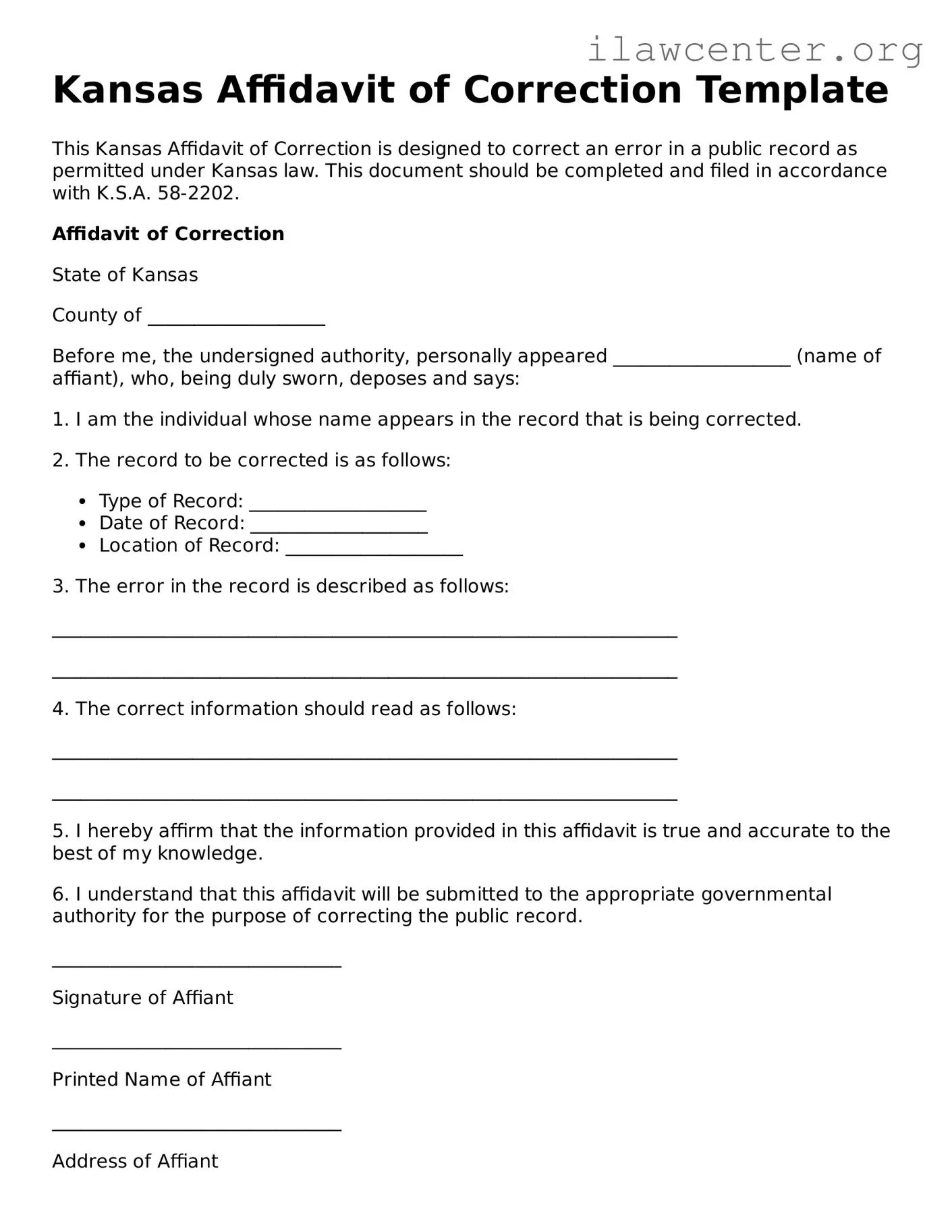
Kansas Affidavit of Correction Preview

Kansas Affidavit of Correction Template

This Kansas Affidavit of Correction is designed to correct an error in a public record as permitted under Kansas law. This document should be completed and filed in accordance with K.S.A. 58-2202.

Affidavit of Correction

State of Kansas

County of ___________________

Before me, the undersigned authority, personally appeared ___________________ (name of affiant), who, being duly sworn, deposes and says:

1. I am the individual whose name appears in the record that is being corrected.

2. The record to be corrected is as follows:

  • Type of Record: ___________________
  • Date of Record: ___________________
  • Location of Record: ___________________

3. The error in the record is described as follows:

___________________________________________________________________

___________________________________________________________________

4. The correct information should read as follows:

___________________________________________________________________

___________________________________________________________________

5. I hereby affirm that the information provided in this affidavit is true and accurate to the best of my knowledge.

6. I understand that this affidavit will be submitted to the appropriate governmental authority for the purpose of correcting the public record.

_______________________________

Signature of Affiant

_______________________________

Printed Name of Affiant

_______________________________

Address of Affiant

_______________________________

Phone Number of Affiant

Subscribed and sworn to before me this _____ day of ____________, 20__.

_______________________________

Notary Public

My commission expires: ________________

PDF Form Characteristics

Fact Name Details
Purpose The Kansas Affidavit of Correction is used to correct errors in public records, such as deeds or mortgages.
Governing Law This form is governed by Kansas Statutes Annotated (K.S.A.) 58-2220.
Eligibility Any party with an interest in the document may file an affidavit to correct an error.
Required Information The form requires details about the original document, the nature of the error, and the corrected information.
Filing Process After completion, the affidavit must be filed with the appropriate county register of deeds.
Effectiveness Once filed, the correction is effective as if the original document contained the corrected information.

Instructions on Utilizing Kansas Affidavit of Correction

After completing the Kansas Affidavit of Correction form, you will need to submit it to the appropriate office for processing. Make sure to keep a copy for your records. Here are the steps to fill out the form correctly.

  1. Obtain the Kansas Affidavit of Correction form from the appropriate state website or office.
  2. Read the instructions carefully to understand what information is required.
  3. Fill in your name and contact information in the designated fields.
  4. Provide the details of the original document that needs correction, including dates and any reference numbers.
  5. Clearly state the corrections that need to be made. Be specific and concise.
  6. Sign and date the affidavit at the bottom of the form.
  7. If required, have the affidavit notarized to verify your identity.
  8. Make a copy of the completed form for your records.
  9. Submit the form to the appropriate office, either in person or by mail, as instructed.

Important Facts about Kansas Affidavit of Correction

What is a Kansas Affidavit of Correction?

A Kansas Affidavit of Correction is a legal document used to correct errors in public records. This form is typically used to amend mistakes found in documents such as deeds, mortgages, or other legal filings. It provides a way to officially acknowledge and rectify these errors to ensure that public records are accurate and reliable.

Who can file an Affidavit of Correction?

Any individual or entity that is affected by an error in a public record can file an Affidavit of Correction. This includes property owners, lenders, or other parties who have a legal interest in the document being corrected. It is essential that the person filing the affidavit has the authority to make corrections on behalf of the affected parties.

What types of errors can be corrected using this affidavit?

Common errors that can be corrected with a Kansas Affidavit of Correction include typographical mistakes, incorrect legal descriptions, misspelled names, or any other inaccuracies that may lead to confusion or misinterpretation of the document. The goal is to ensure clarity and correctness in the public record.

How do I complete the Affidavit of Correction?

To complete the Affidavit of Correction, you will need to provide specific information about the original document, including the type of document, the date it was filed, and the nature of the error. You will also need to clearly state the correct information. After filling out the form, it must be signed in the presence of a notary public to ensure its validity.

Where do I submit the Affidavit of Correction?

Once the Affidavit of Correction is completed and notarized, it should be submitted to the appropriate county office where the original document was filed. This is typically the county clerk or register of deeds office. Be sure to keep a copy of the affidavit for your records after it has been filed.

Common mistakes

Filling out the Kansas Affidavit of Correction form can be straightforward, but many individuals make common mistakes that can lead to delays or complications. One frequent error is failing to provide accurate information. When individuals do not double-check the details, such as names, dates, or addresses, it can result in the form being rejected.

Another mistake is neglecting to sign the affidavit. A signature is essential for the document to be valid. Without it, the affidavit cannot be processed. Additionally, individuals often forget to date the form. A missing date can raise questions about the affidavit's validity and may lead to further scrutiny.

Some people mistakenly assume that they can submit the form without proper identification. The Kansas Affidavit of Correction typically requires a form of ID to verify the identity of the person making the correction. Failing to include this can cause unnecessary delays.

Inaccurate notary information is another common issue. If the affidavit requires notarization, the notary's signature and seal must be correct. Errors in this section can invalidate the document. Furthermore, individuals sometimes overlook the need for supporting documents. If the correction relates to a specific record, relevant documents must accompany the affidavit to substantiate the claim.

Another frequent oversight is not following the specific instructions provided for the form. Each section may have unique requirements, and ignoring these can lead to incomplete submissions. In some cases, individuals may not provide a clear explanation for the correction. A vague description can create confusion and hinder the processing of the affidavit.

Some people also fail to keep copies of their submitted forms. Retaining a copy is essential for personal records and can be useful if any issues arise later. Lastly, individuals sometimes miss deadlines for submitting the affidavit. Timeliness is crucial, and delays can complicate matters further.

By being aware of these common mistakes, individuals can ensure a smoother process when filling out the Kansas Affidavit of Correction form. Taking the time to review the form carefully can save time and prevent frustration down the line.

Documents used along the form

The Kansas Affidavit of Correction form is a vital document used to amend errors in public records. However, it is often accompanied by other forms and documents that help facilitate the correction process. Below is a list of commonly used documents that may be necessary when filing an Affidavit of Correction in Kansas.

  • Certificate of Correction: This document is filed with the appropriate state agency to officially correct errors in previously filed documents, such as articles of incorporation or deeds. It outlines the specific changes being made.
  • Affidavit of Identity: This form verifies the identity of the individual making the correction. It may be required to confirm that the person submitting the affidavit is authorized to do so.
  • Supporting Documentation: This includes any additional paperwork that substantiates the need for the correction. Examples include copies of identification, prior records, or other relevant documents.
  • Cover Letter: A cover letter may accompany the Affidavit of Correction and other documents. It should clearly state the purpose of the submission and list all enclosed documents for clarity.

Each of these documents plays a crucial role in ensuring that corrections are processed smoothly and accurately. Be sure to gather all necessary paperwork to avoid delays in your correction request.

Similar forms

The Affidavit of Correction form is a useful document for correcting errors in official records. It shares similarities with several other legal documents. Here’s a list of nine documents that are akin to the Affidavit of Correction, along with a brief explanation of how they relate:

  • Declaration of Correction: This document is used to rectify mistakes in legal documents, similar to an Affidavit of Correction, but often lacks the formal sworn statement.
  • Notice of Correction: A notice that alerts parties to an error in a public record. Like the Affidavit, it serves to inform and correct but may not require a sworn statement.
  • Amendment: This document formally changes the content of an existing record. It is similar in purpose to an Affidavit of Correction but typically involves more detailed revisions.
  • Correction Deed: Used to correct errors in property deeds, this document functions like an Affidavit of Correction but is specific to real estate transactions.
  • Errata Sheet: Often used in publishing, an errata sheet lists corrections to printed material. It serves a similar function of correcting errors but is not a legal document.
  • Certificate of Correction: This document is filed to amend a previously filed certificate, much like the Affidavit of Correction, but usually pertains to corporate filings.
  • Judicial Correction Order: Issued by a court to correct a clerical error in a judgment or order. It serves a similar purpose but involves judicial oversight.
  • Release of Lien: This document clears a lien from a property record. While it doesn’t correct an error, it serves to amend the public record similarly.
  • Petition for Reformation: A legal request to change the terms of a contract or deed due to mutual mistake. It is similar in intent but often requires court intervention.

Each of these documents plays a role in ensuring accuracy and clarity in legal and public records, much like the Affidavit of Correction.

Dos and Don'ts

When filling out the Kansas Affidavit of Correction form, it's important to follow specific guidelines to ensure accuracy and compliance. Here are six essential dos and don'ts:

  • Do read the instructions carefully before starting.
  • Do provide accurate information that matches existing records.
  • Do sign and date the form in the designated area.
  • Don't leave any required fields blank.
  • Don't use correction fluid or tape on the form.
  • Don't submit the form without making a copy for your records.

Misconceptions

The Kansas Affidavit of Correction form is a useful tool for rectifying errors in public records, but several misconceptions surround its use. Understanding these misconceptions can help individuals navigate the process more effectively. Here are six common misunderstandings:

  • It can be used for any type of error. Many believe the affidavit can correct any mistake, but it is specifically designed for clerical errors, such as typos or incorrect names, rather than substantive changes.
  • Anyone can file an Affidavit of Correction. This form must be filed by the person who is the subject of the record or their legal representative. Unauthorized individuals cannot submit this form.
  • The process is immediate. Some think that once the affidavit is filed, the corrections take effect right away. In reality, it may take time for the corrections to be processed and reflected in the public record.
  • It eliminates the original document. There is a misconception that filing an affidavit removes the original document from public view. However, the original record remains; the affidavit simply serves to clarify the error.
  • It is not legally binding. Some individuals believe that an affidavit holds no legal weight. In fact, once properly executed and filed, it is a legally binding document that can be used to support the corrected information.
  • All errors can be corrected using this form. Many assume that any mistake, no matter how significant, can be corrected with this affidavit. However, substantial changes, such as altering ownership or transferring property rights, require different legal procedures.

By dispelling these misconceptions, individuals can better understand the appropriate use of the Kansas Affidavit of Correction form and ensure they follow the correct procedures to address errors in public records.

Key takeaways

The Kansas Affidavit of Correction form is a valuable tool for correcting errors in public records. Here are key takeaways to keep in mind when filling out and using this form:

  • The form is used to correct mistakes in official documents, such as deeds or court records.
  • Ensure all information is accurate and complete before submitting the form.
  • Sign the affidavit in front of a notary public to validate the document.
  • File the completed affidavit with the appropriate office, such as the county clerk or register of deeds.
  • Keep a copy of the filed affidavit for your personal records.
  • Be aware that there may be a filing fee associated with submitting the affidavit.
  • Check for any specific requirements or additional documentation needed by the office where you are filing.

Following these guidelines will help ensure a smooth process when correcting errors in public records.