Attorney-Verified  Bill of Sale Document for Kansas

Attorney-Verified Bill of Sale Document for Kansas

The Kansas Bill of Sale form is a legal document used to transfer ownership of personal property from one party to another. This form provides essential details about the transaction, including the buyer, seller, and description of the item being sold. To facilitate the transfer process, consider filling out the form by clicking the button below.

Article Guide

When engaging in the sale or transfer of personal property in Kansas, a Bill of Sale form serves as a vital document that protects both the buyer and the seller. This form outlines essential details, including the names and addresses of the parties involved, a description of the item being sold, and the sale price. It also includes the date of the transaction, ensuring that both parties have a clear record of when the sale occurred. Importantly, a Bill of Sale can help establish proof of ownership and may be required for certain transactions, such as vehicle sales. In Kansas, this document can be particularly beneficial when it comes to transferring titles for vehicles, boats, or other significant assets. By providing a written record of the transaction, the Bill of Sale helps to prevent misunderstandings and disputes down the line, offering peace of mind to everyone involved.

Kansas Bill of Sale Preview

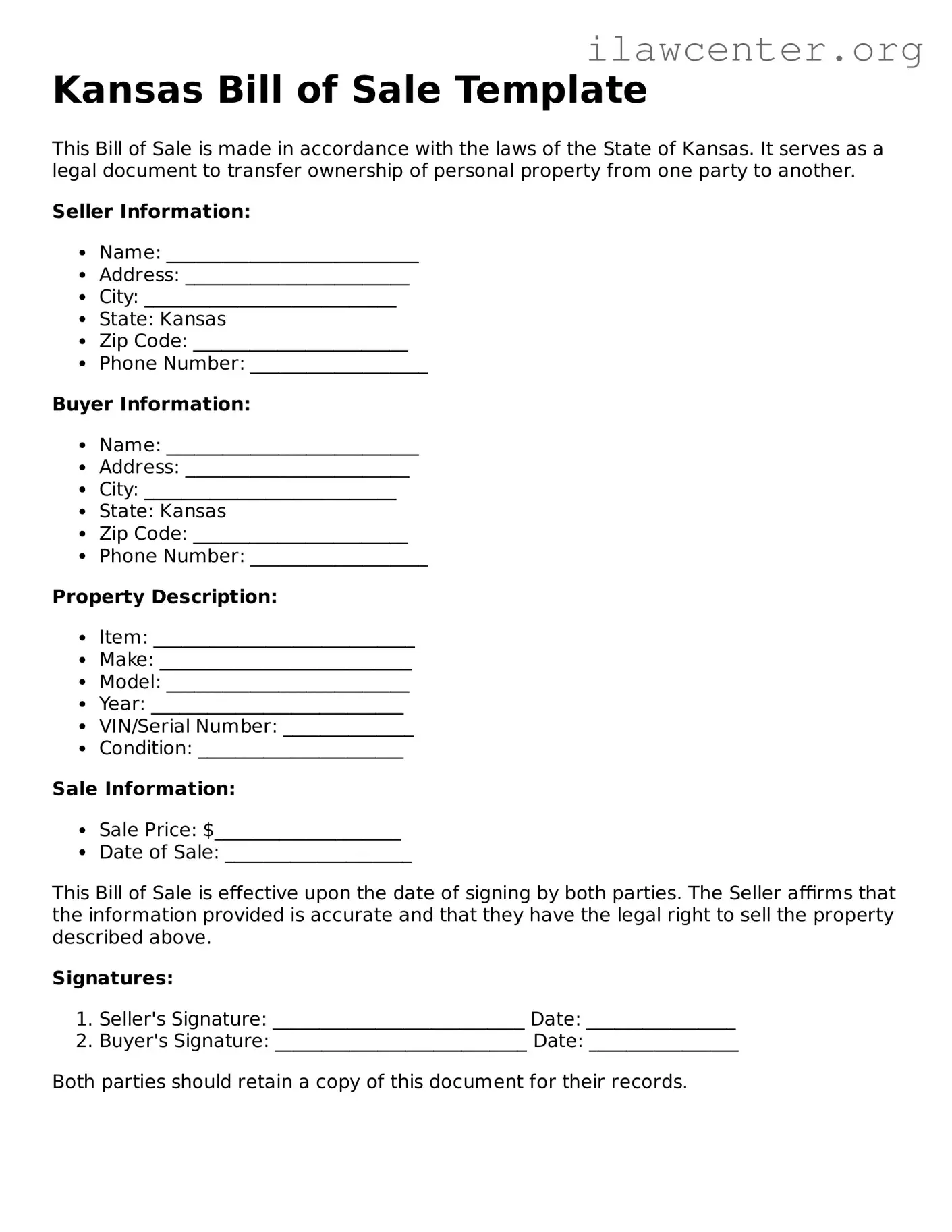
Kansas Bill of Sale Template

This Bill of Sale is made in accordance with the laws of the State of Kansas. It serves as a legal document to transfer ownership of personal property from one party to another.

Seller Information:

  • Name: ___________________________
  • Address: ________________________
  • City: ___________________________
  • State: Kansas
  • Zip Code: _______________________
  • Phone Number: ___________________

Buyer Information:

  • Name: ___________________________
  • Address: ________________________
  • City: ___________________________
  • State: Kansas
  • Zip Code: _______________________
  • Phone Number: ___________________

Property Description:

  • Item: ____________________________
  • Make: ___________________________
  • Model: __________________________
  • Year: ___________________________
  • VIN/Serial Number: ______________
  • Condition: ______________________

Sale Information:

  • Sale Price: $____________________
  • Date of Sale: ____________________

This Bill of Sale is effective upon the date of signing by both parties. The Seller affirms that the information provided is accurate and that they have the legal right to sell the property described above.

Signatures:

  1. Seller's Signature: ___________________________ Date: ________________
  2. Buyer's Signature: ___________________________ Date: ________________

Both parties should retain a copy of this document for their records.

PDF Form Characteristics

Fact Name Details
Definition A Kansas Bill of Sale is a legal document that records the transfer of ownership of personal property from one party to another.
Governing Law The Kansas Bill of Sale is governed by the Kansas Statutes Annotated, specifically K.S.A. 84-9-101 et seq.
Types of Property This form can be used for various types of personal property, including vehicles, boats, and equipment.
Notarization While notarization is not required, it is recommended to add an extra layer of authenticity.
Consideration The Bill of Sale should include the consideration, or the amount paid for the property.
Buyer's and Seller's Information Both the buyer's and seller's names and addresses must be clearly stated in the document.
Property Description A detailed description of the property being sold should be included to avoid confusion.
As-Is Clause It is common to include an "as-is" clause, indicating that the buyer accepts the property in its current condition.
Record Keeping Both parties should keep a copy of the Bill of Sale for their records after the transaction is complete.
Use in Vehicle Transactions In Kansas, a Bill of Sale is often required for registering a vehicle with the Department of Revenue.

Instructions on Utilizing Kansas Bill of Sale

Filling out the Kansas Bill of Sale form is an essential step in documenting the transfer of ownership for personal property. This process ensures that both the buyer and seller have a clear record of the transaction, protecting their interests. Follow these steps to complete the form accurately.

  1. Obtain the Form: Acquire the Kansas Bill of Sale form from a reliable source, such as a legal website or office supply store.
  2. Identify the Parties: Fill in the names and addresses of both the seller and the buyer at the top of the form.
  3. Describe the Item: Provide a detailed description of the item being sold. Include specifics such as make, model, year, and any identifying numbers (like VIN for vehicles).
  4. State the Sale Price: Clearly indicate the sale price of the item. This should be a specific dollar amount.
  5. Indicate Payment Method: Specify how the payment will be made (cash, check, etc.) and if any deposits were made.
  6. Signatures: Both the seller and buyer must sign the form. Include the date of signing next to each signature.
  7. Witness or Notary (if required): Depending on the nature of the transaction, consider having a witness or notary public sign the document for added legal protection.

After completing the form, ensure that both parties retain a copy for their records. This document serves as proof of the transaction and can be useful for future reference or in case of disputes.

Important Facts about Kansas Bill of Sale

What is a Kansas Bill of Sale?

A Kansas Bill of Sale is a legal document that records the transfer of ownership of personal property from one person to another. This form is particularly useful when buying or selling items such as vehicles, boats, or other valuable assets. It provides proof of the transaction and can help protect both the buyer and the seller in case of disputes.

Do I need a Bill of Sale for every transaction in Kansas?

While a Bill of Sale is not always legally required for every transaction, it is highly recommended for significant purchases. For example, when selling or buying a vehicle, a Bill of Sale is essential for registering the vehicle with the state. It provides necessary details about the transaction and serves as a record for both parties.

What information is typically included in a Kansas Bill of Sale?

A Kansas Bill of Sale generally includes the names and addresses of both the buyer and seller, a description of the item being sold (including any serial numbers or identifying details), the sale price, and the date of the transaction. It may also include terms of sale, such as whether the item is sold "as-is" or if any warranties are provided.

Is a Bill of Sale required for vehicle sales in Kansas?

Yes, a Bill of Sale is required for vehicle sales in Kansas. It serves as proof of the transaction and is necessary for the buyer to register the vehicle in their name. The Kansas Department of Revenue recommends using a Bill of Sale to document the sale, which helps ensure that both parties are protected during the transfer.

Can I create my own Bill of Sale in Kansas?

Absolutely! You can create your own Bill of Sale in Kansas as long as it includes all the necessary information. There are also templates available online that you can use as a guide. Just make sure that the document is clear, complete, and signed by both parties to ensure its validity.

Does a Bill of Sale need to be notarized in Kansas?

In Kansas, notarization of a Bill of Sale is not required for it to be valid. However, having the document notarized can add an extra layer of authenticity and may be beneficial in case of future disputes. It’s always a good practice to keep a signed copy for your records.

What should I do with the Bill of Sale after the transaction?

After the transaction is complete, both the buyer and the seller should keep a copy of the Bill of Sale for their records. The buyer will need it for vehicle registration or proof of ownership, while the seller may want it as evidence of the sale. Storing it in a safe place ensures that both parties have access to it if needed in the future.

Common mistakes

Filling out a Kansas Bill of Sale form can be straightforward, but many individuals make common mistakes that can lead to complications. One frequent error is failing to provide accurate information about the buyer and seller. Each party's full name, address, and contact information must be included. Omitting or misspelling any of these details can create confusion and may even invalidate the document.

Another mistake often made is neglecting to include a detailed description of the item being sold. The Bill of Sale should specify the item’s make, model, year, and any unique identifiers, such as a Vehicle Identification Number (VIN) for cars. Without this information, it becomes difficult to prove ownership or clarify what was sold, which can lead to disputes later on.

People also commonly forget to include the sale price. It's essential to state the amount for which the item is sold. This figure not only establishes the transaction's legitimacy but can also affect tax obligations. Leaving this section blank or writing an ambiguous amount may raise questions during future transactions or legal matters.

Another area where errors occur is in the signatures. Both the buyer and seller must sign the document for it to be valid. Sometimes, individuals overlook this requirement or fail to sign in the designated area. Additionally, if either party is signing on behalf of a business or organization, they should clearly indicate their authority to do so. Missing signatures can render the Bill of Sale ineffective.

Lastly, people often forget to make copies of the completed Bill of Sale. After filling it out, it is important to keep a copy for personal records. This serves as proof of the transaction and can be invaluable if any issues arise in the future. Without a copy, tracking the transaction may become difficult, leading to potential disputes or misunderstandings.

Documents used along the form

The Kansas Bill of Sale form serves as a crucial document in the transfer of ownership for personal property. However, several other forms and documents are often utilized alongside it to ensure a smooth transaction process. Each of these documents plays a specific role in protecting the interests of both the buyer and seller.

  • Title Transfer Document: This document is essential for transferring the title of a vehicle or other registered property. It provides proof that the seller has relinquished ownership and the buyer has accepted it.
  • Vehicle Identification Number (VIN) Verification: This form confirms the VIN of a vehicle, ensuring that the buyer is aware of the vehicle's identity and history, which is particularly important for used cars.
  • Odometer Disclosure Statement: This statement is required when selling a vehicle to disclose the accurate mileage at the time of sale. It helps prevent fraud regarding the vehicle's condition.
  • Release of Liability: This document protects the seller by stating that they are no longer responsible for the vehicle or property once it has been sold. It releases them from any future claims related to the item.
  • Proof of Payment: A receipt or proof of payment serves as evidence that the buyer has fulfilled their financial obligation. This document is important for record-keeping and potential disputes.
  • Sales Agreement: A sales agreement outlines the terms and conditions of the sale, including price, payment methods, and any warranties. It provides clarity and legal protection for both parties.
  • Affidavit of Ownership: This sworn statement can be used when the seller does not have a title for the property. It asserts the seller's ownership and can help in establishing the legitimacy of the sale.
  • Inspection Report: An inspection report documents the condition of the property at the time of sale. It can be beneficial for both parties to have a clear understanding of any existing issues.

Utilizing these documents in conjunction with the Kansas Bill of Sale form can help facilitate a more secure and transparent transaction. Each form addresses specific aspects of the sale, providing both parties with the necessary protection and clarity throughout the process.

Similar forms

A Bill of Sale form is a useful document for transferring ownership of goods. It shares similarities with several other documents that also serve to establish ownership or transfer rights. Here are six documents that are similar to a Bill of Sale:

  • Purchase Agreement: This document outlines the terms of a sale between a buyer and a seller. Like a Bill of Sale, it confirms the transfer of ownership and includes details about the item being sold.
  • Lease Agreement: A lease agreement allows one party to use property owned by another party for a specific time and payment. Both documents establish rights and responsibilities regarding the property.
  • Title Transfer Document: When vehicles are sold, a title transfer document is used to officially change ownership. Similar to a Bill of Sale, it provides proof of the transaction and ownership change.
  • Receipt: A receipt serves as proof of payment for goods or services. It can accompany a Bill of Sale, confirming that payment has been made for the item being transferred.
  • Warranty Deed: This document is used in real estate transactions to transfer property ownership. It guarantees that the seller has the right to sell the property, similar to how a Bill of Sale affirms the seller's ownership of the item.
  • Assignment of Interest: This document transfers rights or interests in a property or asset from one party to another. Like a Bill of Sale, it formalizes the transfer and provides a record of the change in ownership.

Dos and Don'ts

When filling out the Kansas Bill of Sale form, it is important to follow certain guidelines to ensure the document is completed accurately. Below is a list of things to do and avoid.

  • Do provide accurate information about the buyer and seller.
  • Do include a detailed description of the item being sold.
  • Do specify the sale price clearly.
  • Do sign and date the document in the appropriate sections.
  • Don't leave any required fields blank.
  • Don't use vague language in the item description.
  • Don't forget to keep a copy for your records.

By following these guidelines, you can help ensure that the Kansas Bill of Sale form is completed properly.

Misconceptions

Understanding the Kansas Bill of Sale form is essential for anyone involved in buying or selling personal property in the state. However, several misconceptions can lead to confusion. Here are five common misunderstandings:

  1. It is not legally required.

    Many people believe that a Bill of Sale is unnecessary for every transaction. While it is not always legally required, having one protects both the buyer and seller by providing a record of the transaction.

  2. It only applies to vehicles.

    Some think the Bill of Sale is exclusive to vehicle transactions. In reality, it can be used for various personal property sales, including furniture, electronics, and more.

  3. It must be notarized.

    There is a misconception that a Bill of Sale must be notarized to be valid. In Kansas, notarization is not a requirement, although it can add an extra layer of authenticity.

  4. It doesn't need to be detailed.

    Some believe a simple note suffices. A well-drafted Bill of Sale should include detailed information about the item, the parties involved, and the terms of the sale to avoid disputes.

  5. It is only for private sales.

    Many assume that Bills of Sale are only used in private transactions. However, they can also be useful in sales involving businesses, providing clarity and protection for all parties.

By clearing up these misconceptions, individuals can navigate the process of buying and selling property in Kansas more effectively.

Key takeaways

When filling out and using the Kansas Bill of Sale form, it is essential to understand the key components and requirements. Here are some important takeaways:

  • Purpose: The Kansas Bill of Sale serves as a legal document that transfers ownership of personal property from one party to another.
  • Details Required: Include specific information such as the names and addresses of both the buyer and seller, a description of the item, and the sale price.
  • Signatures: Both the buyer and seller must sign the document to validate the transaction.
  • Notarization: While notarization is not always required, having the document notarized can add an extra layer of authenticity.
  • Record Keeping: Keep a copy of the Bill of Sale for your records. This can be useful for future reference or in case of disputes.
  • State-Specific Requirements: Be aware of any specific requirements set by the state of Kansas that may apply to your transaction.
  • Use for Various Transactions: The Bill of Sale can be used for a variety of items, including vehicles, boats, and personal property.

By following these key takeaways, you can ensure a smooth transaction and proper documentation when using the Kansas Bill of Sale form.