Attorney-Verified  Durable Power of Attorney Document for Kansas

Attorney-Verified Durable Power of Attorney Document for Kansas

A Kansas Durable Power of Attorney is a legal document that allows you to appoint someone to make decisions on your behalf if you become unable to do so. This form remains effective even if you become incapacitated, ensuring that your financial and medical matters are handled according to your wishes. To get started, fill out the form by clicking the button below.

Article Guide

The Kansas Durable Power of Attorney form is a crucial legal document that allows individuals to designate someone they trust to make financial and legal decisions on their behalf in the event they become incapacitated. This form remains effective even if the principal becomes unable to manage their own affairs, providing a layer of protection and ensuring that their wishes are honored. Key components of the form include the identification of the principal and the agent, the specific powers granted to the agent, and any limitations on those powers. Additionally, the document must be signed by the principal and witnessed or notarized to ensure its validity. Understanding the nuances of this form is essential for anyone looking to plan for future health or financial uncertainties, as it provides clarity and direction during challenging times.

Kansas Durable Power of Attorney Preview

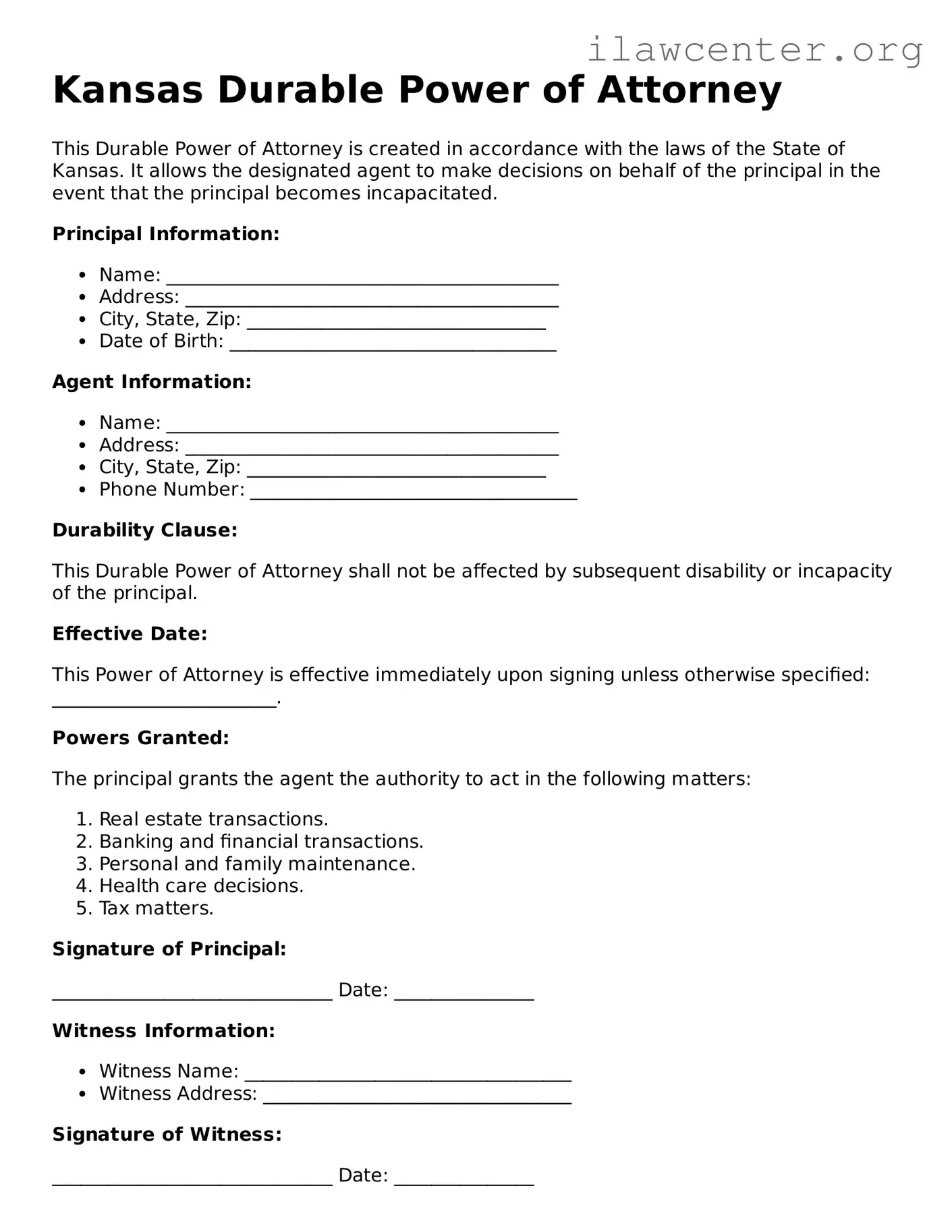
Kansas Durable Power of Attorney

This Durable Power of Attorney is created in accordance with the laws of the State of Kansas. It allows the designated agent to make decisions on behalf of the principal in the event that the principal becomes incapacitated.

Principal Information:

  • Name: __________________________________________
  • Address: ________________________________________
  • City, State, Zip: ________________________________
  • Date of Birth: ___________________________________

Agent Information:

  • Name: __________________________________________
  • Address: ________________________________________
  • City, State, Zip: ________________________________
  • Phone Number: ___________________________________

Durability Clause:

This Durable Power of Attorney shall not be affected by subsequent disability or incapacity of the principal.

Effective Date:

This Power of Attorney is effective immediately upon signing unless otherwise specified: ________________________.

Powers Granted:

The principal grants the agent the authority to act in the following matters:

  1. Real estate transactions.
  2. Banking and financial transactions.
  3. Personal and family maintenance.
  4. Health care decisions.
  5. Tax matters.

Signature of Principal:

______________________________ Date: _______________

Witness Information:

  • Witness Name: ___________________________________
  • Witness Address: _________________________________

Signature of Witness:

______________________________ Date: _______________

Notary Public:

State of Kansas, County of ________________

Subscribed and sworn to before me this ____ day of __________, 20__.

______________________________

Notary Public Signature

My commission expires: ________________

PDF Form Characteristics

Fact Name Description
Definition A Kansas Durable Power of Attorney allows an individual to designate someone else to make financial and legal decisions on their behalf, even if they become incapacitated.
Governing Law The Kansas Durable Power of Attorney is governed by the Kansas Statutes Annotated, specifically K.S.A. 58-6501 et seq.
Durability This type of power of attorney remains effective even if the principal becomes incapacitated, which distinguishes it from a regular power of attorney.
Agent Authority The agent can manage a variety of financial matters, including banking, real estate transactions, and tax matters, unless specifically limited in the document.
Execution Requirements The form must be signed by the principal and acknowledged before a notary public to be valid in Kansas.
Revocation The principal can revoke the Durable Power of Attorney at any time as long as they are mentally competent, typically by providing written notice to the agent.
Important Considerations It is crucial to choose a trustworthy agent, as they will have significant control over the principal's financial affairs.

Instructions on Utilizing Kansas Durable Power of Attorney

Completing the Kansas Durable Power of Attorney form is an important step in designating someone to make decisions on your behalf. This process allows you to choose a trusted individual to handle your financial and legal matters if you become unable to do so yourself. Follow these steps carefully to ensure the form is filled out correctly.

  1. Obtain the Kansas Durable Power of Attorney form. You can find it online or request a copy from a local attorney.
  2. Begin by entering your full name and address at the top of the form. This identifies you as the principal.
  3. Next, provide the name and address of the person you are appointing as your agent. This individual will act on your behalf.
  4. Clearly state the powers you wish to grant your agent. You may choose to give them broad authority or limit their powers to specific areas.
  5. Include any special instructions or limitations. This section is crucial if you have particular wishes regarding your agent's authority.
  6. Sign and date the form at the designated area. Your signature must be present for the document to be valid.
  7. Have the form notarized. Kansas law requires that the document be signed in the presence of a notary public to ensure its authenticity.
  8. Distribute copies of the completed form to your agent, any relevant financial institutions, and keep one for your records.

Important Facts about Kansas Durable Power of Attorney

What is a Kansas Durable Power of Attorney?

A Kansas Durable Power of Attorney is a legal document that allows you to designate someone to make decisions on your behalf if you become unable to do so. This can include financial decisions, medical care, and other important matters. The term "durable" means that the authority granted remains in effect even if you become incapacitated. It is an important tool for ensuring that your wishes are followed when you cannot communicate them yourself.

Who can be appointed as an agent under a Durable Power of Attorney in Kansas?

You can appoint any competent adult as your agent. This may include family members, friends, or professionals, such as attorneys or financial advisors. It is crucial to choose someone you trust, as they will have significant authority over your affairs. Additionally, the agent should be someone who understands your values and wishes to ensure they act in your best interest.

How do I create a Durable Power of Attorney in Kansas?

To create a Durable Power of Attorney in Kansas, you must fill out a specific form that meets state requirements. This form should clearly state your intentions and designate your agent. After completing the form, you must sign it in the presence of a notary public. It is advisable to keep multiple copies of the signed document and provide one to your agent and any relevant institutions, such as banks or healthcare providers.

Can I revoke my Durable Power of Attorney in Kansas?

Yes, you can revoke your Durable Power of Attorney at any time as long as you are competent. To do this, you should create a written revocation document and notify your agent and any institutions that have a copy of the original Durable Power of Attorney. It is important to ensure that all parties are aware of the revocation to prevent any confusion regarding your wishes.

Common mistakes

Filling out a Kansas Durable Power of Attorney form can be a straightforward process, but many people make common mistakes that can lead to complications later on. One frequent error is not clearly defining the powers granted to the agent. It's essential to specify exactly what decisions your agent can make on your behalf, whether it’s financial, medical, or both. Without clarity, your agent may face challenges in executing your wishes.

Another mistake involves not signing the document properly. A Durable Power of Attorney must be signed in front of a notary public to be legally binding. Some individuals overlook this step, thinking their signature alone is sufficient. Remember, a notarized signature adds an important layer of authenticity that helps avoid disputes in the future.

People also often forget to date the document. While it might seem minor, failing to include a date can create confusion regarding when the powers were granted. This can become particularly problematic if there are any changes in your circumstances or if the document is challenged in court.

Additionally, many individuals neglect to discuss their intentions with their chosen agent before completing the form. It’s crucial to have an open conversation with the person you plan to designate. This ensures they understand your wishes and are willing to take on the responsibility. Surprises can lead to misunderstandings when the time comes to act.

Another common oversight is not reviewing the form after filling it out. Once the document is completed, it’s wise to double-check for any errors or omissions. Even a small mistake can invalidate the entire form. Taking the time to review ensures everything is accurate and reflects your intentions.

Lastly, some people fail to keep copies of the signed document. It’s important to provide copies to your agent, your healthcare providers, and anyone else who may need to reference it. This way, everyone involved knows your wishes and has the necessary documentation readily available when needed.

Documents used along the form

The Kansas Durable Power of Attorney form allows an individual to designate another person to manage their financial and legal affairs. This document is often accompanied by other forms that enhance its effectiveness or address different aspects of a person's estate planning needs. Below is a list of commonly used documents that may be relevant.

  • Living Will: This document outlines an individual's wishes regarding medical treatment in situations where they are unable to communicate their preferences. It specifies the types of medical interventions a person does or does not want at the end of life.
  • Health Care Power of Attorney: Similar to the Durable Power of Attorney, this form designates someone to make medical decisions on behalf of an individual if they are incapacitated. It focuses specifically on health care choices.
  • Last Will and Testament: This legal document specifies how a person's assets and affairs should be handled after their death. It allows individuals to name beneficiaries and appoint guardians for minor children.
  • Revocable Living Trust: This document allows an individual to place their assets into a trust during their lifetime, which can be managed by a trustee. It helps avoid probate and provides for the distribution of assets upon death.
  • Advanced Directive: This document combines elements of a living will and health care power of attorney. It allows individuals to express their wishes regarding medical treatment and appoint a representative to make health care decisions.

These documents work together to create a comprehensive plan for managing an individual's affairs in various circumstances. Each serves a specific purpose and can provide clarity and direction for both the individual and their loved ones.

Similar forms

The Durable Power of Attorney (DPOA) is an important legal document that allows an individual to appoint someone else to make decisions on their behalf, especially in financial or health matters. Several other documents serve similar purposes, each with its own specific focus and implications. Below is a list of documents that share similarities with the Durable Power of Attorney:

  • General Power of Attorney: Like the DPOA, this document allows one person to act on another's behalf. However, it typically becomes invalid if the principal becomes incapacitated, unlike the durable version which remains effective.
  • Healthcare Power of Attorney: This document specifically grants someone the authority to make medical decisions for another person. It is similar to the DPOA but focuses solely on health-related matters.
  • Living Will: While not the same as a DPOA, a living will outlines a person's wishes regarding medical treatment in situations where they cannot communicate. It complements the Healthcare Power of Attorney.
  • Revocable Trust: This estate planning tool allows a person to transfer assets into a trust while retaining control. It is similar to a DPOA in that it can help manage assets, but it is more comprehensive in terms of estate management.
  • Advance Healthcare Directive: This document combines a living will and a healthcare power of attorney. It provides instructions for medical care and designates someone to make decisions, akin to the DPOA but focused on health.
  • Financial Power of Attorney: This document specifically grants authority to manage financial matters. It is similar to the DPOA but is often limited to financial decisions rather than broader powers.
  • Guardianship Documents: In cases where individuals cannot make decisions due to incapacity, guardianship documents may be used to appoint someone to make decisions for them. This is similar to the DPOA, but it often involves court approval and oversight.

Dos and Don'ts

When filling out the Kansas Durable Power of Attorney form, it is essential to approach the task with care. The following guidelines can help ensure that the process goes smoothly.

Things You Should Do:

  • Read the entire form carefully before filling it out.
  • Clearly identify the person you are appointing as your agent.
  • Specify the powers you wish to grant to your agent.
  • Sign the document in the presence of a notary public.
  • Keep a copy of the completed form for your records.

Things You Shouldn't Do:

  • Do not leave any sections of the form blank.
  • Avoid using vague language when describing the powers granted.
  • Do not sign the form without proper witnesses or notarization.
  • Refrain from appointing someone who may have conflicting interests.
  • Do not forget to inform your agent about their responsibilities.

Misconceptions

Understanding the Kansas Durable Power of Attorney form is crucial for effective estate planning. However, several misconceptions can lead to confusion. Here are eight common misunderstandings:

  1. It only takes effect when I become incapacitated. Many believe that a Durable Power of Attorney only becomes active when they are unable to make decisions. In Kansas, it can be effective immediately if specified in the document.
  2. My agent can do anything they want with my money. While your agent has broad powers, they are required to act in your best interest and follow the instructions outlined in the document.
  3. It expires when I die. This is a common misconception. The Durable Power of Attorney ceases to be effective upon your death, but it does not cover decisions made after that point.
  4. All powers of attorney are the same. Not all powers of attorney are durable. A standard power of attorney may not remain effective if you become incapacitated, unlike a durable one.
  5. I can’t change my Durable Power of Attorney once it’s signed. You have the right to revoke or modify your Durable Power of Attorney at any time, as long as you are mentally competent.
  6. My spouse automatically has power of attorney over me. Many assume that marriage grants automatic authority. However, a Durable Power of Attorney must be explicitly established for any individual to act on your behalf.
  7. It’s only necessary for older adults. This form is not just for seniors. Anyone can benefit from having a Durable Power of Attorney, especially if they have assets or health concerns.
  8. Once I create it, I don’t need to review it. Life changes, such as marriage, divorce, or new financial situations, may necessitate updates to your Durable Power of Attorney. Regularly reviewing it is essential.

Being informed about these misconceptions can help you make better decisions regarding your Durable Power of Attorney in Kansas.

Key takeaways

Filling out and using the Kansas Durable Power of Attorney form is an important step in planning for your future. Here are some key takeaways to keep in mind:

  • Understand the Purpose: A Durable Power of Attorney allows you to designate someone to make decisions on your behalf if you become incapacitated.
  • Choose Your Agent Wisely: Select a trusted individual who understands your values and will act in your best interest.
  • Specify Powers Clearly: Clearly outline the powers you are granting to your agent. This may include financial decisions, healthcare decisions, or both.
  • Consider Limitations: You can limit the powers granted to your agent. Specify any restrictions you want to impose.
  • Sign in Front of Witnesses: The form must be signed in the presence of at least two witnesses or a notary public to be valid.
  • Keep Copies Accessible: After completing the form, keep copies in accessible locations. Share them with your agent and relevant family members.
  • Review Regularly: Life changes, and so might your preferences. Review your Durable Power of Attorney periodically to ensure it reflects your current wishes.
  • Revocation is Possible: You can revoke the Durable Power of Attorney at any time, as long as you are competent to do so.
  • State-Specific Requirements: Familiarize yourself with Kansas-specific laws regarding Durable Power of Attorney to ensure compliance.
  • Consult a Professional: If you have questions or complex needs, consider consulting with an attorney to ensure your document meets all legal requirements.