Attorney-Verified  Firearm Bill of Sale Document for Kansas

Attorney-Verified Firearm Bill of Sale Document for Kansas

The Kansas Firearm Bill of Sale form is a legal document that records the transfer of ownership of a firearm between two parties. This form ensures that both the buyer and seller have a clear understanding of the transaction and protects their rights. To proceed with your firearm sale, fill out the form by clicking the button below.

Article Guide

When it comes to buying or selling firearms in Kansas, having the right documentation is crucial. The Kansas Firearm Bill of Sale form serves as a vital tool for both parties involved in the transaction, ensuring that the process is smooth and legally sound. This form typically includes essential details such as the names and addresses of the buyer and seller, a description of the firearm being sold—including its make, model, and serial number—and the date of the transaction. Additionally, it often requires both parties to sign, confirming their agreement to the sale and acknowledging that the buyer is legally eligible to own a firearm. By utilizing this form, individuals can protect themselves and establish a clear record of the transaction, which can be invaluable in case of any future disputes or legal inquiries. Understanding the importance of this document can make a significant difference in the responsible ownership and transfer of firearms in Kansas.

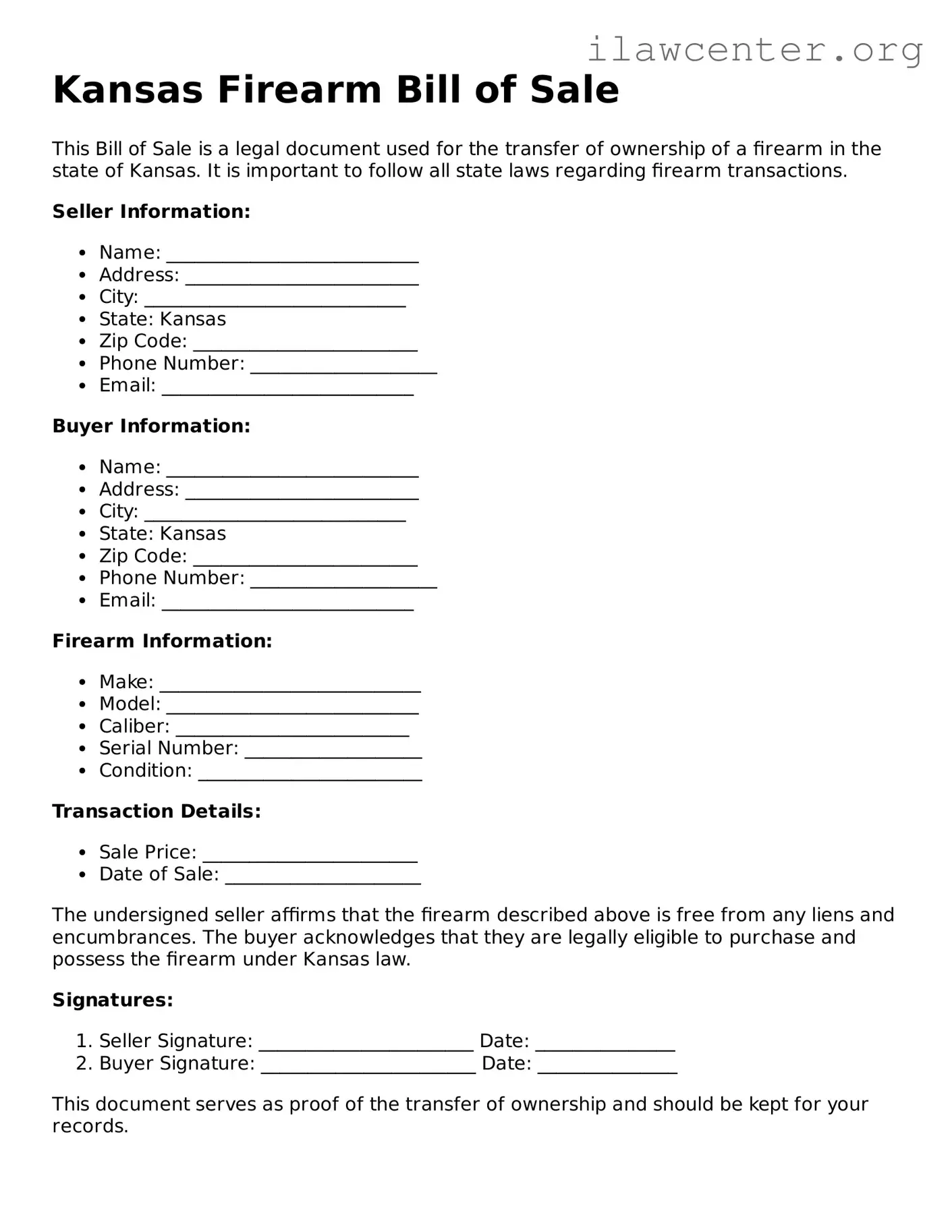
Kansas Firearm Bill of Sale Preview

Kansas Firearm Bill of Sale

This Bill of Sale is a legal document used for the transfer of ownership of a firearm in the state of Kansas. It is important to follow all state laws regarding firearm transactions.

Seller Information:

  • Name: ___________________________
  • Address: _________________________
  • City: ____________________________
  • State: Kansas
  • Zip Code: ________________________
  • Phone Number: ____________________
  • Email: ___________________________

Buyer Information:

  • Name: ___________________________
  • Address: _________________________
  • City: ____________________________
  • State: Kansas
  • Zip Code: ________________________
  • Phone Number: ____________________
  • Email: ___________________________

Firearm Information:

  • Make: ____________________________
  • Model: ___________________________
  • Caliber: _________________________
  • Serial Number: ___________________
  • Condition: ________________________

Transaction Details:

  • Sale Price: _______________________
  • Date of Sale: _____________________

The undersigned seller affirms that the firearm described above is free from any liens and encumbrances. The buyer acknowledges that they are legally eligible to purchase and possess the firearm under Kansas law.

Signatures:

  1. Seller Signature: _______________________ Date: _______________
  2. Buyer Signature: _______________________ Date: _______________

This document serves as proof of the transfer of ownership and should be kept for your records.

PDF Form Characteristics

Fact Name Details
Purpose The Kansas Firearm Bill of Sale form serves as a legal document to record the sale and transfer of firearms between private parties.
Governing Law This form is governed by Kansas Statutes Annotated, Chapter 75, Article 7, which outlines the regulations for firearm transfers.
Parties Involved The document requires information from both the seller and the buyer, ensuring that both parties are clearly identified.
Identification Requirement Both parties must provide valid identification, such as a driver's license or state ID, to verify their identities.
Firearm Description The form must include a detailed description of the firearm being sold, including make, model, and serial number.
As-Is Condition Typically, the sale is made "as-is," meaning the buyer accepts the firearm in its current condition without warranties from the seller.
Record Keeping Both the buyer and seller should keep a copy of the completed Bill of Sale for their records, which may be useful for future reference.
Legal Age Requirement Buyers must be at least 18 years old to purchase a firearm in Kansas, as per state law.

Instructions on Utilizing Kansas Firearm Bill of Sale

Filling out the Kansas Firearm Bill of Sale form is a straightforward process. After completing the form, you will have a record of the transaction that can be useful for both the buyer and the seller. This document serves as proof of sale and helps ensure that all parties are clear about the details of the firearm transfer.

  1. Start by downloading or obtaining a copy of the Kansas Firearm Bill of Sale form.
  2. Fill in the date of the transaction at the top of the form.
  3. Provide the seller's full name and address in the designated fields.
  4. Next, enter the buyer's full name and address.
  5. Describe the firearm being sold. Include details like the make, model, caliber, and serial number.
  6. Indicate the sale price of the firearm in the appropriate section.
  7. Both the buyer and seller should sign and date the form at the bottom.
  8. Make copies of the completed form for both parties to keep for their records.

Important Facts about Kansas Firearm Bill of Sale

What is a Kansas Firearm Bill of Sale?

A Kansas Firearm Bill of Sale is a legal document that records the transfer of ownership of a firearm from one person to another. This form serves as proof of the sale and includes important details such as the names of both the seller and buyer, a description of the firearm, and the date of the transaction.

Is a Bill of Sale required for private firearm sales in Kansas?

While Kansas law does not require a Bill of Sale for private firearm transactions, it is highly recommended. Having a Bill of Sale can protect both the buyer and seller by providing a written record of the sale, which can be useful in case of future disputes or legal issues.

What information should be included in the Bill of Sale?

The Bill of Sale should include the full names and addresses of both the buyer and seller, the date of the transaction, a detailed description of the firearm (including make, model, caliber, and serial number), and the purchase price. Both parties should sign the document to validate the transaction.

Do I need to have the Bill of Sale notarized?

No, notarization is not required for a Kansas Firearm Bill of Sale. However, having the document notarized can add an extra layer of legitimacy and help verify the identities of both parties involved in the transaction.

Can I use a generic Bill of Sale form for firearms?

While a generic Bill of Sale form can be used, it is advisable to use a specific form designed for firearms. This ensures that all necessary details relevant to the sale of a firearm are included, which can help prevent misunderstandings or legal issues down the line.

What if the firearm is a gift?

If the firearm is being given as a gift, it is still a good idea to complete a Bill of Sale. This document can clarify the intent of the transaction and provide proof of ownership transfer, which can be important for both parties in the future.

Are there any restrictions on who can sell or buy a firearm in Kansas?

Yes, certain restrictions apply. Individuals who are prohibited from owning firearms, such as convicted felons or those with restraining orders, cannot legally purchase or possess firearms. Both the seller and buyer should ensure that they are legally allowed to engage in the transaction.

Where can I obtain a Kansas Firearm Bill of Sale form?

You can find Kansas Firearm Bill of Sale forms online through various legal websites, or you can create your own using templates available for download. It's important to ensure that the form you use complies with Kansas laws and includes all necessary information.
Common mistakes

When filling out the Kansas Firearm Bill of Sale form, people often overlook important details. One common mistake is failing to include the correct date of the transaction. This date is crucial as it establishes when the sale took place. Without it, there may be confusion or disputes later on. Always double-check that the date is accurate and clearly written.

Another frequent error is neglecting to provide complete information about the firearm itself. Buyers and sellers should include details such as the make, model, caliber, and serial number. Omitting any of this information can lead to complications down the line, especially if there are questions about the firearm's history or ownership. Make sure to fill in every relevant field.

People also sometimes forget to sign the form. Both the buyer and seller must sign to validate the transaction. A missing signature can render the bill of sale ineffective, which may cause legal issues in the future. It’s a simple step, but one that’s easy to overlook in the excitement of the sale.

Finally, not keeping a copy of the completed bill of sale is a mistake that can have serious consequences. Both parties should retain a copy for their records. This document serves as proof of the transaction and can be essential if any disputes arise later. Always ensure that you have a copy stored safely after the sale is complete.

Documents used along the form

When engaging in the sale or transfer of a firearm in Kansas, it's important to have the right documentation in place. The Kansas Firearm Bill of Sale form is essential, but several other documents can help ensure the transaction is smooth and legally sound. Below is a list of other forms and documents you may encounter in this process.

  • Background Check Authorization Form: This form allows the seller to conduct a background check on the buyer. It ensures that the buyer is legally eligible to own a firearm, helping to prevent illegal sales.
  • Firearm Transfer Record: This document serves as an official record of the firearm's transfer from the seller to the buyer. It includes details about the firearm and the parties involved in the transaction.
  • Identification Verification: A copy of a government-issued ID, such as a driver's license, is often required to verify the identity of the buyer. This helps confirm that the buyer is who they say they are.
  • Affidavit of Eligibility: This sworn statement confirms that the buyer meets all legal requirements to purchase a firearm. It may include information about any prior felony convictions or mental health issues.
  • Gun Owner's Insurance Policy: While not always mandatory, having insurance can protect the buyer and seller from potential liabilities associated with the firearm.
  • Sales Tax Form: In some cases, a sales tax form may be necessary to document the transaction for tax purposes. This ensures compliance with state tax laws.
  • Warranty or Guarantee Document: If applicable, this document outlines any warranties or guarantees related to the firearm being sold. It provides assurance about the condition and functionality of the firearm.
  • Transfer of Ownership Notification: This form notifies local law enforcement or relevant authorities about the change in ownership of the firearm. It helps keep accurate records in case of future inquiries.

Having these documents on hand can make the process of buying or selling a firearm in Kansas much easier. Always ensure that you understand the purpose of each document and keep copies for your records. Proper documentation not only protects both parties involved but also promotes responsible firearm ownership.

Similar forms

  • Vehicle Bill of Sale: This document serves as proof of the transfer of ownership for a vehicle. Like the Firearm Bill of Sale, it includes details about the buyer, seller, and the item being sold, ensuring a clear record of the transaction.
  • Boat Bill of Sale: Similar to the Firearm Bill of Sale, this form is used to document the sale of a boat. It contains information about the vessel, the seller, and the buyer, providing legal protection for both parties.
  • Personal Property Bill of Sale: This form covers the sale of various personal items. It is comparable to the Firearm Bill of Sale in that it outlines the specifics of the item sold and the parties involved in the transaction.
  • Real Estate Purchase Agreement: While more complex, this document also serves to transfer ownership. It includes details about the property, similar to how the Firearm Bill of Sale specifies firearm details.
  • Equipment Bill of Sale: This document is used for the sale of equipment, such as machinery or tools. It functions similarly by providing a record of the transaction and details about the equipment.
  • Business Asset Bill of Sale: This form is used when selling business assets. Like the Firearm Bill of Sale, it details the assets being sold and the parties involved, ensuring clarity in the transaction.
  • Pet Bill of Sale: This document records the sale of a pet. It parallels the Firearm Bill of Sale by including information about the animal and the buyer and seller, establishing ownership transfer.
  • Motorcycle Bill of Sale: Similar to the Vehicle Bill of Sale, this document specifically addresses the sale of motorcycles. It includes pertinent details that are also found in the Firearm Bill of Sale, such as identification of the item and parties involved.

Dos and Don'ts

When filling out the Kansas Firearm Bill of Sale form, it is essential to approach the task with care. Below is a list of things you should and shouldn't do to ensure that the process goes smoothly and complies with legal requirements.

  • Do provide accurate information about the firearm, including make, model, and serial number.
  • Do include the full names and addresses of both the buyer and the seller.
  • Do sign and date the form to validate the transaction.
  • Do keep a copy of the completed Bill of Sale for your records.
  • Do check local laws regarding firearm sales to ensure compliance.
  • Don't leave any fields blank; incomplete information can lead to legal issues.
  • Don't forge or falsify any details on the form.
  • Don't sell a firearm to someone you suspect may not be legally eligible to own one.
  • Don't forget to verify the buyer's identity with a valid ID.

Misconceptions

When discussing the Kansas Firearm Bill of Sale form, several misconceptions often arise. Understanding these can help clarify the process and requirements involved in firearm transactions in Kansas.

  • Misconception 1: A Bill of Sale is required for all firearm transactions.
  • While a Bill of Sale can be beneficial for record-keeping and proof of ownership, it is not legally required for private sales between individuals in Kansas.

  • Misconception 2: The Bill of Sale must be notarized.
  • Notarization is not a requirement for a Bill of Sale in Kansas. However, having it notarized can add an extra layer of authenticity.

  • Misconception 3: The form must be filed with the state.
  • The Bill of Sale does not need to be submitted to any state agency. It is a private document that should be kept by both the buyer and seller.

  • Misconception 4: Only licensed dealers can use a Bill of Sale.
  • Any individual can create and use a Bill of Sale for their firearm transactions, not just licensed dealers.

  • Misconception 5: The Bill of Sale protects against future liability.
  • While a Bill of Sale serves as a record of the transaction, it does not absolve the seller from liability if the firearm is used in a crime after the sale.

  • Misconception 6: The Bill of Sale must include a background check.
  • A Bill of Sale does not include a background check. It is the responsibility of the buyer and seller to ensure they comply with any applicable laws regarding background checks.

  • Misconception 7: The form needs to list the firearm's serial number.
  • While it is advisable to include the serial number for identification purposes, it is not a legal requirement for the Bill of Sale in Kansas.

  • Misconception 8: The Bill of Sale is the only document needed for firearm ownership.
  • The Bill of Sale is important, but it is not the sole document necessary for firearm ownership. Owners should also be aware of and comply with local, state, and federal laws regarding firearm possession.

Key takeaways

When filling out and using the Kansas Firearm Bill of Sale form, keep these key takeaways in mind:

  • Ensure Accuracy: Double-check all information entered on the form. This includes names, addresses, and firearm details. Mistakes can lead to complications.
  • Obtain Signatures: Both the buyer and seller must sign the form. This step is crucial for establishing a legal transaction.
  • Keep a Copy: After the transaction, retain a copy of the Bill of Sale for your records. This serves as proof of the sale and can be important for future reference.
  • Understand Local Laws: Familiarize yourself with local laws regarding firearm sales. Compliance is essential to avoid legal issues.