Attorney-Verified  Living Will Document for Kansas

Attorney-Verified Living Will Document for Kansas

A Kansas Living Will form is a legal document that allows individuals to outline their preferences for medical treatment in case they become unable to communicate their wishes. This form ensures that your healthcare decisions are respected, providing clarity for both your loved ones and medical providers. To take control of your healthcare choices, consider filling out the form by clicking the button below.

Article Guide

Planning for the future can be a daunting task, especially when it comes to healthcare decisions. In Kansas, the Living Will form serves as a vital tool for individuals who wish to express their preferences regarding medical treatment in the event they become unable to communicate those wishes themselves. This document allows you to outline specific medical interventions you do or do not want, providing clarity for your loved ones and healthcare providers during difficult times. It is essential to understand that a Living Will is not just a legal formality; it is a personal declaration of your values and choices regarding end-of-life care. By completing this form, you empower yourself and your family to make informed decisions, ensuring that your wishes are respected and upheld. Furthermore, the process of creating a Living Will in Kansas is straightforward, requiring your signature and the acknowledgment of witnesses to validate your intentions. As you navigate this important aspect of personal planning, knowing how to properly fill out and utilize the Kansas Living Will form can bring peace of mind to you and your loved ones.

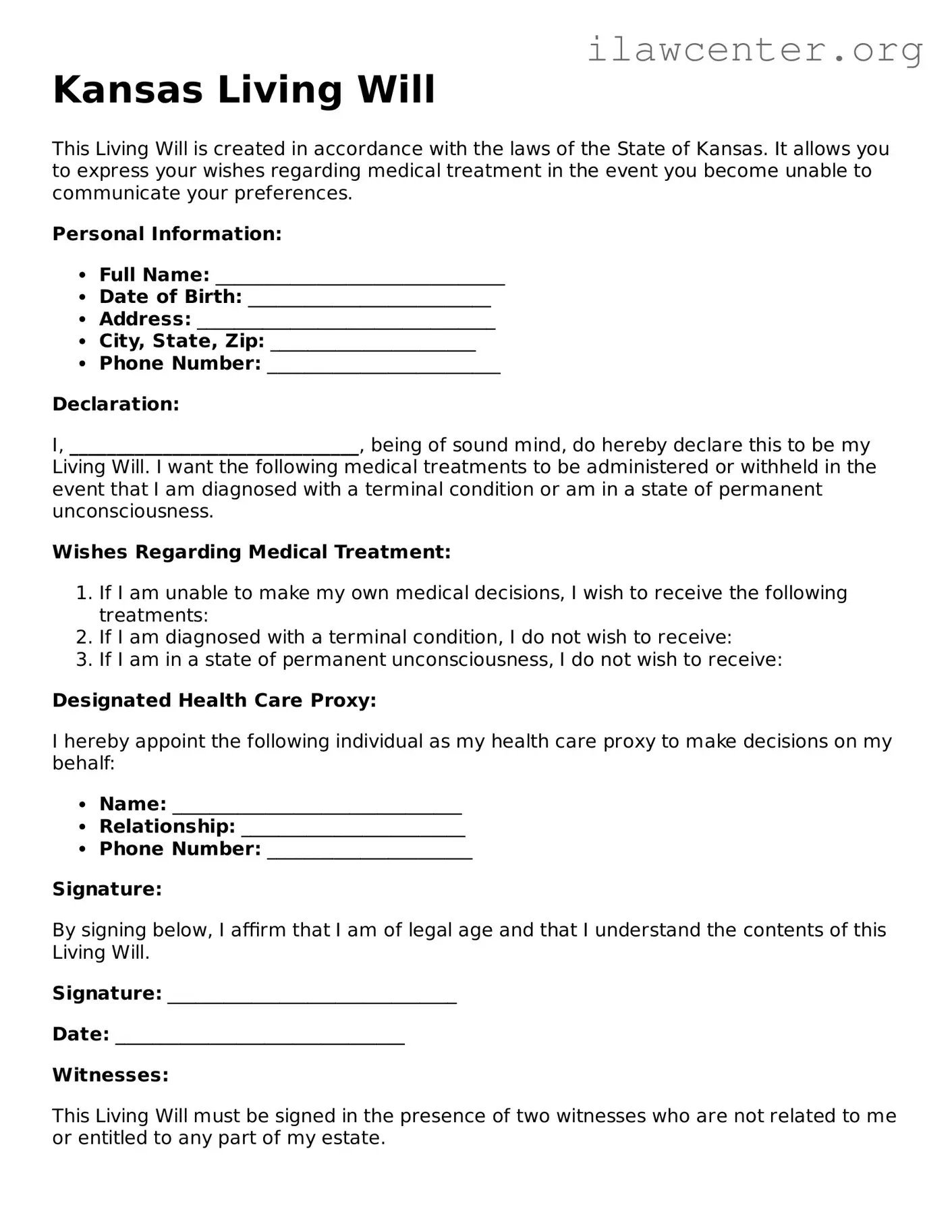
Kansas Living Will Preview

Kansas Living Will

This Living Will is created in accordance with the laws of the State of Kansas. It allows you to express your wishes regarding medical treatment in the event you become unable to communicate your preferences.

Personal Information:

  • Full Name: _______________________________
  • Date of Birth: __________________________
  • Address: ________________________________
  • City, State, Zip: ______________________
  • Phone Number: _________________________

Declaration:

I, _______________________________, being of sound mind, do hereby declare this to be my Living Will. I want the following medical treatments to be administered or withheld in the event that I am diagnosed with a terminal condition or am in a state of permanent unconsciousness.

Wishes Regarding Medical Treatment:

  1. If I am unable to make my own medical decisions, I wish to receive the following treatments:
  2. If I am diagnosed with a terminal condition, I do not wish to receive:
  3. If I am in a state of permanent unconsciousness, I do not wish to receive:

Designated Health Care Proxy:

I hereby appoint the following individual as my health care proxy to make decisions on my behalf:

  • Name: _______________________________
  • Relationship: ________________________
  • Phone Number: ______________________

Signature:

By signing below, I affirm that I am of legal age and that I understand the contents of this Living Will.

Signature: _______________________________

Date: _______________________________

Witnesses:

This Living Will must be signed in the presence of two witnesses who are not related to me or entitled to any part of my estate.

  • Witness 1 Name: ___________________________
  • Witness 1 Signature: ________________________
  • Date: _______________________________
  • Witness 2 Name: ___________________________
  • Witness 2 Signature: ________________________
  • Date: _______________________________

PDF Form Characteristics

Fact Name Description
Definition A Kansas Living Will is a legal document that allows individuals to express their wishes regarding medical treatment in case they become unable to communicate those wishes themselves.
Governing Law The Kansas Living Will is governed by the Kansas Statutes Annotated, specifically K.S.A. 65-28,100 et seq.
Eligibility Any adult who is at least 18 years old can create a Living Will in Kansas.
Witness Requirement The document must be signed in the presence of two witnesses who are not related to the individual or entitled to any portion of their estate.
Revocation A Living Will can be revoked at any time, as long as the individual is mentally competent to do so.
Healthcare Proxy While a Living Will outlines medical treatment preferences, it does not appoint a healthcare proxy. A separate document is needed for that purpose.
Storage and Accessibility It is important to keep the Living Will in a safe but accessible location and to share copies with family members and healthcare providers.

Instructions on Utilizing Kansas Living Will

When preparing to fill out the Kansas Living Will form, it is essential to approach the process with care and consideration. This document is a crucial part of planning for future healthcare decisions. Once you have completed the form, it is advisable to keep it in a safe place and share copies with relevant parties, such as family members and healthcare providers.

  1. Begin by obtaining the Kansas Living Will form. You can find it online or through legal offices.
  2. Read the instructions carefully to understand the requirements and options available.
  3. Fill in your full name, address, and date of birth at the top of the form.
  4. Clearly state your wishes regarding medical treatment in the designated section. Be specific about the types of treatments you would want or not want.
  5. Sign and date the form at the bottom. Ensure that your signature is legible.
  6. Have the form witnessed by two individuals who are not related to you and who will not benefit from your estate. They must also sign the form.
  7. Make copies of the completed and signed form for your records and for your healthcare providers.

Important Facts about Kansas Living Will

What is a Kansas Living Will form?

A Kansas Living Will form is a legal document that allows an individual to outline their preferences regarding medical treatment in the event they become unable to communicate their wishes. This document typically addresses situations where a person is terminally ill or in a persistent vegetative state. By completing this form, individuals can express their desires about life-sustaining treatments and other medical interventions, ensuring their wishes are respected by healthcare providers and family members.

Who can create a Kansas Living Will?

Any adult who is at least 18 years old and is of sound mind can create a Kansas Living Will. It is important that the individual understands the implications of the decisions being made. While anyone can fill out the form, it is advisable to discuss these wishes with family members and healthcare providers to ensure that everyone is aware of the individual’s preferences.

How do I complete a Kansas Living Will form?

To complete a Kansas Living Will form, an individual must fill out the document with their specific wishes regarding medical treatment. This includes decisions about life-sustaining measures, such as resuscitation or artificial nutrition and hydration. After filling out the form, it must be signed in the presence of two witnesses or a notary public to ensure its validity. The signed document should be kept in a safe place, and copies should be provided to family members and healthcare providers to facilitate communication of the individual’s wishes.

Can I change or revoke my Kansas Living Will?

Yes, individuals have the right to change or revoke their Kansas Living Will at any time, as long as they are mentally competent to do so. To revoke the document, the individual can simply destroy the original form and any copies. It is also advisable to inform family members and healthcare providers about the changes to ensure that the most current wishes are known. If a new Living Will is created, it should clearly state that it revokes any previous versions.

Common mistakes

Filling out a Kansas Living Will form can be a straightforward process, but many individuals make critical mistakes that can lead to confusion or disputes later on. One common error is failing to clearly define their wishes regarding medical treatment. It's essential to specify whether you want life-sustaining treatments in certain situations. Without clear instructions, healthcare providers may struggle to understand your intentions.

Another frequent mistake is neglecting to update the Living Will when personal circumstances change. Life events such as marriage, divorce, or the birth of a child can significantly impact your healthcare preferences. If the form is not revised accordingly, it may not reflect your current desires, potentially leading to unwanted treatments.

Many people also overlook the importance of having witnesses or notarization. Kansas law requires that the Living Will be signed in the presence of two witnesses or a notary public. Failing to meet this requirement can render the document invalid. It's crucial to ensure that the witnesses are not related to you or have any financial interest in your estate.

Additionally, individuals often forget to communicate their wishes to family members and healthcare providers. A Living Will is only effective if those involved are aware of its existence and contents. Discussing your preferences openly can help prevent misunderstandings and ensure that your wishes are honored.

Lastly, some individuals may rush through the form without fully understanding its implications. Taking the time to read and comprehend each section is vital. Misinterpretations can lead to unintended consequences, making it essential to approach the process with care and attention.

Documents used along the form

A Kansas Living Will is an important document that outlines an individual's preferences regarding medical treatment in situations where they may be unable to communicate their wishes. However, it is often accompanied by other forms and documents that help ensure a comprehensive approach to healthcare decision-making. Below are some commonly used forms that complement the Kansas Living Will.

  • Durable Power of Attorney for Health Care: This document allows you to designate someone to make healthcare decisions on your behalf if you are unable to do so. It can cover a wide range of medical choices and is effective even when you are still capable of making decisions.
  • Do Not Resuscitate (DNR) Order: A DNR order is a specific request not to receive cardiopulmonary resuscitation (CPR) if your heart stops or if you stop breathing. This document is crucial for individuals who wish to avoid aggressive life-saving measures in certain medical situations.
  • Physician Orders for Life-Sustaining Treatment (POLST): This form translates your wishes regarding life-sustaining treatment into medical orders. It is intended for individuals with serious illnesses and ensures that healthcare providers follow your preferences in emergencies.
  • Advance Directive Registry: This is a centralized database where individuals can store their advance directives, including Living Wills and Durable Powers of Attorney. It allows healthcare providers easy access to your wishes when needed.
  • Health Care Proxy: Similar to a Durable Power of Attorney for Health Care, a health care proxy designates someone to make medical decisions on your behalf. This document is particularly useful in emergency situations where immediate decisions are required.
  • Medical Release Form: This form grants permission for healthcare providers to share your medical information with designated individuals. It is essential for ensuring that your healthcare proxy or family members can access necessary information to make informed decisions.
  • Organ Donation Form: If you wish to donate your organs after death, this document specifies your wishes regarding organ donation. It can be included as part of your advance directives to ensure your intentions are honored.

Understanding these documents and how they work together can provide peace of mind. By preparing and organizing your healthcare preferences, you empower yourself and your loved ones to make informed decisions during challenging times. It is always advisable to discuss these documents with family members and healthcare professionals to ensure everyone is on the same page regarding your wishes.

Similar forms

A Living Will is an important document that outlines your wishes regarding medical treatment in the event that you become unable to communicate those wishes yourself. Several other documents serve similar purposes, providing guidance on healthcare decisions and end-of-life care. Here are seven documents that share similarities with a Living Will:

  • Advance Healthcare Directive: This document combines a Living Will and a Durable Power of Attorney for Healthcare, allowing you to specify your medical treatment preferences and appoint someone to make decisions on your behalf.
  • Durable Power of Attorney for Healthcare: This document designates an individual to make healthcare decisions for you if you are unable to do so, without necessarily detailing specific medical treatment preferences.
  • Do Not Resuscitate (DNR) Order: A DNR order explicitly states that you do not want to receive CPR or other life-saving measures in the event of cardiac arrest, similar to the end-of-life decisions outlined in a Living Will.
  • POLST (Physician Orders for Life-Sustaining Treatment): This is a medical order that specifies the types of medical treatment you want or do not want, often used for patients with serious illnesses, and is based on discussions with healthcare providers.
  • Healthcare Proxy: This document allows you to appoint someone to make healthcare decisions for you, similar to a Durable Power of Attorney, but it may not include specific treatment preferences.
  • Five Wishes: This document goes beyond medical preferences, addressing personal, emotional, and spiritual needs at the end of life, making it a comprehensive approach to advance care planning.
  • Living Trust: While primarily focused on the distribution of assets after death, a Living Trust can also include provisions for healthcare decisions, making it a broader estate planning tool that touches on similar themes as a Living Will.

Understanding these documents can help ensure your healthcare wishes are honored, providing peace of mind for you and your loved ones.

Dos and Don'ts

Filling out a Kansas Living Will form is an important step in ensuring your healthcare wishes are respected. Here’s a helpful list of things you should and shouldn’t do when completing this form.

  • Do clearly state your wishes regarding medical treatment.
  • Do discuss your decisions with family members and healthcare providers.
  • Do sign and date the form in the presence of a witness.
  • Do keep a copy of the completed form in a safe place.
  • Do review and update your Living Will as your preferences change.
  • Don't use vague language that could lead to confusion.
  • Don't forget to have the required number of witnesses.
  • Don't ignore state laws regarding Living Wills.
  • Don't assume that verbal wishes are enough; always put them in writing.

By following these guidelines, you can ensure that your Living Will accurately reflects your healthcare preferences and provides peace of mind for you and your loved ones.

Misconceptions

Many people have misconceptions about the Kansas Living Will form. Understanding the truth can help you make informed decisions about your healthcare wishes. Here are seven common misconceptions:

  1. A Living Will is only for the elderly.

    This is not true. Anyone over 18 can create a Living Will. It's a good idea for all adults to consider their healthcare preferences.

  2. A Living Will is the same as a Power of Attorney.

    While both documents deal with healthcare decisions, a Living Will specifically outlines your wishes regarding medical treatment, while a Power of Attorney allows someone to make decisions on your behalf.

  3. You can’t change a Living Will once it’s signed.

    This is a misconception. You can update or revoke your Living Will at any time, as long as you are mentally competent to do so.

  4. A Living Will only applies in hospitals.

    In fact, a Living Will can guide healthcare providers in various settings, including nursing homes or hospice care.

  5. If I have a Living Will, doctors won’t try to save my life.

    This is a misunderstanding. A Living Will only comes into play when you are unable to communicate your wishes. Until then, medical professionals will always strive to provide necessary care.

  6. You don’t need witnesses to sign a Living Will.

    In Kansas, you do need at least two witnesses who are not related to you or your healthcare providers to validate your Living Will.

  7. Living Wills are only for end-of-life situations.

    While they often address end-of-life care, Living Wills can also specify your preferences for treatment in other serious medical situations.

By clearing up these misconceptions, you can take important steps toward ensuring your healthcare wishes are respected.

Key takeaways

When considering a Kansas Living Will, it’s important to understand the key aspects of the form and its implications. Below are essential takeaways to keep in mind:

  • The Kansas Living Will allows individuals to express their wishes regarding medical treatment in the event they become unable to communicate those wishes themselves.
  • It is crucial to complete the form while you are of sound mind. This ensures that your preferences are clearly stated and legally binding.
  • Once completed, the Living Will must be signed and dated in the presence of two witnesses or a notary public to be considered valid.
  • It is advisable to provide copies of the completed Living Will to your healthcare providers and family members to ensure that your wishes are known and respected.
  • Remember that you can revoke or modify your Living Will at any time, as long as you are still competent to do so.