Attorney-Verified  Marital Separation Agreement Document for Kansas

Attorney-Verified Marital Separation Agreement Document for Kansas

A Kansas Marital Separation Agreement is a legal document that outlines the terms of separation between spouses who wish to live apart while remaining legally married. This agreement addresses various aspects such as asset division, child custody, and support obligations. For those considering this step, filling out the form can provide clarity and structure during a challenging time; click the button below to get started.

Article Guide

When couples find themselves at a crossroads in their marriage, a Kansas Marital Separation Agreement can serve as a vital tool for navigating the complexities of separation. This legal document outlines the terms and conditions that govern the relationship during a period of separation, addressing critical aspects such as property division, financial responsibilities, and child custody arrangements. By clearly defining each party's rights and obligations, this agreement can help minimize conflict and provide a framework for moving forward. It is essential to ensure that both partners understand the implications of the agreement, as it can significantly impact their lives during and after separation. Moreover, having a well-drafted agreement can facilitate a smoother transition, making it easier to manage day-to-day responsibilities while allowing each individual the space to reflect on their future. In Kansas, this form is not just a piece of paper; it represents a commitment to resolving differences amicably and thoughtfully, paving the way for a more stable post-separation environment.

Kansas Marital Separation Agreement Preview

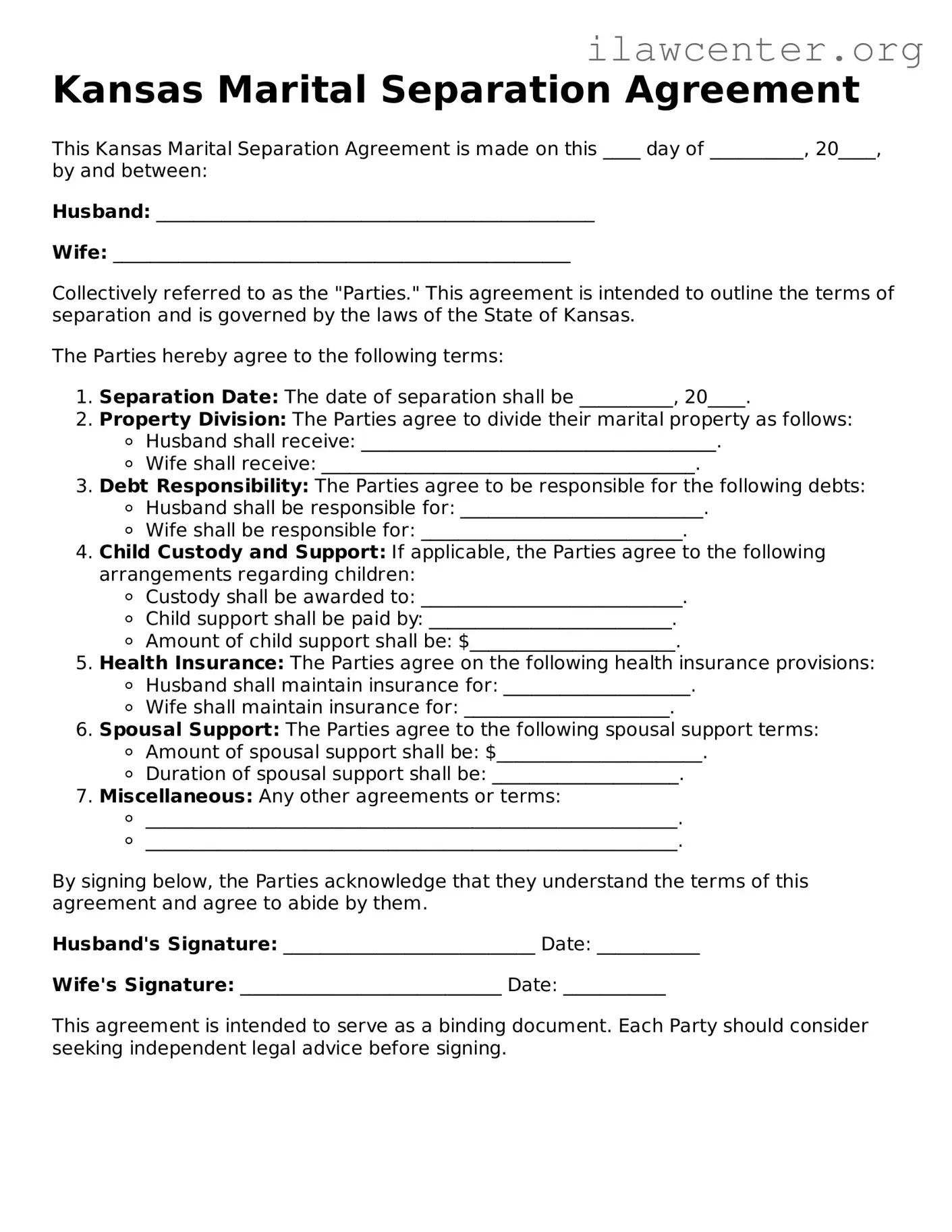
Kansas Marital Separation Agreement

This Kansas Marital Separation Agreement is made on this ____ day of __________, 20____, by and between:

Husband: _______________________________________________

Wife: _________________________________________________

Collectively referred to as the "Parties." This agreement is intended to outline the terms of separation and is governed by the laws of the State of Kansas.

The Parties hereby agree to the following terms:

  1. Separation Date: The date of separation shall be __________, 20____.
  2. Property Division: The Parties agree to divide their marital property as follows:
    • Husband shall receive: ______________________________________.
    • Wife shall receive: ________________________________________.
  3. Debt Responsibility: The Parties agree to be responsible for the following debts:
    • Husband shall be responsible for: __________________________.
    • Wife shall be responsible for: ____________________________.
  4. Child Custody and Support: If applicable, the Parties agree to the following arrangements regarding children:
    • Custody shall be awarded to: ____________________________.
    • Child support shall be paid by: __________________________.
    • Amount of child support shall be: $______________________.
  5. Health Insurance: The Parties agree on the following health insurance provisions:
    • Husband shall maintain insurance for: ____________________.
    • Wife shall maintain insurance for: ______________________.
  6. Spousal Support: The Parties agree to the following spousal support terms:
    • Amount of spousal support shall be: $______________________.
    • Duration of spousal support shall be: ____________________.
  7. Miscellaneous: Any other agreements or terms:
    • _________________________________________________________.
    • _________________________________________________________.

By signing below, the Parties acknowledge that they understand the terms of this agreement and agree to abide by them.

Husband's Signature: ___________________________ Date: ___________

Wife's Signature: ____________________________ Date: ___________

This agreement is intended to serve as a binding document. Each Party should consider seeking independent legal advice before signing.

PDF Form Characteristics

Fact Name Details
Definition A Kansas Marital Separation Agreement outlines the terms of separation between spouses.
Governing Law This agreement is governed by the Kansas Statutes, specifically K.S.A. 60-1601 et seq.
Purpose It helps clarify rights and responsibilities regarding property, debts, and child custody.
Notarization While notarization is not required, it is recommended for legal enforceability.
Mutual Agreement Both spouses must agree to the terms for the agreement to be valid.
Modification The agreement can be modified in writing if both parties consent.
Filing The agreement is not filed with the court unless it is part of a divorce proceeding.
Legal Advice Consulting an attorney is advisable to ensure all legal rights are protected.

Instructions on Utilizing Kansas Marital Separation Agreement

After completing the Kansas Marital Separation Agreement form, you will typically need to file it with the appropriate court. This may involve additional steps, such as serving the other party with the document and possibly attending a court hearing.

  1. Begin by obtaining the Kansas Marital Separation Agreement form. This can be done online or at your local courthouse.
  2. Fill in the full names of both spouses at the top of the form.
  3. Provide the date of marriage and the date of separation.
  4. List all children from the marriage, including their names and birth dates.
  5. Detail the arrangements for child custody, visitation, and child support, if applicable.
  6. Outline the division of property, including real estate, vehicles, and personal belongings.
  7. Specify any spousal support or alimony agreements.
  8. Include any additional agreements that both parties have reached.
  9. Both parties should review the form for accuracy and completeness.
  10. Sign and date the form in the designated areas.

Important Facts about Kansas Marital Separation Agreement

What is a Kansas Marital Separation Agreement?

A Kansas Marital Separation Agreement is a legal document that outlines the terms of a couple's separation. It addresses various aspects such as property division, debt responsibilities, child custody, and support obligations. This agreement helps both parties understand their rights and responsibilities during the separation period.

Is a Marital Separation Agreement legally binding in Kansas?

Yes, a Marital Separation Agreement is legally binding in Kansas as long as both parties voluntarily sign it. It is advisable for each party to seek independent legal advice before signing to ensure that their interests are protected and that they fully understand the terms of the agreement.

Do I need an attorney to create a Marital Separation Agreement?

While it is not legally required to have an attorney, it is highly recommended. An attorney can help you navigate the complexities of the law, ensure that your rights are protected, and assist in drafting an agreement that meets your specific needs.

Can a Marital Separation Agreement be modified?

Yes, a Marital Separation Agreement can be modified if both parties agree to the changes. It is important to document any modifications in writing and have both parties sign the updated agreement to ensure its enforceability.

What happens if one party violates the Marital Separation Agreement?

If one party violates the terms of the agreement, the other party can seek legal remedies. This may include filing a motion with the court to enforce the agreement or seeking damages for any losses incurred due to the violation.

How does a Marital Separation Agreement affect child custody and support?

The agreement can specify custody arrangements and child support obligations. It is essential to prioritize the best interests of the child when drafting these provisions. Courts generally uphold the terms agreed upon by both parents, provided they are reasonable and serve the child's welfare.

Can a Marital Separation Agreement address spousal support?

Yes, the agreement can include provisions for spousal support, also known as alimony. Both parties can negotiate the amount and duration of support, which can be included in the final agreement. However, courts may review these terms to ensure they are fair and just.

What should be included in a Marital Separation Agreement?

A comprehensive Marital Separation Agreement should include details on property division, debt allocation, child custody arrangements, visitation rights, child support, and spousal support. Clear and specific language helps prevent misunderstandings and disputes in the future.

How long does it take to finalize a Marital Separation Agreement?

The time it takes to finalize a Marital Separation Agreement varies depending on the complexity of the issues involved and how well both parties communicate. If both parties are cooperative and reach an agreement quickly, it may take only a few weeks. However, if disputes arise, it could take longer to resolve.

What if my spouse and I cannot agree on the terms of the Marital Separation Agreement?

If you and your spouse cannot reach an agreement, consider mediation or collaborative law as options. These approaches involve neutral third parties who can help facilitate discussions and negotiations. If all else fails, you may need to pursue a court-based resolution.
Common mistakes

Filling out the Kansas Marital Separation Agreement form can be a daunting task, and many people make mistakes that can lead to complications later on. One common error is failing to provide complete information about both spouses. It's essential to include full names, addresses, and other identifying details. Omitting this information can create confusion and delays in the processing of the agreement.

Another frequent mistake is not addressing all relevant issues. The agreement should cover various aspects, including property division, child custody, and support obligations. If any of these topics are overlooked, it may lead to disputes down the line. It’s crucial to think through every detail and ensure that all necessary points are included.

Some individuals also neglect to specify the terms clearly. Vague language can result in misunderstandings. For example, instead of saying, “we will share the children,” it’s better to outline specific visitation schedules. Clear terms help prevent future conflicts and ensure both parties understand their rights and responsibilities.

Additionally, people often forget to consider tax implications. The division of assets and support payments can have tax consequences that are easily overlooked. Consulting with a financial advisor or tax professional can provide valuable insights and help avoid unexpected tax liabilities.

Another mistake is not having the agreement reviewed by a lawyer. While it may seem tempting to handle everything independently, legal expertise can be invaluable. A lawyer can identify potential pitfalls and ensure that the agreement complies with Kansas law. This step can save both time and money in the long run.

Moreover, failing to sign and date the agreement properly can invalidate it. Both spouses must sign the document, and it should be dated accurately. A missing signature or incorrect date can lead to challenges in enforcing the agreement later on.

Lastly, many people do not keep copies of the signed agreement. It’s important to retain a copy for personal records and to share one with the other spouse. Having a record of the agreement can be crucial if disputes arise in the future. Keeping everything organized and accessible can make a significant difference in managing post-separation issues.

Documents used along the form

A Kansas Marital Separation Agreement is a vital document for couples who wish to outline the terms of their separation. It is often accompanied by several other forms and documents that help clarify legal rights and responsibilities. Below is a list of commonly used documents that may be relevant in conjunction with the Kansas Marital Separation Agreement.

  • Petition for Divorce: This document initiates the divorce process and outlines the grounds for divorce, as well as the requests for division of property, child custody, and support.
  • Child Custody Agreement: This agreement specifies the arrangements for child custody and visitation, ensuring that both parents understand their rights and obligations regarding their children.
  • Child Support Worksheet: A financial document used to calculate the amount of child support one parent may owe to the other, based on income and other factors.
  • Property Settlement Agreement: This document details how marital property and debts will be divided between the spouses, helping to prevent future disputes.
  • Financial Affidavit: A sworn statement of an individual's financial situation, including income, expenses, assets, and liabilities, often required in divorce proceedings.
  • Spousal Support Agreement: This outlines any alimony or spousal support arrangements, including the amount and duration of payments, if applicable.
  • Parenting Plan: A comprehensive plan that addresses parenting time, decision-making responsibilities, and other aspects of raising children after separation.
  • Notice of Hearing: A document that informs parties involved in a divorce or separation case about the date and time of scheduled hearings.
  • Affidavit of Service: A document that confirms that legal papers have been delivered to the other party, ensuring that they are aware of the proceedings.

These documents collectively serve to provide clarity and structure during the separation process. By understanding and utilizing these forms, individuals can better navigate the complexities of marital separation and divorce in Kansas.

Similar forms

A Marital Separation Agreement is an important document for couples who decide to live apart while still legally married. It outlines the terms of the separation, including financial responsibilities, child custody, and property division. Several other documents serve similar purposes in various contexts. Here’s a list of ten documents that share similarities with a Marital Separation Agreement:

  • Divorce Agreement: This document finalizes the terms of a divorce, including asset division and custody arrangements, much like a Marital Separation Agreement but typically occurs at the end of the marriage.
  • Separation Agreement: Often used interchangeably with a Marital Separation Agreement, this document outlines the terms of separation without necessarily involving divorce.
  • Child Custody Agreement: This focuses specifically on the custody and visitation rights of children, detailing how parents will share responsibilities, similar to the child custody provisions in a Marital Separation Agreement.
  • Property Settlement Agreement: This document addresses the division of property and debts during a separation or divorce, similar to the financial aspects covered in a Marital Separation Agreement.
  • Postnuptial Agreement: Created after marriage, this document outlines how assets will be divided in the event of separation or divorce, resembling the financial terms in a Marital Separation Agreement.
  • Prenuptial Agreement: Established before marriage, this document sets forth how assets will be managed and divided, sharing the same goal of clarifying financial matters as a Marital Separation Agreement.
  • Legal Separation Agreement: Similar to a Marital Separation Agreement, this document is used when couples choose to separate but remain legally married, detailing the same types of arrangements.
  • Custody Mediation Agreement: This document results from mediation and outlines the agreed-upon terms for child custody, akin to the custody arrangements in a Marital Separation Agreement.
  • Debt Settlement Agreement: This focuses on how debts will be managed and paid off during a separation, paralleling the financial obligations outlined in a Marital Separation Agreement.
  • Alimony Agreement: This specifies the terms of spousal support, similar to the financial responsibilities outlined in a Marital Separation Agreement.

Understanding these documents can help individuals navigate the complexities of separation and divorce. Each serves a unique purpose but shares the common goal of providing clarity and structure during challenging times.

Dos and Don'ts

When completing the Kansas Marital Separation Agreement form, it’s important to approach the task with care. Here are some dos and don’ts to keep in mind:

  • Do read the entire form carefully before starting. Understanding each section will help ensure accuracy.
  • Do provide complete and truthful information. This includes financial details, property ownership, and any agreements regarding child custody.
  • Do consult with a legal professional if you have questions. Getting guidance can prevent mistakes that may affect your agreement.
  • Do keep a copy of the completed form for your records. Having documentation can be helpful in the future.
  • Don’t rush through the form. Taking your time can help avoid errors that might complicate the separation process.
  • Don’t leave any sections blank. If a section does not apply, indicate that clearly instead of skipping it.
  • Don’t forget to sign and date the form. An unsigned form may not be considered valid.
  • Don’t ignore deadlines. Submitting the form on time is crucial for ensuring the separation process proceeds smoothly.

Misconceptions

When it comes to the Kansas Marital Separation Agreement, there are several misconceptions that can lead to confusion. Understanding these misconceptions can help you make informed decisions during a challenging time.

  • Misconception 1: A Marital Separation Agreement is the same as a divorce.
  • Many people think that signing a separation agreement means they are officially divorced. In reality, a separation agreement outlines the terms of living apart while still being legally married. Divorce is a separate legal process that ends the marriage.

  • Misconception 2: A separation agreement is not legally binding.
  • Some believe that a marital separation agreement holds no legal weight. However, once both parties sign the agreement, it becomes enforceable in court. This means that the terms outlined in the document can be upheld legally.

  • Misconception 3: All assets and debts must be divided equally.
  • It’s a common belief that assets and debts must be split 50/50. While equitable distribution is a guiding principle in Kansas, it does not always mean equal division. Factors such as the length of the marriage and each spouse's financial situation can influence how assets are divided.

  • Misconception 4: A separation agreement cannot be changed once signed.
  • Some individuals think that once a separation agreement is signed, it cannot be modified. This is not true. If both parties agree, they can renegotiate and amend the agreement at any time, provided the changes are documented and signed.

Key takeaways

When navigating the Kansas Marital Separation Agreement form, it's essential to understand its significance and how to fill it out effectively. Here are some key takeaways to keep in mind:

  • Understand the Purpose: This form outlines the terms of separation between spouses, addressing issues like property division, child custody, and support obligations.
  • Gather Necessary Information: Before filling out the form, collect all relevant financial documents, including income statements, asset valuations, and debts.
  • Be Clear and Specific: Clearly define terms related to property division, child custody, and support to avoid misunderstandings later on.
  • Consider Legal Advice: While it's possible to fill out the form without an attorney, consulting with a legal professional can provide valuable insights and ensure your rights are protected.
  • Complete All Sections: Make sure to fill out every section of the form to prevent delays or complications in the separation process.
  • Review for Accuracy: Double-check all information for accuracy before submitting the form. Mistakes can lead to legal issues down the line.
  • Sign and Date: Ensure that both parties sign and date the agreement. This step is crucial for the document's validity.
  • File with the Court: After completing the form, file it with the appropriate court to make the separation official.
  • Keep Copies: Retain copies of the signed agreement for your records. This documentation can be essential for future reference.

By following these guidelines, individuals can navigate the separation process more smoothly and ensure that their agreement is comprehensive and legally sound.