Attorney-Verified  Motor Vehicle Power of Attorney Document for Kansas

Attorney-Verified Motor Vehicle Power of Attorney Document for Kansas

The Kansas Motor Vehicle Power of Attorney form allows an individual to designate another person to act on their behalf regarding motor vehicle transactions. This legal document is essential for anyone who needs to transfer ownership, register a vehicle, or handle other related matters without being physically present. To get started with this form, click the button below.

Article Guide

In the state of Kansas, the Motor Vehicle Power of Attorney form serves as a vital legal document that empowers an individual, known as the agent, to act on behalf of another person, referred to as the principal, specifically concerning motor vehicle transactions. This form is particularly useful when the principal is unable to be present for important tasks such as transferring ownership of a vehicle, registering a new car, or handling any related paperwork. By designating an agent, the principal can ensure that their interests are represented and that necessary actions can be taken efficiently. The form outlines the scope of authority granted to the agent, detailing the specific powers they may exercise, which can include signing titles, obtaining license plates, and managing other essential vehicle-related duties. It is important for individuals to understand the implications of this document, including the need for proper signatures and notarization, as well as the potential for revocation should the principal wish to terminate the agent's authority. Overall, the Kansas Motor Vehicle Power of Attorney form facilitates smooth transactions and provides peace of mind for those who may be unable to manage their vehicle affairs directly.

Kansas Motor Vehicle Power of Attorney Preview

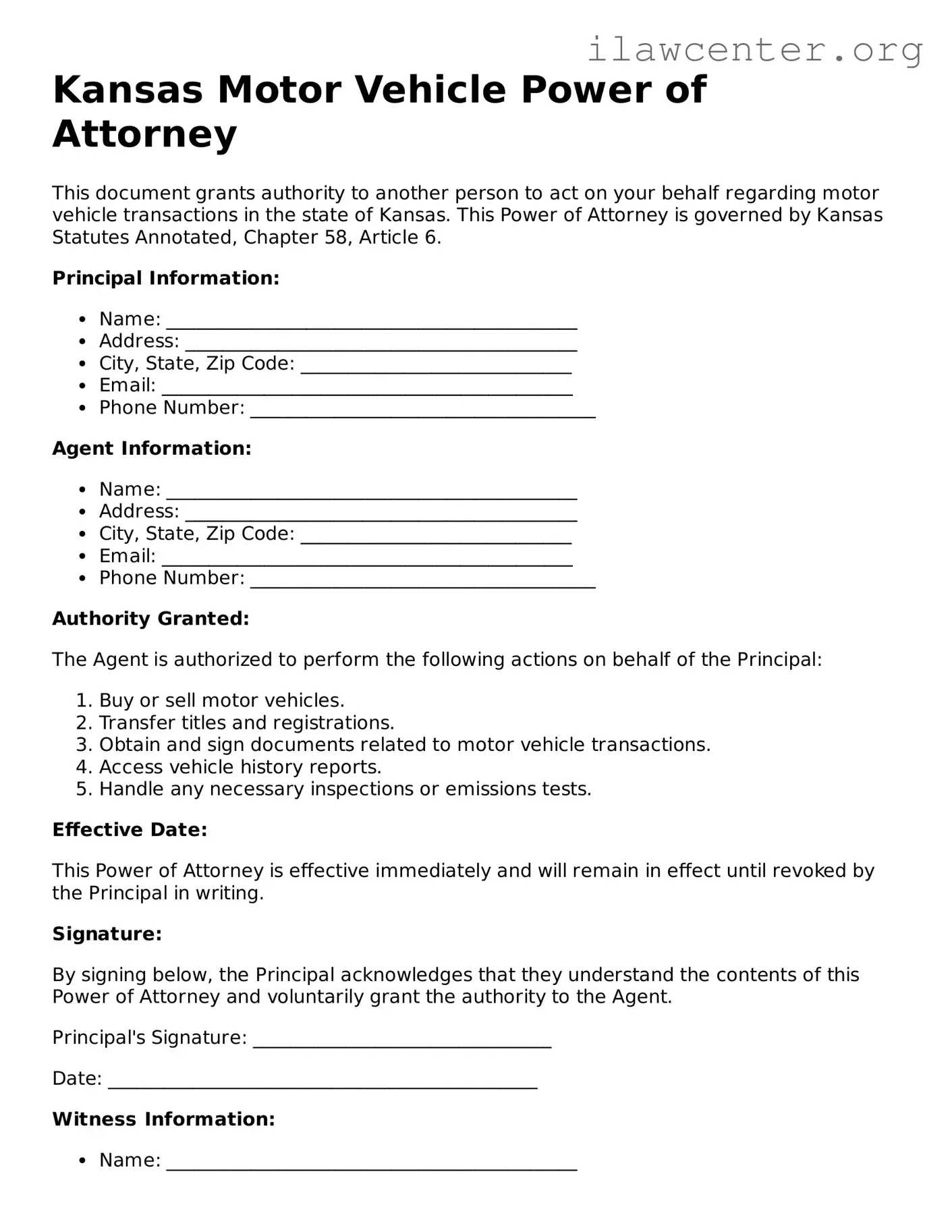
Kansas Motor Vehicle Power of Attorney

This document grants authority to another person to act on your behalf regarding motor vehicle transactions in the state of Kansas. This Power of Attorney is governed by Kansas Statutes Annotated, Chapter 58, Article 6.

Principal Information:

  • Name: ____________________________________________
  • Address: __________________________________________
  • City, State, Zip Code: _____________________________
  • Email: ____________________________________________
  • Phone Number: _____________________________________

Agent Information:

  • Name: ____________________________________________
  • Address: __________________________________________
  • City, State, Zip Code: _____________________________
  • Email: ____________________________________________
  • Phone Number: _____________________________________

Authority Granted:

The Agent is authorized to perform the following actions on behalf of the Principal:

  1. Buy or sell motor vehicles.
  2. Transfer titles and registrations.
  3. Obtain and sign documents related to motor vehicle transactions.
  4. Access vehicle history reports.
  5. Handle any necessary inspections or emissions tests.

Effective Date:

This Power of Attorney is effective immediately and will remain in effect until revoked by the Principal in writing.

Signature:

By signing below, the Principal acknowledges that they understand the contents of this Power of Attorney and voluntarily grant the authority to the Agent.

Principal's Signature: ________________________________

Date: ______________________________________________

Witness Information:

  • Name: ____________________________________________
  • Signature: _________________________________________
  • Date: _____________________________________________

PDF Form Characteristics

Fact Name Description
Purpose The Kansas Motor Vehicle Power of Attorney form allows an individual to authorize another person to handle motor vehicle transactions on their behalf.
Governing Law This form is governed by the Kansas Statutes Annotated, specifically K.S.A. 8-135.
Signatories Both the principal (the person granting power) and the agent (the person receiving power) must sign the form for it to be valid.
Durability The power of attorney can be durable, meaning it remains effective even if the principal becomes incapacitated, unless stated otherwise.
Revocation The principal can revoke the power of attorney at any time by providing written notice to the agent.
Usage This form is commonly used for tasks such as transferring vehicle titles, registering vehicles, and obtaining license plates.

Instructions on Utilizing Kansas Motor Vehicle Power of Attorney

To complete the Kansas Motor Vehicle Power of Attorney form, follow these steps carefully. Once you have filled out the form, it will be ready for submission, allowing someone else to act on your behalf regarding your vehicle matters.

  1. Obtain the Kansas Motor Vehicle Power of Attorney form. You can find it online or at your local Department of Motor Vehicles (DMV) office.
  2. Fill in your name in the designated space as the "Principal." This is the person granting the authority.
  3. Provide your address, including city, state, and zip code, in the appropriate fields.
  4. Enter the name of the person you are appointing as your "Agent." This individual will have the authority to act on your behalf.
  5. List the Agent's address, including city, state, and zip code.
  6. Specify the vehicle details, including the make, model, year, and Vehicle Identification Number (VIN).
  7. Indicate the specific powers you are granting to your Agent by checking the appropriate boxes. Ensure you understand what each option entails.
  8. Sign and date the form at the bottom. Your signature must match the name provided as the Principal.
  9. Have your signature notarized. This step is essential for the form to be valid.
  10. Make copies of the completed and notarized form for your records and for your Agent.

Important Facts about Kansas Motor Vehicle Power of Attorney

What is a Kansas Motor Vehicle Power of Attorney form?

The Kansas Motor Vehicle Power of Attorney form allows one person to authorize another person to handle specific tasks related to their motor vehicle. This can include signing documents, transferring titles, and managing registration matters on their behalf.

Who can be a principal and an agent in this form?

The principal is the person granting the authority, while the agent is the individual receiving that authority. In Kansas, the principal must be the registered owner of the vehicle, and the agent can be anyone the principal trusts, such as a family member, friend, or legal representative.

What tasks can the agent perform with this Power of Attorney?

The agent can perform various tasks, including signing title transfers, registering the vehicle, and handling any related paperwork. Essentially, the agent acts on behalf of the principal for all matters involving the vehicle specified in the form.

Do I need to have the form notarized?

Yes, in Kansas, the Motor Vehicle Power of Attorney form must be notarized to be valid. This step ensures that the signatures are authentic and that the document meets legal requirements.

How long is the Power of Attorney valid?

The Power of Attorney remains valid until the principal revokes it or until the specific tasks assigned to the agent are completed. It's important to keep a copy of the document for your records and to notify the agent if you decide to revoke it.

Can I use this form for multiple vehicles?

Yes, you can use the Kansas Motor Vehicle Power of Attorney form for multiple vehicles. Just ensure that you list each vehicle clearly on the form to avoid any confusion about which vehicles the agent is authorized to manage.

What should I do if I need to revoke the Power of Attorney?

If you need to revoke the Power of Attorney, you should create a written notice stating your intention to revoke it. Notify your agent and any relevant parties, such as the DMV, to ensure that they are aware of the change. Keeping a record of the revocation is also a good practice.

Common mistakes

Filling out the Kansas Motor Vehicle Power of Attorney form can be straightforward, but there are common mistakes that individuals often make. One frequent error is failing to provide complete information about the vehicle. This includes not listing the vehicle identification number (VIN), make, model, and year. Without this information, the power of attorney may not be valid for the intended vehicle transactions.

Another mistake is neglecting to sign and date the form. While it may seem simple, an unsigned or undated document can lead to delays or complications. Both the principal and the agent must provide their signatures. If either party forgets this step, the authority granted in the form could be questioned.

Additionally, people sometimes choose an agent who is not trustworthy or does not understand the responsibilities involved. Selecting someone without considering their reliability can lead to misuse of authority. It’s important to choose an agent who is responsible and understands the implications of managing someone else's vehicle matters.

Inaccurate or incomplete notarization is another common pitfall. The form requires notarization to be valid, and if the notary fails to complete their section properly, it can invalidate the document. Ensure that the notary signs and stamps the form correctly to avoid any issues.

Some individuals overlook the importance of providing clear instructions regarding the powers granted to the agent. The form should specify what actions the agent is authorized to perform. Vague language can lead to misunderstandings and potential conflicts down the line.

Finally, failing to keep a copy of the completed form is a mistake that can cause problems later. Having a copy allows both the principal and the agent to reference the agreement if any questions arise. It’s a good practice to store this document in a safe place where it can be easily accessed when needed.

Documents used along the form

The Kansas Motor Vehicle Power of Attorney form allows an individual to designate another person to act on their behalf in matters related to motor vehicles. When using this form, several other documents may also be required to ensure a smooth transaction. Below are five commonly used forms and documents that complement the Power of Attorney in Kansas.

  • Kansas Vehicle Title Application: This form is necessary for registering a vehicle in Kansas. It includes details about the vehicle and the owner, ensuring proper documentation for title issuance.
  • Bill of Sale: A Bill of Sale serves as proof of the transaction between the buyer and seller. It outlines the terms of the sale, including the purchase price and vehicle details.
  • Odometer Disclosure Statement: This statement is required for the transfer of a vehicle title. It verifies the vehicle's mileage at the time of sale, helping to prevent fraud.
  • Application for Kansas Title and Registration: This application is essential for obtaining a new title and registering a vehicle in Kansas. It requires information about the vehicle and the owner.
  • Affidavit of Heirship: If the vehicle is inherited, this document may be needed to establish ownership transfer from the deceased to the heir. It provides legal recognition of the heir's right to the vehicle.

Utilizing these documents alongside the Kansas Motor Vehicle Power of Attorney form can streamline the process of managing vehicle-related matters. Proper documentation ensures compliance with state laws and protects the interests of all parties involved.

Similar forms

The Motor Vehicle Power of Attorney (POA) form allows an individual to designate someone else to handle specific tasks related to their vehicle. This document shares similarities with several other legal forms. Here are eight documents that are comparable to the Motor Vehicle POA, along with a brief explanation of how they relate:

  • General Power of Attorney: This document grants broad authority to an agent to act on behalf of the principal in various matters, including financial and legal decisions.
  • Health Care Power of Attorney: Similar to the Motor Vehicle POA, this form allows a person to appoint someone to make medical decisions on their behalf if they become unable to do so themselves.
  • Durable Power of Attorney: This type of POA remains effective even if the principal becomes incapacitated. Like the Motor Vehicle POA, it allows the designated agent to act on behalf of the principal.
  • Limited Power of Attorney: This document restricts the agent's authority to specific tasks, much like how the Motor Vehicle POA limits authority to vehicle-related matters.
  • Financial Power of Attorney: This form permits someone to manage financial affairs for the principal, similar to how the Motor Vehicle POA allows for vehicle management.
  • Real Estate Power of Attorney: This document allows an agent to handle real estate transactions for the principal, paralleling the Motor Vehicle POA's focus on vehicle transactions.
  • Business Power of Attorney: This form enables someone to manage business-related decisions and actions on behalf of the principal, akin to the vehicle-specific authority granted in a Motor Vehicle POA.
  • Revocable Living Trust: While not a POA, this document allows for the management of assets, including vehicles, during the grantor's lifetime and can be similar in purpose to the Motor Vehicle POA.

Dos and Don'ts

When filling out the Kansas Motor Vehicle Power of Attorney form, it’s important to get it right. Here’s a straightforward list of things to do and avoid.

  • Do read the entire form carefully before starting.
  • Do ensure you have the correct names and addresses of both parties.
  • Do provide a clear description of the vehicle involved.
  • Do sign the form in the presence of a notary public.
  • Do keep a copy of the completed form for your records.
  • Don't leave any required fields blank.
  • Don't use white-out or erase any mistakes on the form.
  • Don't sign the form without understanding what powers you are granting.
  • Don't forget to check for any state-specific requirements.
  • Don't submit the form without double-checking for accuracy.

By following these guidelines, you can help ensure that your Power of Attorney form is filled out correctly and efficiently.

Misconceptions

The Kansas Motor Vehicle Power of Attorney form is a crucial document for anyone needing to delegate authority regarding vehicle transactions. However, several misconceptions surround its use. Here are five common misunderstandings:

  1. It can only be used for buying or selling vehicles. Many people think this form is limited to just buying or selling a vehicle. In reality, it can also be used for title transfers, registration, and other vehicle-related matters.

  2. Only a lawyer can fill it out. While legal assistance can be helpful, it is not necessary to have a lawyer complete the form. Individuals can fill it out themselves, provided they understand the requirements and implications.

  3. It is only valid for a specific period. Some believe that the Power of Attorney is only valid for a limited time. In fact, it remains effective until the designated tasks are completed or revoked by the principal.

  4. It must be notarized to be valid. While notarization can add an extra layer of security, it is not a strict requirement for the Kansas Motor Vehicle Power of Attorney form to be considered valid.

  5. It cannot be revoked once signed. This is a significant misconception. A principal can revoke the Power of Attorney at any time, as long as they are mentally competent to do so.

Understanding these misconceptions can help individuals effectively utilize the Kansas Motor Vehicle Power of Attorney form. It is essential to ensure that the document is used correctly to avoid any potential issues in vehicle transactions.

Key takeaways

When completing and utilizing the Kansas Motor Vehicle Power of Attorney form, it is essential to understand the following key points:

  • The form allows an individual to designate another person to handle motor vehicle transactions on their behalf.
  • It is important to provide accurate information about both the principal (the person granting authority) and the agent (the person receiving authority).
  • The form must be signed by the principal in the presence of a notary public to ensure its validity.
  • Specific powers can be granted, including the ability to transfer ownership, register vehicles, and obtain titles.
  • The Power of Attorney can be limited to a specific transaction or can be general, allowing for broader authority.
  • Once completed, the form should be kept in a safe place, and copies should be provided to the agent and any relevant parties.
  • Revocation of the Power of Attorney can occur at any time, but it must be done in writing.
  • It is advisable to review the form periodically to ensure it meets current needs and legal requirements.