Attorney-Verified  Non-compete Agreement Document for Kansas

Attorney-Verified Non-compete Agreement Document for Kansas

A Kansas Non-compete Agreement form is a legal document that restricts an employee from working for competitors or starting a competing business for a specified period after leaving their job. This agreement aims to protect a company's confidential information and business interests. To ensure compliance and safeguard your rights, consider filling out the form by clicking the button below.

Article Guide

In the competitive landscape of today's job market, protecting business interests while ensuring fair employment practices is crucial. The Kansas Non-compete Agreement form serves as a vital tool for employers seeking to safeguard their proprietary information and client relationships from potential competition by former employees. This form outlines the specific terms under which an employee agrees not to engage in similar work or establish a competing business within a designated geographical area and time frame after leaving the company. Key components of this agreement include the duration of the non-compete clause, the geographical limitations, and the nature of the restricted activities. By clearly defining these aspects, the form aims to strike a balance between the employer's need for protection and the employee's right to seek employment opportunities. Understanding the nuances of this agreement is essential for both parties to navigate the complexities of employment and competition in Kansas effectively.

Kansas Non-compete Agreement Preview

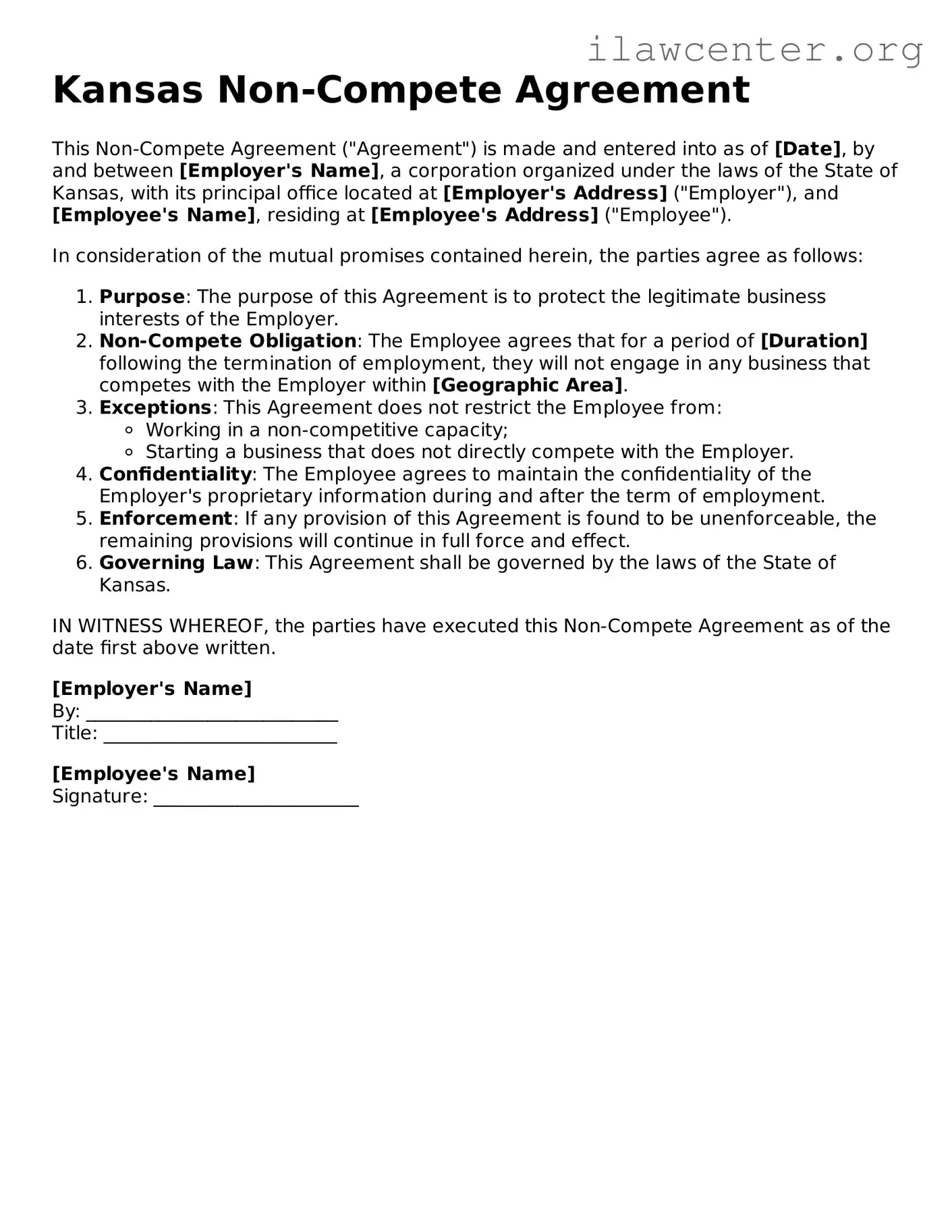
Kansas Non-Compete Agreement

This Non-Compete Agreement ("Agreement") is made and entered into as of [Date], by and between [Employer's Name], a corporation organized under the laws of the State of Kansas, with its principal office located at [Employer's Address] ("Employer"), and [Employee's Name], residing at [Employee's Address] ("Employee").

In consideration of the mutual promises contained herein, the parties agree as follows:

  1. Purpose: The purpose of this Agreement is to protect the legitimate business interests of the Employer.
  2. Non-Compete Obligation: The Employee agrees that for a period of [Duration] following the termination of employment, they will not engage in any business that competes with the Employer within [Geographic Area].
  3. Exceptions: This Agreement does not restrict the Employee from:
    • Working in a non-competitive capacity;
    • Starting a business that does not directly compete with the Employer.
  4. Confidentiality: The Employee agrees to maintain the confidentiality of the Employer's proprietary information during and after the term of employment.
  5. Enforcement: If any provision of this Agreement is found to be unenforceable, the remaining provisions will continue in full force and effect.
  6. Governing Law: This Agreement shall be governed by the laws of the State of Kansas.

IN WITNESS WHEREOF, the parties have executed this Non-Compete Agreement as of the date first above written.

[Employer's Name]
By: ___________________________
Title: _________________________

[Employee's Name]
Signature: ______________________

PDF Form Characteristics

Fact Name Details
Governing Law Kansas Statutes Annotated, Section 50-112
Enforceability Non-compete agreements must be reasonable in scope and duration to be enforceable.
Consideration A valid non-compete agreement requires consideration, such as employment or a promotion.
Restrictions Agreements should not impose undue hardship on the employee or the public.

Instructions on Utilizing Kansas Non-compete Agreement

After obtaining the Kansas Non-compete Agreement form, you will need to complete it accurately to ensure it meets the necessary requirements. Following the steps below will help you fill out the form correctly.

  1. Begin by entering the date at the top of the form. This should reflect the date you are completing the agreement.
  2. Provide your full legal name in the designated section. Ensure that the spelling is correct and matches any official identification.
  3. Enter the name of the employer or company that you are entering into the agreement with. This should also be the full legal name.
  4. Fill in the address of the employer or company. Include the street address, city, state, and zip code.
  5. Specify the duration of the non-compete period. This is the length of time you agree not to compete after leaving the company.
  6. Detail the geographic area that the non-compete agreement will cover. Be specific about the locations included.
  7. Read through the terms of the agreement carefully. Make sure you understand all conditions and obligations outlined in the document.
  8. Sign the form where indicated. Ensure that your signature is clear and legible.
  9. Provide the date of your signature. This is usually placed next to your signature.
  10. If required, have a witness sign the document as well. Include their name and date of signature if necessary.

Once you have completed these steps, review the form for any errors or omissions before submitting it to the relevant parties. Keeping a copy for your records is advisable.

Important Facts about Kansas Non-compete Agreement

What is a non-compete agreement in Kansas?

A non-compete agreement is a contract between an employer and an employee that restricts the employee from engaging in certain competitive activities after leaving the company. In Kansas, these agreements are enforceable to some extent, provided they are reasonable in scope, duration, and geographic area. The intention is to protect the employer’s legitimate business interests, such as trade secrets and customer relationships, while still allowing the employee to find future employment.

What are the key elements that make a non-compete agreement enforceable in Kansas?

For a non-compete agreement to be enforceable in Kansas, it must meet several criteria. First, it should be necessary to protect the employer's legitimate business interests. Second, the restrictions must be reasonable in terms of duration and geographic scope. Typically, a duration of one to two years is considered reasonable. Lastly, the agreement should not impose an undue hardship on the employee, preventing them from earning a livelihood.

Can an employee negotiate the terms of a non-compete agreement?

Yes, employees can negotiate the terms of a non-compete agreement before signing it. It is advisable for employees to seek clarification on any terms they find unclear or restrictive. Negotiation can involve altering the duration, geographic area, or specific activities that are restricted. Open communication between the employer and employee can lead to a more balanced agreement that protects both parties' interests.

What should an employee do if they believe their non-compete agreement is unfair?

If an employee believes their non-compete agreement is unfair or overly restrictive, they have several options. First, they may seek legal advice to understand their rights and options. An attorney can help assess the agreement's enforceability and may assist in negotiating changes. Alternatively, the employee can discuss their concerns directly with their employer, as some companies may be willing to modify the terms to reach a mutually agreeable solution.

What happens if an employee violates a non-compete agreement?

If an employee violates a non-compete agreement, the employer may take legal action to enforce the agreement. This could involve seeking an injunction to prevent the employee from continuing the competitive activity or pursuing damages for any losses incurred due to the violation. The outcome will depend on the specific terms of the agreement and the circumstances surrounding the violation. Legal counsel is recommended for both parties to navigate the complexities of such situations.

Common mistakes

When filling out the Kansas Non-compete Agreement form, individuals often overlook critical details that can affect the validity of the agreement. One common mistake is failing to clearly define the scope of the non-compete clause. This includes specifying the geographical area where the restrictions apply and the duration of the non-compete period. Without these details, the agreement may be deemed too broad or vague, which can lead to enforceability issues in the future.

Another frequent error involves neglecting to consider the reasonableness of the restrictions imposed by the agreement. Kansas courts typically evaluate whether the terms are fair and necessary to protect legitimate business interests. If the restrictions are overly harsh or limit a person's ability to work in their field, a court may refuse to enforce the agreement. It’s essential to strike a balance that protects the employer while still allowing the employee to pursue their career.

People also often forget to include necessary signatures and dates on the form. An unsigned or undated agreement can create confusion and potentially invalidate the entire document. Both parties must sign the agreement, and it should be dated to reflect when the terms were agreed upon. This simple step can prevent future disputes about when the agreement came into effect.

Lastly, individuals may not seek legal advice before signing the Non-compete Agreement. Understanding the implications of the agreement is crucial. Without proper guidance, one might inadvertently agree to terms that could limit their professional opportunities significantly. Consulting with a legal expert can provide clarity and ensure that the agreement is fair and enforceable.

Documents used along the form

When entering into a Kansas Non-compete Agreement, several other documents may be necessary to ensure clarity and legal compliance. Each of these forms serves a unique purpose, helping to outline expectations and protect the interests of both parties involved. Below is a list of commonly used documents that often accompany a Non-compete Agreement.

  • Employment Agreement: This document outlines the terms of employment, including job responsibilities, compensation, and duration of employment. It often includes clauses related to confidentiality and non-disclosure.
  • Confidentiality Agreement: Also known as a Non-disclosure Agreement (NDA), this form protects sensitive information shared between parties. It prevents employees from sharing proprietary information with outside parties.
  • Non-solicitation Agreement: This document restricts a former employee from soliciting clients or employees from the company after leaving. It helps maintain business relationships and workforce stability.
  • Severance Agreement: This agreement outlines the terms of severance pay and benefits for an employee who is leaving the company. It may also include clauses related to non-compete and confidentiality.
  • Intellectual Property Assignment Agreement: This document ensures that any inventions or creations made during employment belong to the employer. It is crucial for companies that rely on innovation.
  • Offer Letter: This formal letter outlines the terms of the job offer, including salary, start date, and benefits. It may reference the Non-compete Agreement as part of the employment terms.
  • Release of Claims: This document releases the employer from any future claims the employee might have after leaving the company. It often accompanies severance agreements.

These documents, when used in conjunction with the Kansas Non-compete Agreement, help establish a clear understanding between employers and employees. They protect both parties and ensure that everyone is on the same page regarding their rights and responsibilities.

Similar forms

The Non-compete Agreement is similar to several other legal documents. Each serves a specific purpose in protecting business interests and outlining obligations. Below are four documents that share similarities with the Non-compete Agreement:

  • Non-disclosure Agreement (NDA): This document prevents one party from sharing confidential information with others. Like a Non-compete Agreement, it aims to protect sensitive business information and trade secrets.
  • Employment Contract: An employment contract outlines the terms of employment, including duties, compensation, and restrictions. It may include non-compete clauses to restrict employees from working with competitors after leaving the company.
  • Confidentiality Agreement: Similar to an NDA, a confidentiality agreement restricts the sharing of proprietary information. Both documents aim to safeguard a company's interests, but confidentiality agreements may also address the handling of sensitive data.
  • Partnership Agreement: This document outlines the terms of a partnership, including roles and responsibilities. It may include non-compete clauses to prevent partners from engaging in competitive activities that could harm the business.

Dos and Don'ts

When filling out the Kansas Non-compete Agreement form, it is essential to approach the task with care. The following list outlines important do's and don'ts to ensure clarity and compliance.

  • Do read the entire agreement thoroughly before filling it out.
  • Do provide accurate and complete information about your employment and the terms of the agreement.
  • Do consult with a legal professional if you have any questions or concerns.
  • Do ensure that the agreement complies with Kansas state laws regarding non-compete clauses.
  • Do keep a copy of the signed agreement for your records.
  • Don't rush through the form without understanding its implications.
  • Don't leave any sections blank; incomplete forms may be deemed invalid.
  • Don't sign the agreement without fully understanding the restrictions it imposes.
  • Don't ignore any clauses that seem unreasonable or overly restrictive.
  • Don't assume verbal agreements will hold up; everything should be documented in writing.

Misconceptions

Misconceptions about the Kansas Non-compete Agreement form can lead to confusion and missteps. Here are eight common misconceptions, clarified for better understanding:

  1. Non-compete agreements are always enforceable. Many people believe that all non-compete agreements hold up in court. In reality, enforceability depends on several factors, including reasonableness in scope and duration.
  2. Signing a non-compete means I cannot work in my field again. This is not true. Non-compete agreements typically restrict employment with specific competitors for a limited time and within a defined geographical area.
  3. All employers use the same non-compete terms. Employers can vary significantly in how they draft non-compete agreements. Each agreement should be reviewed carefully to understand its specific terms.
  4. Non-compete agreements are only for executives. While executives often sign these agreements, they can apply to employees at various levels, including those in sales or specialized roles.
  5. If I leave my job, I won't be bound by the agreement. Leaving a job does not automatically release you from the non-compete terms. The agreement may still apply, depending on its language and your circumstances.
  6. Non-compete agreements are the same as non-disclosure agreements. These are different. A non-compete restricts where you can work, while a non-disclosure agreement protects confidential information.
  7. Employers can enforce non-compete agreements at any time. There are limits to enforcement. Employers must act within a reasonable timeframe and cannot impose restrictions that are overly broad or unfair.
  8. I cannot negotiate the terms of a non-compete agreement. Many people think non-compete terms are set in stone. However, they can often be negotiated. It’s wise to discuss any concerns with your employer before signing.

Understanding these misconceptions can help individuals navigate their rights and obligations regarding non-compete agreements in Kansas.

Key takeaways

When filling out and using the Kansas Non-compete Agreement form, it is important to consider several key points. Here are some takeaways to keep in mind:

  • Understand the Purpose: A non-compete agreement is designed to protect a business's interests by restricting employees from working with competitors for a certain period after leaving the company.
  • Know the Limits: Kansas law requires that non-compete agreements be reasonable in scope, duration, and geographic area to be enforceable.
  • Consider the Employee's Role: The nature of the employee's position can affect the validity of the agreement. Higher-level positions may warrant stricter non-compete terms.
  • Review and Negotiate: Both parties should review the agreement thoroughly. Employees may negotiate terms to ensure they are fair and reasonable.
  • Document Everything: Keep a signed copy of the agreement for records. This documentation can be crucial if disputes arise in the future.

By keeping these points in mind, individuals and businesses can better navigate the complexities of non-compete agreements in Kansas.