Attorney-Verified  Notary Acknowledgement Document for Kansas

Attorney-Verified Notary Acknowledgement Document for Kansas

The Kansas Notary Acknowledgement form is a legal document used to confirm that a signature on a document is genuine and was made voluntarily. This form serves an important role in various transactions, providing assurance to all parties involved. To get started on your Notary Acknowledgement, click the button below.

Article Guide

The Kansas Notary Acknowledgement form serves as an essential tool in the realm of notarization, providing a clear and concise way to verify the authenticity of signatures on various documents. This form is particularly important for individuals and businesses that require legal assurance regarding the identity of signers and the voluntary nature of their signatures. By utilizing this form, a notary public confirms that the signer appeared before them, acknowledged their signature, and affirmed their understanding of the document's content. The form typically includes spaces for the notary's name, signature, and seal, as well as details about the signer and the date of the acknowledgment. Moreover, it is crucial for ensuring that documents such as contracts, deeds, and affidavits are executed correctly and can be upheld in legal settings. Understanding the components and purpose of the Kansas Notary Acknowledgement form is vital for anyone engaging in transactions that require notarization, as it helps to safeguard against potential disputes and enhances the credibility of the documents involved.

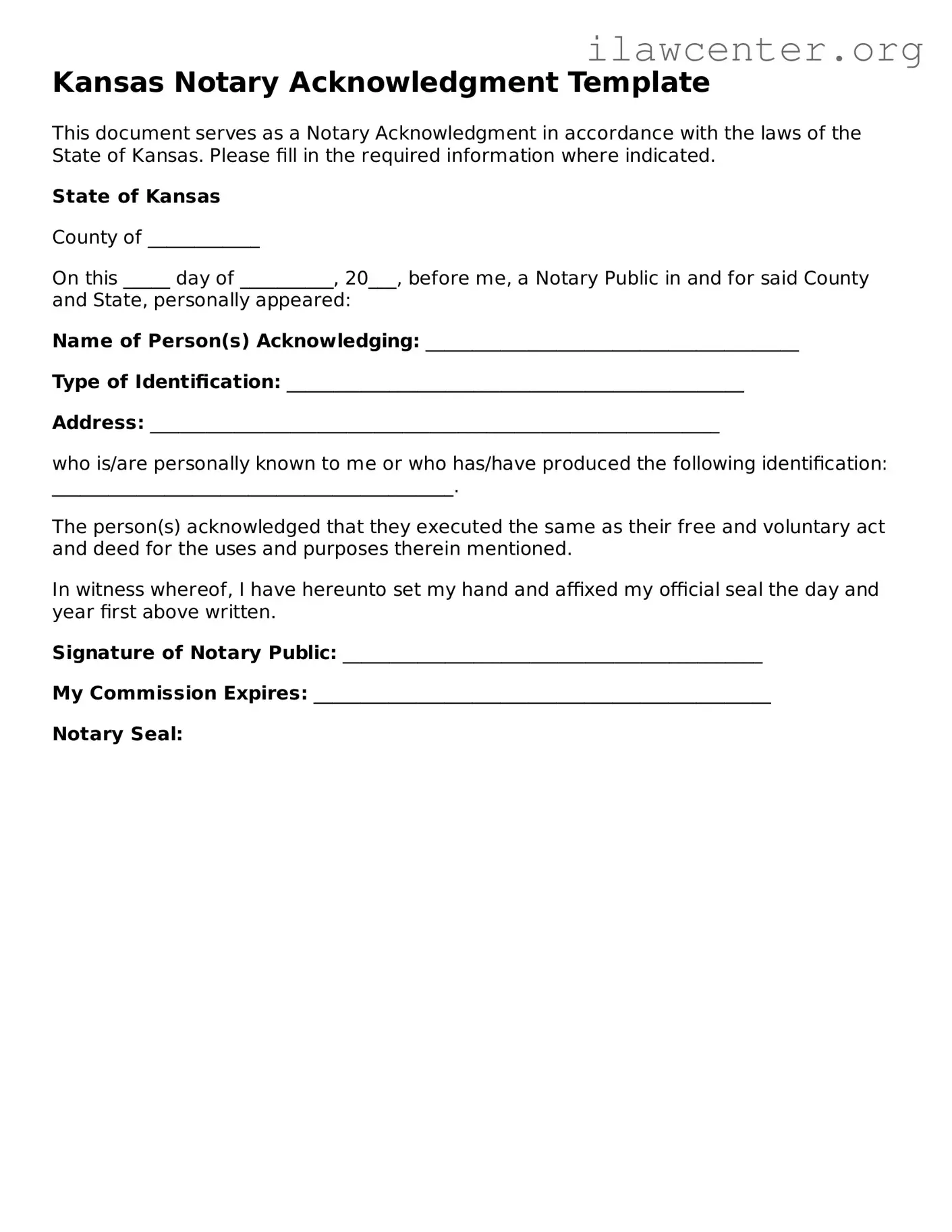
Kansas Notary Acknowledgement Preview

Kansas Notary Acknowledgment Template

This document serves as a Notary Acknowledgment in accordance with the laws of the State of Kansas. Please fill in the required information where indicated.

State of Kansas

County of ____________

On this _____ day of __________, 20___, before me, a Notary Public in and for said County and State, personally appeared:

Name of Person(s) Acknowledging: ________________________________________

Type of Identification: _________________________________________________

Address: _____________________________________________________________

who is/are personally known to me or who has/have produced the following identification: ___________________________________________.

The person(s) acknowledged that they executed the same as their free and voluntary act and deed for the uses and purposes therein mentioned.

In witness whereof, I have hereunto set my hand and affixed my official seal the day and year first above written.

Signature of Notary Public: _____________________________________________

My Commission Expires: _________________________________________________

Notary Seal:

PDF Form Characteristics

Fact Name Description
Governing Law The Kansas Notary Acknowledgment form is governed by K.S.A. 53-501 et seq.
Purpose This form is used to verify the identity of a signer and confirm that they willingly signed a document.
Signature Requirement The signer must personally appear before the notary public to sign the acknowledgment.
Notary's Role A notary public must witness the signature and complete the acknowledgment form.
Form Content The form typically includes the date, the signer's name, and the notary's signature and seal.
Seal Requirement A notary public must affix their official seal to the acknowledgment form for it to be valid.
Record Keeping Notaries are required to maintain a record of all acknowledgments performed in their notary journal.
Validity The acknowledgment is valid in Kansas as long as it meets the statutory requirements.
Use Cases This form is commonly used for real estate transactions, legal documents, and powers of attorney.

Instructions on Utilizing Kansas Notary Acknowledgement

Filling out the Kansas Notary Acknowledgement form is a straightforward process. After completing the form, you will be ready to submit it as needed for your legal documents or transactions. Follow these steps to ensure that you fill it out correctly.

  1. Begin by locating the Kansas Notary Acknowledgement form. You can find it online or at your local notary office.
  2. At the top of the form, write the date when the acknowledgment is being made.
  3. In the designated area, enter the name of the person who is signing the document. Make sure to spell their name correctly.
  4. Next, provide the address of the signer. This should include the street address, city, and state.
  5. In the following section, you will need to indicate the type of identification the signer is providing. Common options include a driver’s license or passport.
  6. Write down the identification number from the signer’s ID in the appropriate space.
  7. Now, the notary public will need to sign the form. Leave space for their signature at the bottom.
  8. Finally, ensure that the notary public completes the date and their official seal on the form.

Once you have filled out the form and it has been properly signed and sealed by the notary, you can proceed with your legal matters confidently.

Important Facts about Kansas Notary Acknowledgement

What is a Kansas Notary Acknowledgement form?

The Kansas Notary Acknowledgement form is a legal document used to verify the identity of a signer and confirm that they willingly signed a document. This form is essential in ensuring the authenticity of signatures on various legal documents, such as contracts, deeds, and affidavits. It serves to protect all parties involved by providing a clear record of the signing process.

Who can act as a notary in Kansas?

In Kansas, a notary public is an individual appointed by the Secretary of State to perform notarial acts. To become a notary, one must meet specific requirements, including being at least 18 years old, a resident of Kansas or a resident of a bordering state, and having no felony convictions. Notaries play a crucial role in maintaining the integrity of legal documents.

How do I complete a Kansas Notary Acknowledgement form?

Completing a Kansas Notary Acknowledgement form involves several steps. First, the signer must appear before the notary. The notary will then ask the signer to provide identification to verify their identity. After confirming the identity, the notary will complete the form by filling in details such as the date, the signer's name, and the document being acknowledged. Finally, the notary will sign and affix their seal to the form, completing the process.

Is a Notary Acknowledgement form required for all documents?

No, a Notary Acknowledgement form is not required for every document. However, many legal documents benefit from having this form attached, as it adds an extra layer of verification. Common documents that often require notarization include real estate transactions, powers of attorney, and certain court documents. Always check the specific requirements for your document to ensure compliance.

What happens if a Notary Acknowledgement is not completed correctly?

If a Notary Acknowledgement is not completed correctly, the document may be considered invalid. This can lead to complications, including delays in legal proceedings or issues with enforcement. It's vital to ensure that all information is accurate and that the notary follows proper procedures to avoid any potential problems.

Can I use a Kansas Notary Acknowledgement form for documents signed outside of Kansas?

Generally, a Kansas Notary Acknowledgement form is intended for use within Kansas. If a document is signed outside of Kansas, it may require a different acknowledgment form or the services of a notary public in that jurisdiction. Always consult local laws to ensure that the correct form is used for documents executed outside of Kansas.

How long is a Kansas Notary Acknowledgement valid?

A Kansas Notary Acknowledgement does not have a specific expiration date. However, the validity of the acknowledgment can be affected by the document it is attached to. If the underlying document has a set expiration date or if legal circumstances change, the acknowledgment may no longer hold value. Always ensure that the document remains valid and relevant.

What should I do if my notary public is unavailable?

If your notary public is unavailable, you have a couple of options. You can seek another notary public who can perform the acknowledgment for you. Many banks, law offices, and shipping centers offer notary services. Alternatively, if time is of the essence, consider scheduling an appointment with your notary for a later date. Ensure that you have all necessary documents ready to facilitate a smooth process.

Can a notary public refuse to notarize a document?

Yes, a notary public can refuse to notarize a document under certain circumstances. If the notary has doubts about the signer's identity, if the signer appears under duress, or if the document does not meet legal requirements, the notary has the right to decline. It's essential for notaries to adhere to ethical standards and ensure that all conditions for notarization are met.
Common mistakes

When filling out the Kansas Notary Acknowledgement form, people often make several common mistakes that can lead to complications. One frequent error is failing to include the correct date. The date is crucial as it indicates when the acknowledgment took place. Without it, the document may be considered incomplete.

Another mistake involves not providing the signer's name correctly. It is essential that the name on the form matches the name on the identification presented. If there are discrepancies, it could raise questions about the validity of the acknowledgment.

Some individuals forget to check the identification of the signer. Notaries must verify that the person signing the document is indeed who they claim to be. Failing to do so can result in legal challenges down the line.

Additionally, people sometimes neglect to fill out the notary's information completely. This includes the notary's name, signature, and seal. Omitting any of these elements can render the acknowledgment ineffective.

Another common oversight is not including the venue. The venue indicates where the acknowledgment took place. Without it, the document may lack essential context and could be questioned in legal settings.

Some individuals may rush through the process and fail to read the entire form. This can lead to misunderstandings about what is required. Taking the time to read carefully can help avoid mistakes.

Moreover, people sometimes forget to sign the acknowledgment themselves. The notary must sign the document, but the signer must also provide their signature. Both signatures are necessary for the acknowledgment to be valid.

Lastly, notaries may fail to keep a proper record of the acknowledgment. Maintaining a journal of notarial acts is important for accountability. Without proper records, it can be challenging to verify past acknowledgments if questions arise later.

Documents used along the form

When dealing with the Kansas Notary Acknowledgement form, several other documents often accompany it to ensure proper legal procedures are followed. Each of these documents plays a vital role in various transactions and legal processes. Below is a list of commonly used forms that complement the Notary Acknowledgement.

  • Power of Attorney: This document allows one person to grant another the authority to act on their behalf in legal or financial matters. It can be specific or general and is often notarized to confirm the identity of the parties involved.
  • Affidavit: An affidavit is a written statement confirmed by oath or affirmation, used as evidence in court. It must be notarized to validate the identity of the person making the statement.
  • Deed: A deed is a legal document that transfers ownership of property from one party to another. It typically requires notarization to ensure that the signatures are legitimate and that the transfer is legally binding.
  • Mortgage Agreement: This document outlines the terms of a loan secured by real estate. Notarization is often required to protect all parties and ensure that the agreement is enforceable.
  • Certificate of Trust: This document certifies the existence of a trust and outlines the powers of the trustee. Notarization adds a layer of authenticity, ensuring that the trust is recognized by financial institutions and other entities.
  • Release of Liability: This form releases one party from legal responsibility for certain actions or events. Notarization helps confirm that all parties understand and agree to the terms outlined in the document.

Each of these documents serves a unique purpose and can be essential in various legal situations. Understanding their roles can help individuals navigate the complexities of legal transactions more effectively.

Similar forms

The Notary Acknowledgment form serves a vital role in the legal process, confirming that a signature on a document is genuine. Several other documents share similar functions or purposes. Here’s a look at six documents that are comparable to the Notary Acknowledgment form:

  • Affidavit: An affidavit is a written statement confirmed by oath or affirmation. Like a Notary Acknowledgment, it requires a notary to verify the identity of the person making the statement and to ensure that the signature is authentic.
  • Power of Attorney: This document grants someone the authority to act on another person's behalf. Notarization is often required to validate the Power of Attorney, similar to how a Notary Acknowledgment confirms the authenticity of a signature.
  • Deed: A deed transfers ownership of real property. Notarization is typically required to ensure that the parties involved are who they claim to be, mirroring the purpose of a Notary Acknowledgment.
  • Wills: A will outlines how a person's assets should be distributed after their death. While not always required, notarization can add an extra layer of validation, akin to the Notary Acknowledgment process.
  • Contracts: Certain contracts may require notarization to be enforceable. This ensures that all parties involved are properly identified and agree to the terms, similar to the function of a Notary Acknowledgment.
  • Loan Documents: Many loan agreements require notarization to confirm the identities of the parties involved and to validate their signatures. This process is similar to that of a Notary Acknowledgment, ensuring authenticity and preventing fraud.

Each of these documents plays a crucial role in legal transactions, just as the Notary Acknowledgment does. Understanding their similarities can help clarify their importance in the legal landscape.

Dos and Don'ts

When filling out the Kansas Notary Acknowledgement form, it is important to follow certain guidelines to ensure accuracy and compliance. Here are four things to do and four things to avoid:

Things to Do:

  • Provide accurate information about the signer, including their name and address.
  • Ensure that the signer is present when you complete the acknowledgment.
  • Use a black or blue pen to fill out the form, as this is standard practice.
  • Sign and stamp the form in the designated area to validate the acknowledgment.

Things to Avoid:

  • Do not fill out the form without the signer being present.
  • Avoid using white-out or erasing any information on the form.
  • Do not sign the form until the signer has completed their part.
  • Refrain from using any abbreviations or unclear language that could lead to confusion.

Misconceptions

Notary acknowledgments are essential in many legal processes, yet several misconceptions exist about the Kansas Notary Acknowledgment form. Understanding these misconceptions can help individuals navigate the notary process more effectively.

  • The form is only necessary for real estate transactions. Many people believe that notary acknowledgments are only required for real estate documents. In reality, they can be needed for various legal documents, including contracts, powers of attorney, and other agreements.
  • A notary can perform the acknowledgment without the signer present. Some individuals think that a notary can complete the acknowledgment process without the signer being present. This is incorrect. The signer must appear before the notary and provide identification to verify their identity.
  • Notaries can provide legal advice during the acknowledgment process. Another common misconception is that notaries can give legal advice or explain the contents of the document being acknowledged. Notaries are not authorized to provide legal counsel; their role is to verify identities and witness signatures.
  • All notaries can notarize documents in any state. Many assume that a notary public can notarize documents anywhere in the United States. However, notaries are typically limited to the jurisdiction in which they are commissioned. A Kansas notary cannot notarize documents in another state unless they are also commissioned there.

By clarifying these misconceptions, individuals can better understand the purpose and limitations of the Kansas Notary Acknowledgment form, leading to smoother legal transactions.

Key takeaways

When filling out and using the Kansas Notary Acknowledgement form, it is essential to understand its components and requirements. Here are some key takeaways:

  1. Purpose: The form serves to verify the identity of the signer and confirm that they signed the document voluntarily.
  2. Identification: Notaries must ensure that they properly identify the individual signing the document. Acceptable forms of identification include a driver's license or a passport.
  3. Signature: The signer must provide their signature in the presence of the notary. This step is crucial for the acknowledgment to be valid.
  4. Date: The notary must include the date of the acknowledgment. This date is important for record-keeping and legal purposes.
  5. Notary Seal: A notary seal or stamp must be affixed to the acknowledgment form. This seal serves as an official mark of the notary's authority.
  6. State Requirements: Familiarity with Kansas state laws regarding notarial acts is essential. Each state may have specific rules that govern notary practices.
  7. Record Keeping: Notaries are encouraged to maintain a journal of their notarial acts. This practice can provide a record in case of future disputes.
  8. Limitations: Notaries cannot provide legal advice or assist in the completion of the document being acknowledged. Their role is strictly to witness the signing process.

Understanding these key points can help ensure that the Kansas Notary Acknowledgement form is filled out correctly and used effectively.