Attorney-Verified  Power of Attorney Document for Kansas

Attorney-Verified Power of Attorney Document for Kansas

A Kansas Power of Attorney form is a legal document that allows an individual to appoint someone else to make decisions on their behalf, especially in financial or medical matters. This form is crucial for ensuring that your wishes are respected when you are unable to communicate them yourself. Don’t wait—fill out the form by clicking the button below.

Article Guide

The Kansas Power of Attorney form is a crucial legal document that allows individuals to designate someone they trust to make decisions on their behalf. This can include managing financial matters, making healthcare choices, or handling real estate transactions. By using this form, you can ensure that your affairs are managed according to your wishes, especially in situations where you may be unable to communicate or make decisions for yourself. The form typically includes sections for appointing an agent, outlining their powers, and specifying any limitations on those powers. Additionally, it may require signatures from witnesses or a notary to validate the document. Understanding the key components and implications of the Kansas Power of Attorney form is essential for anyone looking to secure their future and protect their interests.

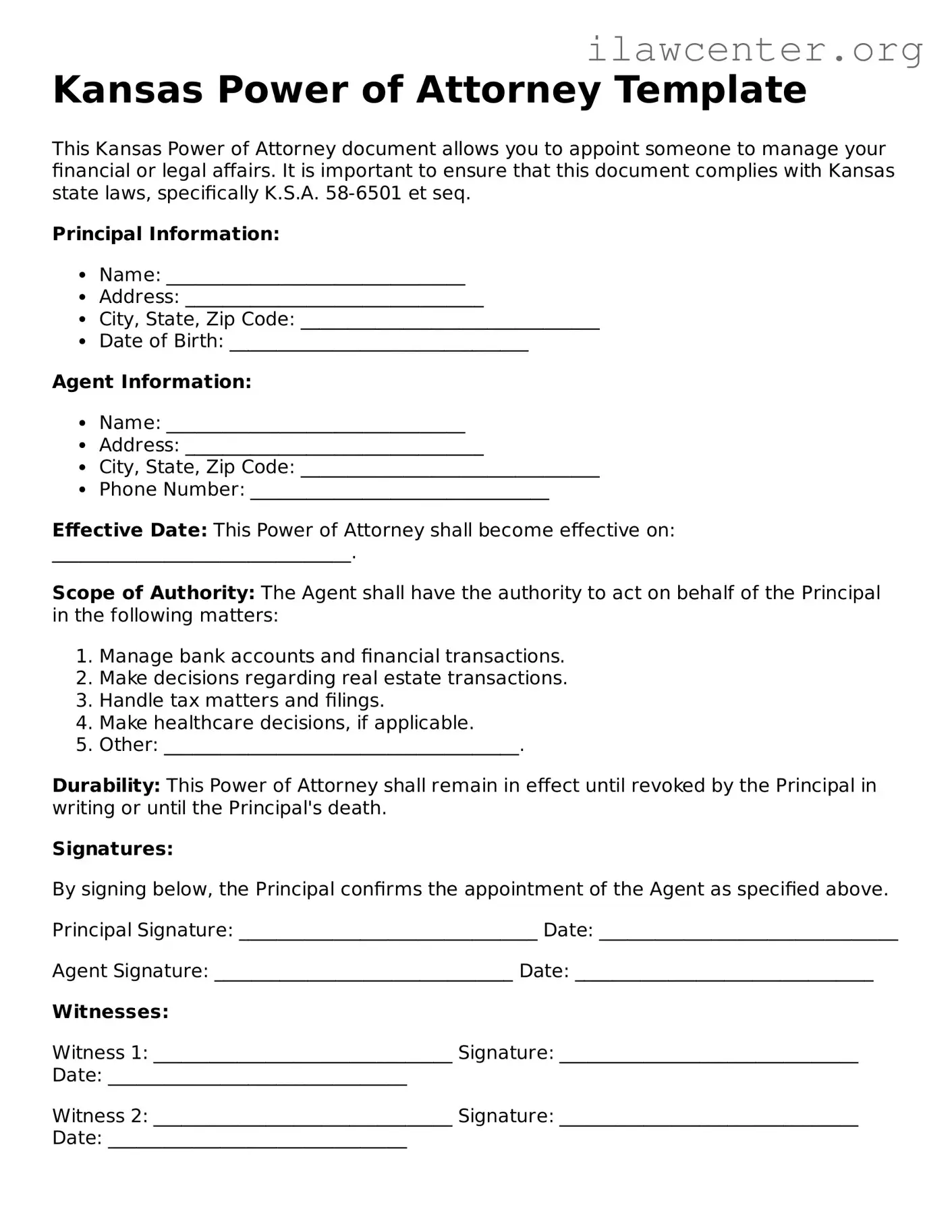
Kansas Power of Attorney Preview

Kansas Power of Attorney Template

This Kansas Power of Attorney document allows you to appoint someone to manage your financial or legal affairs. It is important to ensure that this document complies with Kansas state laws, specifically K.S.A. 58-6501 et seq.

Principal Information:

  • Name: ________________________________
  • Address: ________________________________
  • City, State, Zip Code: ________________________________
  • Date of Birth: ________________________________

Agent Information:

  • Name: ________________________________
  • Address: ________________________________
  • City, State, Zip Code: ________________________________
  • Phone Number: ________________________________

Effective Date: This Power of Attorney shall become effective on: ________________________________.

Scope of Authority: The Agent shall have the authority to act on behalf of the Principal in the following matters:

  1. Manage bank accounts and financial transactions.
  2. Make decisions regarding real estate transactions.
  3. Handle tax matters and filings.
  4. Make healthcare decisions, if applicable.
  5. Other: ______________________________________.

Durability: This Power of Attorney shall remain in effect until revoked by the Principal in writing or until the Principal's death.

Signatures:

By signing below, the Principal confirms the appointment of the Agent as specified above.

Principal Signature: ________________________________ Date: ________________________________

Agent Signature: ________________________________ Date: ________________________________

Witnesses:

Witness 1: ________________________________ Signature: ________________________________ Date: ________________________________

Witness 2: ________________________________ Signature: ________________________________ Date: ________________________________

Notarization:

State of Kansas, County of ________________________________.

Subscribed and sworn to before me this _____ day of ____________, 20__.

Notary Public: ________________________________ My Commission Expires: ________________________________

PDF Form Characteristics

Fact Name Details
Governing Law The Kansas Power of Attorney is governed by the Kansas Uniform Power of Attorney Act, K.S.A. 58-6501 et seq.
Types of Powers A Power of Attorney can grant either general or specific powers to the agent, allowing them to manage financial or medical decisions.
Durability The Kansas Power of Attorney can be made durable, meaning it remains effective even if the principal becomes incapacitated.
Agent's Authority The agent's authority can include making decisions regarding property, finances, and healthcare, depending on the specified powers.
Signing Requirements The form must be signed by the principal in the presence of a notary public or two witnesses to be valid.
Revocation The principal can revoke the Power of Attorney at any time, as long as they are competent to do so.

Instructions on Utilizing Kansas Power of Attorney

Filling out the Kansas Power of Attorney form is an important step in designating someone to manage your financial or legal affairs. Once completed, this form will empower your chosen agent to act on your behalf, ensuring your interests are represented. Follow the steps below carefully to ensure accuracy and compliance.

  1. Obtain the Form: Download the Kansas Power of Attorney form from a reliable source or acquire a hard copy from an attorney or legal service provider.
  2. Identify Yourself: In the designated section, clearly print your full name and address. This identifies you as the principal.
  3. Select Your Agent: Write the name and address of the person you are appointing as your agent. This individual will have the authority to act on your behalf.
  4. Specify Powers Granted: Indicate the specific powers you wish to grant to your agent. You may choose general powers or limit them to specific tasks.
  5. Set an Expiration Date: If desired, include an expiration date for the power of attorney. If no date is specified, it remains in effect until revoked.
  6. Sign the Form: Sign and date the form in the presence of a notary public. This step is crucial for the form to be legally valid.
  7. Distribute Copies: After notarization, make copies of the signed form for your agent and any relevant institutions, such as banks or healthcare providers.

Once you have completed these steps, your Kansas Power of Attorney form will be ready for use. Ensure that your agent understands their responsibilities and that they have access to the necessary copies to act on your behalf when needed.

Important Facts about Kansas Power of Attorney

What is a Power of Attorney in Kansas?

A Power of Attorney (POA) is a legal document that allows one person to grant another person the authority to act on their behalf. In Kansas, this can cover financial matters, healthcare decisions, or other personal affairs. The person granting the authority is known as the principal, while the person receiving the authority is called the agent or attorney-in-fact.

What types of Power of Attorney are available in Kansas?

Kansas recognizes several types of Power of Attorney. The most common are General Power of Attorney, which gives broad powers to the agent, and Limited Power of Attorney, which restricts the agent's authority to specific tasks or time frames. There is also a Durable Power of Attorney, which remains effective even if the principal becomes incapacitated, and a Healthcare Power of Attorney, which specifically pertains to medical decisions.

How do I create a Power of Attorney in Kansas?

To create a Power of Attorney in Kansas, you need to complete the appropriate form, clearly specifying the powers you wish to grant. The form must be signed by the principal and notarized. It’s important to ensure that the document complies with Kansas law to be valid. Consider consulting with a legal professional if you have any questions about the process.

Can I revoke a Power of Attorney in Kansas?

Yes, you can revoke a Power of Attorney at any time, as long as you are mentally competent. To revoke, you must create a written document stating your intention to revoke the POA. This revocation should be signed and dated, and it’s advisable to notify your agent and any institutions or individuals that may have relied on the original Power of Attorney.

What happens if the principal becomes incapacitated?

If the principal becomes incapacitated and has executed a Durable Power of Attorney, the agent can continue to act on their behalf. If the Power of Attorney is not durable, it will become invalid upon the principal's incapacitation. It’s crucial to understand the type of Power of Attorney you are using to ensure that your wishes are honored in case of incapacity.

Do I need an attorney to create a Power of Attorney in Kansas?

No, you do not need an attorney to create a Power of Attorney in Kansas. However, consulting with a legal professional can provide valuable guidance and ensure that the document meets all legal requirements. This is especially recommended if your situation is complex or if you have specific concerns about the powers you wish to grant.

Common mistakes

Filling out a Power of Attorney (POA) form can be a straightforward process, but many people stumble along the way. One common mistake is failing to specify the powers granted. A POA can be general or limited, and without clear definitions, the agent may not have the authority to act in the ways you intended. Always ensure that you clearly outline what powers you are granting to your agent, whether it’s handling financial matters, making healthcare decisions, or both.

Another frequent error is neglecting to sign the document properly. A Power of Attorney must be signed by the principal, the person granting the authority. If the signature is missing or not dated, the document may be considered invalid. Double-check that you have signed and dated the form, and remember that some states may require a witness or notarization to make the document legally binding.

People often overlook the importance of choosing the right agent. Selecting someone who is not trustworthy or who may not have your best interests at heart can lead to complications. It’s essential to choose an individual who is reliable and capable of making decisions on your behalf. Discuss your choice with that person beforehand to ensure they are willing to take on this responsibility.

Additionally, failing to keep the Power of Attorney document updated is a mistake that can have serious consequences. Life changes, such as marriage, divorce, or the death of an agent, may necessitate revisions to your POA. Regularly review the document to ensure it reflects your current wishes and circumstances.

Some individuals mistakenly believe that a Power of Attorney is only necessary for older adults. In reality, anyone can benefit from having a POA, especially those who may face unexpected health issues or accidents. It's a proactive step that can save time and stress for your loved ones in a crisis.

Lastly, many people do not discuss their wishes with their agent or family members. A Power of Attorney is not just a legal document; it represents your preferences and values. Open conversations about your intentions can help prevent confusion and conflict later on. Make sure your loved ones understand your choices and the reasons behind them.

Documents used along the form

The Kansas Power of Attorney form is a crucial document that allows an individual to appoint someone else to make decisions on their behalf. However, several other forms and documents may be used in conjunction with it to ensure comprehensive management of personal and financial matters. Below is a list of commonly associated documents.

  • Durable Power of Attorney: This document grants authority to an agent to make decisions on behalf of the principal even if the principal becomes incapacitated. It remains effective until the principal revokes it or passes away.
  • Advance Healthcare Directive: Also known as a living will, this document outlines an individual's preferences regarding medical treatment and end-of-life care. It can specify what types of medical interventions should or should not be used.
  • HIPAA Release Form: This form allows designated individuals to access a person's medical records and health information. It ensures that healthcare providers can share necessary information with the appointed agents.
  • Will: A will outlines how a person's assets should be distributed after their death. It can also designate guardians for minor children and address other important matters related to the individual's estate.

Utilizing these documents alongside the Kansas Power of Attorney can provide a more complete framework for managing personal and financial affairs, ensuring that an individual’s wishes are respected and followed in various circumstances.

Similar forms

The Power of Attorney (POA) form is an important legal document that grants someone the authority to act on another person's behalf. While it serves a specific purpose, several other documents share similarities in function and intent. Here are eight documents that are comparable to the Power of Attorney:

  • Living Will: This document outlines a person's wishes regarding medical treatment in situations where they cannot communicate their preferences. Like a POA, it empowers someone to make decisions on behalf of another, but it focuses specifically on healthcare choices.
  • Healthcare Proxy: This is a type of POA specifically for healthcare decisions. It designates an individual to make medical choices if the person is incapacitated, ensuring that their healthcare preferences are respected.
  • Durable Power of Attorney: Similar to a standard POA, this document remains effective even if the person becomes incapacitated. It ensures that financial and legal decisions can continue to be made on behalf of the individual.
  • Financial Power of Attorney: This document specifically grants authority to handle financial matters. It allows the designated person to manage bank accounts, pay bills, and make investment decisions, similar to a general POA.
  • Trust Agreement: A trust allows a person to place assets under the management of a trustee for the benefit of beneficiaries. Both trusts and POAs involve delegating authority, but trusts typically focus on asset management and distribution.
  • Will: While a will takes effect after a person's death, it serves a similar purpose of designating how a person's affairs should be managed. Both documents reflect the individual's wishes, though they operate at different times.
  • Guardianship Agreement: This document appoints someone to care for a minor or an incapacitated adult. Like a POA, it involves decision-making authority, but it often extends to personal care and living arrangements.
  • Advance Directive: This combines elements of both a living will and a healthcare proxy. It provides instructions for medical treatment and designates a representative to make decisions, paralleling the decision-making authority found in a POA.

Understanding these documents can help individuals make informed decisions about their legal and healthcare needs. Each serves a unique purpose, yet they all share the common goal of ensuring that a person's wishes are honored when they cannot advocate for themselves.

Dos and Don'ts

When filling out the Kansas Power of Attorney form, it is essential to approach the process with care. Here are some important dos and don'ts to keep in mind:

  • Do ensure that you understand the powers you are granting to your agent.
  • Do choose a trustworthy person to act as your agent.
  • Do clearly specify the powers you wish to grant in the document.
  • Do date and sign the form in front of a notary public.
  • Don't leave any sections of the form blank; complete all required fields.
  • Don't assume that the form is valid without proper signatures and notarization.
  • Don't select an agent who may have conflicting interests or may not act in your best interest.
  • Don't forget to provide copies of the signed document to your agent and any relevant institutions.

Misconceptions

Understanding the Kansas Power of Attorney form is crucial for effective legal planning. However, several misconceptions can lead to confusion. Here are six common misconceptions:

  1. Only lawyers can create a Power of Attorney.

    This is not true. While consulting a lawyer can be beneficial, individuals can fill out and execute a Power of Attorney form on their own, as long as they meet the legal requirements.

  2. A Power of Attorney is only for financial matters.

    Many people believe that a Power of Attorney is limited to financial decisions. In reality, it can also cover health care decisions, property management, and other personal matters.

  3. Once a Power of Attorney is signed, it cannot be changed.

    This misconception is incorrect. You can revoke or modify a Power of Attorney at any time, as long as you are mentally competent to do so.

  4. A Power of Attorney is effective immediately after signing.

    While some Powers of Attorney are effective immediately, others can be set to activate only under certain conditions, such as incapacitation. It's important to specify the terms clearly.

  5. My Power of Attorney will automatically end when I die.

    This is a common belief, but it’s important to note that a Power of Attorney does indeed terminate upon the principal's death. However, any actions taken while the principal was alive remain valid.

  6. Anyone can be appointed as my agent.

    While you have the freedom to choose your agent, it’s essential to select someone trustworthy and capable. Not everyone is qualified to act in this capacity, especially if they lack the necessary knowledge or experience.

By addressing these misconceptions, individuals can make informed decisions regarding their Power of Attorney and ensure their wishes are respected.

Key takeaways

Filling out and using a Kansas Power of Attorney form is an important step in managing your financial and legal affairs. Here are some key takeaways to consider:

  1. Understand the Types: There are different types of Power of Attorney forms available in Kansas. A general Power of Attorney grants broad powers, while a durable Power of Attorney remains effective even if you become incapacitated.
  2. Choose Your Agent Wisely: The person you designate as your agent should be someone you trust completely. This individual will have the authority to make significant decisions on your behalf.
  3. Be Clear and Specific: When filling out the form, be as specific as possible about the powers you are granting. This helps avoid any confusion or misinterpretation later on.
  4. Sign and Date Properly: Ensure that you sign and date the Power of Attorney form in the presence of a notary public. This step is crucial for the document to be legally valid.
  5. Review Regularly: Life circumstances change, and so may your needs. Regularly review your Power of Attorney to ensure it still reflects your wishes and the current situation.

By keeping these points in mind, you can effectively navigate the process of creating and using a Kansas Power of Attorney form.