Attorney-Verified  Promissory Note Document for Kansas

Attorney-Verified Promissory Note Document for Kansas

A Kansas Promissory Note is a legal document that outlines a borrower's promise to repay a specified amount of money to a lender under agreed-upon terms. This form serves as a crucial tool for both parties, ensuring clarity and protection in financial transactions. To create your own Promissory Note, click the button below.

Article Guide

In the realm of personal and business finance, the Kansas Promissory Note form serves as a vital tool for establishing clear and enforceable agreements between parties. This document outlines the borrower's promise to repay a specified amount of money to the lender, detailing essential elements such as the loan amount, interest rate, payment schedule, and maturity date. Importantly, it also includes provisions regarding default, which helps protect the lender's interests in the event that the borrower fails to meet their obligations. The form can be customized to fit various lending situations, whether for personal loans, business financing, or real estate transactions. By providing a structured framework for the loan agreement, the Kansas Promissory Note not only fosters transparency but also minimizes potential disputes, ensuring that both parties understand their rights and responsibilities. Understanding the nuances of this form can empower individuals and businesses alike to navigate their financial commitments with confidence.

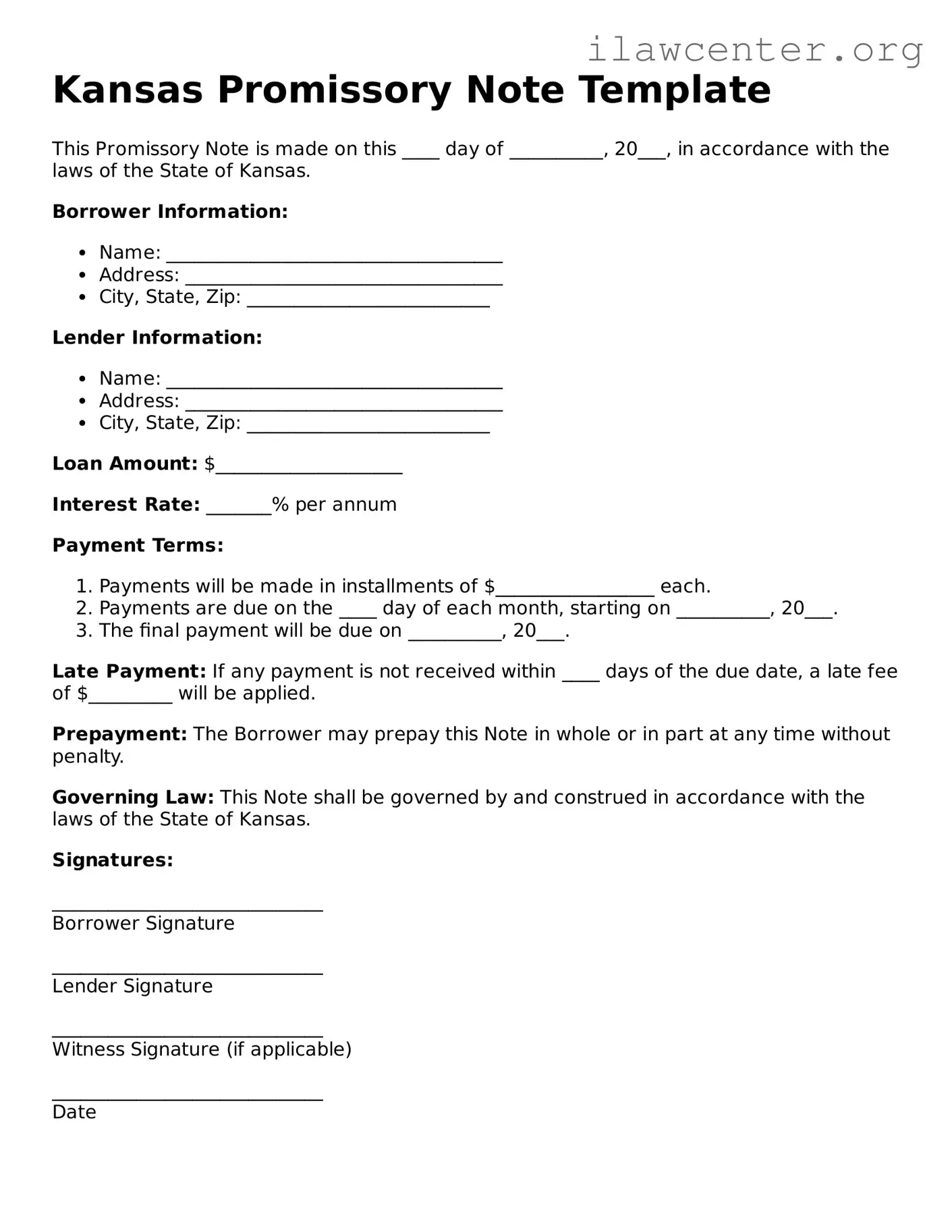
Kansas Promissory Note Preview

Kansas Promissory Note Template

This Promissory Note is made on this ____ day of __________, 20___, in accordance with the laws of the State of Kansas.

Borrower Information:

  • Name: ____________________________________
  • Address: __________________________________
  • City, State, Zip: __________________________

Lender Information:

  • Name: ____________________________________
  • Address: __________________________________
  • City, State, Zip: __________________________

Loan Amount: $____________________

Interest Rate: _______% per annum

Payment Terms:

  1. Payments will be made in installments of $_________________ each.
  2. Payments are due on the ____ day of each month, starting on __________, 20___.
  3. The final payment will be due on __________, 20___.

Late Payment: If any payment is not received within ____ days of the due date, a late fee of $_________ will be applied.

Prepayment: The Borrower may prepay this Note in whole or in part at any time without penalty.

Governing Law: This Note shall be governed by and construed in accordance with the laws of the State of Kansas.

Signatures:

_____________________________
Borrower Signature

_____________________________
Lender Signature

_____________________________
Witness Signature (if applicable)

_____________________________
Date

PDF Form Characteristics

Fact Name Description
Definition A Kansas Promissory Note is a written promise to pay a specific amount of money to a designated person or entity at a specified time.
Governing Law The Kansas Uniform Commercial Code (UCC) governs promissory notes in Kansas, specifically under Article 3.
Key Elements Essential elements include the date, amount, interest rate (if applicable), payment terms, and signatures of the parties involved.
Transferability Promissory notes in Kansas can be transferred to another party, allowing for flexibility in financial transactions.
Enforceability For a promissory note to be enforceable, it must be clear, unambiguous, and signed by the maker.

Instructions on Utilizing Kansas Promissory Note

Once you have the Kansas Promissory Note form in front of you, it’s time to fill it out carefully. Make sure you have all the necessary information at hand, as this will help you complete the form accurately.

  1. Start by entering the date at the top of the form. Use the format month, day, year.
  2. Next, fill in the name and address of the borrower. This is the person who will be responsible for repaying the loan.
  3. Then, provide the lender’s name and address. This is the person or entity providing the loan.
  4. Indicate the principal amount of the loan. This is the total amount borrowed.
  5. Specify the interest rate. Make sure to write it as a percentage.
  6. Detail the payment schedule. Include how often payments are due (monthly, quarterly, etc.) and the amount of each payment.
  7. Include the maturity date. This is when the loan must be fully paid off.
  8. Provide any additional terms or conditions relevant to the loan. This could include late fees or prepayment options.
  9. Finally, both the borrower and lender should sign and date the form at the bottom.

Important Facts about Kansas Promissory Note

What is a Kansas Promissory Note?

A Kansas Promissory Note is a written agreement in which one party promises to pay a specific amount of money to another party at a designated time or on demand. It serves as a legal document that outlines the terms of the loan, including interest rates, repayment schedules, and any collateral involved. This form is commonly used in personal loans, business transactions, and real estate deals in Kansas.

What are the key components of a Kansas Promissory Note?

Essential components include the names and addresses of the borrower and lender, the principal amount, the interest rate, the repayment terms, and the date of the agreement. Additionally, any penalties for late payments or default, as well as provisions for prepayment, should be clearly stated. Including these details ensures clarity and protects the rights of both parties.

Is a Kansas Promissory Note legally binding?

Yes, a properly executed Kansas Promissory Note is legally binding. This means that if one party fails to uphold their end of the agreement, the other party can take legal action to enforce the terms. To be enforceable, the note must meet specific legal requirements, such as being signed by the borrower and containing all necessary details.

Do I need to notarize a Kansas Promissory Note?

Notarization is not required for a Kansas Promissory Note to be valid. However, having the document notarized can add an extra layer of security and credibility. It provides proof that the parties involved willingly signed the document, which can be beneficial in case of a dispute.

What happens if the borrower defaults on the loan?

If the borrower defaults, the lender has several options. They may choose to initiate legal proceedings to recover the owed amount. The terms of the promissory note should outline the steps the lender can take in the event of a default, including any late fees or interest that may accrue. Understanding these terms beforehand can help both parties navigate potential issues.

Can a Kansas Promissory Note be modified?

Yes, a Kansas Promissory Note can be modified if both parties agree to the changes. It is advisable to document any modifications in writing and have both parties sign the amended note. This ensures that there is a clear record of the new terms and helps prevent misunderstandings in the future.

Where can I obtain a Kansas Promissory Note form?

Kansas Promissory Note forms can be obtained from various sources. Many legal websites offer templates that can be customized to fit specific needs. Additionally, local legal offices or financial institutions may provide forms. It is important to ensure that the form complies with Kansas state laws and includes all necessary information.
Common mistakes

Filling out a Kansas Promissory Note form can be straightforward, but several common mistakes can lead to complications. One frequent error is failing to include all necessary parties. The borrower and lender must be clearly identified. Omitting a party or using incorrect names can create confusion and legal issues later on.

Another mistake involves the amount of the loan. It's essential to specify the exact sum being borrowed. Rounding off the number or using vague terms can lead to disputes. Always write the amount in both numerical and written form to avoid ambiguity.

People often overlook the importance of specifying the interest rate. If no interest rate is indicated, the loan may be considered interest-free, which may not reflect the intentions of the lender. Ensure that the interest rate is clearly stated and complies with Kansas law.

Additionally, many individuals forget to outline the repayment terms. It’s vital to detail how and when payments will be made. This includes specifying the payment schedule, due dates, and any grace periods. Without clear repayment terms, misunderstandings can arise.

Another common oversight is neglecting to include a late fee provision. If payments are missed, having a clearly defined late fee can provide protection for the lender. This clause should specify the amount of the fee and when it will be applied.

Signatures are crucial. Failing to obtain the necessary signatures from all parties can render the document invalid. Each party involved must sign and date the document to ensure it is legally binding.

Finally, not keeping a copy of the completed Promissory Note is a mistake many make. Always retain a signed copy for your records. This ensures that both parties have access to the agreed-upon terms and can refer back to them if needed.

Documents used along the form

When entering into a financial agreement, it is essential to understand the various documents that may accompany a Kansas Promissory Note. Each document serves a specific purpose and helps ensure that both parties are clear on their rights and obligations. Below is a list of commonly used forms and documents that may be utilized alongside a Kansas Promissory Note.

  • Loan Agreement: This document outlines the terms of the loan, including the amount borrowed, interest rate, repayment schedule, and any collateral involved. It serves as a comprehensive guide to the expectations of both the lender and the borrower.
  • Security Agreement: If the loan is secured by collateral, this document specifies what assets are being pledged. It details the rights of the lender in the event of default and ensures that the borrower understands the implications of using collateral.
  • Disclosure Statement: This document provides important information about the loan, including fees, interest rates, and other terms. It ensures transparency and helps the borrower make informed decisions.
  • Personal Guarantee: In some cases, a lender may require a personal guarantee from a third party. This document holds that person responsible for the loan if the borrower defaults, adding an extra layer of security for the lender.
  • Amortization Schedule: This schedule breaks down the repayment plan into monthly payments, showing how much of each payment goes toward interest and how much goes toward the principal. It helps borrowers understand their financial obligations over time.
  • Default Notice: Should a borrower fail to make payments as agreed, a default notice formally informs them of their breach of contract. This document outlines the consequences and the lender's options for recourse.
  • Release of Liability: Once the loan is paid off, this document serves to release the borrower from any further obligations. It provides peace of mind and confirms that the lender has no further claims against the borrower.
  • Assignment of Rights: If the lender decides to transfer the loan to another party, this document formally assigns the rights and obligations of the loan to the new lender, ensuring the continuity of the agreement.
  • Notarization Certificate: This document confirms that the signatures on the promissory note and related documents have been witnessed by a notary public, adding an extra layer of authenticity and legal validity.

Each of these documents plays a crucial role in the lending process. Understanding their purposes can help borrowers and lenders navigate their financial agreements more effectively. Always consider consulting with a legal professional to ensure that all documents are properly drafted and executed.

Similar forms

  • Loan Agreement: Like a promissory note, a loan agreement outlines the terms of a loan, including the amount borrowed, interest rate, and repayment schedule. However, it often includes more detailed terms and conditions.

  • Mortgage: A mortgage is similar in that it involves borrowing money, typically for purchasing real estate. It secures the loan with the property itself, whereas a promissory note is simply a promise to repay.

  • Installment Agreement: This document also details a repayment plan for borrowed funds. It specifies the amount and frequency of payments, similar to a promissory note, but often covers larger transactions or purchases.

  • Credit Agreement: A credit agreement establishes the terms of credit extended to a borrower. It includes repayment terms and interest rates, akin to a promissory note, but is generally broader in scope.

  • Personal Guarantee: A personal guarantee involves an individual agreeing to repay a debt if the primary borrower defaults. It shares similarities with a promissory note in that it represents a commitment to repay a debt.

Dos and Don'ts

When filling out the Kansas Promissory Note form, it is important to follow certain guidelines to ensure accuracy and legality. Here are some key dos and don’ts:

  • Do provide accurate information for all parties involved in the note.
  • Do clearly state the terms of repayment, including interest rates and due dates.
  • Don’t leave any sections blank; all fields should be completed to avoid confusion.
  • Don’t use ambiguous language; clarity is essential in legal documents.

Misconceptions

When discussing the Kansas Promissory Note form, several misconceptions often arise. Understanding these misconceptions can help individuals navigate the legal landscape more effectively.

  • Misconception 1: A promissory note must be notarized to be valid.
  • In Kansas, a promissory note does not require notarization to be enforceable. As long as the note includes the necessary elements, such as the amount, terms of repayment, and signatures, it is valid.

  • Misconception 2: Promissory notes are only for large loans.
  • Many people believe that promissory notes are only used for significant amounts of money. However, they can be used for any loan amount, regardless of size.

  • Misconception 3: All promissory notes are the same.
  • Promissory notes can vary significantly in terms of structure and terms. Each note can be tailored to fit the specific agreement between the lender and borrower.

  • Misconception 4: A verbal agreement is sufficient for a promissory note.
  • While verbal agreements can be legally binding, having a written promissory note provides clear evidence of the terms and conditions, which is crucial in case of disputes.

  • Misconception 5: The borrower can change the terms of the note without the lender's consent.
  • Changes to the terms of a promissory note typically require mutual agreement. The lender must consent to any modifications, ensuring both parties are on the same page.

  • Misconception 6: Promissory notes do not have to include a repayment schedule.
  • It is essential for a promissory note to include a repayment schedule or terms. This clarity helps prevent misunderstandings about when payments are due.

  • Misconception 7: A promissory note does not need to specify interest rates.
  • While it is possible to create a zero-interest promissory note, including an interest rate is common practice. This helps clarify the cost of borrowing and the lender's expectations.

  • Misconception 8: Promissory notes are only for personal loans.
  • Promissory notes can be used in various contexts, including business transactions, real estate deals, and more. They are versatile financial instruments.

  • Misconception 9: If a borrower defaults, the lender has no recourse.
  • In the event of a default, the lender typically has several options, including pursuing legal action to recover the owed amount. A well-drafted promissory note provides the lender with rights to enforce repayment.

Key takeaways

When filling out and utilizing the Kansas Promissory Note form, it is essential to keep several key points in mind. These takeaways can help ensure that the document serves its intended purpose effectively.

  • Clear Identification of Parties: It is crucial to accurately identify both the borrower and the lender. Include full names and addresses to avoid any confusion regarding who is involved in the agreement.
  • Loan Amount and Terms: Specify the exact amount being borrowed, along with the repayment terms. This includes the interest rate, payment schedule, and any late fees that may apply.
  • Signatures and Dates: Ensure that both parties sign and date the document. This step confirms that all parties agree to the terms outlined in the note, making it legally binding.
  • Retention of Copies: After completing the form, both the borrower and lender should keep a copy of the signed document. This practice provides a reference for future communications and helps protect both parties’ interests.