Attorney-Verified  Quitclaim Deed Document for Kansas

Attorney-Verified Quitclaim Deed Document for Kansas

A Kansas Quitclaim Deed is a legal document that allows a property owner to transfer their interest in a property to another party without making any guarantees about the title. This form is often used in situations where the transfer is between family members or in divorce settlements, providing a straightforward way to convey ownership. To get started on filling out the form, click the button below.

Article Guide

The Kansas Quitclaim Deed form serves as a crucial legal instrument for transferring property rights from one party to another without guaranteeing the quality of the title. This type of deed is particularly useful in situations where the granter may not have complete knowledge of the property's history or when the transfer occurs between family members or in informal arrangements. Unlike warranty deeds, which provide assurances regarding the title's validity, quitclaim deeds offer no such protections, making them simpler yet riskier for the grantee. The form typically includes essential details such as the names of the granter and grantee, a description of the property, and the date of the transfer. Signatures from both parties, often notarized, are also required to validate the transaction. Understanding the nuances of this form is vital for anyone involved in property transfers in Kansas, as it can significantly impact the rights and responsibilities of the parties involved.

Kansas Quitclaim Deed Preview

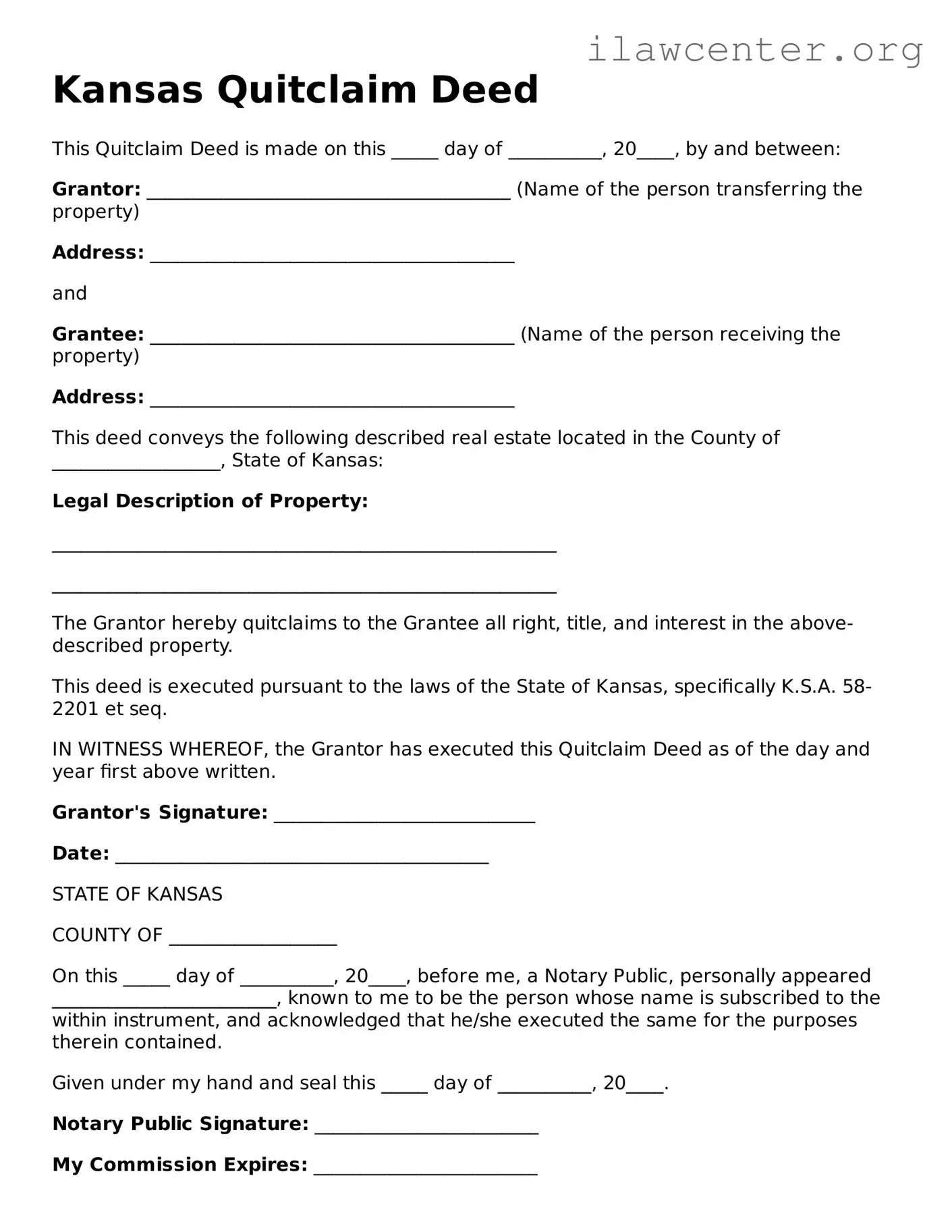
Kansas Quitclaim Deed

This Quitclaim Deed is made on this _____ day of __________, 20____, by and between:

Grantor: _______________________________________ (Name of the person transferring the property)

Address: _______________________________________

and

Grantee: _______________________________________ (Name of the person receiving the property)

Address: _______________________________________

This deed conveys the following described real estate located in the County of __________________, State of Kansas:

Legal Description of Property:

______________________________________________________

______________________________________________________

The Grantor hereby quitclaims to the Grantee all right, title, and interest in the above-described property.

This deed is executed pursuant to the laws of the State of Kansas, specifically K.S.A. 58-2201 et seq.

IN WITNESS WHEREOF, the Grantor has executed this Quitclaim Deed as of the day and year first above written.

Grantor's Signature: ____________________________

Date: ________________________________________

STATE OF KANSAS

COUNTY OF __________________

On this _____ day of __________, 20____, before me, a Notary Public, personally appeared ________________________, known to me to be the person whose name is subscribed to the within instrument, and acknowledged that he/she executed the same for the purposes therein contained.

Given under my hand and seal this _____ day of __________, 20____.

Notary Public Signature: ________________________

My Commission Expires: ________________________

PDF Form Characteristics

Fact Name Description
Definition A Kansas Quitclaim Deed is a legal document used to transfer ownership of real estate without guaranteeing the title's validity.
Governing Law This deed is governed by the Kansas Statutes Annotated, specifically K.S.A. 58-2201 through K.S.A. 58-2210.
Use Cases Commonly used among family members, for property transfers between spouses, or in divorce settlements.
Limitations It does not provide any warranties or guarantees regarding the property title, which means the buyer assumes all risks.

Instructions on Utilizing Kansas Quitclaim Deed

Filling out the Kansas Quitclaim Deed form is a straightforward process. Once completed, the form must be signed and notarized before being filed with the appropriate county office. This ensures that the transfer of property ownership is officially recorded.

  1. Begin by obtaining the Kansas Quitclaim Deed form. You can find this online or at your local county clerk’s office.
  2. In the top section, fill in the names of the grantor(s) (the person(s) transferring the property) and the grantee(s) (the person(s) receiving the property).
  3. Provide the current address of the grantor(s) beneath their names.
  4. Next, include the legal description of the property being transferred. This can typically be found on the property’s current deed or tax records.
  5. Write the address of the property in the designated space to clarify the location.
  6. If applicable, indicate any additional terms or conditions of the transfer in the appropriate section.
  7. Both the grantor(s) and grantee(s) must sign the form in the designated area. Ensure that signatures are dated.
  8. Find a notary public to witness the signatures. The notary will need to complete their section to validate the document.
  9. Once notarized, make copies of the completed form for your records.
  10. Finally, file the original Quitclaim Deed with the county clerk’s office where the property is located. Be prepared to pay any required filing fees.

Important Facts about Kansas Quitclaim Deed

What is a Kansas Quitclaim Deed?

A Kansas Quitclaim Deed is a legal document used to transfer ownership of real estate from one party to another. It provides a way for the grantor (the person transferring the property) to relinquish any claim they may have to the property without making any guarantees about the title. This means the grantee (the person receiving the property) takes on the property "as is," with no warranties regarding its legal status or any existing liens.

When should I use a Quitclaim Deed?

Quitclaim Deeds are commonly used in situations such as transferring property between family members, settling divorce agreements, or clearing up title issues. If you want to transfer property without the complexities of a warranty deed, a Quitclaim Deed may be appropriate.

How do I complete a Kansas Quitclaim Deed?

To complete a Quitclaim Deed in Kansas, you will need to include the names of the grantor and grantee, a legal description of the property, and the date of the transfer. The document must be signed by the grantor in the presence of a notary public. After signing, it should be filed with the county register of deeds where the property is located.

Is a Quitclaim Deed the same as a Warranty Deed?

No, a Quitclaim Deed is not the same as a Warranty Deed. A Warranty Deed provides guarantees about the title and protects the grantee from any claims against the property. In contrast, a Quitclaim Deed offers no such protections, which is why it is often used in less formal transactions.

What are the risks of using a Quitclaim Deed?

The primary risk of using a Quitclaim Deed is that the grantee may inherit any existing issues with the property, such as liens or disputes over ownership. It is essential to conduct a title search or consult with a real estate professional to understand any potential risks before proceeding.

Do I need an attorney to prepare a Quitclaim Deed?

Can a Quitclaim Deed be revoked?

Once a Quitclaim Deed is executed and recorded, it cannot be revoked unilaterally. However, if both parties agree, they can execute a new deed to reverse the transfer. This process should be documented and recorded to ensure clarity in ownership.

Are there any fees associated with filing a Quitclaim Deed in Kansas?

Yes, there are typically fees associated with filing a Quitclaim Deed in Kansas. These fees vary by county, so it is best to check with your local register of deeds for the exact amount. Additionally, there may be costs for notarization and any title searches you choose to conduct.

What happens after I file a Quitclaim Deed?

After filing a Quitclaim Deed, the county register of deeds will record the document, making the transfer of ownership official. It is important to keep a copy of the recorded deed for your records. The new owner should also consider obtaining title insurance to protect against any future claims or issues with the property.

Common mistakes

Filling out a Kansas Quitclaim Deed form can be a straightforward process, but mistakes can lead to complications down the line. One common error is failing to include the correct names of the grantor and grantee. It's essential that these names match exactly with the legal documents of the individuals involved. Any discrepancies can create confusion and may even invalidate the deed.

Another frequent mistake is neglecting to provide a proper legal description of the property. The description should be detailed enough to identify the property clearly. Vague or incomplete descriptions can result in disputes over property boundaries or ownership, which can be costly and time-consuming to resolve.

Many people also overlook the necessity of having the deed notarized. In Kansas, a Quitclaim Deed must be signed in the presence of a notary public. Without this notarization, the document may not be considered legally binding, which defeats the purpose of the deed itself.

Additionally, failing to check for any existing liens or encumbrances on the property can lead to significant issues. A Quitclaim Deed does not guarantee that the property is free of debts. Buyers should conduct thorough due diligence to ensure they are not inheriting financial obligations tied to the property.

Some individuals mistakenly believe that a Quitclaim Deed can transfer ownership of real estate without the consent of all parties involved. This is not the case. All owners must agree to the transfer, and their signatures are required. Ignoring this requirement can lead to legal disputes and potential challenges to the deed's validity.

Another common oversight is not including the date of the transfer. While it may seem minor, the date is crucial for establishing the timeline of ownership. Omitting this information can complicate matters if questions arise about when the transfer took place.

People often forget to file the Quitclaim Deed with the appropriate county office after completing it. Filing is essential for the deed to be recognized officially. Without this step, the transfer may not be recorded, leaving the status of ownership unclear.

Lastly, some individuals do not seek legal advice when filling out the Quitclaim Deed. While the form may seem simple, the implications of a property transfer can be significant. Consulting with a legal expert can help ensure that all aspects of the deed are handled correctly, protecting the interests of all parties involved.

Documents used along the form

A Kansas Quitclaim Deed is a legal document used to transfer ownership of real property from one party to another without guaranteeing the title. When executing a quitclaim deed, several other forms and documents may be necessary to ensure a smooth transaction. Below is a list of commonly used documents that accompany the Kansas Quitclaim Deed.

  • Property Title Search Report: This report provides information about the current ownership and any liens or encumbrances on the property. It helps the parties understand the legal status of the property being transferred.
  • Affidavit of Title: This document is often used to affirm that the seller has the legal right to transfer the property. It typically includes a statement regarding the absence of any undisclosed liens or claims.
  • Purchase Agreement: This is a contract between the buyer and seller outlining the terms of the sale. It includes details such as the purchase price, contingencies, and closing date.
  • Closing Statement: Also known as a settlement statement, this document summarizes the financial transactions involved in the property transfer. It includes details about fees, taxes, and the final amount owed by the buyer.
  • Notice of Transfer: This form may be required to notify local authorities of the change in property ownership. It ensures that the new owner is recognized for tax purposes.
  • IRS Form 1099-S: This form is used to report the sale or exchange of real estate. It is important for tax purposes and must be filed with the IRS if the transaction meets certain criteria.
  • Certificate of Exemption: In some cases, this document certifies that the transfer of property is exempt from certain taxes or fees, such as transfer taxes.
  • Power of Attorney: If one party cannot be present at the signing, a power of attorney allows another individual to sign on their behalf, ensuring the transaction can proceed smoothly.
  • Title Insurance Policy: This insurance protects the buyer and lender against any future claims or disputes regarding the title of the property. It is often recommended during real estate transactions.

Understanding these accompanying documents is crucial for anyone involved in a property transfer using a Kansas Quitclaim Deed. Each document serves a specific purpose and helps ensure that the transaction is legally sound and protects the interests of all parties involved.

Similar forms

A Quitclaim Deed is a legal document that transfers ownership of property from one party to another without any warranties or guarantees about the title. While it serves a specific purpose, several other documents share similarities with it in terms of property transfer and ownership rights. Here are four such documents:

  • Warranty Deed: This document also transfers property ownership but provides a guarantee that the title is clear of any liens or claims. Unlike a Quitclaim Deed, it offers protection to the buyer against potential future disputes over ownership.
  • Grant Deed: Similar to a Warranty Deed, a Grant Deed conveys property ownership and includes assurances that the seller has not transferred the property to anyone else and that it is free from undisclosed encumbrances. It is commonly used in real estate transactions.
  • Deed of Trust: This document is often used in real estate financing. It involves three parties: the borrower, the lender, and a trustee. While it does not directly transfer ownership, it secures the loan with the property as collateral, much like a Quitclaim Deed transfers ownership without warranties.
  • Special Purpose Deed: This type of deed is used for specific situations, such as a transfer of property between family members or for tax purposes. Like a Quitclaim Deed, it may not provide the same level of assurance about the title but serves to facilitate a transfer of ownership.

Dos and Don'ts

When filling out the Kansas Quitclaim Deed form, it's essential to approach the process with care. Here are some important do's and don'ts to keep in mind:

  • Do ensure that all names are spelled correctly. Accuracy is crucial to avoid future complications.
  • Do include a legal description of the property. This helps to clearly identify the parcel being transferred.
  • Don't leave any sections blank. Incomplete forms can lead to delays or rejections.
  • Don't forget to have the deed notarized. A notarized signature is often required for the deed to be valid.

Paying attention to these details can streamline the process and help ensure that the property transfer goes smoothly.

Misconceptions

When it comes to the Kansas Quitclaim Deed form, there are several misconceptions that people often have. Understanding these can help clarify its purpose and use. Here are seven common misconceptions:

  1. A Quitclaim Deed transfers ownership of property completely.

    This is not entirely true. A Quitclaim Deed transfers whatever interest the grantor has in the property, but it does not guarantee that the grantor has any ownership interest at all.

  2. A Quitclaim Deed is only for transferring property between family members.

    While it is commonly used in family transactions, Quitclaim Deeds can be used in any situation where property ownership is being transferred.

  3. A Quitclaim Deed provides protection against future claims.

    Actually, a Quitclaim Deed offers no warranties or guarantees. If there are existing claims or liens on the property, the new owner may still be responsible for them.

  4. You need an attorney to create a Quitclaim Deed.

    While having legal assistance can be helpful, it is not required. Many people successfully create and file Quitclaim Deeds on their own.

  5. A Quitclaim Deed must be notarized to be valid.

    In Kansas, a Quitclaim Deed does need to be notarized to be recorded, but it is still valid without notarization for the purposes of the transfer itself.

  6. A Quitclaim Deed is the same as a Warranty Deed.

    This is a major misconception. A Warranty Deed provides guarantees about the title, while a Quitclaim Deed does not offer any such assurances.

  7. You cannot use a Quitclaim Deed for real estate transactions involving a mortgage.

    This is false. A Quitclaim Deed can be used in transactions involving mortgaged properties, but it does not affect the mortgage itself.

Understanding these misconceptions can help you navigate property transfers more effectively. Always consider seeking advice if you have questions about your specific situation.

Key takeaways

Filling out and using the Kansas Quitclaim Deed form requires careful attention to detail. Here are key takeaways to consider:

  • Understand the Purpose: A quitclaim deed transfers ownership without guaranteeing the title's validity. It is often used among family members or to clear up title issues.
  • Identify the Parties: Clearly list the grantor (the person transferring the property) and the grantee (the person receiving the property). Ensure names are accurate and match legal documents.
  • Provide a Legal Description: Include a precise legal description of the property. This is essential for identifying the property in public records.
  • Consider Notarization: Although notarization is not always required, having the deed notarized adds credibility and may be necessary for recording.
  • Check Local Requirements: Different counties may have specific requirements for filing. Always verify local regulations before submission.
  • Record the Deed: After completing the form, file it with the appropriate county office to make the transfer official. This step is crucial for public notice.
  • Understand Tax Implications: Be aware that transferring property can have tax consequences. Consult a tax professional if unsure.
  • Keep Copies: Retain copies of the completed quitclaim deed for your records. This documentation is important for future reference.