Attorney-Verified  Rental Application Document for Kansas

Attorney-Verified Rental Application Document for Kansas

The Kansas Rental Application form is a crucial document used by landlords to screen potential tenants. It collects essential information such as employment history, rental history, and personal references to assess an applicant's suitability. Understanding this form can streamline the rental process and help ensure a good fit between landlords and tenants.

Ready to get started? Fill out the form by clicking the button below.

Article Guide

The Kansas Rental Application form serves as a critical tool for both landlords and prospective tenants in the rental process. This document typically requires essential personal information from applicants, including their full name, contact details, and Social Security number. Additionally, it often requests employment history, income verification, and references to assess the applicant's financial stability and reliability as a tenant. The form may also include questions about rental history, such as previous addresses and landlord contact information, to help landlords evaluate an applicant's past behavior in rental situations. Furthermore, applicants might need to disclose any criminal history, which can influence a landlord's decision. By gathering this information, the Kansas Rental Application form aims to streamline the tenant selection process while ensuring that both parties have a clear understanding of the expectations and responsibilities involved in a rental agreement.

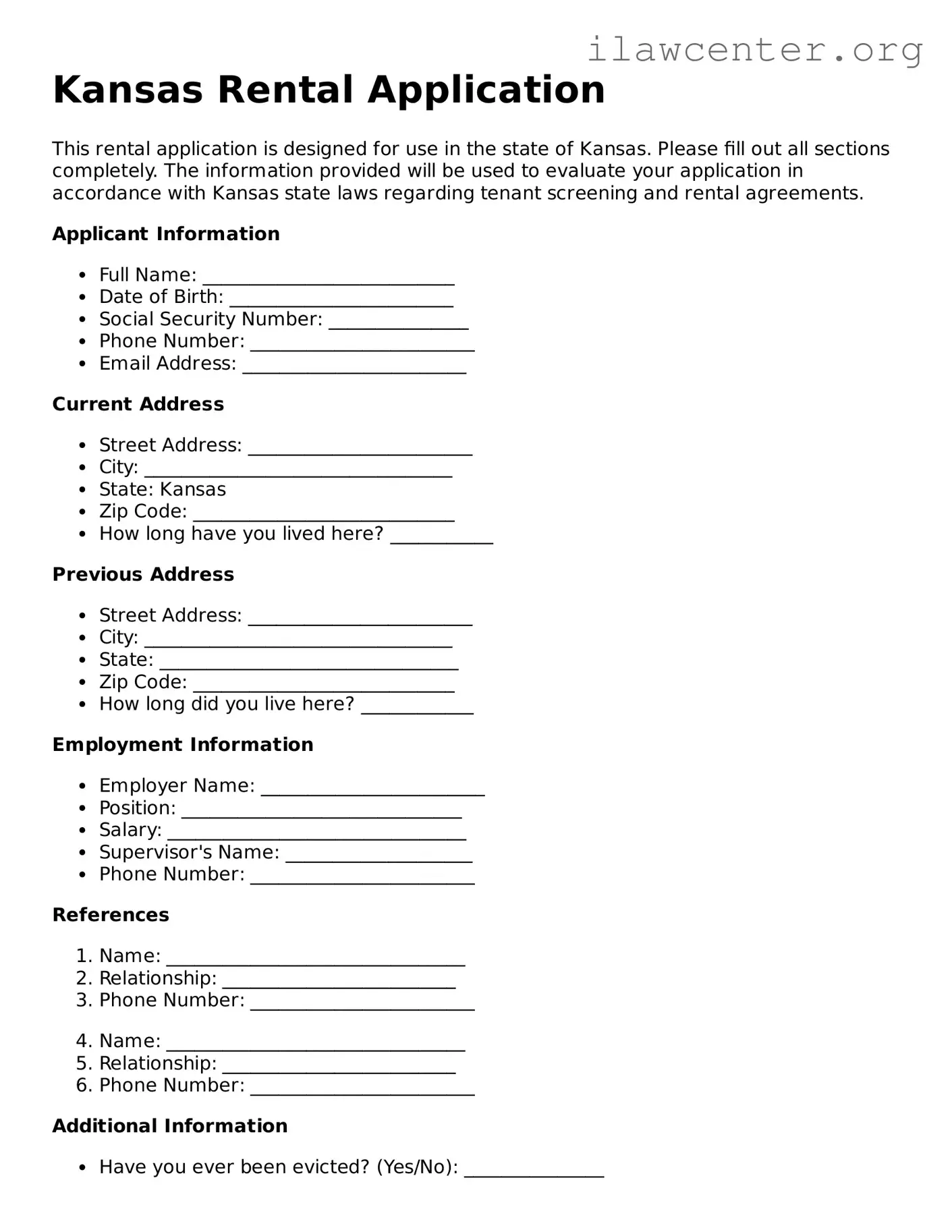
Kansas Rental Application Preview

Kansas Rental Application

This rental application is designed for use in the state of Kansas. Please fill out all sections completely. The information provided will be used to evaluate your application in accordance with Kansas state laws regarding tenant screening and rental agreements.

Applicant Information

  • Full Name: ___________________________
  • Date of Birth: ________________________
  • Social Security Number: _______________
  • Phone Number: ________________________
  • Email Address: ________________________

Current Address

  • Street Address: ________________________
  • City: _________________________________
  • State: Kansas
  • Zip Code: ____________________________
  • How long have you lived here? ___________

Previous Address

  • Street Address: ________________________
  • City: _________________________________
  • State: ________________________________
  • Zip Code: ____________________________
  • How long did you live here? ____________

Employment Information

  • Employer Name: ________________________
  • Position: ______________________________
  • Salary: ________________________________
  • Supervisor's Name: ____________________
  • Phone Number: ________________________

References

  1. Name: ________________________________
  2. Relationship: _________________________
  3. Phone Number: ________________________
  1. Name: ________________________________
  2. Relationship: _________________________
  3. Phone Number: ________________________

Additional Information

  • Have you ever been evicted? (Yes/No): _______________
  • Do you have any pets? (Yes/No): ____________________
  • If yes, please describe: ___________________________
  • Emergency Contact Name: __________________________
  • Emergency Contact Phone: _________________________

By signing below, you authorize the landlord to conduct a background check and verify the information provided in this application.

Signature: ___________________________ Date: ________________

PDF Form Characteristics

Fact Name Description
Purpose The Kansas Rental Application form is used by landlords to screen potential tenants.
Required Information Applicants must provide personal information, rental history, and employment details.
Application Fee Landlords may charge an application fee to cover the cost of background checks.
Governing Law The application process in Kansas is governed by Kansas Statutes Annotated, Chapter 58.
Fair Housing Compliance Landlords must comply with federal and state fair housing laws when using the application.

Instructions on Utilizing Kansas Rental Application

After obtaining the Kansas Rental Application form, you will need to complete it accurately to proceed with your rental process. Make sure you have all necessary information ready, such as your personal details, employment history, and references. Follow these steps to fill out the form correctly.

  1. Begin by entering your full name in the designated section.
  2. Provide your current address, including street, city, state, and zip code.
  3. Fill in your contact information, including your phone number and email address.
  4. Indicate your date of birth and Social Security number as required.
  5. List your employment details, including your employer's name, address, and your position.
  6. Include your monthly income and any additional sources of income.
  7. Provide information about your rental history, including previous addresses and landlords' contact information.
  8. List personal references, including their names and contact details.
  9. Review the application for accuracy and completeness.
  10. Sign and date the application where indicated.

Once you have filled out the form, submit it to the landlord or property management company along with any required fees. They will review your application and contact you regarding the next steps in the rental process.

Important Facts about Kansas Rental Application

What is a Kansas Rental Application form?

The Kansas Rental Application form is a document used by landlords and property managers to collect essential information from prospective tenants. This form typically includes sections for personal details, rental history, employment information, and references. By filling out this application, potential tenants provide landlords with the necessary information to assess their suitability for renting a property.

What information is typically required on the application?

Generally, a Kansas Rental Application will ask for personal information such as the applicant's full name, contact information, and Social Security number. Additionally, applicants may need to provide details about their current and previous residences, including addresses, dates of occupancy, and reasons for leaving. Employment history, income verification, and references from previous landlords or employers are also commonly requested to evaluate the applicant's financial stability and reliability.

Is there a fee associated with submitting a rental application?

Many landlords and property management companies charge an application fee to cover the costs of processing the application, conducting background checks, and verifying the information provided. This fee can vary widely, often ranging from $25 to $75. It’s important for applicants to inquire about the fee upfront and understand whether it is refundable if the application is denied.

How long does it take to process a rental application?

The processing time for a rental application can vary based on several factors, including the landlord's policies and the completeness of the application submitted. Typically, landlords may take anywhere from a few days to a week to review applications. During this time, they may conduct background checks, contact references, and verify employment. Applicants should feel free to ask the landlord for an estimated timeline to manage their expectations effectively.

Common mistakes

When filling out the Kansas Rental Application form, many applicants make common mistakes that can hinder their chances of securing a rental. One frequent error is providing incomplete information. Landlords need a full picture of your background, including employment history, income, and references. If any sections are left blank, it can raise red flags. Always double-check that every required field is filled in.

Another mistake is failing to disclose accurate income details. Some applicants underestimate their income or omit additional sources. Landlords typically verify income to ensure applicants can afford the rent. Misrepresenting your financial situation can lead to rejection or even eviction later on. Be honest and thorough when reporting your income.

Many people also overlook the importance of providing accurate references. Listing friends or family members instead of professional references can weaken your application. Landlords prefer to hear from previous landlords or employers who can vouch for your reliability and character. Choose references who can speak positively about your rental history and responsibility.

Finally, applicants sometimes forget to sign the application. A missing signature can render the application incomplete and lead to delays. Always review your application before submitting it. Make sure that you’ve signed and dated it appropriately. Taking these steps can improve your chances of getting the rental you want.

Documents used along the form

When renting a property in Kansas, several forms and documents often accompany the rental application. Each of these documents serves a specific purpose, helping both landlords and tenants understand their rights and responsibilities. Here’s a list of common forms that may be required during the rental process.

  • Lease Agreement: This legally binding contract outlines the terms of the rental arrangement, including the duration of the lease, rent amount, and rules regarding the property.
  • Credit Report Authorization: A document that allows the landlord to obtain the tenant's credit report, providing insight into the tenant's financial history and reliability.
  • Background Check Consent Form: This form permits landlords to conduct background checks on potential tenants, ensuring safety and security for the property and community.
  • Income Verification Documents: Proof of income, such as pay stubs or tax returns, helps landlords assess whether a tenant can afford the rent.
  • Pet Policy Agreement: If pets are allowed, this document outlines the rules and fees associated with pet ownership within the rental property.
  • Move-In Inspection Checklist: A form used to document the condition of the property before a tenant moves in, helping to avoid disputes over damages later.
  • Notice of Rent Increase: A formal notification that informs tenants of any changes in rent, typically requiring a specific notice period as per state laws.
  • Tenant's Insurance Policy: Proof of renter's insurance, which protects the tenant's personal belongings and may be required by the landlord.
  • Application Fee Receipt: A receipt confirming payment of any application fees, which may be required to process the rental application.
  • Termination Notice: A formal document used by either party to terminate the lease agreement, specifying the reasons and the notice period required.

Understanding these documents can greatly enhance the rental experience for both tenants and landlords. By being informed, individuals can navigate the rental process with confidence and clarity, ensuring that their rights and responsibilities are respected throughout the duration of the lease.

Similar forms

  • Lease Agreement: This document outlines the terms and conditions under which a tenant will rent a property. Like a rental application, it requires personal information and details about the rental arrangement.

  • Tenant Screening Form: Similar to a rental application, this form collects information to assess a potential tenant’s background, including credit history and rental history.

  • Background Check Authorization: This document allows landlords to check a tenant's criminal and financial history. It is often included with the rental application to obtain consent.

  • Employment Verification Form: This form confirms a tenant's employment status and income. It shares the goal of verifying the applicant's ability to pay rent.

  • Income Verification Document: Similar to the rental application, this document provides proof of income, which helps landlords evaluate financial stability.

  • Rental History Form: This document lists previous rental experiences. It helps landlords understand an applicant's past behavior as a tenant, much like the rental application.

  • Guarantor Agreement: This agreement is similar in that it requires personal information. It ensures that a guarantor will cover rent if the tenant fails to pay.

  • Pet Application Form: If a tenant has pets, this form collects information about the animals. It works alongside the rental application to assess suitability for the property.

  • Move-In Checklist: While this document is used after approval, it is similar in that it outlines the condition of the property and includes tenant information, ensuring transparency.

Dos and Don'ts

When filling out the Kansas Rental Application form, there are important guidelines to follow. Here are five things you should and shouldn't do:

  • Do provide accurate personal information.
  • Do include your current and previous rental history.
  • Do disclose all sources of income.
  • Do read the application thoroughly before submission.
  • Do sign and date the application where required.
  • Don't leave any sections blank unless instructed.
  • Don't provide false information.
  • Don't forget to include references.
  • Don't submit the application without checking for errors.
  • Don't ignore the application fee requirements.

Misconceptions

Understanding the Kansas Rental Application form is essential for both landlords and tenants. However, several misconceptions often arise regarding this document. Here are seven common misunderstandings:

  • 1. The application fee is non-refundable. Many believe that once paid, the application fee cannot be returned. While this is often true, it can vary based on the landlord's policy.
  • 2. A rental application guarantees approval. Some applicants assume that submitting the form guarantees they will be accepted. In reality, approval depends on various factors, including credit history and rental references.
  • 3. Landlords must accept all applicants. There is a misconception that landlords are obligated to accept any application. However, they have the right to choose tenants based on their criteria.
  • 4. All personal information is confidential. While landlords must protect sensitive information, certain details may be shared with third-party screening services, leading to potential privacy concerns.
  • 5. The application process is the same for all properties. Applicants often think that the rental application process is uniform across all properties. In fact, each landlord may have different requirements and procedures.
  • 6. Providing false information has no consequences. Some individuals believe they can embellish their applications without repercussions. However, providing false information can lead to immediate denial or future eviction.
  • 7. A co-signer is always required. Many assume that a co-signer is necessary for every application. This is not universally true; it depends on the applicant's financial situation and the landlord's policies.

By addressing these misconceptions, both tenants and landlords can navigate the rental application process more effectively.

Key takeaways

When filling out and using the Kansas Rental Application form, there are several important points to keep in mind. These takeaways will help ensure a smooth application process.

  • Complete all sections: Ensure that every section of the application is filled out. Incomplete applications may be rejected.
  • Provide accurate information: Double-check all personal details, including your name, address, and contact information. Accuracy is crucial.
  • Employment history: Include your current and previous employment information. This helps landlords assess your financial stability.
  • References: List personal and professional references. Choose individuals who can vouch for your character and reliability.
  • Credit history: Be prepared to authorize a credit check. Landlords often evaluate credit scores to gauge financial responsibility.
  • Application fee: Some landlords charge a non-refundable application fee. Confirm the amount and payment method before submission.
  • Timeliness: Submit your application promptly. Delays can result in losing the rental opportunity.
  • Read the lease terms: Before signing any lease, review the terms thoroughly. Understand your rights and responsibilities as a tenant.
  • Follow up: After submitting your application, follow up with the landlord or property manager. This shows your interest and can help expedite the process.