Attorney-Verified  Small Estate Affidavit Document for Kansas

Attorney-Verified Small Estate Affidavit Document for Kansas

The Kansas Small Estate Affidavit is a legal document that allows individuals to settle the estate of a deceased person without the need for formal probate proceedings, provided the estate meets certain criteria. This form simplifies the process, making it easier for heirs to claim assets quickly and efficiently. To get started on your Small Estate Affidavit, fill out the form by clicking the button below.

Article Guide

In the state of Kansas, the Small Estate Affidavit serves as a practical tool for individuals navigating the often complex process of settling a deceased loved one's estate. Designed for estates that do not exceed a certain value, this form simplifies the administration of smaller estates, allowing heirs to bypass the lengthy and costly probate process. By utilizing the Small Estate Affidavit, beneficiaries can claim assets directly from financial institutions, such as banks or insurance companies, with minimal legal intervention. The form requires specific information, including the names of the deceased and the heirs, as well as a detailed account of the estate's assets and liabilities. Importantly, it also includes an affirmation that the estate qualifies under Kansas law, ensuring that the process remains efficient and straightforward. Understanding the nuances of this form can significantly ease the burden during a challenging time, providing a clear pathway for heirs to access what is rightfully theirs without unnecessary delays.

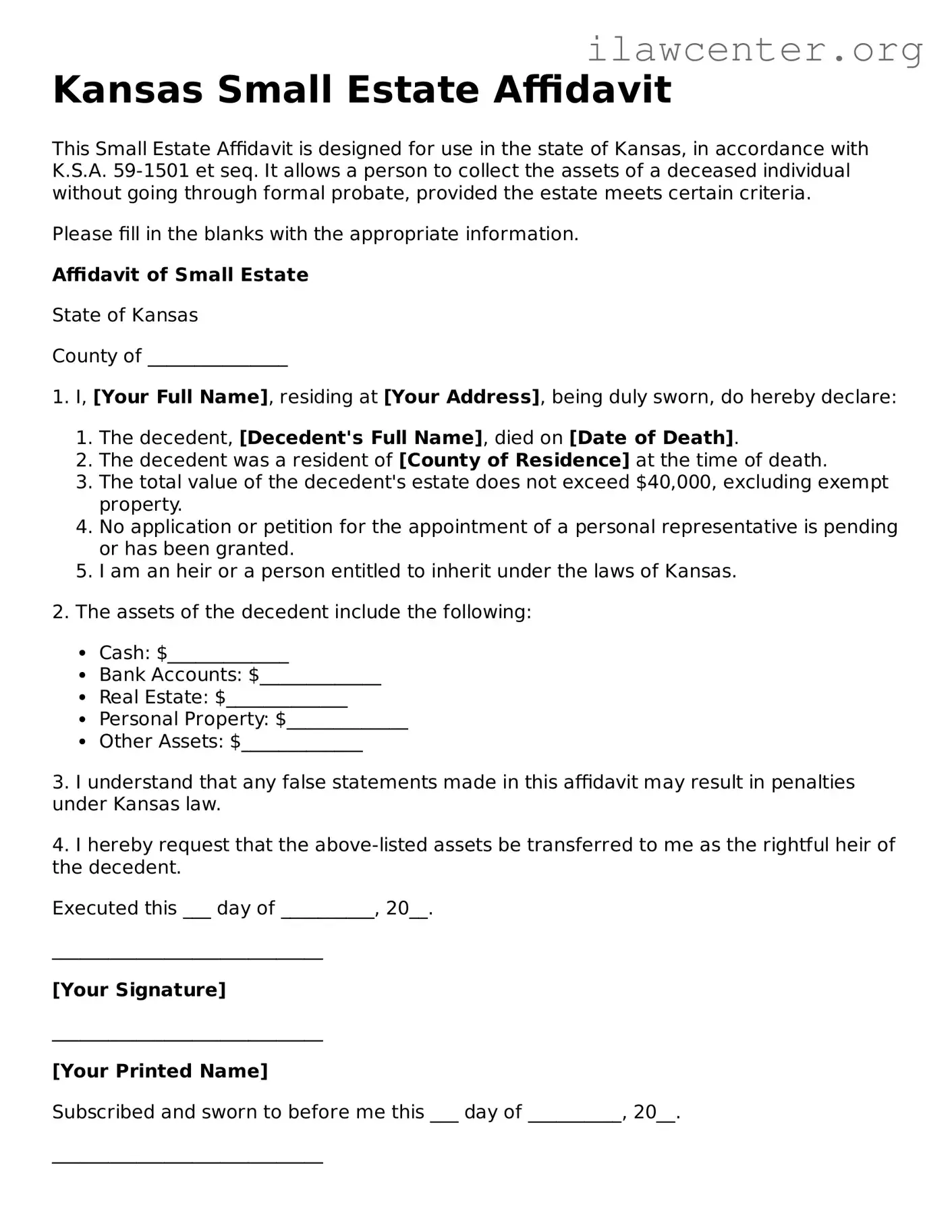
Kansas Small Estate Affidavit Preview

Kansas Small Estate Affidavit

This Small Estate Affidavit is designed for use in the state of Kansas, in accordance with K.S.A. 59-1501 et seq. It allows a person to collect the assets of a deceased individual without going through formal probate, provided the estate meets certain criteria.

Please fill in the blanks with the appropriate information.

Affidavit of Small Estate

State of Kansas

County of _______________

1. I, [Your Full Name], residing at [Your Address], being duly sworn, do hereby declare:

  1. The decedent, [Decedent's Full Name], died on [Date of Death].
  2. The decedent was a resident of [County of Residence] at the time of death.
  3. The total value of the decedent's estate does not exceed $40,000, excluding exempt property.
  4. No application or petition for the appointment of a personal representative is pending or has been granted.
  5. I am an heir or a person entitled to inherit under the laws of Kansas.

2. The assets of the decedent include the following:

  • Cash: $_____________
  • Bank Accounts: $_____________
  • Real Estate: $_____________
  • Personal Property: $_____________
  • Other Assets: $_____________

3. I understand that any false statements made in this affidavit may result in penalties under Kansas law.

4. I hereby request that the above-listed assets be transferred to me as the rightful heir of the decedent.

Executed this ___ day of __________, 20__.

_____________________________

[Your Signature]

_____________________________

[Your Printed Name]

Subscribed and sworn to before me this ___ day of __________, 20__.

_____________________________

[Notary Public's Signature]

My commission expires: _______________

PDF Form Characteristics

Fact Name Description
Purpose The Kansas Small Estate Affidavit allows heirs to claim assets without going through probate.
Eligibility This form is used when the total value of the estate is $40,000 or less for individuals, or $100,000 or less for a couple.
Governing Law The form is governed by Kansas Statutes Annotated, Chapter 59, Article 24.
Filing Requirements The affidavit must be filed with the court in the county where the deceased lived.
Signature The affidavit must be signed by the heirs and notarized to be valid.
Assets Covered It can be used for bank accounts, personal property, and other assets that do not require a formal probate process.
Time Limit Heirs must file the affidavit within six months of the death of the individual.
Debts The affidavit does not relieve heirs from paying the deceased's debts; they may need to settle outstanding obligations.
Alternative Options If the estate exceeds the small estate limit, a full probate process is required to distribute assets.

Instructions on Utilizing Kansas Small Estate Affidavit

Once you have gathered all necessary information and documents, you can begin filling out the Kansas Small Estate Affidavit form. Completing this form accurately is crucial to ensure a smooth process for settling the estate. Follow these steps to fill out the form correctly.

  1. Start with the title section. Write "Small Estate Affidavit" at the top of the form.
  2. Provide the name of the deceased individual in the designated space.
  3. Fill in the date of death. Ensure that this date is accurate, as it is essential for the process.
  4. List the address of the deceased. Include the street address, city, state, and zip code.
  5. Indicate whether the deceased left a will. If there is a will, you will need to provide details about it.
  6. Identify the heirs. List the names and relationships of all individuals entitled to inherit from the estate.
  7. Detail the assets of the estate. Include real estate, bank accounts, and personal property.
  8. State the total value of the estate. Ensure this value does not exceed the Kansas small estate limit.
  9. Sign and date the affidavit. Ensure that you are the person authorized to file this document.
  10. Have the affidavit notarized. A notary public must witness your signature for the document to be valid.

After completing the form, you will need to file it with the appropriate court. This step is essential to initiate the process of settling the estate. Be sure to keep copies for your records.

Important Facts about Kansas Small Estate Affidavit

What is a Kansas Small Estate Affidavit?

The Kansas Small Estate Affidavit is a legal document that allows individuals to settle the estate of a deceased person without going through the formal probate process. This option is typically available for estates that have a total value below a certain threshold, which, as of 2023, is $40,000 for individuals and $100,000 for married couples. This affidavit simplifies the process of transferring property and assets to the rightful heirs or beneficiaries, making it a more accessible option for families during a difficult time.

Who is eligible to use the Small Estate Affidavit?

Eligibility for using the Small Estate Affidavit in Kansas generally depends on the total value of the estate. If the estate's total value is below the specified limits, the heirs or beneficiaries can utilize this form. Additionally, the person filing the affidavit must be an heir or a beneficiary named in the deceased's will, or a legal representative of the estate. It is important to ensure that all requirements are met to avoid complications in the transfer of assets.

What assets can be transferred using the Small Estate Affidavit?

The Small Estate Affidavit can be used to transfer various types of assets, including bank accounts, personal property, and real estate, as long as the total value remains under the established limits. However, certain assets, such as life insurance policies or retirement accounts with designated beneficiaries, may not be included in the estate for this purpose. It is crucial to review the specific assets involved to determine their eligibility for transfer using this affidavit.

How do I complete the Small Estate Affidavit?

To complete the Small Estate Affidavit, you will need to gather necessary information about the deceased, including their full name, date of death, and a list of their assets. The affidavit form itself must be filled out accurately, detailing the relationship of the affiant to the deceased and confirming that the estate qualifies for the small estate process. Once completed, the affidavit should be signed in the presence of a notary public. After notarization, it can be submitted to the appropriate institutions, such as banks or the county clerk's office, to facilitate the transfer of assets.

What happens if the estate exceeds the Small Estate limits?

If the total value of the estate exceeds the limits set for the Small Estate Affidavit, the heirs or beneficiaries will need to pursue the formal probate process. This involves filing a petition with the probate court and may require more extensive documentation and legal representation. While this process can be more time-consuming and costly, it ensures that the estate is settled according to the law and the wishes of the deceased. Seeking guidance from a legal professional may be beneficial in navigating this more complex process.

Common mistakes

Filling out the Kansas Small Estate Affidavit form can be straightforward, but many people make common mistakes that can delay the process. One frequent error is failing to provide accurate information about the deceased. It’s crucial to ensure that names, dates of birth, and dates of death are correct. A simple typo can lead to complications, potentially causing the court to reject the affidavit.

Another mistake involves not listing all the assets. The form requires a complete inventory of the deceased's assets. Some individuals may overlook certain items or underestimate their value. This oversight can lead to issues, especially if the estate exceeds the small estate threshold. Always double-check to ensure that every asset is accounted for and properly valued.

People often forget to include the necessary signatures. The affidavit must be signed by the affiant, who is usually a close relative or an interested party. Additionally, if there are multiple heirs, their signatures may also be required. Neglecting this step can result in delays as the court may need to request additional documentation.

Lastly, many individuals do not understand the importance of notarization. The Kansas Small Estate Affidavit must be notarized to be valid. Skipping this step can render the affidavit ineffective. Always ensure that you have the document notarized before submitting it to avoid unnecessary setbacks.

Documents used along the form

When dealing with small estates in Kansas, the Small Estate Affidavit is a crucial document. However, several other forms and documents may be needed to ensure a smooth process. Below is a list of common forms that often accompany the Small Estate Affidavit.

  • Death Certificate: This official document confirms the passing of the individual whose estate is being settled. It is essential for proving the decedent's death and is typically required when filing the Small Estate Affidavit.
  • List of Assets: This document outlines all the assets owned by the deceased at the time of death. It helps to establish the value of the estate and ensures that the Small Estate Affidavit is completed accurately.
  • Affidavit of Heirship: This form may be necessary to establish the rightful heirs of the deceased. It provides legal recognition of the heirs and can simplify the distribution of assets.
  • Notice to Creditors: This document serves to inform any creditors of the decedent about the estate proceedings. It ensures that all debts are settled before the distribution of assets to heirs.
  • Will (if applicable): If the deceased left a will, it should be included in the estate documentation. The will outlines the decedent's wishes regarding asset distribution and can provide guidance during the settlement process.

Having these documents ready can streamline the process of settling a small estate in Kansas. It’s always wise to consult with a legal professional to ensure that all requirements are met and to facilitate a smooth transition for all involved parties.

Similar forms

The Small Estate Affidavit is a useful legal document that simplifies the process of settling an estate when the deceased's assets fall below a certain value. It is important to understand that there are several other documents that serve similar purposes in estate management. Here are five documents that share similarities with the Small Estate Affidavit:

  • Last Will and Testament: This document outlines how a person's assets should be distributed after their death. Like the Small Estate Affidavit, it helps to clarify the wishes of the deceased, although it typically requires a more formal probate process.
  • Letter of Administration: This document is issued by a court when someone dies without a will. It appoints an administrator to manage the estate. Similar to the Small Estate Affidavit, it allows for the transfer of assets, but it usually involves more legal oversight.
  • Trust Agreement: A trust is a legal arrangement where one party holds property for the benefit of another. Like the Small Estate Affidavit, it can facilitate the transfer of assets without going through probate, but it requires more complex planning and setup.
  • Affidavit of Heirship: This document is used to establish the heirs of a deceased person when no will exists. It serves a similar purpose to the Small Estate Affidavit by helping to clarify who is entitled to inherit, but it is often used in situations where the estate is not small enough to qualify for the Small Estate Affidavit process.
  • Probate Petition: This is a request to the court to open probate proceedings for a deceased person's estate. While the Small Estate Affidavit is a simpler alternative to probate, a probate petition is necessary when the estate exceeds the small estate threshold, thus requiring formal court involvement.

Dos and Don'ts

When filling out the Kansas Small Estate Affidavit form, there are several important things to keep in mind. Below is a list of actions to take and avoid.

  • Do provide accurate information about the deceased's assets and debts.
  • Do ensure that all required signatures are present before submitting the form.
  • Do check the eligibility requirements for using the Small Estate Affidavit.
  • Do keep copies of the completed affidavit for your records.
  • Don't leave any sections of the form blank; fill in all necessary information.
  • Don't forget to notarize the affidavit, as it is a required step.
  • Don't submit the form without verifying that all information is correct.

Misconceptions

The Kansas Small Estate Affidavit is a useful tool for settling small estates without the need for formal probate. However, several misconceptions can lead to confusion. Here are ten common misunderstandings:

  1. Only estates under $10,000 qualify. Many believe that only estates valued at $10,000 or less can use this affidavit. In reality, the limit is $40,000 for personal property and $100,000 for real property, making it accessible for more estates.
  2. All debts must be paid before using the affidavit. While it's important to address debts, the affidavit allows for some flexibility. Certain debts can be settled after the affidavit is filed.
  3. Only heirs can file the affidavit. This is not true. Any interested party, including creditors, can file the affidavit if they have a legitimate claim to the estate.
  4. Filing the affidavit is a lengthy process. In fact, the process is relatively quick. Once the affidavit is completed, it can often be filed the same day.
  5. Real estate cannot be transferred using the affidavit. This is a misconception. Real estate can indeed be transferred, provided it meets the valuation limits.
  6. The affidavit must be notarized. While notarization is a good practice, it is not a legal requirement for the affidavit to be valid.
  7. All assets must be listed on the affidavit. Some individuals think they must list every single asset. However, only the assets that are part of the small estate need to be included.
  8. The affidavit is only for individuals without a will. This is misleading. Even if a will exists, the small estate affidavit can still be utilized if the estate qualifies.
  9. The process is the same in all states. Each state has its own rules regarding small estate affidavits. It's crucial to understand Kansas-specific regulations.
  10. Once filed, the affidavit cannot be challenged. This is incorrect. Interested parties can still contest the affidavit if they believe there are grounds to do so.

Understanding these misconceptions can help individuals navigate the process more effectively and avoid unnecessary delays.

Key takeaways

When dealing with the Kansas Small Estate Affidavit form, it’s important to understand the key aspects to ensure a smooth process. Here are six essential takeaways:

  1. Eligibility Requirements: The Small Estate Affidavit can be used when the total value of the estate is $40,000 or less for individuals or $100,000 or less for married couples. Ensure that the estate meets these criteria before proceeding.
  2. Required Information: The form requires specific details about the deceased, including their name, date of death, and the names of the heirs. Gather this information in advance to streamline the process.
  3. Affidavit Completion: The affidavit must be signed under oath. This means that all information provided should be accurate and truthful. Misrepresentation can lead to legal consequences.
  4. Filing with the Court: After completing the affidavit, it must be filed with the appropriate court in Kansas. This step is crucial for the legal transfer of assets.
  5. Asset Distribution: Once the affidavit is filed and accepted, heirs can claim the assets listed. It’s important to understand how the distribution will occur and to communicate with all parties involved.
  6. Legal Advice: While the Small Estate Affidavit is designed to simplify the process, seeking legal advice can be beneficial. An attorney can provide guidance and ensure that all legal requirements are met.

Understanding these key points will help navigate the Kansas Small Estate Affidavit process more effectively.