Attorney-Verified  Transfer-on-Death Deed Document for Kansas

Attorney-Verified Transfer-on-Death Deed Document for Kansas

The Kansas Transfer-on-Death Deed form is a legal document that allows property owners to designate beneficiaries who will receive their real estate upon their death, bypassing the probate process. This tool provides a straightforward way to transfer property while ensuring that the owner's wishes are honored. For those interested in securing their property for future generations, consider filling out the form by clicking the button below.

Article Guide

The Kansas Transfer-on-Death Deed (TOD) form serves as a vital estate planning tool, allowing property owners to transfer real estate to designated beneficiaries upon their death without the need for probate. This form simplifies the process of transferring ownership, ensuring that the property passes directly to the named individuals, thereby avoiding the complexities and delays often associated with probate proceedings. Key elements of the TOD include the identification of the property being transferred, the specification of beneficiaries, and the requirement for the property owner's signature, which must be notarized. Additionally, the form must be filed with the appropriate county office to be effective, ensuring that the transfer is legally recognized. By utilizing the TOD, property owners in Kansas can maintain control over their assets during their lifetime while providing a clear and efficient pathway for their heirs to receive property after their passing. This proactive approach to estate planning can significantly reduce the administrative burden on families during a difficult time.

Kansas Transfer-on-Death Deed Preview

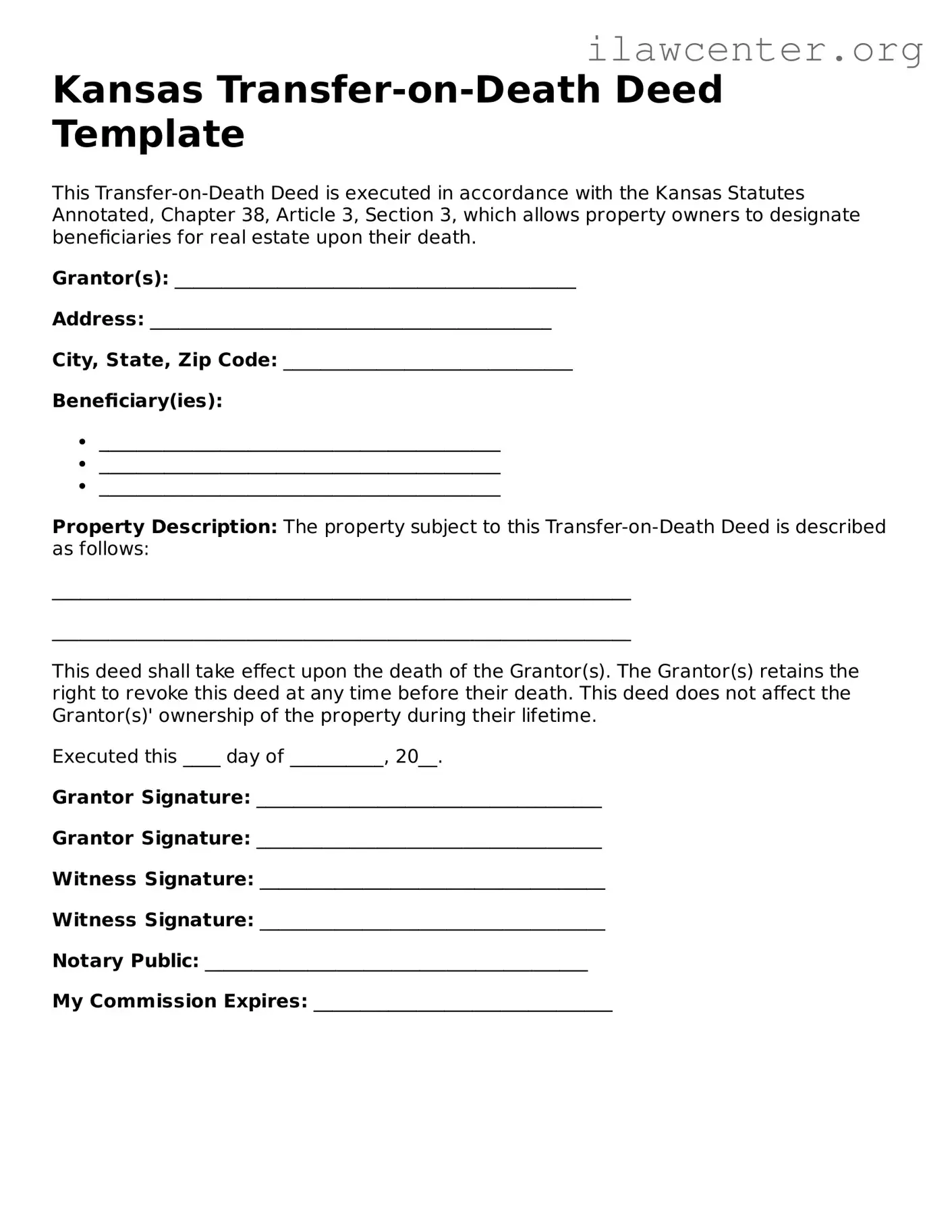
Kansas Transfer-on-Death Deed Template

This Transfer-on-Death Deed is executed in accordance with the Kansas Statutes Annotated, Chapter 38, Article 3, Section 3, which allows property owners to designate beneficiaries for real estate upon their death.

Grantor(s): ___________________________________________

Address: ___________________________________________

City, State, Zip Code: _______________________________

Beneficiary(ies):

  • ___________________________________________
  • ___________________________________________
  • ___________________________________________

Property Description: The property subject to this Transfer-on-Death Deed is described as follows:

______________________________________________________________

______________________________________________________________

This deed shall take effect upon the death of the Grantor(s). The Grantor(s) retains the right to revoke this deed at any time before their death. This deed does not affect the Grantor(s)' ownership of the property during their lifetime.

Executed this ____ day of __________, 20__.

Grantor Signature: _____________________________________

Grantor Signature: _____________________________________

Witness Signature: _____________________________________

Witness Signature: _____________________________________

Notary Public: _________________________________________

My Commission Expires: ________________________________

PDF Form Characteristics

Fact Name Details
Definition A Transfer-on-Death (TOD) deed allows property owners in Kansas to transfer real estate to beneficiaries upon their death without going through probate.
Governing Law The Kansas Transfer-on-Death Deed is governed by K.S.A. 58-6a101 et seq.
Eligibility Any individual who holds title to real estate in Kansas can create a TOD deed.
Beneficiaries Property owners can name one or more beneficiaries in their TOD deed, allowing for flexibility in estate planning.
Revocation A TOD deed can be revoked at any time before the property owner's death, ensuring control over the property.
Filing Requirements The TOD deed must be signed by the property owner and recorded with the county register of deeds to be effective.
Tax Implications There are generally no immediate tax implications for the transfer of property via a TOD deed until the beneficiary sells the property.
Limitations Transfer-on-Death deeds cannot be used for all types of property, such as personal property or properties held in a trust.

Instructions on Utilizing Kansas Transfer-on-Death Deed

Once you have obtained the Kansas Transfer-on-Death Deed form, you will need to carefully fill it out to ensure that your property is transferred as intended. After completing the form, it must be signed, notarized, and filed with the appropriate county office to be effective.

  1. Begin by entering your name as the owner of the property in the designated section.
  2. Provide your address, including the city, state, and zip code.
  3. Identify the property you wish to transfer by including its legal description. This may require referencing a previous deed or property records.
  4. Next, list the name(s) of the beneficiary or beneficiaries who will receive the property upon your passing.
  5. Include the address(es) of the beneficiary or beneficiaries to ensure proper identification.
  6. Review the form for accuracy, ensuring that all names and descriptions are correct.
  7. Sign the form in the presence of a notary public to validate your signature.
  8. After notarization, make copies of the completed form for your records.
  9. Finally, file the original deed with the appropriate county office where the property is located.

Important Facts about Kansas Transfer-on-Death Deed

What is a Kansas Transfer-on-Death Deed?

A Kansas Transfer-on-Death Deed allows property owners to designate beneficiaries who will receive their real estate upon the owner's death. This deed does not transfer ownership until the owner passes away, allowing the owner to retain full control of the property during their lifetime.

Who can create a Transfer-on-Death Deed in Kansas?

Any individual who owns real estate in Kansas can create a Transfer-on-Death Deed. There are no restrictions based on age or residency, but it is important that the property owner is of sound mind when executing the deed.

How do I complete a Transfer-on-Death Deed?

To complete a Transfer-on-Death Deed, you must provide your name, the legal description of the property, and the names of the beneficiaries. The deed must be signed in the presence of a notary public and then filed with the county register of deeds where the property is located.

Can I change or revoke a Transfer-on-Death Deed?

Yes, you can change or revoke a Transfer-on-Death Deed at any time during your lifetime. To do so, you must create a new deed that explicitly revokes the previous one or file a formal revocation document with the county register of deeds.

What are the benefits of using a Transfer-on-Death Deed?

The primary benefit is that it allows for the direct transfer of property without going through probate, which can save time and money. Additionally, the property owner retains control of the property until death, and the beneficiaries do not have any rights to the property while the owner is still alive.

Are there any tax implications associated with a Transfer-on-Death Deed?

Generally, there are no immediate tax implications when creating a Transfer-on-Death Deed. However, the property may be subject to estate taxes upon the owner's death, depending on the overall value of the estate. It is advisable to consult a tax professional for personalized guidance.

What happens if I do not have a Transfer-on-Death Deed?

If you do not have a Transfer-on-Death Deed, your property will go through probate after your death. This process can be lengthy and costly, and the distribution of your assets will be determined according to state law rather than your personal wishes.

Common mistakes

Filling out the Kansas Transfer-on-Death Deed form can be a straightforward process, but many people stumble along the way. One common mistake occurs when individuals forget to include all necessary information about the property. This includes the legal description, which is crucial for identifying the property in question. If this information is incomplete or inaccurate, it can lead to complications down the road, potentially delaying the transfer or even causing legal disputes.

Another frequent error involves not properly signing the deed. In Kansas, the deed must be signed by the owner in the presence of a notary public. Skipping this step or failing to have a notary present can render the deed invalid. It's essential to ensure that all signatures are in place and that the document is properly notarized to avoid any issues with the transfer.

People also often overlook the importance of recording the deed with the appropriate county office. Even if the deed is filled out correctly and signed, it must be filed to be effective. Failing to record the deed means that the transfer may not be recognized by the state, leaving the property in limbo. This step is crucial for ensuring that the wishes of the property owner are honored after their passing.

Lastly, many individuals do not take the time to review the beneficiaries they have named in the deed. It’s vital to ensure that the names are spelled correctly and that the relationship to the owner is clear. Mistakes in this area can lead to confusion or disputes among family members. Taking a moment to double-check this information can save a lot of heartache later on.

Documents used along the form

The Kansas Transfer-on-Death Deed is a useful tool for individuals looking to transfer property upon their death without the need for probate. However, there are several other forms and documents that often accompany this deed to ensure a smooth transition of property ownership. Understanding these documents can help streamline the process and clarify the intentions of the property owner.

  • Will: A will is a legal document that outlines how a person's assets should be distributed after their death. While a Transfer-on-Death Deed can bypass probate for the property it covers, a will can address other assets and specify guardianship for minor children.
  • Affidavit of Death: This document serves as proof of a person's death. It is often required when transferring property to ensure that the Transfer-on-Death Deed is executed correctly and to confirm the identity of the deceased.
  • Property Title: The title document provides evidence of ownership of the property. It is essential to have the title updated to reflect the transfer once the property owner passes away, ensuring that the new owner can claim their rights to the property.
  • Beneficiary Designation Forms: For certain assets like life insurance policies or retirement accounts, these forms specify who will receive the assets upon the owner's death. They work alongside the Transfer-on-Death Deed to create a comprehensive estate plan.
  • Power of Attorney: This document grants someone the authority to act on behalf of the property owner during their lifetime. It can be particularly useful if the owner becomes incapacitated, allowing the designated person to manage property affairs until the owner passes away.

By utilizing these documents in conjunction with the Kansas Transfer-on-Death Deed, individuals can ensure that their property is handled according to their wishes and that their loved ones are taken care of during a difficult time. Proper planning can provide peace of mind and clarity for everyone involved.

Similar forms

The Transfer-on-Death Deed (TODD) is a unique estate planning tool that allows individuals to transfer property directly to beneficiaries upon their death, bypassing the probate process. However, there are several other documents that serve similar purposes in estate planning. Here are ten documents that share similarities with the TODD:

  • Will: A will outlines how a person's assets should be distributed after their death. Like a TODD, it designates beneficiaries but typically requires probate to execute the wishes outlined.
  • Living Trust: A living trust allows a person to place their assets into a trust during their lifetime. Upon death, the assets can be transferred to beneficiaries without going through probate, similar to a TODD.
  • Beneficiary Designation Forms: These forms are used for accounts like life insurance or retirement plans. They allow individuals to name beneficiaries directly, ensuring assets pass outside of probate, akin to a TODD.
  • Joint Tenancy with Right of Survivorship: This ownership arrangement allows two or more people to own property together. Upon the death of one owner, the property automatically transfers to the surviving owner, similar to the TODD mechanism.
  • Payable-on-Death (POD) Accounts: POD accounts allow individuals to designate beneficiaries for bank accounts. Upon death, funds are transferred directly to the named beneficiaries, much like a TODD for real estate.
  • Transfer-on-Death Registration for Securities: This allows individuals to name beneficiaries for stocks and bonds. Upon death, the securities are transferred directly to the beneficiaries, paralleling the TODD process.
  • Life Estate Deed: A life estate deed allows a person to live in a property during their lifetime while designating a beneficiary who will inherit the property after their death, similar to the TODD’s purpose.
  • Community Property with Right of Survivorship: This form of ownership is specific to married couples. It allows for automatic transfer of property to the surviving spouse upon death, resembling the TODD's function.
  • Revocable Trust: A revocable trust can be altered during the grantor's lifetime. It allows for the seamless transfer of assets upon death, similar to how a TODD operates.
  • Declaration of Trust: This document outlines the terms of a trust and the beneficiaries involved. It can facilitate the transfer of assets upon death, akin to a TODD, while providing more control over the management of assets during the grantor's lifetime.

Understanding these documents can empower individuals to make informed decisions about their estate planning needs. Each serves a unique purpose, yet they all share the common goal of simplifying the transfer of assets to loved ones.

Dos and Don'ts

When filling out the Kansas Transfer-on-Death Deed form, it is important to approach the task with care. Here are ten things you should and shouldn't do:

  • Do ensure that you are eligible to use a Transfer-on-Death Deed in Kansas.
  • Don't leave any sections of the form blank; incomplete forms can lead to complications.
  • Do provide accurate information about the property, including the legal description.
  • Don't use vague language; be specific in your descriptions.
  • Do sign the deed in front of a notary public.
  • Don't forget to have the deed recorded at the county register of deeds office.
  • Do keep a copy of the completed deed for your records.
  • Don't assume that verbal agreements are sufficient; written documentation is essential.
  • Do consult with a legal professional if you have questions about the process.
  • Don't rush the process; take your time to ensure everything is filled out correctly.

Misconceptions

The Kansas Transfer-on-Death Deed (TODD) form is often misunderstood. Here are ten common misconceptions surrounding this legal document:

  1. The TODD form is only for wealthy individuals. Many believe that only those with substantial assets can benefit from a TODD. In reality, it is available to anyone who owns property in Kansas, regardless of their financial status.
  2. Using a TODD avoids all taxes. While a TODD can help avoid probate, it does not eliminate potential tax liabilities. Beneficiaries may still be responsible for property taxes or capital gains taxes upon the sale of the property.
  3. The TODD is a will. A Transfer-on-Death Deed is not the same as a will. It specifically transfers property upon the death of the owner without going through probate, while a will outlines the distribution of assets after death.
  4. You cannot change a TODD once it is created. This is false. A TODD can be revoked or modified at any time during the owner’s lifetime, as long as the owner is competent to do so.
  5. A TODD is effective immediately. A Transfer-on-Death Deed does not take effect until the owner passes away. Until that time, the owner retains full control over the property.
  6. All property can be transferred using a TODD. Certain types of property, such as personal property or jointly owned assets, may not be eligible for transfer via a TODD. Only real estate can be transferred through this deed.
  7. Beneficiaries automatically inherit the property. While the TODD allows for a direct transfer, beneficiaries may still need to address any debts or liens attached to the property before they can fully inherit it.
  8. The TODD form is complicated and difficult to understand. Many people assume that the TODD is a complex legal document. However, it is designed to be straightforward and user-friendly, making it accessible for most property owners.
  9. You must hire a lawyer to create a TODD. While consulting a lawyer can be beneficial, it is not a legal requirement to create a TODD. Property owners can complete the form themselves if they understand the process.
  10. A TODD is only useful for certain types of property. Some believe that a TODD is limited in scope. In fact, it can be used for various types of real estate, including residential homes, commercial properties, and vacant land.

Understanding these misconceptions can help individuals make informed decisions regarding property transfer in Kansas.

Key takeaways

Filling out and using the Kansas Transfer-on-Death Deed form can be straightforward if you keep a few key points in mind. Here are some essential takeaways:

  1. Eligibility: Only real estate can be transferred using this deed. Ensure that the property qualifies.
  2. Owner's Intent: Clearly indicate your intention to transfer the property upon your death. This must be explicitly stated in the deed.
  3. Beneficiary Designation: List the full names of the beneficiaries who will receive the property. Be precise to avoid confusion.
  4. Signature Requirements: The deed must be signed by the property owner in the presence of a notary public.
  5. Filing the Deed: After signing, file the deed with the appropriate county register of deeds office to make it effective.
  6. Revocation: You can revoke the deed at any time before your death. Ensure you follow the proper procedure for revocation.
  7. Tax Implications: Understand any potential tax implications for your beneficiaries when the property is transferred.
  8. Consultation Recommended: It may be beneficial to consult with a legal expert to ensure all aspects of the deed are properly addressed.

By following these key points, you can effectively utilize the Kansas Transfer-on-Death Deed form to manage the transfer of your property.