Attorney-Verified  Homeschool Letter of Intent Document for Kentucky

Attorney-Verified Homeschool Letter of Intent Document for Kentucky

The Kentucky Homeschool Letter of Intent is a document that parents must submit to officially declare their intention to homeschool their children. This form serves as a notification to the local school district and outlines the family's commitment to providing an educational experience outside of traditional schooling. To get started, fill out the form by clicking the button below.

Article Guide

For families in Kentucky considering homeschooling, the process begins with the completion of the Homeschool Letter of Intent form. This essential document serves as a formal notification to the local school district of a family's intent to educate their child at home. It requires basic information, including the names and ages of the children being homeschooled, as well as the address of the residence. Additionally, parents must indicate whether they are following a specific curriculum or a more personalized approach to education. By submitting this letter, families not only comply with state regulations but also establish a foundation for their educational journey. Understanding the nuances of this form can empower parents to take charge of their children's learning experience while ensuring they meet Kentucky's legal requirements. As families embark on this rewarding path, the Letter of Intent is the first step toward creating a tailored educational environment that meets the unique needs of each child.

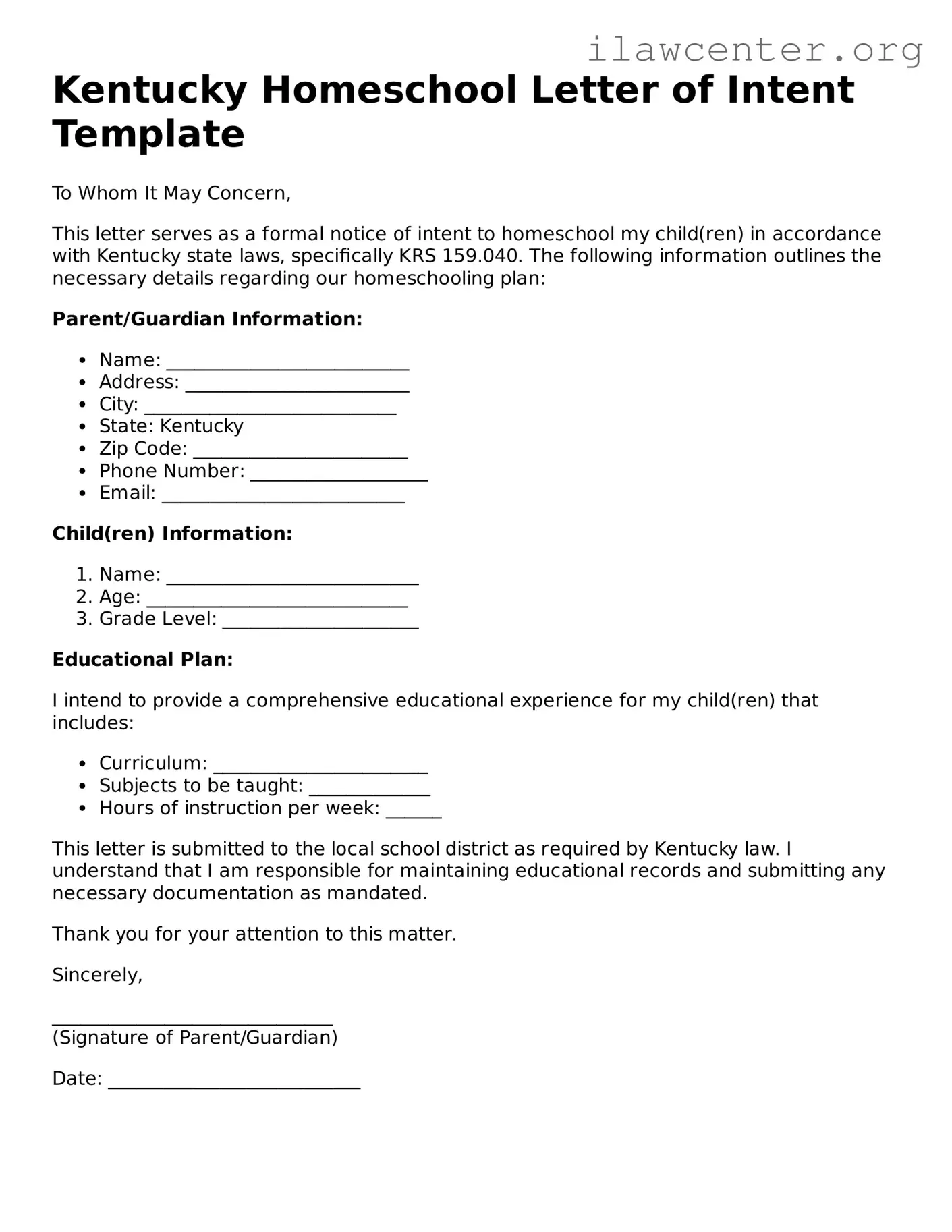
Kentucky Homeschool Letter of Intent Preview

Kentucky Homeschool Letter of Intent Template

To Whom It May Concern,

This letter serves as a formal notice of intent to homeschool my child(ren) in accordance with Kentucky state laws, specifically KRS 159.040. The following information outlines the necessary details regarding our homeschooling plan:

Parent/Guardian Information:

  • Name: __________________________
  • Address: ________________________
  • City: ___________________________
  • State: Kentucky
  • Zip Code: _______________________
  • Phone Number: ___________________
  • Email: __________________________

Child(ren) Information:

  1. Name: ___________________________
  2. Age: ____________________________
  3. Grade Level: _____________________

Educational Plan:

I intend to provide a comprehensive educational experience for my child(ren) that includes:

  • Curriculum: _______________________
  • Subjects to be taught: _____________
  • Hours of instruction per week: ______

This letter is submitted to the local school district as required by Kentucky law. I understand that I am responsible for maintaining educational records and submitting any necessary documentation as mandated.

Thank you for your attention to this matter.

Sincerely,

______________________________
(Signature of Parent/Guardian)

Date: ___________________________

PDF Form Characteristics

Fact Name Details
Governing Law The Kentucky Homeschool Letter of Intent is governed by KRS 159.160.
Submission Deadline The letter must be submitted by August 1st of each year or within 14 days of beginning homeschooling.
Required Information Parents must provide the names, ages, and grades of their children on the form.
Educational Plan While not required with the letter, a proposed educational plan is recommended for effective homeschooling.
Notification to Local School District Parents must send the letter to their local school district to officially notify them of the homeschooling decision.
Record Keeping Families are encouraged to maintain educational records and assessments, although not submitted with the letter.

Instructions on Utilizing Kentucky Homeschool Letter of Intent

Once you have decided to homeschool your child in Kentucky, the next step is to complete the Homeschool Letter of Intent form. This form serves as a notification to the local school district about your intent to homeschool. After submitting the form, you will receive further guidance on the next steps and requirements for your homeschooling journey.

  1. Begin by downloading the Kentucky Homeschool Letter of Intent form from the official Kentucky Department of Education website.
  2. Fill in your personal information at the top of the form. This includes your name, address, and contact details.
  3. Provide the name and age of each child you plan to homeschool. Ensure that the information is accurate and up-to-date.
  4. Indicate the grade level for each child. This helps the school district understand the educational stage of your children.
  5. Sign and date the form at the bottom to confirm your intent to homeschool.
  6. Make a copy of the completed form for your records before submission.
  7. Submit the form to your local school district office. You can do this either by mail or in person, depending on your preference.

Important Facts about Kentucky Homeschool Letter of Intent

What is the Kentucky Homeschool Letter of Intent?

The Kentucky Homeschool Letter of Intent is a formal document that parents or guardians must submit to notify the local school district of their intent to homeschool their children. This letter is a crucial first step in the homeschooling process in Kentucky, ensuring that the district is aware of the educational choice being made.

Who needs to submit the Letter of Intent?

Any parent or guardian who wishes to homeschool their child in Kentucky must submit this letter. This requirement applies to children who are of compulsory school age, which is typically between 6 and 18 years old. If you have multiple children, a separate letter is required for each child.

When should the Letter of Intent be submitted?

The Letter of Intent should be submitted at the beginning of the school year or as soon as the decision to homeschool is made. It is advisable to send the letter at least 14 days before the start of the school year to ensure compliance with state regulations.

What information must be included in the Letter of Intent?

The Letter of Intent must include the names and ages of the children being homeschooled, the address of the homeschooling location, and a statement indicating the parent or guardian's intent to provide home education. Additional details, such as the educational curriculum to be used, may also be beneficial but are not strictly required.

Is there a specific format for the Letter of Intent?

While there is no mandated format for the Letter of Intent, it should be clear and concise. A simple letter format that includes the necessary information will suffice. It is recommended to keep a copy for your records after submitting it to the school district.

Where should the Letter of Intent be sent?

The completed Letter of Intent should be sent to the local school district office where your children reside. Each district may have its own submission guidelines, so checking the district's website or contacting them directly for specific instructions is advisable.

What happens after submitting the Letter of Intent?

After the Letter of Intent is submitted, the school district will acknowledge receipt of your letter. There is no further action required on your part unless the district contacts you for additional information. It is important to keep track of your submission date and any correspondence received.

Are there any consequences for not submitting the Letter of Intent?

Failing to submit the Letter of Intent may result in your child being considered truant, which can lead to legal repercussions. It is crucial to comply with this requirement to avoid any issues with local education authorities.

Can I change my mind after submitting the Letter of Intent?

Yes, parents can change their minds about homeschooling after submitting the Letter of Intent. If you decide to enroll your child back into a public or private school, you should notify the school district of this change. Keeping open communication with the district is essential for a smooth transition.
Common mistakes

Filling out the Kentucky Homeschool Letter of Intent form can be a straightforward process, but many individuals still make common mistakes that can lead to complications. One frequent error is failing to include all required information. The form typically asks for specific details about the student and the educational program. Omitting any of these details can result in delays or even rejection of the application.

Another mistake is neglecting to sign and date the form. A signature is essential, as it verifies the intent to homeschool. Without it, the form may be considered incomplete. Additionally, some individuals mistakenly assume that submitting the form electronically is sufficient. In Kentucky, the form must be submitted in a physical format to the appropriate school district.

Misunderstanding the deadlines is also a common issue. Parents often overlook the fact that the Letter of Intent must be submitted by a certain date, typically at the beginning of the school year. Failing to meet this deadline can lead to complications in the homeschooling process.

Some families mistakenly believe that they can use a generic form or template found online. Each school district in Kentucky may have specific requirements or variations of the form. Therefore, it is crucial to use the official form provided by the local school district to ensure compliance.

Another error involves not keeping a copy of the submitted form. It is advisable to maintain a personal record of all correspondence with the school district. This can be invaluable if questions arise later about the homeschooling status or if there is a need to provide proof of intent.

Many people also fail to update the form when there are changes in the homeschooling situation. If a family moves or if there are changes in the educational plan, it is important to notify the school district by submitting an updated Letter of Intent. Ignoring this step can create misunderstandings regarding the homeschooling status.

Some parents do not provide adequate information about their educational program. The form typically allows for a brief description of the curriculum or teaching methods. Skipping this section can lead to questions from the school district about the educational approach being taken.

Additionally, individuals sometimes overlook the importance of including the correct contact information. Providing accurate phone numbers and email addresses ensures that the school district can reach the family if there are any questions or issues with the form.

Finally, a lack of attention to detail can result in typographical errors. Simple mistakes in spelling or numbers can lead to confusion or miscommunication. Taking the time to review the form carefully before submission can help avoid these pitfalls.

Documents used along the form

When families decide to homeschool in Kentucky, the Homeschool Letter of Intent is just the starting point. To ensure a smooth homeschooling experience, there are several other forms and documents that can be beneficial. These documents help clarify educational plans, track progress, and fulfill any necessary requirements. Below is a list of essential documents often used alongside the Homeschool Letter of Intent.

  • Curriculum Plan: This document outlines the educational materials and resources you plan to use throughout the school year. It provides a roadmap for the subjects and topics to be covered.
  • Attendance Record: Keeping track of daily attendance is important. This record shows how many days your child is engaged in learning activities, which can be helpful for accountability.
  • Progress Reports: Regularly documenting your child's progress can help you assess their understanding and mastery of subjects. These reports can be shared with educational authorities if needed.
  • Standardized Test Results: Some families choose to administer standardized tests to evaluate their child’s academic performance. Keeping these results can provide insight into areas that may need more focus.
  • Portfolio of Work: A collection of your child’s completed assignments, projects, and assessments can serve as a tangible representation of their learning journey. It’s a great way to showcase their progress over time.
  • Educational Philosophy Statement: This document explains your approach to education and the values that guide your homeschooling. It can help clarify your goals and intentions.
  • Extracurricular Activity Log: Documenting any extracurricular activities, such as sports, arts, or community service, can provide a well-rounded view of your child’s development outside of academics.
  • IEP or 504 Plan (if applicable): For children with special needs, these plans outline specific accommodations and services to support their learning. It’s essential to have these documents on hand if they apply.
  • Withdrawal Form (if applicable): If your child is transitioning from a public or private school to homeschooling, this form officially withdraws them from their previous institution.

Having these documents in place can make the homeschooling process smoother and more organized. Each serves a specific purpose, helping you stay on track and ensuring that your child receives a comprehensive education. By preparing these materials, you can feel confident in your homeschooling journey.

Similar forms

  • Notice of Intent to Homeschool: This document serves a similar purpose as the Homeschool Letter of Intent. It formally informs the local school district of a parent's intention to educate their child at home. It typically includes the child’s name, age, and the educational plan.

  • Homeschool Curriculum Plan: Like the Letter of Intent, this document outlines the educational framework parents plan to follow. It provides details on subjects to be taught, resources to be used, and the educational goals for the year.

  • Affidavit of Intent to Homeschool: This document is often required by some states as a legal declaration of a parent's intent to homeschool. It may include similar information to the Letter of Intent, but it is typically sworn under oath, emphasizing the legal commitment to homeschooling.

  • Annual Assessment Report: While this document is submitted after a homeschooling period, it shares similarities in that it communicates the educational progress of the child to the school district. It reflects the outcomes of the educational plan outlined in the Letter of Intent.

Dos and Don'ts

When filling out the Kentucky Homeschool Letter of Intent form, it's important to follow certain guidelines to ensure a smooth process. Here’s a straightforward list of what to do and what to avoid:

  • Do provide accurate information about the child’s name and age.
  • Do include the address where the homeschooling will take place.
  • Do submit the form to the appropriate school district.
  • Do keep a copy of the submitted form for your records.
  • Don't leave any sections of the form blank.
  • Don't forget to sign and date the form before submission.

By following these guidelines, you can ensure that your Letter of Intent is processed without unnecessary delays.

Misconceptions

Homeschooling in Kentucky can be an enriching experience for families, but there are several misconceptions surrounding the Homeschool Letter of Intent form. Understanding these misconceptions can help parents navigate the process more effectively. Here are four common misunderstandings:

  • Misconception 1: The Letter of Intent is a complex legal document.
  • Many parents fear that the Letter of Intent is filled with legal jargon and complicated requirements. In reality, the form is straightforward and requires only basic information about the student and the educational plan. It is designed to be accessible for all families.

  • Misconception 2: Submitting the Letter of Intent means I have to follow a strict curriculum.
  • Some believe that once they submit the Letter of Intent, they are locked into a specific curriculum or educational approach. However, Kentucky law allows for flexibility. Parents can choose the teaching methods and materials that best suit their child’s needs.

  • Misconception 3: I need to submit the Letter of Intent every year.
  • It’s a common belief that the Letter of Intent must be filed annually. While you do need to submit it when you first begin homeschooling, you only need to update it if there are significant changes, such as a new address or a change in the educational plan.

  • Misconception 4: The Letter of Intent is only for certain age groups.
  • Some parents think that the Letter of Intent only applies to children of certain ages. In truth, any child who is being homeschooled, regardless of age, should have a Letter of Intent on file. This ensures that all students receive the proper educational oversight.

Key takeaways

Filling out the Kentucky Homeschool Letter of Intent form is a crucial step for parents choosing to homeschool their children. Here are some key takeaways to keep in mind:

  • The form must be submitted to the local school district superintendent.
  • Include the names and ages of all children being homeschooled.
  • Provide a statement indicating your intent to homeschool.
  • The form should be submitted by August 1st or within 14 days of beginning homeschooling.
  • Keep a copy of the submitted form for your records.

By following these guidelines, you can ensure a smooth start to your homeschooling journey in Kentucky.