Attorney-Verified  Living Will Document for Kentucky

Attorney-Verified Living Will Document for Kentucky

A Kentucky Living Will is a legal document that allows individuals to express their wishes regarding medical treatment in the event they become unable to communicate their preferences. This form is essential for ensuring that your healthcare decisions are respected and carried out according to your values. Take control of your future by filling out the Living Will form today—click the button below to get started!

Article Guide

The Kentucky Living Will form is a crucial document that allows individuals to express their wishes regarding medical treatment in the event they become unable to communicate those wishes themselves. This form empowers people to make decisions about life-sustaining treatments, ensuring that their preferences are honored during critical medical situations. It covers various aspects, including the types of medical interventions one may wish to accept or decline, such as resuscitation efforts, artificial nutrition, and hydration. Additionally, the form allows individuals to appoint a healthcare surrogate, someone who can make medical decisions on their behalf if they are incapacitated. By completing this document, residents of Kentucky can gain peace of mind, knowing their healthcare choices will be respected, even when they cannot voice them directly. Understanding the importance of this form is essential for anyone looking to take control of their healthcare decisions and ensure their values and preferences are upheld in times of medical uncertainty.

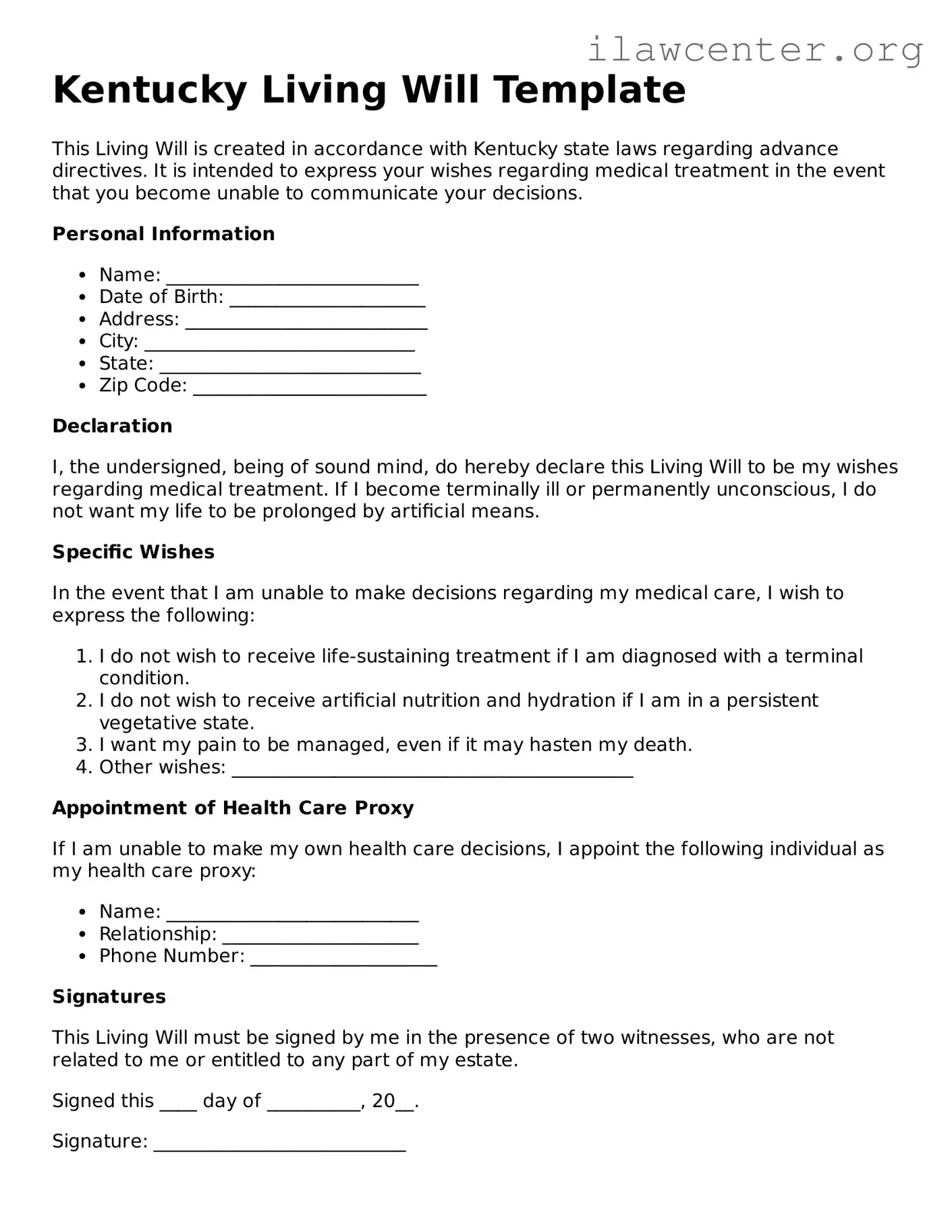
Kentucky Living Will Preview

Kentucky Living Will Template

This Living Will is created in accordance with Kentucky state laws regarding advance directives. It is intended to express your wishes regarding medical treatment in the event that you become unable to communicate your decisions.

Personal Information

  • Name: ___________________________
  • Date of Birth: _____________________
  • Address: __________________________
  • City: _____________________________
  • State: ____________________________
  • Zip Code: _________________________

Declaration

I, the undersigned, being of sound mind, do hereby declare this Living Will to be my wishes regarding medical treatment. If I become terminally ill or permanently unconscious, I do not want my life to be prolonged by artificial means.

Specific Wishes

In the event that I am unable to make decisions regarding my medical care, I wish to express the following:

  1. I do not wish to receive life-sustaining treatment if I am diagnosed with a terminal condition.
  2. I do not wish to receive artificial nutrition and hydration if I am in a persistent vegetative state.
  3. I want my pain to be managed, even if it may hasten my death.
  4. Other wishes: ___________________________________________

Appointment of Health Care Proxy

If I am unable to make my own health care decisions, I appoint the following individual as my health care proxy:

  • Name: ___________________________
  • Relationship: _____________________
  • Phone Number: ____________________

Signatures

This Living Will must be signed by me in the presence of two witnesses, who are not related to me or entitled to any part of my estate.

Signed this ____ day of __________, 20__.

Signature: ___________________________

Witnesses

We, the undersigned witnesses, do hereby affirm that the person who signed this Living Will appears to be of sound mind and is doing so voluntarily.

  • Witness 1 Name: ___________________________
  • Witness 1 Signature: ______________________
  • Witness 2 Name: ___________________________
  • Witness 2 Signature: ______________________

PDF Form Characteristics

Fact Name Description
Purpose The Kentucky Living Will form allows individuals to express their wishes regarding medical treatment in case they become unable to communicate those wishes themselves.
Governing Law This form is governed by Kentucky Revised Statutes (KRS) Chapter 311, specifically KRS 311.621 through KRS 311.643.
Eligibility Any adult resident of Kentucky can create a Living Will. There are no specific requirements regarding age or health status.
Signature Requirement The form must be signed by the individual creating the Living Will and witnessed by two individuals who are not related to the individual or entitled to any portion of their estate.
Revocation A Living Will can be revoked at any time by the individual. This can be done verbally or in writing.
Healthcare Proxy The Living Will can be used in conjunction with a Healthcare Proxy, which designates someone to make medical decisions on behalf of the individual.
Specific Instructions Individuals can include specific instructions about the types of medical treatment they wish to receive or refuse.
Advance Directives The Living Will is a type of advance directive, which is a broader category that includes various documents outlining healthcare preferences.
Storage It is advisable to keep the Living Will in a safe place and share copies with family members and healthcare providers.
Legal Recognition The Kentucky Living Will is legally recognized in the state and must be honored by healthcare providers when validly executed.

Instructions on Utilizing Kentucky Living Will

To fill out the Kentucky Living Will form, follow these steps carefully. Completing the form accurately ensures that your wishes regarding medical treatment are clearly communicated. Make sure to have a pen and a quiet space to focus.

  1. Obtain the Kentucky Living Will form. You can find it online or request a physical copy from a legal office.
  2. Read the instructions on the form thoroughly. Understanding each section is crucial.
  3. Begin with your personal information. Write your full name, address, and date of birth in the designated areas.
  4. Next, indicate your preferences for medical treatment. This section may include options regarding life-sustaining treatments and resuscitation.
  5. Consider any specific conditions under which you want or do not want treatment. Clearly state your wishes in the provided space.
  6. Sign and date the form at the bottom. Your signature confirms that you understand and agree with the contents.
  7. Have the form witnessed. Kentucky law requires at least two witnesses who are not related to you or beneficiaries of your estate.
  8. Make copies of the completed form. Keep one for your records and provide copies to your healthcare provider and family members.

Important Facts about Kentucky Living Will

What is a Living Will in Kentucky?

A Living Will is a legal document that allows you to outline your preferences for medical treatment in case you become unable to communicate your wishes. It specifically addresses end-of-life care and helps ensure that your healthcare providers follow your desires regarding life-sustaining treatments.

Who can create a Living Will in Kentucky?

Any adult who is at least 18 years old and of sound mind can create a Living Will in Kentucky. This includes individuals who are capable of understanding the nature and consequences of their decisions regarding medical treatment.

What should be included in a Living Will?

Your Living Will should clearly state your wishes regarding medical treatments you do or do not want in specific situations, such as terminal illness or irreversible coma. You can also designate a healthcare proxy to make decisions on your behalf if you are unable to do so.

How do I create a Living Will in Kentucky?

To create a Living Will, you can use a standard form provided by the state or consult with an attorney to ensure it meets your specific needs. The form must be signed in the presence of two witnesses or a notary public to be valid.

Can I change or revoke my Living Will?

Yes, you can change or revoke your Living Will at any time as long as you are mentally competent. To revoke it, you can destroy the document or create a new one that clearly states your updated wishes.

What happens if I do not have a Living Will?

If you do not have a Living Will and become unable to communicate your wishes, your healthcare providers will follow standard medical procedures. This may lead to treatments that you might not have wanted. Family members may have to make difficult decisions on your behalf, which can lead to disagreements.

Is a Living Will the same as a Durable Power of Attorney for Healthcare?

No, a Living Will and a Durable Power of Attorney for Healthcare are different documents. A Living Will focuses on your treatment preferences, while a Durable Power of Attorney designates someone to make healthcare decisions for you if you are unable to do so.

Where should I keep my Living Will?

Keep your Living Will in a safe but accessible place. Inform your family members, healthcare proxy, and primary care physician about its location. It’s also a good idea to carry a copy with you, especially when traveling.

Do I need a lawyer to create a Living Will in Kentucky?

While it is not required to have a lawyer to create a Living Will in Kentucky, consulting one can be beneficial. A lawyer can help ensure that your document complies with state laws and accurately reflects your wishes.
Common mistakes

Filling out a Kentucky Living Will form is an important step in making your healthcare wishes known. However, many individuals make common mistakes that can lead to confusion or even invalidate the document. Understanding these pitfalls can help ensure that your Living Will accurately reflects your desires.

One frequent mistake is failing to sign the form. A Living Will must be signed by the individual creating it to be considered valid. Without a signature, healthcare providers may not honor the document, leaving your wishes unfulfilled. It's essential to remember that your signature is a vital part of the process.

Another common error involves not dating the form. A date provides context for when the Living Will was created. If there are multiple versions of the document, the date helps clarify which one reflects your most current wishes. Always include the date to avoid any potential confusion.

Some people overlook the importance of witnesses. In Kentucky, the law requires that a Living Will be signed in the presence of two witnesses. These witnesses cannot be related to you or have any financial interest in your estate. Failing to meet these criteria may render your Living Will invalid.

Additionally, individuals sometimes forget to specify their preferences clearly. Ambiguous language can lead to misunderstandings about your healthcare choices. It is crucial to be as specific as possible regarding the types of medical treatment you wish to receive or refuse, ensuring that your intentions are unmistakable.

Another mistake is neglecting to review the form after filling it out. Life circumstances and personal beliefs can change over time. Regularly reviewing your Living Will ensures that it continues to align with your current values and healthcare preferences. If changes are necessary, update the document accordingly.

Some people mistakenly believe that a Living Will is the same as a power of attorney. While both documents deal with healthcare decisions, they serve different purposes. A Living Will outlines your wishes regarding medical treatment, whereas a power of attorney designates someone to make decisions on your behalf. It's important to understand these distinctions when preparing your documents.

Lastly, failing to communicate your wishes to loved ones can create unnecessary stress during difficult times. It is essential to discuss your Living Will with family members and healthcare providers. This open dialogue ensures that everyone understands your preferences and can advocate for your wishes when needed.

By avoiding these common mistakes, you can create a Living Will that accurately reflects your healthcare wishes and provides peace of mind for you and your loved ones.

Documents used along the form

A Kentucky Living Will is an important document that outlines an individual's preferences regarding medical treatment in the event they become unable to communicate their wishes. However, several other forms and documents can complement the Living Will, ensuring that a person's healthcare decisions are respected and understood. Below is a list of these essential documents.

  • Durable Power of Attorney for Healthcare: This document allows an individual to appoint someone they trust to make medical decisions on their behalf if they are unable to do so. This agent can act according to the preferences outlined in the Living Will.
  • Do Not Resuscitate (DNR) Order: A DNR order is a specific request not to receive CPR or other life-saving measures in the event of cardiac arrest. This document must be signed by a physician and can be included with the Living Will.
  • Healthcare Proxy: Similar to a Durable Power of Attorney, a healthcare proxy designates a person to make healthcare decisions. This document can be particularly useful in situations where the individual has not specified their wishes in a Living Will.
  • Advance Directive: An advance directive is a broader term that includes both Living Wills and Durable Powers of Attorney. It encompasses any document that outlines a person’s healthcare preferences and decisions.
  • Physician Orders for Life-Sustaining Treatment (POLST): This is a medical order that specifies the types of medical treatment a patient wishes to receive or avoid in emergency situations. It is often used for patients with serious illnesses.
  • Organ Donation Form: This document indicates an individual’s wishes regarding organ donation after death. It can be included with the Living Will to ensure that these wishes are honored.
  • Patient Advocate Designation: This form allows individuals to appoint someone to advocate for their healthcare preferences and rights, ensuring their wishes are communicated effectively to medical staff.
  • Medical History and Medication List: While not a legal document, maintaining an updated medical history and medication list can help healthcare providers make informed decisions in accordance with the Living Will.
  • Funeral Planning Documents: Although separate from healthcare decisions, these documents outline preferences for funeral arrangements and can relieve family members of decision-making burdens during a difficult time.

Having these documents in place alongside a Kentucky Living Will can provide clarity and guidance for healthcare providers and loved ones. They ensure that an individual's wishes are honored, even when they cannot express them directly. It is crucial to review and update these documents regularly to reflect any changes in preferences or circumstances.

Similar forms

A Living Will is an important document that outlines a person's wishes regarding medical treatment in situations where they may no longer be able to communicate their preferences. Several other documents serve similar purposes, providing guidance on health care decisions and end-of-life care. Here are five documents that share similarities with a Living Will:

  • Advance Directive: This is a broader term that encompasses both Living Wills and Durable Power of Attorney for Health Care. It allows individuals to specify their health care preferences and appoint someone to make decisions on their behalf if they are unable to do so.
  • Durable Power of Attorney for Health Care: This document allows a person to designate a trusted individual to make medical decisions on their behalf. While a Living Will specifies treatment preferences, a Durable Power of Attorney focuses on appointing someone to act in the individual’s best interest.
  • Do Not Resuscitate (DNR) Order: A DNR order specifically instructs medical personnel not to perform CPR if a person stops breathing or their heart stops. Like a Living Will, it reflects a person's wishes regarding end-of-life care but is more focused on resuscitation efforts.
  • Physician Orders for Life-Sustaining Treatment (POLST): This is a medical order that outlines a patient's preferences for life-sustaining treatments. It is similar to a Living Will but is designed for those who are seriously ill or nearing the end of life, ensuring that their wishes are followed in medical settings.
  • Health Care Proxy: This document allows an individual to appoint someone to make health care decisions on their behalf if they become incapacitated. While a Living Will expresses specific wishes, a Health Care Proxy empowers someone to interpret and make decisions based on those wishes.

Understanding these documents can help individuals make informed choices about their health care and ensure their preferences are respected. Each serves a unique role in the broader context of health care planning.

Dos and Don'ts

When filling out the Kentucky Living Will form, it is important to be aware of certain guidelines to ensure that your wishes are clearly communicated. Here is a list of things you should and shouldn't do:

  • Do clearly state your medical preferences regarding life-sustaining treatment.
  • Do discuss your wishes with family members and loved ones.
  • Do ensure that you are of sound mind when completing the form.
  • Do sign and date the document in the presence of witnesses.
  • Do keep a copy of the completed form in a safe place.
  • Don't use vague language that could lead to confusion about your wishes.
  • Don't forget to review and update the document as your preferences may change.
  • Don't neglect to inform your healthcare provider about the existence of your Living Will.
  • Don't sign the form without understanding its contents fully.

By following these guidelines, you can ensure that your Living Will accurately reflects your wishes and provides clarity for your loved ones and healthcare providers.

Misconceptions

Understanding the Kentucky Living Will form is essential for making informed decisions about end-of-life care. However, several misconceptions can lead to confusion. Here are six common misconceptions:

  1. Living Wills are only for the elderly.

    This is not true. Anyone, regardless of age, can benefit from having a Living Will. Life can be unpredictable, and having a plan in place ensures that your wishes are known and respected.

  2. A Living Will is the same as a Do Not Resuscitate (DNR) order.

    While both documents address end-of-life care, they serve different purposes. A Living Will outlines your preferences for medical treatment in specific situations, while a DNR specifically instructs medical personnel not to perform CPR if your heart stops.

  3. Once completed, a Living Will cannot be changed.

    This misconception is false. You have the right to modify or revoke your Living Will at any time, as long as you are mentally competent to do so. Regularly reviewing and updating your wishes is a good practice.

  4. Only lawyers can create a Living Will.

    While legal assistance can be helpful, it is not necessary. The Kentucky Living Will form is designed to be user-friendly, allowing individuals to complete it on their own. However, consulting with a healthcare professional can provide additional guidance.

  5. A Living Will is only effective if it is notarized.

    In Kentucky, a Living Will does not need to be notarized to be valid. It must be signed and witnessed by two individuals who are not related to you and do not stand to inherit from your estate.

  6. Living Wills are only applicable in hospitals.

    This is a misconception. A Living Will is applicable in any healthcare setting, including nursing homes, hospice care, and even at home, ensuring that your wishes are honored wherever you receive care.

By clarifying these misconceptions, individuals can make more informed decisions about their healthcare preferences and ensure their wishes are respected.

Key takeaways

Filling out and using the Kentucky Living Will form is an important step in planning for future medical care. Here are some key takeaways to keep in mind:

  • The Kentucky Living Will form allows individuals to express their wishes regarding medical treatment in case they become unable to communicate.
  • It is crucial to complete the form while you are still in good health and can make informed decisions.
  • You must sign the form in the presence of two witnesses or a notary public for it to be legally valid.
  • Witnesses cannot be related to you, cannot be your healthcare provider, and should not benefit from your estate.
  • Once completed, share copies of your Living Will with family members and your healthcare provider to ensure they are aware of your wishes.
  • You have the right to change or revoke your Living Will at any time, as long as you are mentally competent.
  • Keep the original document in a safe place, and inform your loved ones where to find it in case it is needed.