Attorney-Verified  Medical Power of Attorney Document for Kentucky

Attorney-Verified Medical Power of Attorney Document for Kentucky

The Kentucky Medical Power of Attorney form is a legal document that allows individuals to designate someone they trust to make medical decisions on their behalf in case they become incapacitated. This form ensures that your healthcare preferences are honored, even when you cannot communicate them yourself. To take control of your medical decisions, consider filling out the form by clicking the button below.

Article Guide

In Kentucky, the Medical Power of Attorney form serves as an essential legal document that allows individuals to designate someone they trust to make healthcare decisions on their behalf in the event they become unable to communicate their wishes. This form is particularly important for ensuring that a person's medical treatment preferences are respected, even when they cannot voice them due to illness or incapacity. It covers a range of healthcare decisions, including choices about medical procedures, medications, and end-of-life care. The appointed individual, often referred to as the agent or proxy, gains the authority to discuss medical options with healthcare providers, access medical records, and make critical decisions that align with the individual’s values and desires. Understanding the nuances of this form, including the requirements for its execution and any potential limitations, is crucial for anyone considering its use. By planning ahead and completing this document, individuals can ensure that their healthcare wishes are honored, providing peace of mind for themselves and their loved ones.

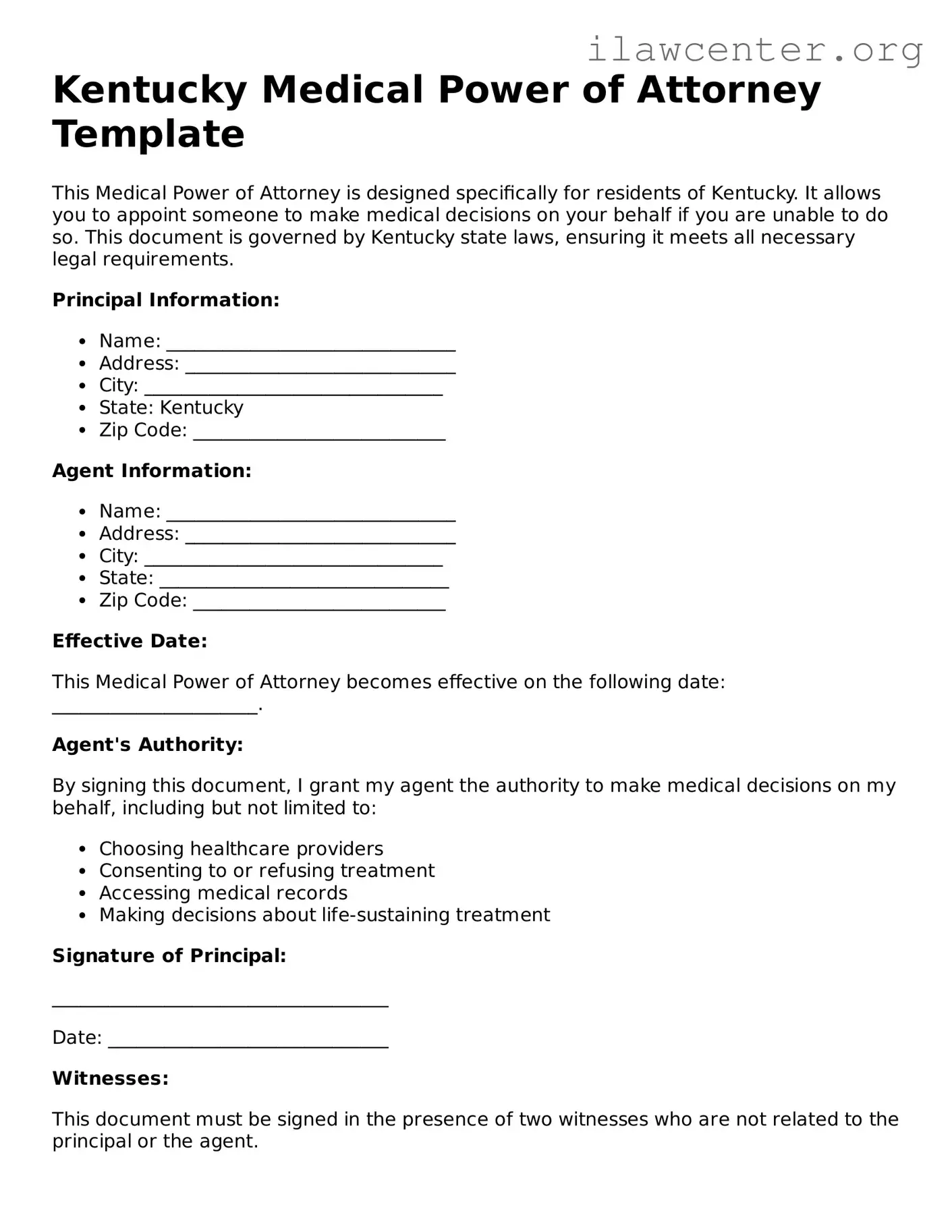
Kentucky Medical Power of Attorney Preview

Kentucky Medical Power of Attorney Template

This Medical Power of Attorney is designed specifically for residents of Kentucky. It allows you to appoint someone to make medical decisions on your behalf if you are unable to do so. This document is governed by Kentucky state laws, ensuring it meets all necessary legal requirements.

Principal Information:

  • Name: _______________________________
  • Address: _____________________________
  • City: ________________________________
  • State: Kentucky
  • Zip Code: ___________________________

Agent Information:

  • Name: _______________________________
  • Address: _____________________________
  • City: ________________________________
  • State: _______________________________
  • Zip Code: ___________________________

Effective Date:

This Medical Power of Attorney becomes effective on the following date: ______________________.

Agent's Authority:

By signing this document, I grant my agent the authority to make medical decisions on my behalf, including but not limited to:

  • Choosing healthcare providers
  • Consenting to or refusing treatment
  • Accessing medical records
  • Making decisions about life-sustaining treatment

Signature of Principal:

____________________________________

Date: ______________________________

Witnesses:

This document must be signed in the presence of two witnesses who are not related to the principal or the agent.

Witness 1: ___________________________

Date: ______________________________

Witness 2: ___________________________

Date: ______________________________

Notary Public:

State of Kentucky, County of _______________

Subscribed and sworn to before me on this _____ day of __________, 20__.

____________________________________

Notary Public Signature

My Commission Expires: _______________

PDF Form Characteristics

Fact Name Description
Purpose The Kentucky Medical Power of Attorney form allows an individual to appoint someone to make healthcare decisions on their behalf if they become incapacitated.
Governing Law This form is governed by Kentucky Revised Statutes, Chapter 311.621.
Eligibility Any adult resident of Kentucky can create a Medical Power of Attorney.
Signature Requirements The form must be signed by the principal and witnessed by two individuals or notarized.
Revocation The principal can revoke the Medical Power of Attorney at any time, as long as they are competent to do so.
Durability This power of attorney remains effective even if the principal becomes incapacitated.

Instructions on Utilizing Kentucky Medical Power of Attorney

Filling out the Kentucky Medical Power of Attorney form is an important step in ensuring that your healthcare preferences are respected in the event that you cannot make decisions for yourself. This document allows you to designate someone you trust to make medical decisions on your behalf. Once completed, the form should be signed and witnessed according to Kentucky state law.

  1. Obtain the Kentucky Medical Power of Attorney form. You can find this form online or at a local legal office.
  2. Read through the entire form carefully to understand its sections and requirements.
  3. Fill in your full name and address at the top of the form.
  4. Designate your chosen agent by writing their full name and address in the specified section.
  5. Consider adding an alternate agent in case your primary agent is unavailable. Provide their name and address if you choose to do so.
  6. Specify any limitations or specific instructions regarding your medical care, if desired. This can include preferences for certain treatments or procedures.
  7. Review the completed form to ensure all information is accurate and complete.
  8. Sign the form in the presence of two witnesses. Make sure the witnesses are not related to you and are not named as agents in the document.
  9. Have the witnesses sign the form, acknowledging that they witnessed your signature.
  10. Consider having the document notarized for added validity, though it is not required in Kentucky.
  11. Keep the original form in a safe place and provide copies to your designated agent and any healthcare providers you may have.

Important Facts about Kentucky Medical Power of Attorney

What is a Kentucky Medical Power of Attorney?

A Kentucky Medical Power of Attorney is a legal document that allows you to appoint someone to make medical decisions on your behalf if you become unable to do so. This person is known as your agent or attorney-in-fact. They will have the authority to make healthcare decisions based on your wishes and best interests.

Who can be my agent in a Medical Power of Attorney?

Your agent can be any competent adult you trust. This could be a family member, friend, or someone who understands your values and healthcare preferences. However, certain individuals, such as your healthcare provider or an employee of your healthcare provider, may not be eligible to serve as your agent.

What decisions can my agent make?

Your agent can make a wide range of healthcare decisions, including consent to or refusal of medical treatment, choice of healthcare providers, and decisions about life-sustaining treatment. They will act according to your wishes and best interests when making these choices.

Do I need to notarize the Medical Power of Attorney?

No, Kentucky does not require the Medical Power of Attorney to be notarized. However, it must be signed by you and witnessed by two individuals who are not related to you and who do not stand to gain from your estate.

Can I change or revoke my Medical Power of Attorney?

Yes, you can change or revoke your Medical Power of Attorney at any time as long as you are mentally competent. To revoke it, you should notify your agent and any healthcare providers who have a copy of the document. It is also a good idea to create a new document if you are making changes.

When does the Medical Power of Attorney take effect?

The Medical Power of Attorney takes effect when you become unable to make your own medical decisions. This can be due to illness, injury, or any condition that affects your ability to communicate your wishes.

Is there a specific form I need to use in Kentucky?

While Kentucky does not require a specific form, it is recommended to use a form that meets state requirements. This ensures that your Medical Power of Attorney is valid and recognized by healthcare providers.

Can I include specific instructions in my Medical Power of Attorney?

Yes, you can include specific instructions regarding your healthcare preferences. This may involve your wishes about life support, organ donation, or any other medical treatments. Clearly stating your preferences helps guide your agent in making decisions that align with your values.

What happens if I don’t have a Medical Power of Attorney?

If you do not have a Medical Power of Attorney and become unable to make your own medical decisions, the court may appoint a guardian to make decisions for you. This process can be lengthy and may not reflect your personal wishes.

How can I ensure my Medical Power of Attorney is followed?

To ensure your Medical Power of Attorney is followed, share copies of the document with your agent, healthcare providers, and family members. Discuss your wishes with them so they understand your preferences. Keeping everyone informed helps ensure your decisions are honored.

Common mistakes

Filling out a Kentucky Medical Power of Attorney form is an important step in ensuring that your healthcare preferences are honored when you cannot speak for yourself. However, many individuals make common mistakes that can lead to confusion or even legal complications. Understanding these pitfalls can help ensure that your wishes are clearly communicated.

One frequent mistake is failing to designate a specific agent. It's essential to choose someone you trust to make medical decisions on your behalf. Simply naming a general term like "my family" can create ambiguity. Your agent should be clearly identified by name, along with their contact information, to avoid any misunderstandings.

Another common error is neglecting to discuss your wishes with your chosen agent. It’s not enough to simply appoint someone; that person should be aware of your healthcare preferences. Without this conversation, they may struggle to make decisions that align with your values and desires.

Many people also overlook the importance of signing and dating the form. In Kentucky, the document must be signed by you, the principal, and dated to be valid. An unsigned or undated form can lead to challenges when it’s needed. Additionally, witnesses must also sign the document, adding another layer of necessary compliance.

In some cases, individuals fail to update their Medical Power of Attorney as circumstances change. Life events such as a divorce, a new relationship, or a change in health can necessitate a review of your appointed agent or your specific wishes. Regularly revisiting the document ensures it reflects your current situation.

Another mistake is not considering alternate agents. If your primary agent is unavailable or unable to act, having a backup can prevent delays in decision-making. Clearly naming an alternate agent can provide peace of mind and ensure continuity in your healthcare decisions.

People sometimes forget to provide copies of the completed form to relevant parties. It's important to share the Medical Power of Attorney with your healthcare provider, family members, and anyone else who may need access to it. This ensures that your wishes are known and can be acted upon swiftly.

Additionally, some individuals make the mistake of using outdated forms. Laws and regulations can change, and using an old version may lead to complications. Always ensure that you are using the most current form available from a reliable source.

Finally, failing to understand the scope of authority granted to the agent can lead to unintended consequences. The Medical Power of Attorney can cover various medical decisions, but it’s crucial to specify what decisions your agent can make. Clarifying this can help avoid disputes among family members during critical times.

By being aware of these common mistakes, individuals can take proactive steps to ensure that their Medical Power of Attorney accurately reflects their wishes and is legally sound. Proper preparation can make a significant difference when it matters most.

Documents used along the form

When considering the Kentucky Medical Power of Attorney form, it’s essential to understand that it often works in conjunction with several other documents. These forms can help ensure that your healthcare wishes are respected and that your loved ones are prepared to make decisions on your behalf if necessary. Below is a list of commonly used forms and documents that complement the Medical Power of Attorney.

  • Living Will: This document outlines your preferences regarding medical treatment and interventions if you become unable to communicate your wishes. It typically addresses end-of-life care, such as resuscitation and life support.
  • Durable Power of Attorney: Unlike the Medical Power of Attorney, this document allows you to appoint someone to handle your financial and legal matters. It remains effective even if you become incapacitated.
  • Do Not Resuscitate (DNR) Order: A DNR order is a specific request not to receive CPR or other life-saving measures in the event of cardiac arrest. This document must be signed by a physician and is often included in your medical records.
  • HIPAA Authorization: This form allows you to designate individuals who can access your medical information. It ensures that your healthcare providers can share your health details with the people you trust.
  • Advance Directive: An advance directive combines elements of a living will and a medical power of attorney. It provides guidance on your healthcare preferences and designates a healthcare proxy.
  • Healthcare Proxy: This document specifically appoints someone to make medical decisions on your behalf if you are unable to do so. It is often included in the Medical Power of Attorney but can also stand alone.
  • Patient Advocate Designation: This form allows you to appoint a patient advocate who can make healthcare decisions for you. It emphasizes your values and preferences regarding treatment options.
  • Personal Health Record: A personal health record is a comprehensive collection of your medical history, medications, allergies, and treatment preferences. Keeping this document updated can facilitate better communication with healthcare providers.

By understanding these additional forms and documents, you can create a more comprehensive plan for your healthcare decisions. This proactive approach can provide peace of mind for you and your loved ones, ensuring that your wishes are honored when it matters most.

Similar forms

  • Durable Power of Attorney: This document allows someone to make financial decisions on your behalf if you become incapacitated. Like a Medical Power of Attorney, it grants authority to act when you cannot.
  • Living Will: A Living Will outlines your wishes regarding medical treatment in situations where you cannot communicate. It complements a Medical Power of Attorney by specifying what kind of care you want or do not want.
  • Health Care Proxy: Similar to a Medical Power of Attorney, a Health Care Proxy designates someone to make medical decisions for you. The key difference is that it often focuses solely on health care decisions.
  • Do Not Resuscitate (DNR) Order: A DNR order instructs medical personnel not to perform CPR if your heart stops. While it is specific to resuscitation, it aligns with the intentions of a Medical Power of Attorney regarding end-of-life care.
  • Advance Directive: This is a broader term that includes both a Living Will and a Medical Power of Attorney. It provides comprehensive instructions about your medical care preferences and designates a decision-maker.
  • Patient Advocate Designation: This document allows you to appoint someone to advocate for your medical needs and preferences. It shares similarities with a Medical Power of Attorney in that it empowers someone to act on your behalf.

Dos and Don'ts

When filling out the Kentucky Medical Power of Attorney form, it's important to follow certain guidelines. Here are six things you should and shouldn't do:

  • Do ensure that you are of sound mind when completing the form.
  • Do choose a trusted person as your agent who understands your wishes.
  • Do clearly state your medical preferences and any specific instructions.
  • Do sign the document in front of a notary public or witnesses as required.
  • Don't leave any sections blank; fill out all required information.
  • Don't assume your agent knows your wishes without discussing them first.

By following these guidelines, you can help ensure that your medical decisions are respected when you cannot speak for yourself.

Misconceptions

The Kentucky Medical Power of Attorney form is a vital document that allows individuals to designate someone they trust to make healthcare decisions on their behalf if they become unable to do so. However, there are several misconceptions surrounding this form that can lead to confusion. Here are six common misunderstandings:

  1. Misconception 1: The Medical Power of Attorney is only for the elderly.

    This is not true. Anyone, regardless of age, can benefit from having a Medical Power of Attorney. Unexpected medical emergencies can happen to anyone, making it essential to have a plan in place.

  2. Misconception 2: A Medical Power of Attorney is the same as a living will.

    While both documents deal with healthcare decisions, they serve different purposes. A Medical Power of Attorney appoints someone to make decisions for you, whereas a living will outlines your preferences for medical treatment.

  3. Misconception 3: Once I sign the form, I lose control over my healthcare decisions.

    This is a common fear, but it is unfounded. You retain control as long as you are capable of making your own decisions. The appointed agent steps in only when you are unable to communicate your wishes.

  4. Misconception 4: I can only appoint a family member as my agent.

    While many people choose family members, you can appoint anyone you trust, including friends or professionals. The key is to select someone who understands your values and will advocate for your wishes.

  5. Misconception 5: The Medical Power of Attorney form is a one-time document.

    In reality, you can update or revoke your Medical Power of Attorney at any time, as long as you are mentally competent. Life changes, and so may your preferences regarding healthcare decisions.

  6. Misconception 6: I don’t need a Medical Power of Attorney if I have health insurance.

    Health insurance covers medical costs, but it does not address who makes decisions about your care. A Medical Power of Attorney ensures that someone you trust is empowered to make those critical decisions if necessary.

Understanding these misconceptions can help individuals make informed decisions about their healthcare planning. Taking the time to establish a Medical Power of Attorney can provide peace of mind for both you and your loved ones.

Key takeaways

Filling out and using the Kentucky Medical Power of Attorney form is an important step in ensuring your healthcare decisions are honored. Here are some key takeaways to keep in mind:

  • The form allows you to designate a trusted individual as your healthcare agent.
  • Your agent will have the authority to make medical decisions on your behalf if you are unable to do so.
  • It is crucial to choose someone who understands your values and wishes regarding medical treatment.
  • The form must be signed in the presence of two witnesses or a notary public to be valid.
  • You can revoke or change your Medical Power of Attorney at any time as long as you are competent.
  • Keep copies of the completed form in accessible locations, such as with your healthcare provider or family members.
  • Review the document periodically to ensure it still reflects your current wishes and circumstances.