Attorney-Verified  Motor Vehicle Power of Attorney Document for Kentucky

Attorney-Verified Motor Vehicle Power of Attorney Document for Kentucky

The Kentucky Motor Vehicle Power of Attorney form allows an individual to designate someone else to handle specific tasks related to their vehicle, such as transferring ownership or registering the vehicle. This legal document ensures that your chosen representative can act on your behalf, streamlining the process for various motor vehicle-related transactions. If you need to authorize someone to manage your vehicle matters, consider filling out this form by clicking the button below.

Article Guide

When it comes to managing vehicle-related matters in Kentucky, the Motor Vehicle Power of Attorney form serves as a crucial tool for individuals who need to delegate authority. This form allows one person, known as the principal, to appoint another, called the agent, to handle specific tasks related to their vehicle. Whether it’s signing documents for a title transfer, registering a vehicle, or dealing with the Department of Motor Vehicles, this form simplifies the process. It ensures that the agent can act on behalf of the principal, making it easier to navigate the often complex world of vehicle ownership and transactions. Understanding the key components of this form, including the rights granted, the responsibilities of the agent, and the necessary signatures, is essential for anyone looking to streamline their vehicle affairs in Kentucky. By using this form properly, individuals can save time and avoid potential headaches associated with vehicle management.

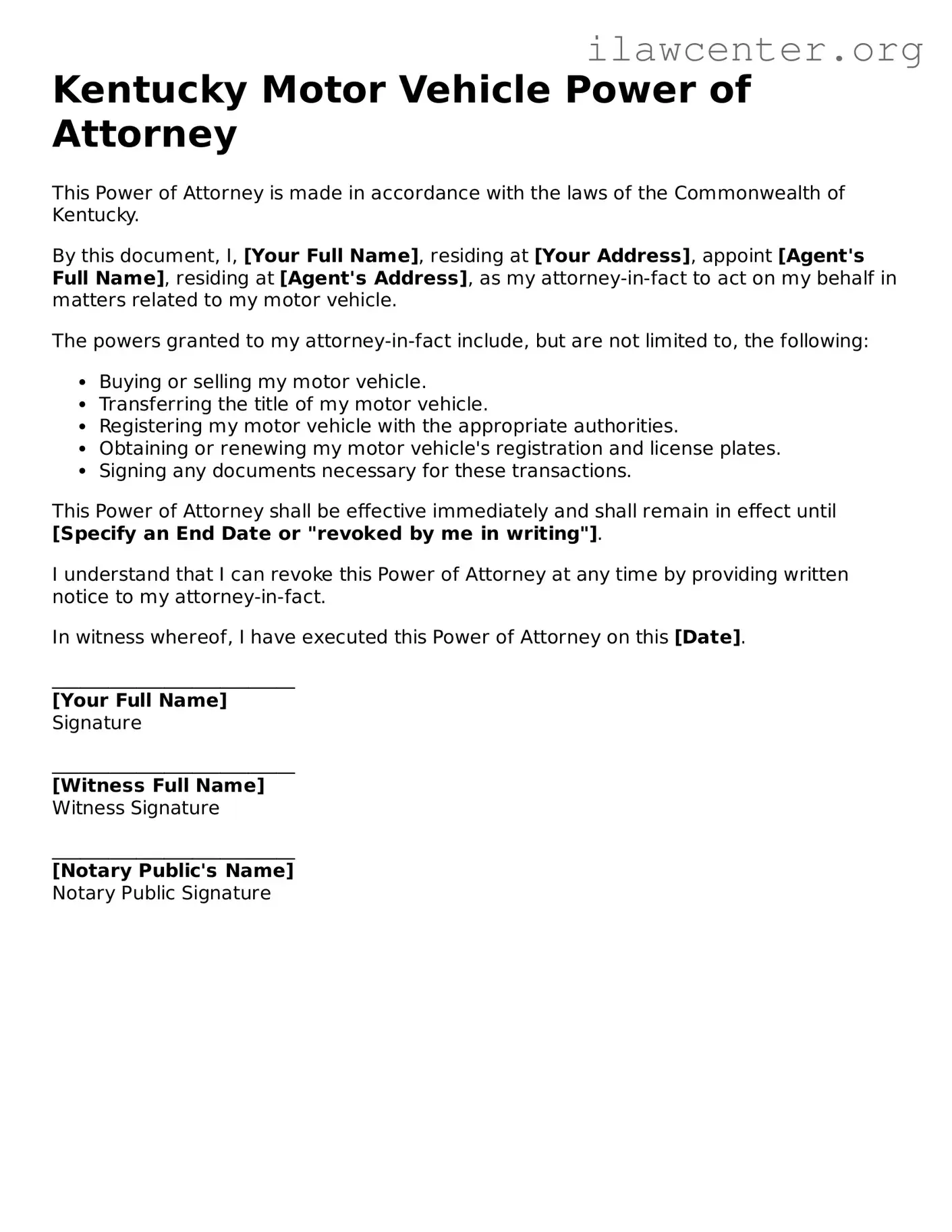
Kentucky Motor Vehicle Power of Attorney Preview

Kentucky Motor Vehicle Power of Attorney

This Power of Attorney is made in accordance with the laws of the Commonwealth of Kentucky.

By this document, I, [Your Full Name], residing at [Your Address], appoint [Agent's Full Name], residing at [Agent's Address], as my attorney-in-fact to act on my behalf in matters related to my motor vehicle.

The powers granted to my attorney-in-fact include, but are not limited to, the following:

  • Buying or selling my motor vehicle.
  • Transferring the title of my motor vehicle.
  • Registering my motor vehicle with the appropriate authorities.
  • Obtaining or renewing my motor vehicle's registration and license plates.
  • Signing any documents necessary for these transactions.

This Power of Attorney shall be effective immediately and shall remain in effect until [Specify an End Date or "revoked by me in writing"].

I understand that I can revoke this Power of Attorney at any time by providing written notice to my attorney-in-fact.

In witness whereof, I have executed this Power of Attorney on this [Date].

__________________________
[Your Full Name]
Signature

__________________________
[Witness Full Name]
Witness Signature

__________________________
[Notary Public's Name]
Notary Public Signature

PDF Form Characteristics

Fact Name Description
Purpose The Kentucky Motor Vehicle Power of Attorney form allows an individual to designate another person to handle specific motor vehicle transactions on their behalf.
Governing Law This form is governed by Kentucky Revised Statutes, specifically KRS 186A.200.
Principal The individual granting the authority is known as the principal.
Agent The person designated to act on behalf of the principal is referred to as the agent.
Signature Requirement The principal must sign the form for it to be valid. This signature often requires notarization.
Expiration The power of attorney can specify an expiration date, or it may remain effective until revoked by the principal.
Vehicle Transactions This form can be used for various transactions, including title transfers, registration, and obtaining duplicate titles.
Revocation The principal has the right to revoke the power of attorney at any time, provided they notify the agent and any relevant parties.
Use Cases This form is particularly useful for individuals who are unable to attend to vehicle matters due to absence or incapacity.

Instructions on Utilizing Kentucky Motor Vehicle Power of Attorney

Filling out the Kentucky Motor Vehicle Power of Attorney form is a straightforward process. This document allows you to designate someone to act on your behalf regarding motor vehicle transactions. Follow the steps below to complete the form accurately.

  1. Obtain the Kentucky Motor Vehicle Power of Attorney form. You can find this form on the Kentucky Department of Vehicle Regulation website or at your local county clerk's office.
  2. Begin by entering the date at the top of the form. Ensure that the date is written in the format MM/DD/YYYY.
  3. Fill in your full name as the principal. This is the person granting the power of attorney.
  4. Provide your address, including street, city, state, and zip code.
  5. Next, enter the name of the attorney-in-fact. This is the person you are authorizing to act on your behalf.
  6. Include the attorney-in-fact's address, ensuring it is complete with street, city, state, and zip code.
  7. Describe the specific powers you are granting. This may include buying, selling, or transferring a vehicle.
  8. Sign the form in the designated area. Your signature must match the name you provided as the principal.
  9. Have the form notarized. This step is crucial for the form to be valid. A notary public will verify your identity and witness your signature.
  10. Make copies of the completed and notarized form for your records and for the attorney-in-fact.

Once you have completed these steps, the form is ready for use. Ensure that the attorney-in-fact understands their responsibilities and the powers granted to them.

Important Facts about Kentucky Motor Vehicle Power of Attorney

What is a Kentucky Motor Vehicle Power of Attorney form?

The Kentucky Motor Vehicle Power of Attorney form is a legal document that allows one person to designate another person to act on their behalf concerning motor vehicle-related matters. This can include tasks such as transferring ownership of a vehicle, applying for title and registration, and handling other administrative functions associated with motor vehicles. Essentially, it empowers an agent to make decisions regarding the vehicle as if they were the owner.

Who can serve as an agent under this form?

In Kentucky, the agent named in the Motor Vehicle Power of Attorney form can be anyone the principal trusts to handle their vehicle-related affairs. This might include family members, friends, or professionals such as attorneys or agents in a dealership. The key requirement is that the agent must be at least 18 years old and capable of understanding the responsibilities assigned to them.

How do I complete the form?

To complete the Kentucky Motor Vehicle Power of Attorney form, you will need to provide specific information about both the principal (the person granting authority) and the agent (the person receiving authority). This includes names, addresses, and possibly vehicle details such as the make, model, and VIN. After filling out the form, both parties must sign it, and it may be advisable to have it notarized to enhance its validity.

Do I need to have the form notarized?

While notarization is not strictly required for the Kentucky Motor Vehicle Power of Attorney form to be valid, it is highly recommended. Having the document notarized can help prevent disputes about its authenticity and ensure that the agent’s authority is recognized by third parties, such as the Department of Motor Vehicles or other institutions.

Is there a specific time frame for which the Power of Attorney is valid?

The duration of the authority granted by the Kentucky Motor Vehicle Power of Attorney form can vary based on the intentions of the principal. The form may specify a particular time frame or can be valid until revoked by the principal. If no time frame is indicated, it is typically understood that the authority lasts until the principal decides to revoke it or until their death.

Can I revoke the Power of Attorney once it is granted?

Yes, the principal has the right to revoke the Motor Vehicle Power of Attorney at any time, as long as they are mentally competent to do so. To revoke the authority, the principal should create a written notice of revocation and communicate this to the agent and any relevant parties, such as the DMV. It is advisable to keep a copy of the revocation notice for personal records.

What happens if the agent misuses their authority?

If an agent misuses their authority under the Kentucky Motor Vehicle Power of Attorney, the principal may have legal recourse. This could involve filing a complaint or taking legal action against the agent for any damages incurred due to their actions. It is crucial for the principal to choose an agent wisely and to monitor their activities to ensure that the authority is exercised appropriately.

Can I use this form for other legal matters?

No, the Kentucky Motor Vehicle Power of Attorney form is specifically designed for matters related to motor vehicles. If you need to grant someone authority to handle other types of legal or financial matters, you would need to use a different type of Power of Attorney form tailored to those specific needs. Each form serves a unique purpose, and using the correct one is essential for ensuring that your intentions are legally recognized.

Where can I obtain the Kentucky Motor Vehicle Power of Attorney form?

The Kentucky Motor Vehicle Power of Attorney form can typically be obtained from the Kentucky Transportation Cabinet's website or local DMV offices. Additionally, legal stationery stores or online legal services may offer templates for this form. It is important to ensure that you are using the most current version of the form to comply with state regulations.
Common mistakes

Filling out the Kentucky Motor Vehicle Power of Attorney form can be straightforward, but several common mistakes can lead to complications. One frequent error is failing to provide complete information. Each section of the form must be filled out thoroughly. Omitting details about the vehicle or the parties involved can result in delays or even rejection of the document.

Another mistake often made is not signing the form. Both the principal and the agent must sign the document for it to be valid. Without these signatures, the power of attorney cannot be executed, rendering it ineffective. Additionally, people sometimes forget to date the form. The date of signing is crucial for establishing the timeline of authority.

Some individuals overlook the importance of clarity in designating the agent. The agent should be clearly identified, including their full name and contact information. Ambiguity in this section can lead to disputes or confusion regarding who has the authority to act on behalf of the vehicle owner.

It is also common for people to neglect to check the specific powers granted to the agent. The form allows for various powers related to the vehicle, such as selling, transferring, or registering it. Failing to specify these powers can limit the agent's ability to act effectively.

Additionally, individuals sometimes do not provide sufficient identification for themselves or the agent. Including a driver’s license number or Social Security number can help verify identities and prevent fraud. Missing this information may lead to challenges in executing the authority granted.

Another mistake involves not keeping a copy of the completed form. It is essential to retain a copy for personal records. This ensures that both parties have access to the document and can refer to it when necessary.

Some people also forget to check state-specific requirements. Each state may have unique rules regarding the execution of a power of attorney. Familiarizing oneself with Kentucky's specific regulations can prevent issues down the line.

It is crucial to ensure that the form is notarized if required. While not all power of attorney forms need notarization, some situations may call for it. Neglecting this step can invalidate the document.

Finally, individuals sometimes fail to communicate effectively with their chosen agent. Discussing the powers granted and expectations can help prevent misunderstandings. Open communication ensures that the agent is prepared to act in the principal's best interest.

Documents used along the form

The Kentucky Motor Vehicle Power of Attorney form is a crucial document that allows an individual to appoint another person to act on their behalf regarding motor vehicle transactions. However, this form is often accompanied by several other important documents that facilitate various aspects of vehicle ownership and transfer. Below is a list of commonly used forms and documents that may be relevant in conjunction with the Kentucky Motor Vehicle Power of Attorney.

  • Kentucky Certificate of Title: This document proves ownership of a vehicle. It includes details such as the vehicle identification number (VIN), make, model, and the owner's information.
  • Kentucky Bill of Sale: This document serves as a receipt for the sale of a vehicle. It outlines the terms of the sale, including the purchase price and the parties involved.
  • Kentucky Vehicle Registration Application: This form is required to register a vehicle with the state. It includes information about the vehicle and the owner, and it must be submitted to the local county clerk's office.
  • Kentucky Odometer Disclosure Statement: This form is necessary for the transfer of a vehicle to disclose the accurate mileage at the time of sale, ensuring transparency in the transaction.
  • Kentucky Affidavit of Inheritance: If a vehicle is inherited, this document may be needed to establish the legal transfer of ownership from the deceased to the heir.
  • Kentucky Application for a Duplicate Title: If the original title is lost or damaged, this form allows an individual to request a replacement title from the state.
  • Kentucky Power of Attorney for Vehicle Transactions: While similar to the Motor Vehicle Power of Attorney, this form may be more general and can cover various vehicle-related transactions beyond just motor vehicles.
  • Kentucky Release of Liability: This document protects the seller from any future liability associated with the vehicle after it has been sold, confirming that the vehicle is no longer in their possession.
  • Kentucky Insurance Verification Form: This form may be required to prove that a vehicle is insured before it can be registered or operated legally.

Each of these documents plays a vital role in ensuring that motor vehicle transactions are conducted smoothly and legally. Understanding their purposes and the contexts in which they are used can significantly ease the process of buying, selling, or transferring vehicle ownership in Kentucky.

Similar forms

  • Durable Power of Attorney: This document allows someone to make decisions on your behalf regarding various matters, including financial and legal decisions, even if you become incapacitated.
  • Limited Power of Attorney: Similar to the Motor Vehicle Power of Attorney, this document grants authority for specific tasks or decisions, such as handling a particular transaction or managing certain assets.
  • Healthcare Power of Attorney: This form designates an individual to make medical decisions for you if you are unable to do so. It focuses on health-related matters rather than vehicle issues.
  • Financial Power of Attorney: This document specifically allows someone to manage your financial affairs, including banking and investments, similar to how the Motor Vehicle Power of Attorney manages vehicle-related matters.
  • Real Estate Power of Attorney: Like the Motor Vehicle version, this document gives authority to someone to handle real estate transactions on your behalf, such as buying or selling property.
  • Special Power of Attorney: This type grants authority for a specific act or event, much like the Motor Vehicle Power of Attorney, which is limited to vehicle-related tasks.
  • Living Will: While primarily focused on healthcare decisions, it can work alongside a Healthcare Power of Attorney to ensure your wishes are followed, similar to how a Motor Vehicle Power of Attorney ensures your vehicle matters are managed.
  • Trustee Authorization: This document allows a trustee to manage assets within a trust, similar to how a Motor Vehicle Power of Attorney allows someone to manage your vehicle affairs.
  • Consent to Transfer Title: This document is used specifically for transferring ownership of a vehicle. It shares similarities with the Motor Vehicle Power of Attorney in that it facilitates vehicle transactions.

Dos and Don'ts

When filling out the Kentucky Motor Vehicle Power of Attorney form, it's essential to follow certain guidelines to ensure the document is valid and effective. Here are some key dos and don’ts to consider:

  • Do provide accurate information about the principal and the agent. Ensure that names, addresses, and contact details are correct.
  • Do clearly specify the powers you are granting. Be explicit about what the agent can do on your behalf regarding your vehicle.
  • Do sign the form in the presence of a notary. This adds a layer of authenticity and helps prevent any future disputes.
  • Do keep a copy of the completed form for your records. This ensures you have a reference in case any issues arise later.
  • Don’t leave any sections blank. Incomplete forms can lead to delays or rejection.
  • Don’t use outdated versions of the form. Always check for the latest version to avoid legal complications.
  • Don’t grant powers that you are uncomfortable with. Ensure you trust the person you are designating as your agent.
  • Don’t forget to date the form. A missing date can create confusion about when the powers were granted.

Misconceptions

Many people have misunderstandings about the Kentucky Motor Vehicle Power of Attorney form. Here are some common misconceptions:

  1. It can only be used for buying and selling vehicles.

    While this form is often associated with transactions like buying or selling a vehicle, it can also be used for other purposes. This includes registering a vehicle, transferring titles, and handling other motor vehicle-related tasks.

  2. Only a lawyer can complete this form.

    Many believe that a lawyer's involvement is necessary to fill out this form. However, individuals can prepare and submit the form themselves. It’s designed to be user-friendly for anyone needing to delegate motor vehicle authority.

  3. It is only valid in Kentucky.

    Some think the Kentucky Motor Vehicle Power of Attorney is only valid within the state. In reality, it can be recognized in other states, but it’s important to check local laws to ensure compliance.

  4. Once signed, it cannot be revoked.

    This is not true. The person who grants the power can revoke it at any time, as long as they follow the proper procedures. Keeping a record of the revocation is also important for future reference.

Key takeaways

Filling out and using the Kentucky Motor Vehicle Power of Attorney form can be a straightforward process if you keep a few key points in mind. Here are some important takeaways to consider:

  • Understand the Purpose: This form allows you to appoint someone else to handle specific vehicle-related tasks on your behalf, such as transferring ownership or registering a vehicle.
  • Choose Your Agent Wisely: The person you designate as your agent should be trustworthy and capable of managing your vehicle affairs responsibly.
  • Complete the Form Accurately: Ensure all required fields are filled out correctly, including your name, the agent's name, and details about the vehicle.
  • Sign in the Presence of a Notary: Your signature must be notarized to validate the document. This step adds an extra layer of security and authenticity.
  • Keep Copies: After completing the form, make several copies for your records and provide one to your agent. This ensures everyone has access to the necessary documentation.
  • Check for Expiration: The power of attorney may have an expiration date or specific conditions under which it becomes invalid. Be aware of these details to avoid complications.
  • Revocation is Possible: If you change your mind, you can revoke the power of attorney at any time. Just make sure to notify your agent and any relevant institutions.
  • Consult Legal Advice if Needed: If you have questions or concerns about the form or its implications, seeking legal advice can provide clarity and peace of mind.

By keeping these points in mind, you can navigate the process of using the Kentucky Motor Vehicle Power of Attorney form more effectively and ensure that your vehicle-related matters are handled according to your wishes.