Attorney-Verified  Notary Acknowledgement Document for Kentucky

Attorney-Verified Notary Acknowledgement Document for Kentucky

The Kentucky Notary Acknowledgement form is a legal document used to verify the identity of individuals signing important papers. This form serves as proof that the signer appeared before a notary public and acknowledged their signature willingly. To ensure your documents are properly executed, consider filling out the form by clicking the button below.

Article Guide

The Kentucky Notary Acknowledgement form plays a vital role in the realm of legal documentation, ensuring that signatures on various documents are verified and authenticated. This form serves as a formal declaration by a notary public, affirming that the individual who signed the document did so willingly and with an understanding of its contents. Typically utilized in real estate transactions, contracts, and other legal agreements, the form includes essential details such as the signer's name, the date of the acknowledgment, and the notary's signature and seal. By providing a clear record of the signing event, the Notary Acknowledgement form enhances the credibility of the document and helps prevent fraud. Understanding the nuances of this form is crucial for individuals and businesses alike, as it safeguards their interests and ensures compliance with Kentucky law.

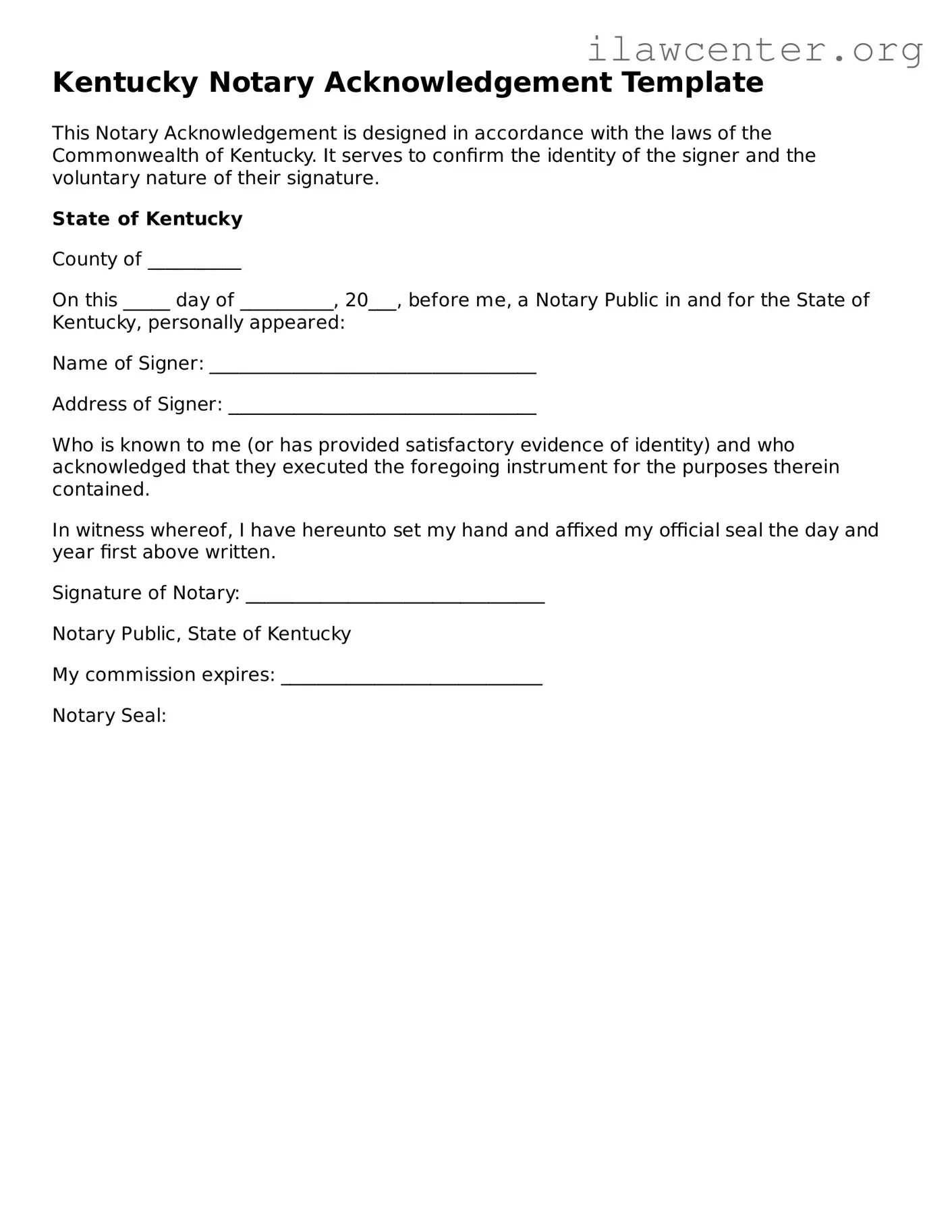
Kentucky Notary Acknowledgement Preview

Kentucky Notary Acknowledgement Template

This Notary Acknowledgement is designed in accordance with the laws of the Commonwealth of Kentucky. It serves to confirm the identity of the signer and the voluntary nature of their signature.

State of Kentucky

County of __________

On this _____ day of __________, 20___, before me, a Notary Public in and for the State of Kentucky, personally appeared:

Name of Signer: ___________________________________

Address of Signer: _________________________________

Who is known to me (or has provided satisfactory evidence of identity) and who acknowledged that they executed the foregoing instrument for the purposes therein contained.

In witness whereof, I have hereunto set my hand and affixed my official seal the day and year first above written.

Signature of Notary: ________________________________

Notary Public, State of Kentucky

My commission expires: ____________________________

Notary Seal:

PDF Form Characteristics

Fact Name Description
Governing Law The Kentucky Notary Acknowledgment form is governed by KRS 423.130.
Purpose This form is used to verify the identity of the signer and their willingness to sign a document.
Signature Requirement The signer must personally appear before the notary public to sign the document.
Notary's Role The notary public certifies that the signature on the document is genuine.
Jurisdiction This form is valid only within the state of Kentucky.
Date Requirement The acknowledgment must include the date on which the notarization occurs.
Identification The notary may require valid identification from the signer to confirm their identity.
Form Variations There are specific variations of the acknowledgment form for different types of documents.
Record Keeping Notaries are required to keep a record of all acknowledgments performed.
Legal Effect A properly executed acknowledgment can enhance the legal standing of a document.

Instructions on Utilizing Kentucky Notary Acknowledgement

Once you have the Kentucky Notary Acknowledgement form in front of you, it’s time to fill it out carefully. This process is straightforward and ensures that all necessary information is accurately recorded. Follow these steps to complete the form correctly.

  1. Begin by locating the section labeled "State of Kentucky" at the top of the form.
  2. Fill in the date on which the acknowledgment is being made. This should be written in the format of month, day, and year.
  3. Next, identify the name of the individual who is signing the document. This name should be printed clearly in the designated area.
  4. In the next section, write the title of the document being acknowledged. Make sure to be specific to avoid any confusion.
  5. Proceed to the area where the notary public will sign. Leave this blank for now; it will be filled in later.
  6. After the signature line, there will be a space for the notary's printed name. This will also be filled in by the notary after the acknowledgment is complete.
  7. Lastly, check the form for any additional requirements or signatures that may be needed, based on the specific document being acknowledged.

After completing these steps, the form will be ready for the notary public to finalize the acknowledgment. Ensure that all information is accurate to avoid any delays in the process.

Important Facts about Kentucky Notary Acknowledgement

What is a Kentucky Notary Acknowledgement form?

The Kentucky Notary Acknowledgement form is a legal document used to confirm that a person has signed a document in the presence of a notary public. This form serves as proof that the individual willingly signed the document, ensuring its authenticity and validity in legal matters.

Who can serve as a notary public in Kentucky?

In Kentucky, a notary public must be at least 18 years old, a resident of the state, and possess the ability to read and write English. Additionally, they must complete a training course and pass an exam to obtain their notary commission from the Secretary of State.

What information is required on the Notary Acknowledgement form?

The form typically requires the name of the person signing the document, the date of the acknowledgment, the notary's name, and their official seal. It may also include details about the document being acknowledged, such as its title or type.

Is the Notary Acknowledgement form necessary for all documents?

No, not all documents require a notary acknowledgment. However, many legal documents, such as deeds, mortgages, and powers of attorney, often need this form to be considered valid. It's essential to check the specific requirements for the type of document you are dealing with.

Can a notary public refuse to acknowledge a signature?

Yes, a notary public has the authority to refuse to acknowledge a signature if they suspect fraud, if the signer is not present, or if the signer does not have the proper identification. The notary must ensure that the signing process is legitimate and that the signer understands what they are signing.

How does one properly complete a Notary Acknowledgement form?

To complete the form, the signer must appear before the notary and provide valid identification. The notary will then fill out the form, including the details of the acknowledgment, and affix their signature and seal. It’s crucial that the signer is fully aware of the contents of the document being acknowledged.

What is the difference between a Notary Acknowledgement and a Notary Jurat?

A Notary Acknowledgement confirms that a person signed a document in front of a notary, while a Notary Jurat requires the signer to swear or affirm that the contents of the document are true. The Jurat includes a statement of oath, whereas the Acknowledgement does not.

How long is a Notary Acknowledgement valid in Kentucky?

A Notary Acknowledgement does not expire as a document itself; however, the underlying document may have its own validity period. It’s important to ensure that the document remains relevant and that any time-sensitive information is addressed.

Where can I obtain a Kentucky Notary Acknowledgement form?

You can find the Kentucky Notary Acknowledgement form through various sources, including online legal document providers, law offices, or the Kentucky Secretary of State's website. Ensure that you are using the most current version of the form to meet legal requirements.
Common mistakes

When completing the Kentucky Notary Acknowledgment form, individuals often encounter several common mistakes that can lead to delays or rejections. One prevalent error is failing to include the correct date of the acknowledgment. The date is crucial, as it indicates when the notary performed the acknowledgment. Without an accurate date, the document may not be considered valid.

Another frequent oversight involves the omission of the signer's name. The acknowledgment must clearly state the name of the individual whose signature is being notarized. If the name is missing or incorrect, the document may not fulfill its intended purpose. It is essential to ensure that the name matches the identification presented to the notary.

Additionally, some individuals neglect to provide the appropriate identification details of the signer. The form typically requires information regarding the type of identification used, such as a driver's license or passport. Failing to include this information can result in questions about the authenticity of the signature.

In some cases, signers may mistakenly think that their signature is sufficient without the notary's stamp or seal. The notary's seal is a vital component of the acknowledgment process. It serves as proof that the notary has verified the identity of the signer and witnessed the signature. Without this seal, the acknowledgment may be deemed incomplete.

Furthermore, individuals sometimes misinterpret the purpose of the acknowledgment itself. An acknowledgment does not verify the content of the document; rather, it confirms that the signer willingly signed it. Confusing these roles can lead to misunderstandings about the notary's responsibilities.

Another common mistake is leaving blank spaces on the form. Each section should be completed thoroughly. Blank spaces can raise concerns about the authenticity of the acknowledgment and may prompt further scrutiny from officials or other parties involved.

Moreover, some people fail to sign the acknowledgment form in the presence of the notary. The notary must witness the signature to validate the acknowledgment. If the signer completes the document prior to the notary's presence, the acknowledgment may not hold up under scrutiny.

Finally, individuals may overlook the need for the notary to complete their section of the form. The notary must provide their signature, seal, and any other required information. Neglecting this step can render the acknowledgment invalid, ultimately leading to complications for all parties involved.

Documents used along the form

In Kentucky, a Notary Acknowledgment form is often used in conjunction with various other documents. These documents serve different purposes but frequently require notarization to ensure their authenticity. Here’s a list of common forms and documents that are typically used alongside the Kentucky Notary Acknowledgment form:

  • Affidavit: A written statement confirmed by oath or affirmation, used as evidence in legal proceedings. It often requires notarization to validate the signer’s identity and the truth of the statements made.
  • Power of Attorney: This document grants someone the authority to act on another person's behalf in legal or financial matters. Notarization helps confirm that the person granting the power fully understands and agrees to the terms.
  • Deed: A legal document that transfers ownership of real estate. Notarization is crucial to ensure the transaction is legitimate and to prevent fraud.
  • Living Will: A document that outlines a person's wishes regarding medical treatment in case they become unable to communicate those wishes. Notarization can help ensure that the document is recognized by healthcare providers.
  • Marriage License Application: This application is required for couples seeking to marry. Some jurisdictions may require notarization to verify the identities of the applicants.
  • Release of Liability: A document that releases one party from liability for certain actions or events. Notarization adds an extra layer of authenticity to the agreement.
  • Trust Documents: These documents establish a trust, detailing how assets are to be managed and distributed. Notarization helps ensure that the trust is executed properly and is legally binding.

Using these documents alongside the Kentucky Notary Acknowledgment form can enhance the legal standing and credibility of various transactions. Always consider consulting with a legal professional to ensure that all necessary forms are completed accurately and appropriately.

Similar forms

The Notary Acknowledgment form serves an important role in verifying the identity of individuals signing documents. There are several other documents that share similarities with the Notary Acknowledgment form. Each of these documents also plays a crucial role in legal processes. Below is a list of seven documents that are similar in purpose or function:

  • Affidavit: This is a written statement confirmed by oath or affirmation, often used as evidence in court. Like a Notary Acknowledgment, it requires the signer to declare the truthfulness of the contents before a notary public.
  • Power of Attorney: This document grants someone the authority to act on another person's behalf. Notarization is often required to ensure that the principal's identity is verified, similar to a Notary Acknowledgment.
  • Deed: A deed is a legal document that conveys property ownership. It typically requires notarization to confirm the identities of the parties involved, paralleling the function of a Notary Acknowledgment.
  • Will: A will outlines a person's wishes regarding the distribution of their assets after death. While not always required, notarization can add an extra layer of validity, akin to a Notary Acknowledgment.
  • Certification of a Document: This is a formal declaration that a document is a true and accurate copy of the original. Like a Notary Acknowledgment, it often requires a notary's verification of the signer's identity.
  • Loan Documents: These include agreements related to borrowing money, often requiring notarization to validate the identities of the parties involved, similar to the Notary Acknowledgment process.
  • Marriage License Application: This document is used to apply for a marriage license and often requires notarization to confirm the identities of the applicants, much like a Notary Acknowledgment.

Each of these documents plays a vital role in ensuring that legal processes are conducted fairly and transparently. Understanding their similarities can help individuals navigate the legal landscape more effectively.

Dos and Don'ts

When filling out the Kentucky Notary Acknowledgement form, it’s important to follow certain guidelines to ensure that the document is valid and legally binding. Here’s a list of things you should and shouldn’t do.

  • Do ensure that all information is accurate and complete.
  • Do sign the form in the presence of the notary public.
  • Do use black or blue ink to fill out the form.
  • Do include the date of the acknowledgment.
  • Do verify that the notary's commission is current and valid.
  • Don't leave any sections blank, as this may invalidate the form.
  • Don't sign the document before meeting with the notary.
  • Don't use pencil or any ink color other than black or blue.
  • Don't forget to bring a valid form of identification.
  • Don't assume that the notary will fill in any missing information for you.

Misconceptions

Understanding the Kentucky Notary Acknowledgement form can be challenging due to several common misconceptions. Here are four key misunderstandings that often arise:

  • Misconception 1: A notary public can create legal documents.
  • This is not true. A notary public's role is to witness signatures and verify identities, not to draft or create legal documents. The notary ensures that the person signing the document is doing so willingly and is aware of its contents.

  • Misconception 2: The notary must know the signer personally.
  • While personal knowledge can help, it is not a requirement. A notary can verify a signer’s identity through proper identification, such as a driver's license or passport, even if they do not know the individual personally.

  • Misconception 3: A notary can refuse to acknowledge a signature without a valid reason.
  • This is incorrect. A notary must have a legitimate reason to refuse service, such as doubts about the signer's identity or the legality of the document. However, they cannot refuse based on personal biases or arbitrary reasons.

  • Misconception 4: The notary acknowledgement makes the document legally binding.
  • Notary acknowledgement does not make a document legally binding by itself. It simply verifies that the signature was made in the presence of the notary. The content of the document and the circumstances surrounding it determine its legal validity.

Key takeaways

Filling out and using the Kentucky Notary Acknowledgement form involves several important considerations. Here are key takeaways to keep in mind:

  1. Purpose: The form serves to verify the identity of the signer and ensure that they are signing willingly.
  2. Completeness: Ensure all required fields are filled out completely to avoid any issues with the acknowledgment.
  3. Signer's Presence: The signer must be present when the notary acknowledges their signature.
  4. Identification: The notary should confirm the identity of the signer through valid identification.
  5. Signature: The notary must sign the acknowledgment form after witnessing the signing of the document.
  6. Date: The date of the acknowledgment must be clearly indicated on the form.
  7. Seal: A notary seal is required to validate the acknowledgment and should be affixed appropriately.
  8. Record Keeping: It is advisable for notaries to keep a record of all acknowledgments performed.
  9. State Compliance: Ensure compliance with Kentucky state laws regarding notarial acts and acknowledgments.

By adhering to these guidelines, individuals can effectively use the Kentucky Notary Acknowledgement form for their notarial needs.