Attorney-Verified  Operating Agreement Document for Kentucky

Attorney-Verified Operating Agreement Document for Kentucky

The Kentucky Operating Agreement form is a legal document that outlines the management structure and operating procedures of a limited liability company (LLC) in Kentucky. This form serves to clarify the roles and responsibilities of members, ensuring smooth operations and compliance with state laws. For those looking to establish their LLC, filling out this form is a crucial step; click the button below to get started.

Article Guide

In the realm of business formation, particularly for limited liability companies (LLCs), the Kentucky Operating Agreement form plays a crucial role in defining the internal structure and operational guidelines of the entity. This document serves as a foundational blueprint, outlining the rights and responsibilities of the members, as well as the management structure of the LLC. Key aspects include the distribution of profits and losses, procedures for member meetings, and guidelines for adding new members or handling member departures. Additionally, the agreement addresses how decisions are made, ensuring that all members understand their roles and the processes involved in running the business. By establishing clear expectations and procedures, the Kentucky Operating Agreement not only helps to prevent misunderstandings among members but also enhances the credibility of the LLC in the eyes of potential investors and partners. Understanding the significance of this form is essential for anyone looking to establish a successful and compliant business in Kentucky.

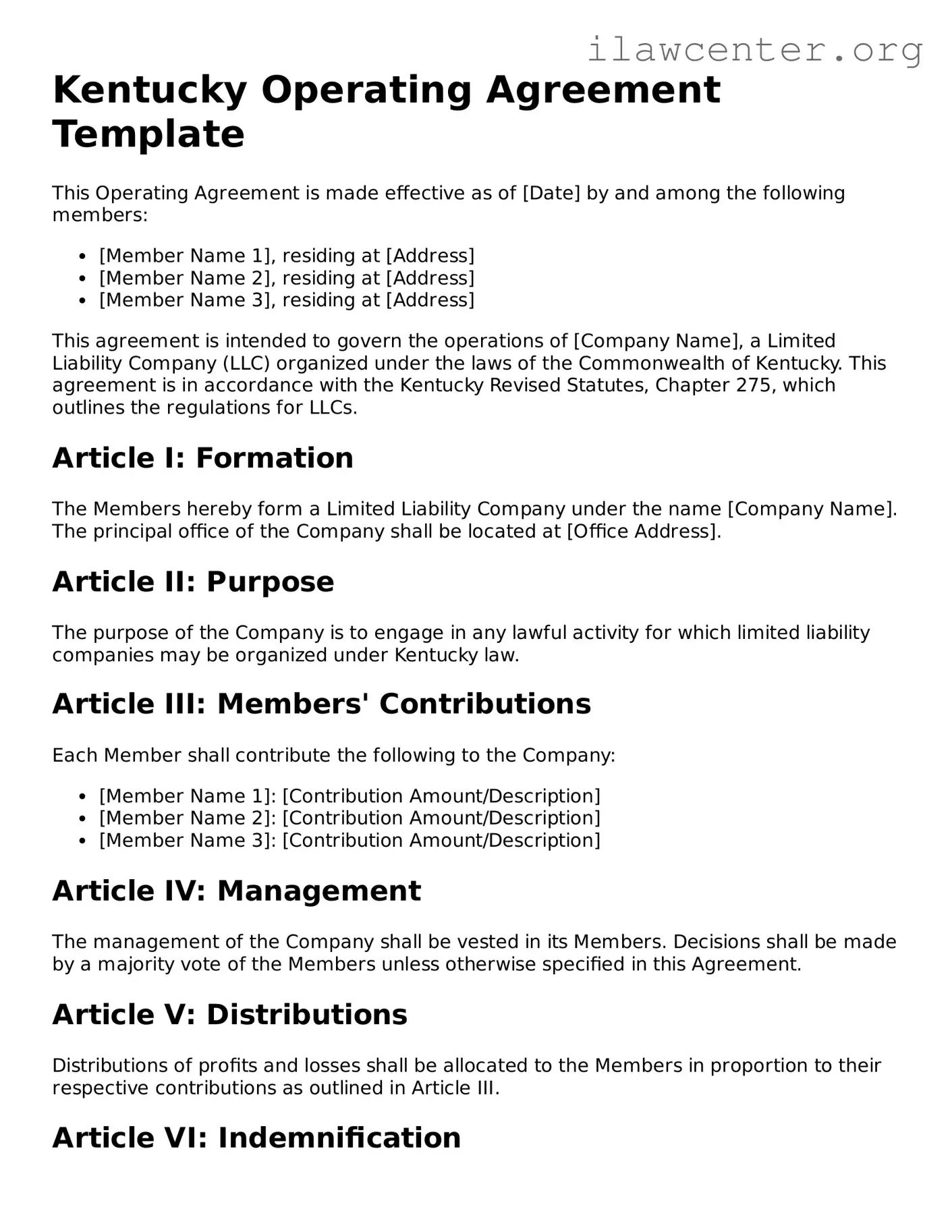
Kentucky Operating Agreement Preview

Kentucky Operating Agreement Template

This Operating Agreement is made effective as of [Date] by and among the following members:

  • [Member Name 1], residing at [Address]
  • [Member Name 2], residing at [Address]
  • [Member Name 3], residing at [Address]

This agreement is intended to govern the operations of [Company Name], a Limited Liability Company (LLC) organized under the laws of the Commonwealth of Kentucky. This agreement is in accordance with the Kentucky Revised Statutes, Chapter 275, which outlines the regulations for LLCs.

Article I: Formation

The Members hereby form a Limited Liability Company under the name [Company Name]. The principal office of the Company shall be located at [Office Address].

Article II: Purpose

The purpose of the Company is to engage in any lawful activity for which limited liability companies may be organized under Kentucky law.

Article III: Members' Contributions

Each Member shall contribute the following to the Company:

  • [Member Name 1]: [Contribution Amount/Description]
  • [Member Name 2]: [Contribution Amount/Description]
  • [Member Name 3]: [Contribution Amount/Description]

Article IV: Management

The management of the Company shall be vested in its Members. Decisions shall be made by a majority vote of the Members unless otherwise specified in this Agreement.

Article V: Distributions

Distributions of profits and losses shall be allocated to the Members in proportion to their respective contributions as outlined in Article III.

Article VI: Indemnification

The Company shall indemnify each Member against any losses or damages incurred in connection with the Company, except in cases of willful misconduct or gross negligence.

Article VII: Amendments

This Operating Agreement may be amended only by a written agreement signed by all Members.

Article VIII: Governing Law

This Agreement shall be governed by and construed in accordance with the laws of the Commonwealth of Kentucky.

IN WITNESS WHEREOF, the Members have executed this Operating Agreement as of the date first above written.

__________________________
[Member Name 1]

__________________________
[Member Name 2]

__________________________
[Member Name 3]

PDF Form Characteristics

Fact Name Description
Purpose The Kentucky Operating Agreement outlines the management structure and operational procedures of a limited liability company (LLC).
Governing Law The agreement is governed by the Kentucky Revised Statutes, specifically KRS Chapter 275.
Members It details the rights and responsibilities of the members involved in the LLC.
Flexibility The agreement allows for flexibility in management, permitting members to choose between member-managed or manager-managed structures.
Profit Distribution It specifies how profits and losses will be distributed among members, which can differ from ownership percentages.
Amendments The agreement can be amended as needed, provided all members agree to the changes.
Dispute Resolution It often includes provisions for resolving disputes among members, which can help avoid costly legal battles.
Duration The agreement may specify the duration of the LLC, whether it is perpetual or for a limited time.
Initial Capital Contributions Members' initial capital contributions are outlined, detailing what each member brings to the LLC.
Compliance Having an Operating Agreement helps ensure compliance with state laws and regulations, providing legal protection for the members.

Instructions on Utilizing Kentucky Operating Agreement

After obtaining the Kentucky Operating Agreement form, it is important to carefully complete each section to ensure accuracy. This document will guide you through the necessary steps to fill out the form properly.

  1. Begin by entering the name of your LLC at the top of the form.
  2. Provide the principal office address of the LLC. This should be a physical address, not a P.O. Box.
  3. List the names and addresses of all members involved in the LLC. Ensure that all members are included.
  4. Specify the purpose of the LLC. Clearly describe the business activities the LLC will engage in.
  5. Indicate the duration of the LLC. You can choose a specific time frame or state that it will exist indefinitely.
  6. Detail the management structure. Decide whether the LLC will be member-managed or manager-managed and provide the necessary information.
  7. Outline the capital contributions made by each member. Include the amount and type of contribution for clarity.
  8. Describe the profit and loss distribution among members. Clearly state how profits and losses will be allocated.
  9. Include any additional provisions that may be relevant to your LLC. This could cover voting rights, dispute resolution, or other operational details.
  10. Finally, ensure that all members sign and date the agreement. This step is crucial for the validity of the document.

Important Facts about Kentucky Operating Agreement

What is a Kentucky Operating Agreement?

A Kentucky Operating Agreement is a legal document that outlines the management structure and operating procedures of a Limited Liability Company (LLC) in Kentucky. It serves as an internal guideline for the members of the LLC, detailing their rights, responsibilities, and the distribution of profits and losses. While not required by law, having an operating agreement is highly recommended to prevent disputes and ensure smooth operations.

Why should I create an Operating Agreement for my LLC?

Creating an Operating Agreement is essential for several reasons. It helps clarify the roles and responsibilities of each member, outlines the decision-making process, and establishes how profits will be shared. This document can protect your personal assets by reinforcing the limited liability status of the LLC. Furthermore, in the event of a dispute, having a clear agreement can simplify resolution and reduce potential legal costs.

Who should draft the Operating Agreement?

The Operating Agreement can be drafted by any member of the LLC, but it is advisable to seek legal assistance to ensure that it complies with Kentucky laws and adequately addresses the specific needs of the business. A lawyer can help tailor the agreement to reflect the unique structure and goals of the LLC, minimizing the risk of future conflicts.

What should be included in a Kentucky Operating Agreement?

Key elements of a Kentucky Operating Agreement typically include the LLC's name and address, the purpose of the business, member contributions, profit and loss distribution, management structure, and procedures for adding or removing members. Additionally, it may outline the process for resolving disputes and the steps for dissolving the LLC if necessary.

Is an Operating Agreement required in Kentucky?

No, Kentucky does not legally require LLCs to have an Operating Agreement. However, it is highly recommended. Without one, the LLC will be governed by default state laws, which may not align with the members' intentions. An Operating Agreement provides clarity and helps avoid misunderstandings among members.

Can the Operating Agreement be amended?

Yes, the Operating Agreement can be amended. The process for making changes should be clearly outlined in the agreement itself. Typically, amendments require the consent of a majority or all members, depending on the provisions set forth in the original document. Regularly reviewing and updating the agreement ensures that it remains relevant as the business evolves.

Common mistakes

When creating an Operating Agreement in Kentucky, individuals often overlook crucial details that can lead to complications down the line. One common mistake is failing to clearly define the roles and responsibilities of each member. Without this clarity, misunderstandings can arise, potentially causing friction among members. Clearly outlining who does what can help prevent disputes and ensure that everyone is on the same page.

Another frequent error is neglecting to specify the percentage of ownership for each member. This information is vital as it determines profit distribution and voting power within the company. If ownership percentages are not documented, disagreements may emerge regarding profit sharing or decision-making authority.

People also sometimes forget to include provisions for handling disputes. An Operating Agreement should contain a clear procedure for resolving conflicts among members. Without such a framework, members may find themselves in prolonged disagreements, which can disrupt business operations.

Additionally, some individuals do not update their Operating Agreements as the business evolves. Changes in membership, ownership percentages, or business direction should be reflected in the agreement. Failing to keep this document current can lead to confusion and legal challenges later on.

Another mistake is overlooking the importance of signatures. An Operating Agreement is not legally binding until all members have signed it. Therefore, it’s essential to ensure that every member’s signature is obtained and that the document is stored safely for future reference.

Some people also make the error of assuming that a verbal agreement is sufficient. While discussions may occur, a written Operating Agreement is necessary to provide legal protection and clarity. Relying solely on verbal agreements can lead to misunderstandings and disputes that could have been easily avoided.

Moreover, individuals often fail to consider the tax implications of their Operating Agreement. The structure of the agreement can influence how the business is taxed. Consulting with a tax professional can help ensure that the agreement is structured in a way that minimizes tax liability.

Lastly, many overlook the need for legal review. While it may seem tempting to fill out the form without professional assistance, having a legal expert review the Operating Agreement can help identify potential pitfalls and ensure compliance with Kentucky laws. Taking this step can save time and resources in the long run.

Documents used along the form

The Kentucky Operating Agreement is a crucial document for limited liability companies (LLCs) in Kentucky. It outlines the management structure, responsibilities, and operational procedures of the company. In addition to the Operating Agreement, several other forms and documents are often utilized in the formation and management of an LLC. Below is a list of these documents, each serving a specific purpose in the business lifecycle.

  • Articles of Organization: This document is filed with the Kentucky Secretary of State to officially create the LLC. It includes basic information such as the company name, address, and the names of its members.
  • Employer Identification Number (EIN): Obtained from the IRS, this number is necessary for tax purposes and is required for opening a business bank account.
  • Membership Certificates: These certificates serve as proof of ownership for each member of the LLC. They can help clarify ownership percentages and rights.
  • Bylaws: While not mandatory for LLCs, bylaws can outline the internal rules and procedures for managing the company, similar to those for corporations.
  • Operating Procedures: This document details the day-to-day operations of the LLC, including decision-making processes and roles of members.
  • Meeting Minutes: These records document the discussions and decisions made during meetings of the members or managers. They serve as a formal record of the LLC's activities.
  • Financial Statements: Regular financial statements provide insight into the financial health of the LLC. They include balance sheets, income statements, and cash flow statements.
  • Tax Returns: Annual tax returns must be filed with the IRS and state tax authorities. These documents report the income, deductions, and tax obligations of the LLC.
  • Amendments to the Operating Agreement: If changes occur within the LLC, such as new members joining or changes in management structure, amendments to the Operating Agreement may be necessary.

Each of these documents plays a vital role in the establishment and operation of an LLC in Kentucky. Proper management of these forms ensures compliance with state regulations and helps protect the interests of all members involved.

Similar forms

The Operating Agreement is an important document for any business structure, particularly for LLCs. It outlines the management and operational procedures of the company. Here are nine other documents that share similarities with the Operating Agreement:

  • Bylaws: Like the Operating Agreement, bylaws govern the internal management of a corporation. They outline the roles of officers, procedures for meetings, and voting rights.
  • Partnership Agreement: This document defines the relationship between partners in a business. It details profit sharing, responsibilities, and dispute resolution, similar to how an Operating Agreement outlines member roles.
  • Shareholder Agreement: This agreement is for corporations and outlines the rights and obligations of shareholders. It includes provisions for share transfers, much like how an Operating Agreement addresses membership interests.
  • Business Plan: While primarily a strategic document, a business plan can include operational details akin to those found in an Operating Agreement, such as management structure and operational goals.
  • Employment Agreement: This document specifies the terms of employment for staff, including duties and compensation. It parallels the Operating Agreement in setting clear expectations for roles within the company.
  • Non-Disclosure Agreement (NDA): An NDA protects sensitive information shared among parties. Like an Operating Agreement, it establishes clear terms to safeguard the interests of the business.
  • Joint Venture Agreement: This outlines the terms of collaboration between two or more parties. It shares similarities with the Operating Agreement in defining roles and responsibilities for each party involved.
  • Franchise Agreement: This document governs the relationship between a franchisor and franchisee. It includes operational guidelines similar to those in an Operating Agreement for LLCs.
  • Articles of Incorporation: This foundational document establishes a corporation's existence. While it serves a different purpose, it complements the Operating Agreement by defining the structure and governance of the business.

Each of these documents plays a crucial role in defining the relationships and responsibilities within a business, ensuring clarity and legal compliance.

Dos and Don'ts

When filling out the Kentucky Operating Agreement form, it is essential to follow specific guidelines to ensure accuracy and compliance. Below is a list of things you should and shouldn't do.

  • Do ensure all member names and addresses are accurately listed.
  • Do clearly define the management structure of the LLC.
  • Do review the document for any errors before submission.
  • Do seek legal advice if you have questions about any provisions.
  • Don't leave any sections blank; incomplete forms may be rejected.
  • Don't use vague language; be specific in your agreements.
  • Don't forget to date and sign the document.
  • Don't ignore state-specific requirements that may apply to your LLC.

Misconceptions

Understanding the Kentucky Operating Agreement form is essential for anyone involved in a business entity in the state. However, several misconceptions can lead to confusion. Below are some common misunderstandings about this important document.

  • All businesses are required to have an Operating Agreement. This is not true. While it is highly recommended for LLCs, Kentucky does not mandate that all businesses have an Operating Agreement.
  • An Operating Agreement is only necessary for multi-member LLCs. This misconception overlooks that even single-member LLCs benefit from having an Operating Agreement to outline management and operational procedures.
  • The Operating Agreement must be filed with the state. In Kentucky, the Operating Agreement is an internal document. It does not need to be filed with the Secretary of State.
  • The Operating Agreement is the same as the Articles of Organization. These are different documents. The Articles of Organization establish the LLC, while the Operating Agreement details the management structure and operating procedures.
  • Once created, the Operating Agreement cannot be changed. This is incorrect. Members can amend the Operating Agreement as needed, provided they follow the amendment procedures outlined within the document.
  • All members must sign the Operating Agreement. While it is best practice for all members to sign, it is not a legal requirement in Kentucky. However, having signatures can help clarify agreements.
  • The Operating Agreement is only for legal purposes. While it serves a legal function, the Operating Agreement also provides a clear framework for day-to-day operations and member relationships.
  • Using a template for the Operating Agreement is sufficient. While templates can be helpful, they may not address specific needs or circumstances of the business. Customization is often necessary for effective governance.

Clarifying these misconceptions can help ensure that business owners in Kentucky understand the importance and function of the Operating Agreement.

Key takeaways

When it comes to establishing a limited liability company (LLC) in Kentucky, the Operating Agreement is a crucial document. Here are some key takeaways to keep in mind when filling out and using the Kentucky Operating Agreement form:

  • Define Roles Clearly: It's important to outline the roles and responsibilities of each member. This clarity helps prevent misunderstandings and ensures that everyone knows what is expected of them.
  • Specify Profit Distribution: The agreement should detail how profits and losses will be shared among members. This can be based on ownership percentages or other agreed-upon methods.
  • Include Management Structure: Decide whether the LLC will be member-managed or manager-managed. This distinction affects how decisions are made and who has authority within the company.
  • Address Dispute Resolution: Consider including a process for resolving disputes among members. This can save time and money in the event of disagreements.
  • Review Regularly: An Operating Agreement should not be a static document. Regular reviews and updates ensure it remains relevant as the business evolves and as members' circumstances change.

By paying attention to these aspects, you can create a solid foundation for your LLC that promotes harmony and clarity among its members.